Editor's Note: Published today to support Blog Action Day 2009 an annual event held every October 15 that unites the world’s bloggers in posting about the same issue on the same day with the aim of sparking discussion around an issue of global importance. This year the theme is climate change.
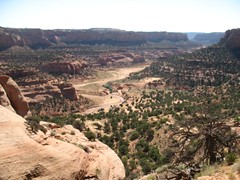
Just how much of this planet is inhabitable? I suppose that as with so many other factoids, this bit of data is Googleable. On the other hand, it is a very sobering thought exercise to engage in as you travel. Since April, we've been traveling in the Sea of Cortez, up the Baja Peninsula, and through the American Southwest. And while much of it has been stunningly beautiful, very little of it is truly inhabitable. We are talking about a vast area stretching from La Paz to the Colorado Plateau, over to Death Valley, up through central Nevada, and all of Utah.
Of course, people do live here. Phoenix is the 12th most populous cities in the United States. Believe it. Wiki says so. There are oases of cool mountains and tree filled valleys. We tromped through ruins nearly 2,000 years old giving silent testimony to the presence of humans for millennia in these barren dry lands.
But I challenge anyone to drive across this countryside day after day without coming to the sober realization that most of the land is too dry to support and sustain life over the long haul. Communities like Hurricane and Farmington and Mesquite – booming now as snow birds flee south and subsisting on deep reservoirs of ground water built over the eons from the seepage of limited rains through thousands of feet of sandstone – these places terrify me.
What are these people thinking? The water will not last forever. It won't even last a generation. DrC just shakes his head as we drive by WalMarts and Burger Kings, Subway, Chevron, and Sonic Burger, “The shape of future ghost towns.” I can almost see the dust and sand and tumbleweeds blowing down the central street, the laundromat door creaking back and forth, a shopping cart catching the wind and rolling a few feet before banging into the wall of the empty casino.
Water is life, and there simply isn't enough to sustain the population here today let alone accommodate the vast numbers of people city planners seem hell bent in seducing down here. “Live where you vacation!” trumpets a road sign in Fredonia. “Retire in style!!” blasts another in St. George. The vivid green grass of these developments glows sharp and unnatural against the dessert background of tans, corals, pinks, and grays. People retiring from Indiana expect a lawn, those from Pennsylvania want to golf. Never mind that water falls in summer deluges to a depth of feet each year up north while these warm, sunny southern wastelands are prone to decades long droughts and the average in even a good year barely tops an inch.
I don't expect these invaders to understand. They will recycle their cans and bottles, install low flow toilets, and call themselves environmentalists. All the cues of government, industry, and public policy encourage them in their delusional belief that they can endlessly flock down here each winter like a pack of wild birds to live harmoniously with nature during their declining years. No one is facing the harsh demographic hard stop date when the water runs out, and the land forces out all but the natives.
How many other places on our overburdened planet are like this? How many other myths are we spinning to comfort ourselves when we push into areas not meant to support our species? I see more clearly the disaster on the horizon than ever before. Even in the absence of global climate change, humans are fast approaching the tipping point. Driving across this great barren expanse, I am filled with a grinding horror at what my girls face in the coming decades. It is not enough to teach them math and science and history. We need to teach them how to survive what's coming.

Thursday, October 15, 2009


Wednesday, October 14, 2009
Ah-mare-eh-can Food!!
A quick list of the foods we eat in the United States... Just because we can.
sour dough bread
salad
flavored humus
cheddar, brie, blue, and jack cheese
grapes, peaches, cherries, blueberries, and strawberries
cheese flavored chips – which are heinously nasty in Mexico
micro brewed beer
more salad
box red wine
high pulp orange juice
massive quantities of peanut butter – preferably on more sour dough bread
juicy red t-bone steaks dripping in corn fed fatty badness
pesto
yet more salad, none of it iceberg
white marshmallows – none of that weird Mexican pink crap
Svenson's breakfast danishes and cinnamon rolls
real maple syrup
Italian hot sausage and raviolis
Taco Bell
Take note people. These are the foods you want to fill the lockers with when you head south from San Diego this fall.
Monday, October 12, 2009
Summer Summers
Finally. We're all done with the hurricane drama. Since I wrote the last piece, we've been relaxing up in Bahia de Los Angeles, nearly 130 miles north of Santa Rosalia. The girls and I have been able to return to the rhythm of boat life, albeit a stunted version without DrC. While a few storms have been worth monitoring closely and we've had a few exciting moments of high wind, the weather has largely been mild and the conditions perfect for cruising.
In a matter of days, we'll return to Santa Rosalia to pick up DrC. Our friends on s/v Ocean Blue tell us the city is recovering rapidly. However, there are still many people in Baja and mainland Mexico who lost everything – including their homes – to Hurricane Jimena. If you are interested in supporting these people, I encourage you to contribute to the recovery effort through the Red Cross. You can also join the Victims of Jimena.
So now we'll shift the articles back to those I wrote during the month post hurricane as well as those I wrote up in the United States during our summer road trip.
Thursday, October 01, 2009
TechTip: 3 Inch Cargo Strap
 Short Answer Three inch polyster cargo strap in large pieces is a very good, relatively inexpensive way to tie down a boat in a hurricane. Get yourself some now.
Long Story Before we left for Vancouver Island, DrC researched some alternatives for a stern tie line. The problem with many solutions is chafe. As the tide goes out, your line often falls on incredibly sharp oyster bed and gets chewed up. He decided to try a 3” cargo strap advertised for its strong holding properties as well as durability in the face of sharp objects.
As a stern tie, this strap worked reasonably well. If you decide to use it for that purpose, make sure you set yourself up with a roller off the stern of the boat. It’s heavy, and it likes to twist. It also doesn’t float. You’ll want to make sure you can easily roll it off and on.
When I arrived in Santa Rosalia just hours before Jimena hit, I was greeted by my fellow cruisers with the most important phrase in hurricane preparation: What line do you have? I pulled out all my dock lines, the jib sheets we’d already planned to replace this fall, our primary and secondary anchor rodes, and the strap. At 300 feet, it made sense to use it to run a line over to the far-side breakwater.
Pros
The strap doesn’t break It has a breaking point of 10,000 lbs. Frankly, unless you plan to hang the boat from the strap, whatever you tie it to is likely to break apart long before the strap snaps. After watching dock lines and anchor rodes snap like threads all over the marina, it was reassuring to have this enormously powerful material holding Don Quixote off the dock. I also used a piece to bridle the boat to a dock piling. There was no question it would hold the boat as long as neither the starboard cleat, nor the bridle attachment point gave way. Consider using the strap around extremely well founded, back plated points such as the stays or even loop it around the mast.The strap doesn’t chafe Though god knows it tried on the pier, our strap showed no sign of wear after 12 hours of attempting to beat itself to bits on the concrete and wood of the opposite shore.
The strap is relatively cheap We purchased 300 feet for about $125 at strapworks.com a year ago. It looks like it’s running roughly $USD.60/foot right now for the 2 inch. I would call to see if they have the wider widths. You also get a discount at longer lengths. The pricing is considerably less than anchor or dock line.
The strap stores well Once you get roller for it, you can roll this thing up into a neat, small roll and stuff it in an protective bag for dry storage. It certainly takes up a lot less space than a comparable length and strength piece of line or rode.
Cons
The strap doesn’t stretch You need stretch in lines during a hurricane for shock absorption as your boat jounces in the waves. The stretch reduces the jerk against your cleats or other attachment points. As a result, several captains here suggested adding shock absorbers to a strap line or using the strap only as a secondary line in case your standard dock line or rode gives way. When you lose a line, you’ll use anything to keep yourself attached to a pier, breakwater, tree, or other anchor point.
The strap has high windage Do not use it for a long line as we did. A three inch strap has a great deal more windage than a standard piece of rode and will twist and flap and fly in the winds. Cut the long line into chunks and use it for much shorter ties to pilings and dock cleats. Save your dock lines and anchor rodes for any stretches that must go over about 20 feet point to point. Alternatively, I think you could attach this to an anchor as a back up to a chain rode. In addition to providing a secondary hold, the wet weight and its resistance to movement underwater would help hold you down.

The strap doesn’t like knots The stuff is slippery. It likes to come undone. When you tie knots with it, add double, triple or even quadruple hitches.
My boat was saved during Jimena primarily because there were an incredible group of people on the docks throughout most of the storm attending the boats. You are only as safe during a storm as the weakest boat around you. Having said that, I credit our bridle strap and the long line to the off side breakwater for keeping my own boat precisely where I put her -- four feet off the docks and positioned precisely mid-way between two dock pilings.
Subscribe to:
Posts (Atom)