The quarantine dock in Whangarei where you can check into New Zealand is located at Marsden Cove Marina. This is found at Marsden Point, near the mouth of the Hatea River. It’s just past the oil refinery and enormous timber yard. The channel both into Hatea River (S35 52.880 E174 32.550) and then into the marina (S35 49.707 E174 28.585) is well marked and well lit allowing for a night approach if you feel compelled to do so, though as usual I would prefer to avoid it if possible.
Before arrival, give Whangarei Maritime Radio a call on VHF 17. If you call them on 16, they’ll make you change to 17 anyway. Just for manners, it helps to pronounce Whangarei at least close to the way the locals do: fon’-gar-eh. Swallow the ‘n’ if you can and give that ‘r’ the tiniest bit of a roll. If you speak with a Texan or New York accent, prepare in advance to spell your boat name several times. “Two countries separated by the same language…” (probably Bernard Shaw)
If checking into New Zealand, make your way directly to the quarantine dock in Marsden Cove Marina. It is clearly marked to the left of the entrance as you come into the marina basin. You do not need to leave your boat. If you’ve called into Maritime Radio, Customs and BioSecurity will arrive in short order. Cruisers including ourselves report the check in process as quick, friendly, and relatively easy, particularly if you are prepared in advance with your paperwork, an inventory of your items, etc. I wrote this up in detail if you’d like more about our own experience. After you check in, you can either head up river to the Town Basin or spend the night in Marsden Cove Marina. The marina graciously offers the first night free, so there really is no point in moving after a long passage from Fiji or Tonga.
The marina has all basic amenities but is well nigh impossible to live in for the long haul unless you have a vehicle. In the small, adjacent retail mall, you will find a nice little café, a liquor store, a tiny chandlery, and a place to get your hair cut but you will not find any place to buy food stuffs to replace your Biosecurity depleted stocks. Make sure that before making the passage, you squirrel away some canned goods that will pass Biosecurity so you’ll have a bite to eat your first night. Showers are $1/min, laundry $4/load, and wireless Internet at the boat with a very strong signal but prices that make Tonga look cheap. A very nice service offered by the marina is a $20/day plus gas rental vehicle. Make arrangements at the office in advance as the vehicle is understandably in high demand. The fuel dock has both diesel and gas and is self-serve requiring an EFTPOS or Visa with pin to use.
Marsden Cove Marina is quite a distance from Whangarei itself. It takes about 20 minutes to drive to town from the marina and one to one and a half hours to make your way by sailboat up the river to the Town Basin. Even so, it is a good place to stop for a few days, maybe even to settle in for the duration if you are more inclined towards quiet and privacy than convenience and boat services. Increasingly, cruisers planning an extended stay in New Zealand move into this marina, buy a car, and live comfortably in the new, well kept, and very peaceful facility.
If we were still in cruising mode, I think I might be more inclined after a few days to move from Marsden Cove into the densely packed urban Whangarei Town Basin. There are several marinas, but if you plan an extended stay it makes good sense to make reservations well in advance. From the Town Basin, all the services of a very active, prosperous community of nearly 50,000 people are within walking distance. Grocery stores, dentist and doctor offices, boat services, every possible type of restaurant and shop, hair cutteries, Internet cafes with cheap broadband… after over six months at anchor, it’s like landing in a little slice of retail heaven. The downtown area of Whangarei displays what I feel are the best characteristics of New Zealand commercial areas. While on the edge you’ll find a few big box stores and large super markets, the inner town is eminently walkable with many small retail outlets, dollar stores, banks, and places to grab a quick bite or a long sit. It is also very Kiwi, very New Zealand. While a bit larger than most, you’ll find precisely this style of town center in nearly every town and village throughout the country. We love spending a day drifting along the streets, poking into toy shops and shoe stores. It is so much better than visiting a mall.
In addition to the advantages of being in town for all the services and shops, the Town Basin is also chock-o-block full of companies catering to the boat trade. I can’t even begin to do just to the long list of services and goods available there, so just go to their web site. We plan to go back in January to get a bunch of work done ourselves. If you’re going to be there, please let us know. Any excuse to get off the boat while it’s on the hard. Really. Any excuse. You could pull my teeth even.

Showing posts with label destinations. Show all posts
Showing posts with label destinations. Show all posts
Sunday, November 13, 2011


Thursday, August 18, 2011
Exploring: Rangiroa
<i>The "Exploring XYZ…" series is our attempt to remember everything we can about the anchorages and stops we make, mostly to benefit cruisers who follow us in future years. We anticipate folding this information into a wiki or Soggy Paws compendium as soon as possible. In the meantime, please feel free to ask questions; If we can remember, we'll share. GPS marks are for reference only. If you use them for navigation and hit something, it's not my fault.</i>
Rangiroa is the largest atoll in the Tuamotus and the second largest in the world. It stretches a really insane 40 miles west to east and roughly 17 north to south at the widest bit. The atoll is so large, it actually has an atoll within it. There are two main passes into the atoll, both found on the north west corner roughly five miles apart. The atoll is so large that in big weather, fetch and wind can build across the lagoon offering little protection to the boats huddled along the north west edge. However, in even the most reasonable and seasonal weather, there is a good chance you'll find a comfortable spot somewhere.
We arrived at Rangiroa very early in the morning after leaving Ahi the night before. The distance between these two atolls is a bit awkward for many boats. From pass to pass is about 80 miles and both passes absolutely require precision on arrival and departure. So either you can make the 80 miles in the roughly 12 hours you have between tide cycles, or you can't. More probable is that you'll do as we did with Loose Pointer -- leave one evening and find yourself skidding along way too fast during the night. You'll end up either hove to or reefed into oblivion just to keep yourself from running into Rangiroa in the middle of the night.
Entering Rangiroa on anything but a slack tide is not an option for either pass. We went in via the eastern and wider Passe Tiputa (S14 58.051 W147 37.355) at what we figure was slack. Winds and wave had been running high for some time prior to our passage, however, so the pass had an outbound current of about 3 knots even during slack. There were standing waves, leaping dolphins, dive boats, and a nicely well formed whirlpool not to mention the obvious and nasty looking tide rip just outside the entrance. That's the bad news. The good news is that Tiputa is relatively wide, very deep, and other than the waves and current, not particularly difficult. Do make a point of heading all the way in past the little motu to your right before turning to curve into the anchorage. I suppose technically you can cut through, but I wouldn't do it personally.
We anchored in the lee of the motu off the resort in 35' of pure sand, no bombies (S14 57.974 W147 38.411). During our week long stay in Rangiroa, there never appeared to be much wind/wave advantage to anchoring any closer to the small dock which serves the village (S14 58.315 W147 38.063). It is true, however, that most of what we wanted including the services of the small magazin, the dive shop, and the Aquarium were all found closer in. The motu and the pass point do provide some wind and wave protection from the prevailing east and southeasterly winds. I wouldn't want to be in Rangiroa if the wind were blowing from the south or south west. On the other hand, the locals are in the process of building a nice park on the motu to serve boaters. Thus far, there is just a small concrete dock, a fire pit, and a single table, but we have hopes (S14 57.775 W147 38.420). Our understanding is that the somewhat infamous anchorage fee for Rangiroa is in part going to pay for construction of the park.
As for the anchorage fee, it is true. As far as we know, Rangiroa is the only place in Polynesia where you pay to anchor. The gendarmerie make this very easy. They will come out to your boat to collect your fee. It was 150 CFP per person per night. This works about to roughly $1.80. Children are free. For your fees, you can assume that some are going to the park. Other bits must be going to maintain the dinghy mooring balls which are conveniently located adjacent to the best snorkeling spot. Also, the gendarmerie are somewhat indifferent tax collectors. If you're there long enough, they will come out. Some boats pretended they were not at home and never paid their fees. Don Quixote felt the fees were sufficiently small and the comforts of our location sufficiently great, we just paid.
At the dock in Passe Tiputa, you'll find a few dive shops and a snack shop that operates only during the lunch hour. The meal prices are reasonable (for French Polynesia), the beer is cold. The magazin is open mornings and afternoons, not during the day. As with most Polynesian magazins, either get there early or pay for bread the day before if you want fresh baguettes. Otherwise, there isn't much for to see in the village north of the pass.
For more information on the snorkeling, see a previous post entitled "The Aquarium."
Airport - S14 57.379 W147 39.366
Pearl Farms - S14 57.276 W147 40.492
Landing Beach near western town - S14 56.684 W147 42.222
Marina - S14 56.717 W147 42.383
Bank/ATM - S14 56.688 W147 42.493
Air Tahiti - S14 56.688 W147 42.493
Clinic and Pharmacy - S14 56.683 W147 42.529
Church - S14 56.666 W147 42.561
Magazin S14 56.685 W147 42.531
Grand Magazin S14 56.703 W147 42.332
Laundry - S14 56.673 W147 42.170
Restaurant Pizzaria Filippo S14 56.675 W147 42.140
Shell Station S14 41.833 W147 41.833
Friday, April 17, 2009
Summer Plans
I've held off as long as I can updating everyone on our plans for the summer not because I am reluctant to share them but simply because I had no idea. We have been working many ideas and angles. It wasn't clear which plan would bear fruit. However, now the various pieces are coming together. We know where we're going to be for the next five months.
First, the economic fiasco up in the States has made it impossible for us to return to our old lives.
In order to live in the States full time, DrC and I would need to work full time and we can't. DrC can't go back to work full time in the Seattle area because the practice that bought his practice doesn't need him full time, and he's not allowed to work for anyone else up there for another two years. Unemployment in my industry – computer and software development – is at an all time high with 800 resumes showing up for each listing posted.
In order to live in Mexico cruising, however, we only need to work roughly three months out of the year which is actually relatively easy to arrange. DrC can work part-time for his old practice, and people who have laid off all their technical writers find themselves suddenly in need of a contract technical writer for a few weeks every few months.
I know that seems odd. What I'm saying is that it's cheaper and more responsible for us to be irresponsible, semi-retired nomads than it is for us to try to work for full time.
But once you start thinking like this, all sorts of fun ideas pop into your head. For example, why cruise? Why work only in the United States? Why tie yourself to just American clients? We've been putting out feelers in every direction to see what would happen. While a recent tentative assignment to the Caribbean fell through, we are eager to see what happens and ready to move in any direction except backwards including those that might take us to New Zealand, the South Pacific, South American, or the wilds of western Canada.
Cool, huh?
So our plans are all tentative; our planning horizon is month-to-month. As long as the cruising kitty has about six months to a year cushion, we'll just keep stringing these opportunities together like pearls on a rope and see where they lead us.
So this summer and fall look something like this:
May and June -- Cruise slowly in a big half circle up and and over through the Sea of Cortez from La Paz to Guyamas.
July -- DrC working in Seattle while the girls and Toast try to survive the heat in Guaymas.
August -- Family wedding in New Mexico for the first week and then three or four weeks of car camping with Grandma Sue in the Southwest United States.
September -- DrC working in Seattle while the girls and Toast swing south visiting a few land based and boat friends before heading back down to Mexico.
October -- Meet up in Guaymas and prep the boat for another cruising season.
Any questions?

First, the economic fiasco up in the States has made it impossible for us to return to our old lives.
In order to live in the States full time, DrC and I would need to work full time and we can't. DrC can't go back to work full time in the Seattle area because the practice that bought his practice doesn't need him full time, and he's not allowed to work for anyone else up there for another two years. Unemployment in my industry – computer and software development – is at an all time high with 800 resumes showing up for each listing posted.
In order to live in Mexico cruising, however, we only need to work roughly three months out of the year which is actually relatively easy to arrange. DrC can work part-time for his old practice, and people who have laid off all their technical writers find themselves suddenly in need of a contract technical writer for a few weeks every few months.
I know that seems odd. What I'm saying is that it's cheaper and more responsible for us to be irresponsible, semi-retired nomads than it is for us to try to work for full time.
But once you start thinking like this, all sorts of fun ideas pop into your head. For example, why cruise? Why work only in the United States? Why tie yourself to just American clients? We've been putting out feelers in every direction to see what would happen. While a recent tentative assignment to the Caribbean fell through, we are eager to see what happens and ready to move in any direction except backwards including those that might take us to New Zealand, the South Pacific, South American, or the wilds of western Canada.
Cool, huh?
So our plans are all tentative; our planning horizon is month-to-month. As long as the cruising kitty has about six months to a year cushion, we'll just keep stringing these opportunities together like pearls on a rope and see where they lead us.
So this summer and fall look something like this:
Any questions?
Tuesday, March 24, 2009
Pick Your Pleasure
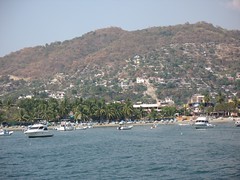
“I think I like it here,” says DrC one evening over pina coladas. We're looking out over the Las Hadas anchorage, watching the white walls turn pink and purple in the setting sun.
I blink, “Really? What brought on this effusive display, husband mine?”
He looks around, sips thoughtfully at his drink, “The pineapple juice really improves it.”
I am reasonably certain he's changed the topic, but with DrC you never can tell. It is within the realm of possibility that his entire interpretation of his experience of Manzanillo Bay is filtered the golden tinted goggles of pina colada fog. I wait a beat, just in case, because the best possible course of action with my husband is to let him think for awhile.
My patience is rewarded with a casual wave of his tumbler at the anchorage, the bay, and the lights on the horizon, “I could live here.” Not the drink, then. “Not too big or busy, hardware stores, spread out, not as polluted.”
Our criteria for favorite place in Mexico varies with each member of the crew. DrC focuses on convenience and accessibility of hardware stores, bait and tackle shops, and large grocery outlets. He likes where the cabbies are indulgent with his many stops, and the local cruiser network is full of pithy advise on how to fix boat gear.
Jaime, on the other hand, focuses exclusively on friends. Hanging out with friends. La Paz, for example, is heaven because she spent the entire time with her friend Isobel. She's driving hard to get us back to Mazatlan solely to meet up with 4-P.A.C.K. and her good friend Casey. Mazatlan? For gods sake child, are you insane? Mazatlan of the stinky sewage anchorage, the smoky horizon and the daily visits by cruise ships?
Aeron selects destinations solely for their swimmability. Pool swimming is good, ocean swimming is great. Any swimming is critical. My little fish. Her partner in all things creative and playful, Mera, also seeks clean water – preferably fresh. However, of all of us Mera is most interested in the remote anchorage. She likes the water calm, the air and water clear, the evenings quiet and peaceful.
I would like to say that I care about the mercadas, clean water for swimming, and the company of fellow cruisers. But when I ask my family what they think is important to me, they tell me that the only really critical feature necessary for my sanity and happiness is a good Internet connection to the boat. I thought I'd broken that umbilical cord. I can stop any time I want to! Really! And they say, “Um... not so much Mom.” DrC just shakes his head.
It is hard to find a place where all of us are happy. Las Hadas has the pool, market, hardware stores, and cruisers, but there are no kid boats here for Jaime. Zihua's water was frequently disgusting, and we rarely got to swim in fresh; There were boat kids, but we didn't have quiet. In Santiago, it's quiet and clean and full of friendly cruisers, but the hardware stores are miles away. Tenacatita? No stores at all. Chamela? No Internet. Ipala? Oh please... just do not even bother dropping hook. La Cruz? Too rolly. Nuevo Vallarta? Too expensive. Mazatlan? You either die of the smell or you live in a boat parking lot. La Paz? Well...
Now La Paz might just do the trick. If we could find a swimming pool...

I blink, “Really? What brought on this effusive display, husband mine?”
He looks around, sips thoughtfully at his drink, “The pineapple juice really improves it.”
I am reasonably certain he's changed the topic, but with DrC you never can tell. It is within the realm of possibility that his entire interpretation of his experience of Manzanillo Bay is filtered the golden tinted goggles of pina colada fog. I wait a beat, just in case, because the best possible course of action with my husband is to let him think for awhile.
My patience is rewarded with a casual wave of his tumbler at the anchorage, the bay, and the lights on the horizon, “I could live here.” Not the drink, then. “Not too big or busy, hardware stores, spread out, not as polluted.”
Our criteria for favorite place in Mexico varies with each member of the crew. DrC focuses on convenience and accessibility of hardware stores, bait and tackle shops, and large grocery outlets. He likes where the cabbies are indulgent with his many stops, and the local cruiser network is full of pithy advise on how to fix boat gear.
Jaime, on the other hand, focuses exclusively on friends. Hanging out with friends. La Paz, for example, is heaven because she spent the entire time with her friend Isobel. She's driving hard to get us back to Mazatlan solely to meet up with 4-P.A.C.K. and her good friend Casey. Mazatlan? For gods sake child, are you insane? Mazatlan of the stinky sewage anchorage, the smoky horizon and the daily visits by cruise ships?
Aeron selects destinations solely for their swimmability. Pool swimming is good, ocean swimming is great. Any swimming is critical. My little fish. Her partner in all things creative and playful, Mera, also seeks clean water – preferably fresh. However, of all of us Mera is most interested in the remote anchorage. She likes the water calm, the air and water clear, the evenings quiet and peaceful.
I would like to say that I care about the mercadas, clean water for swimming, and the company of fellow cruisers. But when I ask my family what they think is important to me, they tell me that the only really critical feature necessary for my sanity and happiness is a good Internet connection to the boat. I thought I'd broken that umbilical cord. I can stop any time I want to! Really! And they say, “Um... not so much Mom.” DrC just shakes his head.
It is hard to find a place where all of us are happy. Las Hadas has the pool, market, hardware stores, and cruisers, but there are no kid boats here for Jaime. Zihua's water was frequently disgusting, and we rarely got to swim in fresh; There were boat kids, but we didn't have quiet. In Santiago, it's quiet and clean and full of friendly cruisers, but the hardware stores are miles away. Tenacatita? No stores at all. Chamela? No Internet. Ipala? Oh please... just do not even bother dropping hook. La Cruz? Too rolly. Nuevo Vallarta? Too expensive. Mazatlan? You either die of the smell or you live in a boat parking lot. La Paz? Well...
Now La Paz might just do the trick. If we could find a swimming pool...
Subscribe to:
Posts (Atom)