Showing posts with label philosophy. Show all posts

Tuesday, May 15, 2012

Do It Yourself - Science


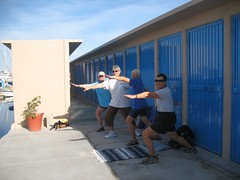
Hands Across Takapuna
Originally uploaded by toastfloats
.
I am not impressed with our global, political leadership. Actually, I am not particularly impressed with their economic leadership, their intellectual capacity, or really any important aspect of their personalities, politics, choices, or methods. In fact, I am becoming That Guy when it comes to politics. Cranky.

Basically, every single one of them appears to spend their day figuring out new ways to make me cranky.

Fortunately, my good friends in the computer world introduced me to ways of thinking that I find sufficiently utopian and anarchist to salve my bruised spirits. The open source movement gives me a nice tingly feeling every time I prowl around and download software or read a well-written blog. When I hear bits of news about progress driven by an X prize, learn of software bazillionaires funding private expeditions to mine asteroids, or monitor the progress of Diaspora, a wee bit of optimism returns.

Kickstarter rocks my world.

Now I have another in my list of reasons to not despair: the #SciFund Challenge. From their web site:

The #SciFund Challenge brings scientists together on RocketHub to raise money directly from people like you. The goal: To fund research in new ways and to connect everyone to the excitement of doing science.

Yeah! You want science to move forward, and you don't think your pet interest is getting enough love and attention in the form of public funding? Fine. Pay for it yourself. I like this idea at so many levels. As a serious skeptic, I'd like to see a lot of nonsense debunked with nice, double-blind, ultra-well constructed tests. While there will always be those who choose to ignore the results, having them in hand to argue with is certainly a starting point. Or maybe I would just like to see more SETI research or help some high school students do serious science or help someone design a better hospital gown.

See, it really doesn't matter, right? I can throw my $10, $20, $100 at whatever toots my horn, yanks my chain, drives my curiosity.

Actually, it's all a bit nepotistic on Don Quixote since I confess that we chose this year to fund a friend doing evolution research. One of those things that routinely has us banging heads on the desk is political leaders who think the world is only 6000 years old. Or 3000. Or ending in 2012. Anything that supports evolution science is yummy tasty to both DrC and myself. Siouxsie's project is a nicely blended mix of "support evolution science" and "figure out how to deal with the super bugs evolving to kill us" dripped liberally with flossies. I'm a cruiser. Small bits that float around and phoesforesce is near and dear. For our pledge, she says she will draw a few words of our choice in glowing bacteria. Be still my beating heart. DrC would like her to write "Fiat Lux" while I am rather partial to the completely self-aggrandizing Toast Floats.


Your opinion matters! Tell me... what should we have Siouxsie write in bug lights?

And PS, go fund science. Now.

Monday, April 16, 2012

Little Obstacles

Small changes can really bollux the day. Today, the problem is a kayak. The floating tennis court next door (otherwise known as s/v Pzazz) has always been a large white shadow next to Don Quixote. She's absolutely enormous. Her engines are incredibly loud, and she's embarassingly clean. We really like the owners, of course, but let's face it. Pzazz makes us look bad.

But as I said, the problem today is actually the kayak. First, it doesn't match the rest of Pzazz. Kayaks are inevitably made of some highly visible shade of orange, red or yellow. This kayak somehow manages to be all three simultaneously. So the big white building in the dock next us is now a big white building with a toothpaste toob of fluorescent flame. Worse, the kayak is somehow ideally positioned to completely block our view of the rest of the marina, including the brand new Lagoon 400 which moved in last week on Dock E.

So on second thought, maybe the kayak is a good thing. If there is one thing worse than being an old, abused family catamaran toddling next to an elegant modern mega yacht, it's being an old, abused boat across the aisle from a brand new boat of the same model. The neighborhood keeps getting nicer. This is going to be a problem when we go to sell the old girl.

The whole thing reminds me forcibly and metaphorically that I too am an abused, old family boat surrounded in beautiful younger models. I thought it was distressing when the girls started to outgrow the sobriquet 'little girls' as they became teenagers. This recent phase of becoming young women, however, is so much worse. As is often the case, the newer models fix many of the deficiencies of the earlier iterations. The new ones are prettier, smarter, faster, and all around nicer than their increasingly canterkous, much-patched mother. The metaphor breaks down only when we start talking storage space and bilges. Let's be honest. I've got them beat all over when it comes to places to store extra calories.

While I could itemize the many broken bits on the good ship Toast, it seems a pointless waste of bytes. I'm more interested in this damn kayak blocking my view. The owners are good people. As soon as I bring it to their attention, they will move the kayak. As I am given to lyrical metaphor and infected with GTD goodness (having committed to rereading the complete David Allen oeuvre as penance for not getting a job fast enough), I wonder what this kayak really means to me. What other obstacles are there between me and what I want. What flaming walls of smelly new plastic stand between me and my hopes and dreams?

Six months ago, my horizons were literal. I am mean literal in the most literal possible sense of the word. The horizon was the HORIZON. It doesn't get any more horizon-ish than staring out across the big blue Pacific 500 miles from anything. Now it feels like there are stoppages and blockages between me and absolutely everything. In only months, the family has accumulated so much cruft it feels like we are already due for a good colonic. We are literally trapped in this slip by weather, broken engine, and inertia. Even if we could get out, we can't get together as every time I try to schedule something, one or more of the crew have a prior committment. It's exciting to see everyone engaged in off boat activities -- plays, climbing mountains, netball, friends, boyfriends (okay that's just weird), music lessons, jobs. However, the family that spent so long living with only each other, now appears to be have burst apart like an overfull water balloon on hot concrete.

It's hard to go from unlimited outlook to a kayak in the face. Even if all I have to do is go over and ask them to move it, it's still there. Getting it out of the way takes time and effort. Getting the kids mustered out for a weekend up in Russell took time and herculean effort. Unfortunately, what stands between me and my children is my children who are not children any more but sexy new models ready for boat shows and yacht races and all sorts of new adventures. And no amount of bitching about it is going to move them out of the way to restore my view of our future as a place where we all bobbed along side by side, linked by a network of docks, lines, and shared goals.

Thursday, February 23, 2012

Friends of Friends

The crew of s/v Ceilydh is here in Auckland due to a completely unreasonable and absurd requirement of Australian immigration law. With very little forewarning, Evan, Diane, and Maia showed up on our transom looking for a place to stay while they sort out the kerfuffle. Unsurprisingly, they settled into our boat with grace, ease, and little disruption to our crew. Frankly, the best guests to have on a boat are fellow yachties. They know not to bring a lot of luggage and to immediately store the luggage out of the way. They never put toilet paper down the head, immediately start helping with boat chores, and when the time comes to leave the boat for the day, they don't leave the hatches open, the lights on, or their crap lying around. In fact, Ceilydh makes betters guests than my eldest daughter to whom I should probably secure everything she owns with a spring loaded, retractable tether.

The homeschool community routinely faces the question of socialization. Boat schoolers must address this issue to an even greater extent. How can we explain to land-based folk just how well socialized our children have become? Our children learn to play with kids of all ages, become instant play mates, enjoy the presence and company of adults. They can talk with anyone, share games and ideas regardless of age, race, or country of origin. Why did it not occur to me until tonight that the same processes that make my girls so capable -- such confident, well-spoken young people -- worked their magic on DrC and I as well?

Tonight as I watch Evan and Diane slip easily and comfortably into a group of Don Quixote's New Zealand friends, I recognize another truism of cruisers: We do well with strangers. Cruisers quite literally drift in and out of each others lives. We meet each other in one anchorage, have a dinner and sundowners, maybe go on a hike, and then we depart in different directions. It is a survival skill to become amiable, to take genuine interest in the lives of people known for less than a day. We learn how to be entertaining ourselves and in turn be diverted by newness, friendly and comfortable in a crowd of people formed of varying social strata, education, political or religious ideology. This isn't the artificial amiability of the politician, but rather a sincere adaptation to a transient social environment.

Just look at my husband. I remember the night years ago in Seattle when my good friend Wyatt looked at me over a glass of red and admitted, "I've known you for a long time. It's only now I think I understand why you married Dean." It took years for my husband to open up enough to let Wyatt know him, to reveal to someone outside our family the deeply sensitive, strong, and giving person inside. DrC has a wicked sense of humor, a keen and insightful intellect, and a wide ranging interest in the world. He is articulate, well read, and very current in his understanding of politics, economics, and society. But back in the day -- in those days before we become cruisers -- I was one of the only people in the world who knew this. He was shy, quiet, extremely private. At parties, he would functionally disappear, particularly in the presence of my loud, widely gesticulating, opinionated self. It was partially my fault, as I was unfortunately the obnoxious bore who would talk way too much, way too loudly, and with rarely a pause to listen. It was partially his fault, as he was a man who listened intently but almost never participated in the conversation.

Yet, here we are. I am settled on the couch listening to Deb tell me all about her broken leg. Moreover, I genuinely am interested; I am not just waiting until she takes a breath before I start in about me-me-me. Her story is actually a bit horrifying, a nasty break with lots of fits and starts in the healing process and the plot includes a great deal of morphine. My participation consists of a skill I learned from my husband, active and engaged listening, comments injected only to spur more revelations from Deb. It is such a pleasure to sit, sip my wine and listen to her voice, take inspiration from her strength both physical and emotional. In turn, DrC is actively engaged across the room sharing ideas about some dang thing with a man I know he's known for all of a half hour. His arms are waving, and he laughs at a comment while maintaining a running stream of dialog. We haven't switched places. I'm not silent, he's not loud and overwhelming, but we are also not the same people. Evan and Mark are sitting on the couch chatting about the performance characteristics of some old schooner Mark used to crew. Diane is giving Steve ideas how to get started in the travel writing business. My cruising friends have slipped seamlessly, effortlessly into this crowd of strangers. All four of us appear to be enjoying ourselves, and perhaps just as importantly give every appearance of providing interest, pleasure and mutual entertainment to the people with whom we interact.

"What about socialization?" The They of the world always ask.

"You mean ours, don't you?" I will now respond. DrC and I have finally completed our socialization, and for damn sure we didn't learn it in school. While DrC and I were out with our daughters on quiet anchorages and busy little port towns, our girls showed us what it means to be well socialized, highly functional members of society. I finally feel like a grown up.
Don Quixote and Ceilydh
by Toastfloats on Flickr

Sunday, February 19, 2012

Welcome Back

I am frequently asked, "How do you write so well? How does one create and maintain a successful blog? Where do the ideas come from? How do you get the words to flow?" This is perhaps the single commonality amongst every writer in the world, regardless of culture, creed, age, gender or language. We are all asked this question. If you write, particularly if you do so with any sort of success whatsoever, people who do not write want to know how you do it. They want the magic PowerPoint bullets which will transform them from a person with great ideas to a person who has written those great ideas down in a form that is entertaining, insightful, or compelling. Consistently, every author interviewed delivers a variation of the same response to this question: writing is 10% inspiration and 90% perspiration.

Writing -- whether it be scripts, music, blogs, novels, or science papers -- is work. If you do it for a living, you need to work even when the 10% chooses not to show up for the day. The problem is that while you can train diligence, inspiration is fickle. At times, the muse screams like a banshee, and a writer literally can not get the words down fast enough. Personally, I relate strongly with novelists who talk about characters who literally won't shut up, characters that have lives and notions of their own, characters that veer the story in a completely unexpected direction, characters that ruin the plot, characters that take over the book and require sequels ad nausea. In my case, articles oft times spring full grown into my head like Athena emerging from the head of Zeus. Other times, I'll start an article on one topic and an idea sends me spinning orthogonally in an entirely different direction. Good writers let this happen. A writer allows the organic flow of their creative self to take over the process. Editing, self-censorship, second thoughts all come later. The first trick is to let those ideas get out of your head, on to the page or into your music, let the fresh air blow through them and give them time to spread out. The 90% is spent cleaning up the resulting mess, paying bills, and answering fan mail.

Now if I were a professional writer (e.g. if you all PAID for these hundreds of thousands of words I've spilled over nearly six years), I would not have the luxury of failing to write for three weeks. Pretending professionalism, I have in the past queued up articles in advance of major life events just in case I could not or would not be able to post new content. It has been a point of pride, in fact, this ability to consistently deliver new material over an extended duration… A test, as it were, of my ability to masquerade as a columnist rather than as the technical writer and project management consultant I am in the Real World. However, the tumor and extensive plastic surgery required to patch me up derailed me completely. I just couldn't bring myself to do the 90% required to get articles onto the page and into the queue. Maybe my id is secretly both spiteful and incredibly vain and decided to make everyone else suffer while my face was reconstructed. Maybe facing my return to the paid work force, I was taking the first steps towards letting go of the Toast Floats project. Or, maybe I'm just lazy.

I marvel at the self-discipline of columnists and journalists who crank out articles year after year with the full knowledge that sometimes they are writing in complete absence of any interest or inspiration in their own work. The real giants in the field must somehow infuse their writing with freshness even in the presence of complete ennui, just as a Broadway actor must deliver a compelling and genuine performance even on the 100th night. Amateurs bloggers like myself, though, have the luxury of simply stopping when the 10% takes a flier. In my case, Inspiration took one look at the estimates for forehead flap surgery, told me to go to hell, and went on vacation. So lacking any self-discipline or any financial incentive or frankly even the faintest shame or remorse, I stopped.

In any case, yesterday I was at a wine festival with some of the best, warmest people in the world -- Ceilydh's Evan and Diane and Lauren of Pico -- and an article sprung full blown into my head. Another swam through my hind brain as I drifted off to sleep last night. A third smacked me literally between the eyes as my wonderful surgical nurse Susan was cleaning goo and scabs off my second nose this morning. Inspiration started whispering in my ear on the walk to the cafe. She took over as soon as I pulled up TextEdit. I started to write about the wine festival and instead this came out… these words you are reading now, written in a Starbuck's knock off in Remeura with an insanely expensive latte cooling on the table beside me.

Writers are compelled to write. The dirty little secret is that there are no PowerPoint bullets that can help you. If you don't write, you don't have to. If you write, you write because you have no choice.

Toast to Ms. Inspiration: Welcome back, babe. I missed you.

Thursday, December 23, 2010

Happy Yule!

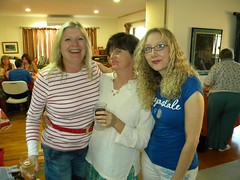
My Blonde Girlsfriends
Originally uploaded by toastfloats.
This year, DrC and I have slipped gently, easily and comfortably into skeptism. Fortunately, skeptics can also be pagans as long as we don't actually have to believe in the Good Fairy, Mother Nature, or Any Other Capitalized Deity -- except, of course, the Flying Spaghetti Monster. We got to this point through a gentle but relentless campaign on the part of DrC's father in the realm of physics combined with beer... specifically Skeptics in the Pub. Through a friend (Steve) of a friend (alien), we met like-minded folk and starting thinking. Thinking is dangerous. Not thinking is also dangerous.

I love to mis-quote Einstein.

So in addition to the other wacky notions such as preparing for the pending zombie apocalypse, getting rid of all our stuff, and letting children play unsupervised on the deck of a boat, you can now add "ignoring the entire holiday season" to the list of Conger family transgressions on normal. We signalled our new conviction that Christmas is a waste of time, money, and emotional energy by getting in the van and driving off for three weeks. Turns out that in New Zealand, this is not a particularly radical notion. When Christmas and New Year fall gobsmack in the middle of summer, spending the two week holiday on the beach is pretty standard. I think DrC has us hiking up a mountain or repelling into a cave or something on Christmas Day. I had to remind him that the tour operators might be taking the day off.. you know... just for the heck of it? But turns out, not so much. Kiwis are pretty practical. Or they also agree that the reason for the season is to make money, a universal commercial consensus that appears to know no borders.

Before you go all "bah humbug" and presume to equate cynism with skepticism, I assure you that the Conger family plans to enjoy ourselves. Once again, we all made each other gifts to exchange on Yule as well as gathered little items for our Santa stocking stuffer extravaganza. DrC made soap this year, I made candy and rollagon organizers, Mera made pou (Maori dance balls), Aeron customized journals, and Jaime made designer t-shirts. I can't say we enjoy this process... inevitably Grandma Sue finishes in August, Mera in October, Aeron in November, DrC two weeks before Solstice, Toast the day before, and Jaime three weeks later. It's pretty stressful, to be honest. The competition. The pressure. The distilled sense of Obligation. On the other hand, it's only once a year. If this is what it takes to get the good doctor to make more soap, I think we're all willing to sacrifice.

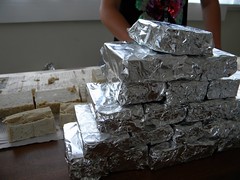
Making Soap
Making Soap
Originally uploaded by toastfloats.
This year's soap offering is oatmeal honey. Stuff smells fantastic and foams up nicely. Unfortunately, there is a bit too much oatmeal so it sort of falls apart when you use it. You have to gather it up and squish it back together again then set it on a dry spot in the shower until the next time. Soap -- With Instructions. For the first time, the soap is vegetarian made of canola oil rather than the usual lard. And as always, the only animals tested in the development process were our girls; They survived.

The stockings are hung
In the trailer with care
Stuffed with good candy
The children won't share
And wouldn't you know
The Congers are happy
Without all those trappings
Absent the sappy
We eat and we play
We hike and we swim
We drink large pint glasses
Filled up to the brim
And together each day
We thank fortune and fate
For the keys they have given us
To the happiness gate.


Enjoy the Holidays!

~ Toast

Monday, June 21, 2010

A Matter of Perspective

We Contemplate the Entrance
We Contemplate the Entrance"
Originally uploaded by toastfloats.
A classical education familiarizes the attentive student with the geographical distortions inherent in all maps of our beautiful Earth which are not projected on to a spinning globe. The most famous, of course, is the distortion of the Mercator projection map model wherein Greenland looks like it could swallow North America while Europe looks like it could fit into Washington state. I’m not really much more impressed with the Gall-Peters projection which makes the globe look like it’s having a really sad, depressing and long faced day… though I’ll grant you the relative sizes of the continents are an improvement.

It turns out that there are all sorts of map models. There is one that breaks the world into a bunch of equilateral triangles and one that stretches the poles lengthwise causing Central America to curve around and South America to look like it’s about nine months pregnant.

Yet, what really strikes me about all these maps is how consistently cartographers cut the world right through the Pacific. Map makers declare, “Look! A place we can slit the globe open and smear it flat without chopping any countries in half!” However, I suspect their subconscious is probably noting, “Holy frickin’ hell that’s a big ocean. Let’s just chop it into chunks and hope no one notices.” Because no matter which projection you use, no matter how you cut the world up, the Pacific is just a great big bloody ocean taking up roughly half the planet.

A little noted side-effect of this tendency to cut the Pacific in half is that you end up either chopping New Zealand in half as or losing a chunk of it in the cropping at the edge of the page or somehow failing to include it whatsoever. The result is that most northern hemispherians tend to think of New Zealand as an island off the coast of Australia. Hell, most Americans – who frequently are incapable of naming all 50 states let alone their capitals – don’t even recognize that New Zealand is a separate country. So when I flew from Australia to New Zealand the first time, I was dismayed and surprised to learn that the trip was going to take hours. Many hours and two time zones.

Cartagraphic epiphany number one: New Zealand is a very long way from Australia.

The corollary to this discovery, of course, is a reinforcement of the first argument, “Holy frickin’ hell the Pacific is a big ocean.” I dwell on this quite a bit as my husband blithely reassures me that we’re ready to sail across it next Spring, citing our good friends Hipnautical and Totem and Sea Level as proof that it can be done. Tisk tisk, DrC. Just because we can, doesn’t mean we should! It’s a really long way. Have you looked at a map recently?

But that brings us to cartographic epiphany number two: The Pacific is full of crap.

That’s both a literal and a figurative discovery, mind you. Studying oceans and marine biology with the girls, we are learning more and more depressing stuff about just how much garbage is floating around in the Pacific. There is an island of plastic larger than the state of Texas just swirling around out there waiting for the human species to come to its senses. Fortunately for mariners, it turns out this Trash Island is not a hazard to navigation for the average cruiser on the Coconut Milk Run. There are far more solid and fixed objects to worry about, however. Islands and muotos and all kinds of rocks in the middle of absolutely nowhere just ready to reach up and grab your keel. The big empty blue bits on the edge of your map are chock o’block full of ridges and mountains and plateaus and atolls. An hour with Google Earth in those blank blue bits zoomed down to about commercial airline height is quite an eye opener.

But then in Google Earth I ran into cartographic epiphany number three, which quite literally rocked my world: There is no up.

The thing is that history is written by the winners and so all human history – and hence all the maps – have been written by a bunch of northern hemispherians. Somewhere along the lines someone decided that the North pole is up, and the South pole is down. Quite literally everything flows from that assumption. But what if the cradle of human civilization had been in Australia? What if we started from islands in the middle of the Pacific? What if life actually began in Africa?... wait… it did. Um… Okay, so what if the Africans had actually been asked how they wanted to draw the map? What if South were up, and the planets actually revolved around the sun clockwise?

Serious Business
Serious Business"
Originally uploaded by toastfloats.
It is. They do.

Turns out you can flip the world upside. You can invert the entire solar system, in fact, and nothing changes but our perspective. New Zealand and Australia are in the top hemisphere, it’s Winter Solstice today, and sometime next spring we’re going to sail the boat all the way up here. It’ll be a long haul uphill against parental opposition and societal expectation. But when we arrive, we’ll be at the top of the world.

* * *

Editor's Note: I want to thank friend and reader SteveF for posting a link in the comments to this fabulous web site on upside down maps: http://flourish.org/upsidedownmap/. The article is full of fascinating information on the relative and culturally specific nature of maps and includes images of many variations. I'm embedding my personal favorite which is both upside down and does NOT cut the Pacific in half. Thank you SteveF!

Thursday, May 06, 2010

Event Horizon

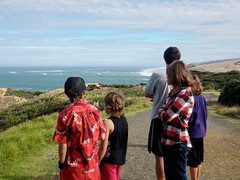
Mera On the Headlands
Originally uploaded by toastfloats.
I used to be really good at planning ahead. In fact, DrC and I were arguably so good at planning ahead that we had our life mapped out clear to 2050. This was 1990 and we were young, very much in love, and -- in retrospect -- pretty dumb. I know that the politically correct term to use for our dimwitted certainty of our future path is "naive", but in retrospect I think we were stupid combined with misguided. Also, naivety implies that our myopia was entirely a by-product of youth and inexperience. Now, I believe that planning for the future requires assumptions which are built into the entire economy and social fabric in which we were raised. Our minds were threaded with notions of what was right, appropriate, necessary, and inevitable which made it relatively effortless to plan ahead.

Somewhere along the line, however, DrC and I fell off the track. Now we can argue ad naseum whether that fall from grace was a bold step into a unique and exciting lifestyle or merely a juvenile collapse into poverty resulting from severe mid-life crises. It doesn't really matter, though. The point is that once you extract all the "you musts", "you shoulds", "you can'ts", and "you won'ts" from the vocabulary of your planning horizon, life looks very different. From where we sit right now, it is almost impossible to figure out what to do next.

As a project manager, this problem makes sense to me as a classic one of resource, time, and scope. In the bounded world of musts and cants, society defines our scope. We are provided from the cradle with a set of parameters that describe what it is possible for us to become, what is required of us to accomplish. The timeline is an actuarially defined life span ranging from 70 to 90 years. As a result, the only real variable we can apply individuality and imagination to is the resource of our personal intellectual and physical capital. By improving ourselves through education and effort, we can increase our scope. Through exercise and good eating, we might increase our time. As a resource, our labor and effort can theoretically improve the probability of achieving the project objective -- a well lived, successful life.

However, the unbounded life destroys the planning process in two directions: time and scope. First, those who step off the track often make a big and scary leap regarding the available time on this plane of existence. When interviewed, these people repeatedly express some variation of the theme: "We only have one life to live. I don't know how long it will be and I don't want to miss any of it." The leap into a boundless lifestyle often follows personal crisis: lost family member, near death experience, children growing up more rapidly then expected. The time to achieve the project objective therefore is no longer a set value in the equation, but rather a variable ranging from two weeks to seventy years.

So too does the scope change utterly once you step outside the box. If the project objective is a "well lived, successful life" then we must look much more closely at that phrase, defining it with considerably greater precision. "The unexamined life is not worth living," said Socrates. Examining your life, however, leads you inevitably to the consideration of "well lived." I would hold it as a truism that "well lived" must be a completely subjective criteria, each of us shading meaning and value to every aspect of our existence. We must balance the relative value of goods, people, pleasure, and family. This becomes an entire branch of philosophy so I won't continue further on this line of thought. Let's just say for the sake of this thread that when you reject the classic definitions of "well lived" and "successful" and start exploring all the many alternative ways to bound these criteria, suddenly scope becomes a much messier variable. It's not that I expect everyone to throw away "money and material wealth" and replace them with "fuzzy logic, family happiness and pretty sunsets." It's simply that without the boundaries, there is very little way to predict scope; It becomes more whimsical. Scope changes over time as you grow, modify your expectations and desires. It changes when new people come into your life and other people leave. There is no hope of setting it at a predictable value and managing time and resources accordingly. Instead, scope is in constant flux and must be revisited continually.

Now to bring this down to earth, we now have a project with an ill-defined and changing objective of unknown duration. In other words, our lives are basically like every software development project every undertaken. The only way these projects ever get done is to first get a strangle hold on the marketing department and make them define the scope… at least for this week… and second draw an arbitrary line in the sand to define the completion date. Which explains, to my mind, why agile programming techniques are so popular amongst the digital natives. Instead of creative planning horizons which extend to infinity, project managers force the entire organization to focus down, in and sharply on a short term objective which is attainable within the known variables of what marketing and sales want now and what we can actually get done with the resources we have on hand. And the shorter the time horizon, the easier it is to know what we're going to build.

Which brings us to my personal headache. I fired the old marketing department and told the Sales team to go to hell about four years ago. And while I really like the new team a lot better, their instructions to "don't worry, be happy" are a bit amorphous and not particularly helpful. As long as I don't try to figure out what to do a decade from now, we can concentrate our family resources on what we need to be happy this week, next month, possibly next year. True, the event horizon must include enough recognition of the future that we don't block ourselves from the 70 year program during which the Zombie Apocalypse is a high probability, while eating every day and taxes are an absolute certainty. But those slow inevitable movements in our lives are merely counter-punctual bass lines on the melody of daily events.

Today, we focus on incremental wins towards our long term, life objective of the well lived life. We're coming out of our "Move to New Zealand" scrum, so it's a good time to look at the backlog and figure out what to do next. I spent a few days living in the Product Planning mode of a decade before migraines beat me back to the weeds of our lives. I just can't handle looking out there very far for any substantial length of time. The girls are happy right now and loving life. DrC is happy right now, getting his medical skills back to polish and learning how to play guitar. It's enough for now to know that by our own measure, we are still highly successful people.
Not a Good Place for a Boat
Originally uploaded by toastfloats.

Friday, January 08, 2010

When You Stop Cruising On a Boat

Mera Leads the Way
Mera Leads the Way
Originally uploaded by toastfloats.
This entire post is along the lines of an Editor's Note. I was all ready to just put this blog to bed for a few months until I could switch to "All New Zealand, All the Time", but then I experienced a midnight epiphany.

Everyone must eventually stop cruising on their boat.

Most cruising books fail to discuss this phase of the cruising life. It's as though the author is afraid that if you -- the voyeur -- learn that the last chapter is not a sail disappearing over a pink and orange laced horizon complete with swelling music and the muffled sounds of theater goers rummaging around in the goo and popcorn detritus around their seats for keys and bags -- well you won't buy the book. Clearly part of what we travel bloggers, authors, and literary wannabes do is sell a dream. And the dream doesn't include stopping.

Yet nevertheless, we all stop. Whether a cruiser stops because the children get too old, the money runs out, family obligations, their boat falls apart, or they simply get sick of the lifestyle, eventually we all return to land. It may not be glamorous or exciting, but it is an important part of the cruising experience. And perhaps we would all be better prepared as cruisers and cruiser-dreamers if we thought of a graceful way to get off the boat prior to cutting the lines.

I don't think DrC and I thought it out carefully enough, to be honest. So once again -- through the Power of Blogging -- I'm going to treat you to an opportunity to sequentially and virtually experience the bumbling and fumbling of the Conger Clan as we attempt to completely upend everything we know and love and replace it with something Exciting and New.

Which Way Now?
Which Way Now?
Originally uploaded by toastfloats.
As a result, some of the articles this month are going to be retrospective... trying to recreate how we made certain choices during the past few months. Some I'll throw out as they happen. And a few will be prospective musings and predictions which -- like New Year's Resolutions -- will be highly speculative and completely improbable.

This is an excellent opportunity for long time readers, first time callers to write in with questions. Don't be shy! I was recently told by a reader that I make it very difficult to send me email... probably a hold over from my days in network security. Nevertheless, I'll brace for spambots and offer the following:

toastfloats at gmail dot com

Looking forward to hearing from you.

Thursday, December 31, 2009

The End of the Beginning

A few mornings before Christmas, I woke suddenly and completely with a thought big and crystal clear in my head: We need to sell Don Quixote. I turned to my sleepy husband and pounced on him with this idea. DrC is not clear headed in the morning. Like most men, he can think of only a two things when awakened. One of them is coffee. If I were to get his full attention, it required that I dispose with these ideas first.

Moving on, the idea of selling Don Quixote fell on fertile emotional soil. We had seriously been noodling leasing her, but the logistics were a nightmare. Putting her on the hard for a year means a lot of expense and slow degradation of the boat without any real return to us. If we planned to cruise for several years after New Zealand, it would make sense to keep her. However, as I've mentioned before, we do not have that much cruising kitty left... maybe a year at most. Jaime is getting long in the tooth for cruising, Aeron would like to spend longer chunks of time in single locations. This summer tempted all of us with a glimpse of a nomadic land life. The absence of Don Quixote in our life would be a financial relief, but it could also be the lifting of a burden enabling us to consider completely different adventures going forward.

Christmas Day found me on the deck of s/v Totem talking with our good friends Behan and Jamie. We were discussing all the options for the future, New Zealand paperwork, and teenagers. Without any prompting, Totem asked me, “Have you thought about selling Don Quixote?” I was struck by this coincidence. Prior to this not a single soul – online or nautical – had asked me whether or not we wanted to sell her. In the cruising world in particular, boat selling and ending the cruising life are topics that no one brings up unless the owner opens the subject. I think it might be taboo. Yet, here was Totem asking about selling Don Quixote before I said anything.

“Why yes... we had just started thinking about it. But it seems... it seems like a really big idea.” I'm almost babbling.

Jaime was less sanguine. When we broached the idea with the girls, we met with mixed reactions. Jaime cried. In her deeply contemplative fashion, Mera thought about the idea and informed us that this made a great deal of sense. She was ready for a new experience. Aeron vacillated back and forth but was largely concerned about Dulcinea's reaction.

This is as far as we'd gotten when a note arrived in my Inbox three days later from a couple we'd met in the Sea of Cortez last summer. “Remember us? We're planning on cruising this fall, and we heard about New Zealand. Would you consider selling or leasing Don Quixote?”

Rule of Three* strikes again.

So if you asked me two weeks ago if we'd sell Don Quixote, I would have said, “Hell no!” And if you ask me today, I'm going to say, “What are you offering?”

The immediate plans do not change. We spend the next two weeks moving the boat back to La Paz. There we are going to clean and empty her out since – whether sold or on the hard – she needs to be empty and clean. Then we'll haul her, paint her bottom, and get a survey done. Again, this must be done. We can't sell her like she is, and we can't leave her on the hard without a new survey for insurance reasons.

But we'll also be exploring all the many varied options of how you list and sell a boat without spending a fortune. The first is, of course, the ubiquitous hive mind of my blog, Twitter feed, and Facebook account. If you know of anyone considering buying a Lagoon 380 in the Pacific, tell them now is the time to do so. There are very few of us out here, they rarely go on sale, and when they do, the owners are rarely as motivated and willing to do a good deal as we are. We will put together a web page with her specifications and equipment over the next week, and get it out to the hive mind with a URL as soon as possible.

Lonely Splendor
Lonely Splendor
Originally uploaded by toastfloats.
The other thing that does not change is our status of “floating.” If cruising is way of thinking, a form of living without traditional boundaries and in a liquid state of adaptive learning, we continue our cruising life for the foreseeable future. Even without Don Quixote, we can cruise in a tramper in New Zealand or Australia, by train in Europe, via R.V in the United States. We can hike, bike, or park. Ironically, the cruising kitty can sustain us for many more years if we simply change the mode of transportation: Our boat is beautiful but like every boat afloat she is a black hole into which you pour money.

I think we needed the comfort and spacious beauty of our Lagoon catamaran to get us out of our incredibly plush, capacious and comfortable land lives. After nearly three years of living on her and two years of moving her from place to place, however, we know how to live much larger with much smaller accommodations, how to do a lot more with a lot less.

Believe it or not, the Conger family is ready to downsize and purge. Again.

* Rule of Three – If three things happen in quick succession that point you towards or away from a certain course of action, the Fates are trying to tell you something. It is a very good idea that you listen and obey.

Saturday, December 26, 2009

Questions from the Class - Don't You Get Stir Crazy?

A fellow doctor interested in our experience on the boat and with getting a locums position in New Zealand passed on these questions from his wife: How did you not go stir crazy on the boat? Did you not feel that you were on top of each other?

Our Boat Parrot is a Cat
Originally uploaded by toastfloats.
My flip response is: Yeah, a boat is small, but you've got the biggest back yard in the entire world.

But this doesn’t get to the heart of her question. I truly believe that when people ask me this question it is less about how we cruising families can live on boats and more about how land based families can give up the comforts of home. It is a scary world outside the secure box we’ve been trained to build and maintain for ourselves and our loved ones. With a house in the suburbs, we have some degree of security and a great deal of familiarity with the rhythms, the requirements, the dangers, and the pleasures. Once we step off the porch and into the street, we are lost in a world of possibilities, not all of which are manageable and most of which are completely unfamiliar.

The way you move a family on to a boat is the way you must do everything in life. First, commit your whole being to the project. You -are- going to do this thing, whether it is getting on a boat and sailing away, climbing into an R.V. and driving around the country, or stepping on to a plane and moving to another country. This is, without question, the hardest step. Everything else is details. To make the commitment, you must believe with all your being that you are doing the right thing for yourself and your loved ones. You can’t go into this half-assed. This is why I object so strongly to the dragged aboard spouse. All members of the family must understand and agree to the endeavor, or it will not be successful. Over and over we’ve seen boats fail and go home because one or more of the crew just wasn’t committed to the life.

With all members of the family on board, you must build your walls against FUD: Fear. Uncertainty. Doubt. These will plague you. Worse, your family, your friends, your colleagues at work and at school will question you. Many will be supportive on the surface, but underneath, their attitude distills to this expression of doubt: What the hell do think you are doing? Challenges to your decision are couched as concerns for your safety, for the well-being and health of your children, for the “socialization and education” of your off spring. You’ll get questions about road bandits, pirates, drug lords, murderers, swine flu, bad water, and storms. Everyone will be “impressed with your courage” and “would love to do something like that” themselves, but you’ll feel the subtext. Your decision challenges the foundation of their existence, their reason for getting up each morning, taking their children to the local public school, going to work, and voting the first week of every other November. And by doing so you are, in some fundamental way, the Enemy. Questioning your choices is their defense. Calm, patient, well-researched responses to the endless what-ifs is your way of making sure that those fears do not undermine your own decision making process.

Then, make a project plan to get you from Point A to Point B. Set dates. Make those dates as specific as possible. Set objectives. Make those objectives as concrete as possible. “Start homeschooling” is too vague. “Withdraw the kids from school March 3, 2010” is much better. To the extent that your funds and situation allow, try to phase the lifestyle changes over the course of several months or even years. In our family, I quit my job, six months later the kids quit school, four months passed and we moved from a 3,000 sq ft house to an 800 sq ft basement, another four months and we moved on to the boat, then three months later my husband quit his job and we left Seattle. By adapting to each major change, we made the entire process less overwhelming.

While you implement your project, let go. Let go of everything. Let go of all the Things that own you. Let go of all the assumptions you have about what you are and why you exist on this planet to serve the greater good of the American (or Canadian or British) economy. At each phase, challenge yourself and your spouse and your children to get rid of baggage: physical and mental. Discover the freedom of not owning stuff. Revel in the wonderful world that is your children’s imagination. Explore the inner voice that enjoys bedroom activities with the spouse, kneading bread, or knitting. Rediscover how good your loved ones smell, even after they have been working, playing, sweating, swimming. Let yourself get dirty.

And now that you are here... at Point B on the boat, in the R.V., settled in Australia, Canada, the UK, New Zealand, Mexico, wherever. Now that you are here... ask yourself these questions again: How do you not go stir crazy on the boat? Don’t you feel that you are on top of each other?

The only time we go stir crazy on the boat is when we are pinned down for several days due to weather and can’t get ashore or in the water. After about the third day, we’re all absolutely mad to get some really vigorous exercise.

Our boat is plenty big enough for everyone. We rattle around and only occasionally knock into one another. We’ve never met a committed cruising family who didn’t adapt their lifestyle -- more or less successfully -- to their boat, no matter how small the craft. We get in each other’s way when cleaning, sometimes when cooking, and occasionally when sneaking up to the salon to stuff stockings on Christmas Eve.

You’ll be fine. You’re going to be successful, too.

Sunset at Salinas
Sunset at Salinas
Originally uploaded by toastfloats.

Saturday, September 12, 2009

Jimena (Wednesday, 7 PM): Tipping Point

It's Getting Ugly
It's Getting Ugly
Originally uploaded by svmaitairoa.
I don’t know when I’ll be able to post this. We just went to the backup generators at the marina and port office. The computer systems and Internet are not on that circuit, naturally. So Internet is down until power comes back. And I can’t go to my boat.

Jimena decided to move directly north, which put Santa Rosalia very much in the path. I’m sitting in the Cool Room with the five children of Don Quixote and Ocean Blue and watching the wind and rain howl. I’d guess the wind speed in the 50’s and we’ve probably seen at least 6 to 10 inches of rain already. The kids have renamed the air conditioned cruiser lounge the Wet Room. The window sills are flooding as is the office above us, and water is pooling on the floor everywhere.

I’m scared. This morning after the first blast I learned graphically where the expression “keep your shit together” must come from. As my stomach cramped and my body rejected dinner, I squeezed my eyes shut tight, took deep breaths, and chanted the phrase which is now my mantra, “We matter, money does not. We matter, money does not.”

Because our boats are getting the crap beaten out of them. Everyone did the best they could, but now we’re essentially helpless in the face of the weather. The storm surge is blasting against the breakwater in 30 foot splashes for all the world like Mickey Mouse on a sorcerian rampage. The boats are bouncing against their lines, children’s toys in the Santa Rosalia bath tub. Everything is jerking and pounding, the wind is screaming and the rain is a stinging deluge. Imagine standing in a shower on the pound-the-hell-out-of-your-shoulders setting. This is the most water-wasteful shower head in the world which alternates massage and sting pellets with a sporadic high pressure open facet.

Santa Rosalia must be a complete disaster. Even what we can see of Highway 1 is a solid wall of mud and water. Occasionally, an emergency vehicle goes by and it’s a wonder it doesn’t simply float away.

Despite the surging waters, the swirling gale, and the incredible bounciness of the boats, the docks are still there and our boats are still afloat, but I don’t know how long that can last. All the captains and most of the boat crews are on the dock, including the port captain and the harbor master. We have several marina staff as well. All told, there are roughly a dozen people manning the docks, the lines, the chafe. Typical of the team, Steve of Ocean Blue can’t bear to spend more than ten minutes at a time away from the boats.

As a group, our single greatest worry is a boat tied to the fuel dock upwind of the marina. We all thought it was a fine place for them, almost completely sheltered in the lee of the breakwater, until we discovered to our horror after the winds had already begun to pick up that the lines and secure fittings on the boat were limited and inadequate. While there is almost no wind at that spot, surge is rolling past s/v Festima Lente’s bow, raising the boat nearly 8 feet on each rolling wall of water and slamming her against the pier. She has snapped every line originally securing her and most of those we’ve desperately thrown over the remnants.

If that boat goes, it takes out all the breakwater lines set by the south side boats, which include Ocean Blue, Rhumb Line, Lillith and Don Quixote. Even if we cut those lines before Festima Lente yanks us off the docks and on to shore, that leaves us with no off side lines to prevent the large, windy catamarans from beating the dock to pieces. Losing this fuel dock boat is simply not an option. After Festima started snapping lines, the rest of the cruisers took over setting an anchor and getting an extremely heavy duty line wrapped around the masts and dock pilings as well as hanging a tire on the side. The crew of all the boats worked like dogs to get that boat set. They continue to work like dogs monitoring the docks, the decks, lines, chafe, movement. Wet, yellow shadows moving in groups of two, three, five where necessary to make sure none of the boats is lost.

Saving Festima Lente
Originally uploaded by svmaitairoa.
But I’m not one of them. I was. I tried. But now here I am with the children in the safe room. I think I could have stayed out there working, but at some point, I would have needed to have a serious breakdown. I could feel it coming as the wind built and the boat started jerking hard against the lines, bouncing against the dock, twanging the lines holding her to the far pier. I felt the tears starting as I leaned into the spray off the break on my way to the port captain to get line for Festima. However, if I break down, the girls will know. They will see evidence of it on my face, in the redness and puffiness of my eyes. They will know. And what’s holding them together right now is Johanna and I sitting here calmly reading novels.

Every time my breath hitches, terrified at the potential loss of Don Quixote, our cruising lifestyle, and our plans for the future, I remind myself that we matter. These three girls, even this kitty cat by my side. We matter most. I matter more than Don Quixote, and DrC doesn’t want to lose me. So I’m not a heroine today. I’m a mother, I’m scared, and I’m going to sit with my children in relative safety while this hellish wind and rain move slowly past, trusting to the hard, dangerous sacrifice of my fellow cruisers working out there.

Monday, June 08, 2009

Lions and Tigers and Bears! OhMY!!

Clever Girl
Clever Girl
Originally uploaded by toastfloats.
Emails and the comment threads both here and on my Facebook account have recently been full of questions regarding the “bad news” flowing out of Mexico. I'd like to take this quick moment to respond to the questions, concerns, and wonderful warm messages of support and worry.

Are you worried about the flu? What are you doing about the flu?
We're paying attention to the flu news, but we've pretty much decided this is a tempest in a 24 hour news cycle tea pot. Basically, sane folk need to keep our eyes on what happens to the flu over the next six months as it heads into winter in the southern hemisphere. Flu doesn't really like warm weather, so it's not a reasonable thing to get bent right now if you're living in a 100 degree climate. We'll monitor whether the flu strengthens or mutates during the southern winter months and pay attention to where it goes and what it does in the fall.

Can you get across the border?
Who knows? Right now, we can travel without restriction. By the time DrC or the girls and I try to travel north, the flu issue could be completely gone or the federales on both sides could have their knickers in a twist. We'll go with whatever the fates hand us. At this point, we're just not going to worry about it.

What about the drug lords and murderers?
There is a drug war going on in Mexico right now, particularly up north near the border. I liken this to the mob wars that took place during Prohibition. There is a lot of money, a lot of corruption, and a lot of violence. However, the violence is largely confined to the community involved in the trade. Like mob families, these folks are killing each other and leaving the rest of the world to toodle along without interference. Occasionally, there are civilian collateral casualties, each of which is a tragedy. Again, this is not something that the crew of Don Quixote needs to worry about. We're nowhere near the areas of violence.

Now Toast.. we've heard about violence against tourists...
Heh. Maybe you have. We haven't. The cruiser community is the most gossipy group of biddies you'll find anyplace. We're like a small town smeared from Zihua to the Sea of Cortez and news travels very fast. It's reasonable to conclude that we know of every incident of theft, violence, or property damage that took place against cruisers this entire season. You can count the issues on one hand, and we haven't heard of any injuries this year. Gracias a Dios, as they say here.

Frankly, cruisers just aren't much of a target in Mexico. In fact, most coastal communities go out of their way to ensure the safety of their yachtistas who support local businesses, contribute to local charities, and encourage the positive interest of the Federales in the region in the form of Singlar and Fonatur developments. In one notable incident this season of cruisers getting stopped by a thief and taken for their pesos, the local policia had the guy arrested, tried, sentenced and incarcerated within 48 hours. Do not – I repeat DO NOT – get on the wrong side of Mexican law and community consensus on policia priorities.

But Toast...
I know it probably seems like we're being too casual, too unconcerned, oblivious, or naïve. Instead, I think what happens is that when you escape the clutch of mainstream media, you start developing a more practical understanding of the dangers which surround you. We can't read about a murder every day, so we start to worry less about getting murdered. We don't read about the swine flu every day, so when we do, a few thousand cases world-wide seems a considerably smaller danger than a coromuel with a bad anchor set. Drug lords don't hang out in marinas, cruisers are not getting attacked, boats this season have largely avoided even petty theft.

Does that mean bad shit can't happen to us? Of course it can. Jaime slipped on a wet floor a few weeks ago, and knocked herself out. We spent two days monitoring her mild concussion and worrying worrying worrying. To make it more entertaining, she slipped again in Escondido requiring a trip to the hospital to get a neck X-ray. So no, we don't think we're invulnerable.

Flying Leap
Flying Leap
Originally uploaded by toastfloats.
But the things we worry about are the issues that face us every day: the safety of our children and ourselves in a dangerous and challenging physical environment, falling overboard on night passages, running into rocks, getting stung by rays, slipping on hikes, eating a fish tainted with ciguerra or getting ice with a nasty intestinal bacteria. We worry constantly about dehydration and sun burn, slipping on wet tiles in our Crocs, and Mommy's back going out... again.

The swing flu, drug lords, and muggers are far far away. Let's just keep them that way.

Thursday, May 07, 2009

Interview: DrC At One Year

Contemplating the View
Originally uploaded by toastfloats.
Roughly a year ago, Keet asked me to interview the girls about their experience as boating kids and their thoughts on the future. The time has come to update and ask a few new questions as well as get some thoughts from DrC.

* * *

Q: What do you think about our plans for the coming year?
Vague. They may change. Except for Sea of Cortez revisiting same places again less appealing. If job in NZ or AU comes we may cross the Pacific.

Q: What was your favorite place to go or thing to do during our first year?
I like the hikes. There are lots of hikes: hikes in Canada, hikes here in the sea. I like playing my guitar. Other things I liked are not printable in a family format.

Q: What was your worst time during the first year?
Probably that gale in Oregon or actually dragging anchor off Santa Cruz in the Channel Islands at three o'clock in the morning with 35 knots of wind in a Santa Ana in a tiny little rocky anchorage with a reef 50 yards behind us. Both were scary. In the case of the gale, it was good to have experienced it, and it wasn't really as bad in retrospect as it seemed at the time. It makes me glad we were going downwind. Basically, even if we weren't we would have turned around... so it's kind of just the way you do it. As far as the gale goes that's just kind of inevitable and if handled properly it need not be a dangerous thing.

With dragging anchor, it was more anxiety provoking of passengers/crew. That's not an experience I need to repeat. There was no benefit to that experience other than being better able to avoid it in the future.

Q: What is the best thing about being a full time cruising sailor?
It's interesting being a vagabond and not having any major responsibilities to the outside world. And watching to see if that would be a liberating experience or not over time. Any conclusions drawn so far...is it liberating? Possibly. Don't know yet. Take another year.

Q: What is the thing you hate most about the cruising life?
I guess having things break down that I've already fixed once before. Also, the dirtiness of the boat, inside and out. When we visit boats that only have an older couple on board, their boats are always so clean and orderly, it looks more luxurious, less like camping.

Q: Are there any places you want to go or see during the coming year? Where would you insist that we go again?
Well, I think the Sea of Cortez is nice. I'm looking forward to exploring it. It's all kind of nice, but I think the SoC is the only place I'd want to visit more than once. Las Hadas and Manzanillo were nice. Not having anything to do but go to the pool all day... It would be nice to do some inland traveling. I'd like to go to the village where they make guitars... see where the Zapatotec weavers do their thing.

Q: Can you tell us one thing that makes boating families special?
Well, the interactions of the family members with strangers. Openness to new experiences, especially the kids. Probably, an enlightened trait. What does that mean?Well you know this is what Buddha would say you should do with your life in some aspects. I think it seems like what life is supposed to be about. So, to the extent that we achieve that, I think that we are leading an enlightened life, succeeding in the way that the kids and you are open to meeting people, trying things, doing new things, rather than just sitting at home watching tv and living the old life.

It's not so much the travel itsef which is liberating or whatever you want to call it. It's the reactions of the kids and the interactions of the kids with other people and their growth.

Q: Anything else you'd like to add?
Um. The extent to which I don't worry about things as much is an advantage. I don't think I've achieved any sort of goal there, but I've made progress. It wasn't really a goal to become blasé about things, more so just to be able to appreciate the benefits of this type of lifestyle.
Proud Papa
Proud Papa
Originally uploaded by toastfloats.

Sunday, May 03, 2009

Are You a Hooker?

Yoga at Marina de La Paz
Originally uploaded by toastfloats.
When I spoke of this season's catitude, I think I depressed a few readers with my persistent combination of smugness and defensiveness about living on a multihull. Even at the time, I made clear that there are a lot of ways you can split the cruising community down demographic and philosophical lines. All are more or less “true” in the sense that the lines exist, the differences are real, and you can see the social dynamics play themselves out on a daily basis. However, it turns out that multihull versus monohull is not even one of the big players in the cruiser schism game.

Almost as profound as the division between sticks (sail) and smokers (power) is the gulf between those who spend the majority of their time at anchor and those who live on the dock. At times, this gulf is nigh on uncrossable since it goes to the heart of cruising philosophy.

Now, obviously there is no way a cruiser can completely avoid periodically throwing out the ground tackle and living on the hook. So we all invest in good ground tackle and learn how to use it. We endlessly sit over drinks and debate the merits of Rockna versus Bruce, scope ratios, storm tactics, bridling and holding ground. However, for all that effort and discussion, once you get out in the cruising grounds, the fleet tends to dissolve into two basic camps: those that live on the dock (dockers) and those that live on the hook (hookers).

Dockers prefer the convenience, comfort, and beauty of the marina. Dockers are clean: their boats are clean, the cloths are clean, their dishes are clean. Dockers know how to negotiate with the local harbor master to get the best weekly and monthly rates. They can tell you where to get Puddle Jumper discounts (12 bottles of dark rum for about $35USD is only my most favorite example). When they pull into a town, they spend weeks or months learning everything there is to know, participating in charitable events, going to all the amateur and professional musical nights, identifying each and every quality tienda, mercada, and restaurant. Their experience of any single city is deep, their knowledge wide, and their enjoyment manifest.

Hookers, on the other hand, prefer the nomadic, camping life of the hook. Hookers are filthy: their boats are salty, their clothes often stand up and try to walk away. Hookers know how to tuck into even the smallest bight to get protection from wind driven fetch and Pacific swell. They know how to negotiate with pangeuras to have fuel, laundry, beer, and fish delivered to the boat. They visit remote villages, natural parks, off shore islands, and open surfing road steads. When they come into a big town, they frequently stay only long enough to take on fuel, food, and clean clothes before letting the wind blow them back to quieter, more remote locations.

Now, nothing is absolute. Every once in awhile, a hooker spends a week on a dock. Even then, their lifestyle choice manifests itself. Hookers in dock work very hard; Docking is an expensive opportunity to complete maintenance that simply can not be accomplished without quick access to hardware stores, water, or other facilities. Their experience of the local town is dominated bysail makers, machine shops, or fabric stores. Of course, they'll have some fun, take in a show, go to a potluck in the marina lobby, but these activities are only at the end of a long, hard day with the expectation of more work on the dawn. Their conversations with one another focus on solving their maintenance problems and getting out from under the expense of marina life as quickly as possible. Hookers are often on extremely limited budgets, and even in the dock, they constantly trade methods to save money.

Periodically, a docker spends a week on the hook. Dockers on the hook seem to view their time out as opportunity to vacation from their vacation. It's not unusual to see them pull into an anchorage and never drop their dinghy. They enjoy sundowners on the deck, gently complain to one another about the rolliness of the anchorage, and struggle with deploying flopper stoppers. They take a million pictures, and are generous with their time, food, and booze to the hookers already in situ. Dockers anchor more tentatively, and they seek the recommendations and advice of hookers for where to go, what to do, and which palapas to visit. Even on the hook, dockers are clean, have the freshest and tastiest finger foods, and serve drinks with ice.

When we set out, Don Quixote anticipated being one of that unusual breed of boats which lives a hybrid, hooker-docker lifestyle. An informal survey suggests that this is a common cruiser dream, assuming the cruising life will be similar to long vacations on the boat. Most thought they would divide their time roughly evenly between hook and dock.

But that's not really what happens. In practice, you find your life sliding into a docker or hooker pattern. Docking is so much cheaper here than in the States, that if you really like the dock lifestyle, you should be able to afford it. It's a wonderful way to live, to raise children, to enjoy and participate intimately with the Mexican and ex-expatriate communities along the water front. Hooking, however, also has an unexpectedly seductive appeal. A hooker can reduce a family's living expenses to less than $USD1000 per month, and the longer you live on the hook, the easier it becomes, the more liberating the pull away from land based concerns.

Contemplating the View
Originally uploaded by toastfloats.
I apologize if I have failed to be objective in this article; we are hookers. Even last summer in the Northwest, our time between dock visits grew steadily longer, but now here in Mexico, we basically do not dock at all. From the time we said goodbye to Victory Cat in December to the time we pulled next to Totem in March, our fenders never came out. After a week of intense scrubbing and maintenance, we abandoned the pull of the La Cruz marina in favor of bobbing around in the La Paz Magote or swinging on the hook out in the southern Baja islands. We empathize with and admire those who drop the lines in late October and do not pull again into a marina until it's time to put the boat to bed for the hurricane season the following July.

The hardships of hooking are well repaid in the economic savings and the sense of empowerment and freedom providing by life outside of the box. On the other hand, the dock box is a lot cleaner. And you can't really overestimate the pull of ice cubes in the rum punch.

Saturday, April 25, 2009

Questions from the Class - Catitude

One of my lady posse who lives on a beautiful monohull down here on the Mexican coastline with us, recently pushed me on an opinion I had casually tossed out: I'd written, “There is amongst even the older cruisers on cats a slightly different approach to cruising.” She replied, “I'm curious. How would you characterize this?”

Favorite People - Jimmy
Originally uploaded by toastfloats.
The difference is subtle, unmistakable, and probably a temporary demographic oddity or maybe just a Winter 2008-2009 coincidence. However, there is something distinctive about this year's cruising class differentiating the multihull and monohull owners. I wrote on the subject long ago when I was naïve, and my skin was still had the pale healthy pallor of a Pacific Northwesterner. Living amongst a lot of monohull and multihull enthusiasts, it surprises me how much about that series still rings true.

Primarily for comedic effect, I characterized Catamaran guy as wearing Bermuda shorts, sun glasses, and a deep tan... the quintessential surfer dude. Weirdly, all the dedicated surfer-cruisers we have met thus far are on multihulls. That can't be right. There must be monohull surfers. But we haven't seen them yet. And all the surfing catamaran and trimaran owners dress like surfer dudes, sound like surfer dudes, look like surfer dudes complete with Polynesian beach wear, expensive sun glasses, and long bleach blonde locks. Except for Jimmie on Sea Level who looks precisely like Jean Luc Picard – in beach gear. Now all cruisers more or less look like beach bums down here. However, cruisers who surf look just a wee bit more so.

Catamarans and trimarans also show up in the anchorage with kayaks, boogie boards, dogs, cats, children, slides, floating islands, and surf boards. They look like mobile party platforms, and their crews take this responsibility very seriously.

"More room for toys makes us more like kids."
-- Steve, Endless Summer

Multihull owners look at the coastline differently for a very practical reason; During the mild winters of the Mexican Riviera, a cat or tri can comfortably stop for the night just about anywhere from Punta Ipala to Acapulco. Now, any boat can stop just about anywhere along the coastline, but in most areas the swell will roll in all night long. If you're tucked in to the beach closely enough, you'll even experience rebound waves off the shore. This means the roadstead anchorages are rolly as all hell. Only the multihulls seem to be able to comfortably skip the microdot breakwaters and just drop a hook anywhere. This totally changes their planning horizon.

"Well, sure the anchorage was a bit bumpy ... but not for ... you know... us."
-- Sue, Sun Baby

DrC's theory is that it's a minority group. Any time you are in a minority group -- for whatever reason -- there is a tendency to collect and bond over shared experience. Many in the multihull minority are also a bit defensive, since we prepped our boats in a culture of monohull dominance... negative monohull dominance. One evening in Barra lagoon, for example, we heard a captain bemoan on the net, "Well well, seven catamarans and a hippie tri. Time to party."

"There is still a multihull stigma. Since the 60's, they were homemade and not of good quality. It's going to take a long time for that image to go away." -- DrC

Another by product of being a minority is that multihull owners hang out with other multihull owners. So of course they tend to do the same things, visit the same places, enjoy the same restaurants and palapas.

"It's a choice to do something different. Seeing and hanging around with other multihulls validates that choice." -- DrC

"If you want to talk boat design, equipment and storm tactics, it's better to drink with someone whose boat has the same issues." -- Jim, Sea Level

Our Favorite Position
Originally uploaded by toastfloats.
Anecdotally, the average age of multihull owners and their crews is less than that of the monohull cruisers. I believe this is a demographic and economic shift rather than self-selection or any meaningful distinction. Multihulls are just starting to popularize outside of the Med and Caribbean. As new owners come into the cruising community, a higher percentage than in the past are multihulls. As time progresses, this demographic will distribute more evenly throughout the age range present out here. But for awhile, at least, the average age is lower.

“I'll admit it. We're an oddity out here. Even more than you are.” – Toby (24), captain of Triumph

Whatever the reasons, this year sees an unusually high number of catamaran and trimarans plying the coastline. Long time cruisers here regularly comment on the influx. Those familiar with cruising the Caribbean talk about how it looks like Pacific Mexico is starting to see the same transition to catamarans as happened long since in those cruising grounds. Tonight in Tenacatita, there were 27 boats, 13 of which were multihulls.

Look, it's easy to make too much of this. The hull preference distinction is no more or less significant than “hookers and dockers”, “retirees and sabbatical cruisers”, or “old couples and the rest of us.” Basically, it's human nature to play with these differences to create shifting social groups, not to mention it makes for entertaining shop talk during sun downers.

However, don't be surprised or alarmed if an anchorage near you suddenly fills up with a flotilla of masted tennis courts, blasting music and calling friendly insults and invitations to one another as they spread into the shallow and rolly spots near the beach.

Particularly if the surf is up.

Friday, March 20, 2009

Turning Around

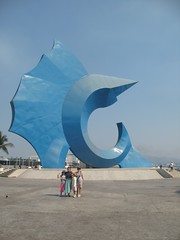
Manzanillo Swordfish
Originally uploaded by toastfloats.
What an odd feeling to be sailing past coastline we have already seen. For the first time since we turned left at Cape Scott, we are treading ground... or more accurately floating over seas... we've already seen and done.

Time is backwards in the Mexican cruising ground. Hard for us to remember down here that in Seattle and Vancouver, Calgary, Portland and San Francisco, the wind is blowing, the rain is falling, and the temperatures require thick blankets, fluffy comforters, and heavy coats. We live in the land of perpetual sun, gentle breezes, hot afternoons and cool evenings. We spend our days avoiding the intensity of direct light, our evenings drinking sun downers on the deck, our nights watching the stars fall out of their orbit and blaze a path to the spangled darkness of the sea. The weather reports are so consistently dull, even the most salty sailor grows complacent and starts to sleep through Don's endless morning chatter on Amigo net.

Now as our season draws to a close, we must all race either north or south to avoid the harsh weather soon to come. The “winter” of the cruising world is the hurricane season which starts in June and runs to roughly November. During this little winter, cruisers flee hot, humid Mexico to visit family in the North or bungalows in the cooler mountains of the central part of the country. Boats must be moved out of the hurricane belt, generally defined by the insurance companies to mean south of Guatemala or north of Mazatlan and La Paz.

So here we are floating the Mexican Riviera, and the time has come to make a decision: north, south, or west. At the end of January, early February, every boat must commit in order to get moved out of the danger zone before the weather turns. The distances in all three directions are actually quite substantial. While we shot down here from Mazatlan to Zihua in roughly two weeks, we now face a 700 mile upwind bash to get back to the Sea of Cortez. Those planning a puddle jump over to the South Pacific have, of course, a considerably farther distance, albeit downwind. Those contemplating the Panama must play dodge with increasingly vicious winds passing from the Gulf of Mexico over the narrowest part of Mexico and blowing with almost sentient ferocity through the Tuanepec.

Don Quixote always planned to head north, back up into the Sea of Cortez to end our first cruising year. DrC's return to the boat in early February signaled an end to our downwind exploration of new coastline. On our return voyage, the family agreed to take our time. First, the trip north is a considerably more challenging sail as we anticipate a sizable portion will involve a bash directly into the prevailing northwest seas and winds. Second, we feel as though we missed too much in our rapid dash south. We'll take our time drifting northwards, stopping in at our favorite haunts to explore them more thoroughly, visiting harbors and anchorages we blew past on our speed run.

I have mixed feelings about turning around. There is the oddest sensation of disappointment. We're not boldly going where no s/v Don Quixote Conger family has gone before. Without the newness, are we still doing something special? Honestly, I don't know where I get these silly notions. My girls would be special in a track house in white suburbia: specially pretty, specially smart, specially charming, specially shitty and annoying. DrC is a stud muffin going into his mid-forties looking like an advertisement for Cruising GQ. And Beach Access not withstanding, Don Quixote can stand on her own as a special craft worthy of attention, notice, admiration. So unless I've complete run out of things to write about, I'm still surrounded in a world of uniquely bright moments, a life full of discovery, hard work, and dirt. Familiarity with the coastline does not render us suddenly average nor does it diminish the value of what we're doing with and for each other.

Drama Queen On the Plank
Originally uploaded by toastfloats.
It may be time to define moving forward less literally. The demands of the cruising life have driven our thinking for nearly two years pushing us always towards new destinations and experiences. Nautical miles and the names of cities gradually replaced our language for describing how we as a family changed, grew, and progressed.

Turning around changes the metric. Dig deeply, Conger clan, to find less geographic milestones to describe the evolution of our sense of family and purpose. Because I can assure you, children mine and handsome hubby, we're not moving backwards. Not yet. Hopefully, not ever.

Author's Note: This was written in late January in Ixtapa just as we started north.