Getting Dulcinea into New Zealand has proven at least as frustratingly difficult as hysterical reports in the cruising blogosphere made it out to be. Despite (or maybe because of) a recent major overhaul of the process to import a cat or dog into the country, the amount of work we have undertaken to bring our pet on this journey has almost made me wish we had left her in Seattle with our friend Greg permanently.
Disclaimer: I am not an import/export specialist. I am not an employee for New Zealand MAF BioSecurity. Do not take anything I write here as The Word on importing your pet. Go to the web site yourself.
The timeline and requirements provided by MAF BioSecurity are pretty confusing, but you can parse them out if you are very careful. The bottom line is that the animal needs a microchip, rabies and rabies titre test, and all sorts of either less serious shots and tests which owners generally administer in any case. All this work needs to be done before you leave North America. The following are the gotchas that got us:
Microchip Type – New Zealand insists that you use an ISO standard microchip. Unfortunately, this standard is relatively new and still not standard, if you know what I mean. Particularly in the United States, many vets administer microchips that do not follow this precise standard. Wiki has a great article if you want to read about how this nonsense all came about and why many American cats and dogs are now running around with multiple chips in their ass. In short, make sure your pet has a 15-digit microchip number and that the chip is scanned and appears on absolutely every scrape of paper relating to your animal.
USDA Stamp - An American animal needs to be USDA approved… sort of like a chunk of beef. You can have your local vet (or any vet for that matter) actually complete all the work. However, you need to then send your paperwork to the nearest USDA veterinary to get a USDA stamp for the application. This stamps isn’t actually a stamp but more like a notary embossment. If you plan to send your paperwork to MAF via PDF or fax, use a soft pencil to darken the stamp so it appears on copies.
Timing is Everything -- Mexico and probably every Central and South American country are decidedly not on the “good country” list. These countries are either uncontrolled for rabies or New Zealand has no idea and is taking it for granted that rabies is in every dog, cat, squirrel, and toddler. You do not want any of those countries on your itinerary within 6 months of your arrival in New Zealand. If it’s a question of sitting off the coastline in the teeth of a 40 knot gale and 5 metre seas for that critical extra day to make it 6 months, I would suck it up and stay off shore. Do not worry about any of the South Pacific islands as apparently they are all on the “good country” list. Actually, this one didn’t get us, but it could have. We were in Mexico 6 months and 2 days prior to our arrival. As it was, it has still been an issue we have had to explain over and over and over again.
Ship Log -- Even though there is no requirement written ANYWHERE that you must do so, BioSecurity is requesting a ship log for every vessel we have spoken to which includes a record of “every berth since leaving the USA.” Now there are several problems with this request.
1) Did I mention that this is not a requirement? It falls into some vague elastic clause which translates as ‘whatever BioSecurity feels like asking for’.
2) Most ship logs are effectively illegible to anyone but intimate family members since folks write in them at all hours, all sea conditions, and in their own cryptic familial short hand.
3) “every berth” What is a berth in this context? Anchorages? Mooring balls? Docks? I’m not clear that they understand that most boats don’t actually touch land for the 6 months between North America and New Zealand. We were in precisely zero “berths” as I think of them – a dock in a marina.
4) “since leaving the USA” Really? Some boats are arriving here after kicking around the Caribbean for a few years, passing through the Canal, and then heading off. Some of have been up in the South Pacific for years. And the law actually specifies the aforementioned 6 month interest in the pet’s location.
I think that the new rules are causing MAF BioSecurity to develop new policy and procedures for private yachts. That is not a bad thing, obviously, and it will surely settle down and be documented in future years. This year, however, it’s a little awkward. Georgia J actually copied their ship log. I pushed back a bit and delivered a summary of all our country entry and exits as well as the brief times tied up to check in to Tonga or take on fuel. I think all vessels arriving with an animal should just pre-emptively supply this information in as easy to use a format as possible. It makes complete sense that they’ll want to know where the animal could have been exposed to diseases since leaving the vets in North America. It makes no sense for them to be wasting time pouring over our insanely detailed descriptions of location, weather conditions, whale sightings and sail changes.
Worms and Fleas -- First, let me state unequivocally that New Zealand hosts some of the most aggressive fleas on the planet. We have friends whose own pets are testimony to the power of Kiwi fleas. To protect this uniquely nasty and pernicious local population, your own animal must be absolutely flea free on arrival in New Zealand. If it is not, the vet at the quarantine facility will make sure it is by bathing it in a toxic soup. If evidence of fleas are found, the process is repeated 14 days later. Same goes for worms. The 14 days is the kicker. If your animal arrived completely parasite free, there would be only a single treatment and the pet released in 10 days. Since every day in a quarantine facility is buckets of money. It behoves you to try to deworm and de-flea your pet before making landfall… perhaps in your copious free time as you sit at Minerva Reef waiting for a good weather window.
* * *
We still do not have Dulcinea, though we are currently scheduled to pick her up on Saturday.* I’ll believe that we are clear of this process when I can hear her scratching her table post in the middle of the night. On an up side, at appears our marina has a firm “don’t ask, don’t tell” policy on liveaboards with pets. We’ll keep her boat-bound for the first two weeks, after which we’ll start letting her out at night to prowl a bit. We hope to train her to stay on the boat during the day, out in the evenings.
We have friends to thank – Greg and Deb – for helping us through this incredibly challenging process. Had it not been for Greg in particular, I think we would have had to shave her and pretend I had borne a mutant baby somewhere along the trip. He assures me that it will all be worth it when she’s settled back on Don Quixote. The girls and DrC agree. Next time we import a pet, however, I’m going to make them do the paperwork.
Next Post: Exploring: Whangarei and Marsden Cove, NZ
* We picked Dulci up. She's settling into her marina life, purring a lot, spending most of her time curled up on the bed in our room, and has only managed to fall off the dock once. Literally stretched and rolled herself off the dock... backwards.

Showing posts with label pets. Show all posts
Showing posts with label pets. Show all posts
Tuesday, November 08, 2011


Friday, November 06, 2009
Leash Your Pet
Mera leaps out of the van, hot on the trail of Dulcinea who zipped out at the first crack of the sliding door. Or more accurately, hot on the trail of Dulcinea's leash. Yes, I said leash. Because folding three young children, my six foot husband, my mother, myself and everything we own into our Chevy wasn't enough of a burden, we decided to bring the cat.
We started with an unleashed cat. This worked through Baja, across Arizona, and into New Mexico. However, at a KOA in Albuquerque, Dulcinea slipped out one night and over a gulch, managing to trap herself on the other side when the local water authority released flood waters upstream. For a horrible 24 hours, we thought she was gone forever. After hearing her plaintiff merows and sending the man of the house swimming across the muddy gulch to rescue her, the family resolved to leash Dulcinea forever more.
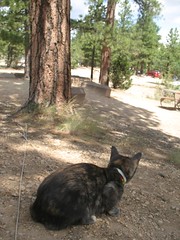
So now Dulci wears a harness, and we clip her to a 20 foot long leash every time she ventures out of the van. This slows her down hardly at all. She loves to prowl and explore. She chases lizards, birds, and insects. With great dignity, she does her personal business – as long as the ground is not too rocky. With a child, DrC, or Grandma Sue in tow, Dulci wanders our campgrounds, attempts to investigate the cars and tents of our fellow campers, and even takes an occasional detour up a hardy tree.
Walking a cat is nothing like walking a dog. For one thing, a dog enjoys the time you spend with him. Your cat pretends you don't exist. Generally, you can encourage a dog to head down a trail or path; Your cat simply heads out across country and assumes you will follow in her wake. Dogs pee on everything. Somehow a dog always has a bit of extra piss for that special bush of tree. A cat pees once, gets the entire smell business covered instantly, and then stalks away head and tail held high despite the indignity of the experience. When done walking, you can coax your dog back to camp with promises of “cookies.” Your cat is never done walking. Never. When she tires, she will twist her leash around a dozen branches and then hide under the prickliest object in the vicinity. Extracting her from the wilderness to put her back in the vehicle requires dexterity and the willingness to sacrifice several inches of skin. It is a thankless job, so we make the children do it.
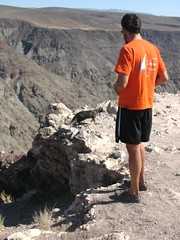
At road stops, DrC often walks the cat. Sometimes Dulci agrees to go potty. Sometimes she sits down in a shady spot and stares at him like he has taken complete leave of his senses. On one memorable stop at Hoover Dam, Dulci didn't like the heat and dove between, through, and under the rocks piled high by the side of the road. Quicker than I could stop her, she'd twined herself down into the boulders a good ten feet on her own personal, feline spelunking tour. It took me a half hour prone on the rocks in the blazing sun to coax, pull, yank, and plead for her to emerge. We both came out of the experience scratching, biting, and hissing.
All the rules regarding pets are about dogs. Pick up pet poo. Keep pet on six foot leash. Do not let pet make noise after 10PM. Don't let pet bark at the wild life. Ducli basically ignores the rules. She buries her poo six inches deep, sleeps after 10 pm, likes her leashes to be a minimum of 20 feet so she can successfully catch the wildlife, and would not bark if her life depended on it... though she does make an interesting mur-grr-chirp when hunting. She attracts comment and visitors wherever we go, though she allows no one to pet her. And each night she settles more or less resignedly into the van with Aeron and Mera safe from bears, coyotes, and stray chihauhaus.
Traveling with a cat on a leash turns out to be relatively easy. Just start young and prepare to be walked by your pet across hill, over dale, and through the shrubbery.
We started with an unleashed cat. This worked through Baja, across Arizona, and into New Mexico. However, at a KOA in Albuquerque, Dulcinea slipped out one night and over a gulch, managing to trap herself on the other side when the local water authority released flood waters upstream. For a horrible 24 hours, we thought she was gone forever. After hearing her plaintiff merows and sending the man of the house swimming across the muddy gulch to rescue her, the family resolved to leash Dulcinea forever more.
So now Dulci wears a harness, and we clip her to a 20 foot long leash every time she ventures out of the van. This slows her down hardly at all. She loves to prowl and explore. She chases lizards, birds, and insects. With great dignity, she does her personal business – as long as the ground is not too rocky. With a child, DrC, or Grandma Sue in tow, Dulci wanders our campgrounds, attempts to investigate the cars and tents of our fellow campers, and even takes an occasional detour up a hardy tree.
Walking a cat is nothing like walking a dog. For one thing, a dog enjoys the time you spend with him. Your cat pretends you don't exist. Generally, you can encourage a dog to head down a trail or path; Your cat simply heads out across country and assumes you will follow in her wake. Dogs pee on everything. Somehow a dog always has a bit of extra piss for that special bush of tree. A cat pees once, gets the entire smell business covered instantly, and then stalks away head and tail held high despite the indignity of the experience. When done walking, you can coax your dog back to camp with promises of “cookies.” Your cat is never done walking. Never. When she tires, she will twist her leash around a dozen branches and then hide under the prickliest object in the vicinity. Extracting her from the wilderness to put her back in the vehicle requires dexterity and the willingness to sacrifice several inches of skin. It is a thankless job, so we make the children do it.
At road stops, DrC often walks the cat. Sometimes Dulci agrees to go potty. Sometimes she sits down in a shady spot and stares at him like he has taken complete leave of his senses. On one memorable stop at Hoover Dam, Dulci didn't like the heat and dove between, through, and under the rocks piled high by the side of the road. Quicker than I could stop her, she'd twined herself down into the boulders a good ten feet on her own personal, feline spelunking tour. It took me a half hour prone on the rocks in the blazing sun to coax, pull, yank, and plead for her to emerge. We both came out of the experience scratching, biting, and hissing.
All the rules regarding pets are about dogs. Pick up pet poo. Keep pet on six foot leash. Do not let pet make noise after 10PM. Don't let pet bark at the wild life. Ducli basically ignores the rules. She buries her poo six inches deep, sleeps after 10 pm, likes her leashes to be a minimum of 20 feet so she can successfully catch the wildlife, and would not bark if her life depended on it... though she does make an interesting mur-grr-chirp when hunting. She attracts comment and visitors wherever we go, though she allows no one to pet her. And each night she settles more or less resignedly into the van with Aeron and Mera safe from bears, coyotes, and stray chihauhaus.
Traveling with a cat on a leash turns out to be relatively easy. Just start young and prepare to be walked by your pet across hill, over dale, and through the shrubbery.
Tuesday, June 16, 2009
Boat Cat Stories
“Oh wow! Check this out!!!” Jaime calls from below. There is a burring buzz, a thump, and peals of laughter.
The cat is at it again.
This time, I'd argue that the hubbub is the girls' fault. In Mera's endless efforts to make the Spy Game more entertaining, she created spy cameras out of yarn and paper and strung them in strategic positions around the boat. The cat just discovered one dangling mid-companion way in front of Mera's door about five feet off the ground. With the boat swaying in a southwest swell, Dulcinea has decided that the camera is a target of opportunity and is repeatedly leaping to try and catch it. This continues until the cat wises up and heads for the salon. This time she dives straight down, catching the “camera” en route, landing with a victorious thud and a triumphant growl seven feet below whereupon she shreds it in vicious glee.
I fought hard to keep a pet off the boat, arguing vigorously against adding yet another problem and more work to our boat lives. Pets require food, water, places to go potty, and care. They make a mess, and they cost money. It is a true pain in the ass to get them across many international borders. We do not need more hair on the boat.
I was wrong.
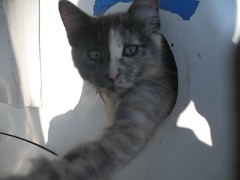
Dulcinea is friend, guardian, comfort toy, entertainment, and child. She adds tremendously to our lives on Don Quixote. She is a really good boat cat, loves to be underway, and appears to have no trouble with her rather constricted living space. When the sea or anchorage are rough, she digs into a confined space. When things are hot, she flops in the coolest places on the boat.
I asked the family for anecdotes of life with Dulcinea:
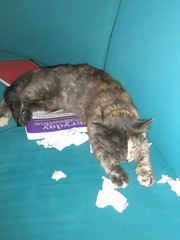
The Cat Ate My Homework – Dulcinea likes paper. She likes to shred paper, specifically. You can not leave a notebook or map lying around anywhere. On more than one occasion, the girls have finished a long science or history assignment, walked off to get a juice or use the head, and come back to find their schoolwork shredded beyond recognition. When it is necessary to tear up paper so that we can heave it overboard, we put it in a box and let kitty go to town.
Crazy Cat – The cat starts running, meowing, and twitching. First, she does two laps of the salon. Without pause, she tears out the cockpit, down the port side, and up onto the salon top. There are a series of pattering thuds and then silence. We all look up... waiting expectantly. “BAM!!” Jaime says what we're all thinking, “Dulcinea's trying to climb the mast again.” DrC concurs, “Yep. Crazy ass cat.”
Cat Overboard! – We're rafted up to Endless Summer. This is the first time we've rafted since Dulcinea joined us. Her nature and inclination is that anything tied to Don Quixote is, by definition, her territory. In La Cruz, that meant the entire A dock including all the boats and cruisers. In this case, Dulcinea starts the takeover of her extended domain by jumping on Endless Summer's port bow. Within a minute, however, she's back – every hair on her body extended straight out and a wild look in her eye. Suky, a lovely Dalmatian, comes bounding over to the rail and slips onto Don Quixote enjoying the new game. With a slip and a yowl, Dulcinea sidesteps gracelessly into the gap between the boats. A half second later we hear a splash and everyone scrambles to the edge to see if she's okay. Disoriented, Dulcinea first heads towards the bows but soon realizes her error and turns around. “Wow, she's a really strong swimmer,” Steve notes. The cat is moving so fast it doesn't occur to any of us to try to get her. By the time DrC moves to the transom, Dulcinea flings herself out of the water and tears into the salon. I shudder. “Goddamnit...” I have no doubt whatsoever, Dulci is now hiding in my bed covers, the most supremely cold, wet, and pissed off cat in a 100 miles. It'll be hours before we get her rinsed in fresh water and dried out. And in the meantime, she'll manage to soak every bed and seat on the boat.
Tuna, Tuna! – “27 seconds!” Aeron calls out. It's a new Don Quixote record. That's 27 seconds from the time I crack open the can of tuna to the moment Dulcinea runs into the salon and meows for her portion. Dulcinea is not crazy about beef or chicken. She's a mad cat for sea food. Boat cat.
Kitty Headlights – “Shine the light to the left,” DrC asks Mera who is sitting on the bow. We have several ways to find our boat at night in a dark anchorage. The corners of the boat have solar sidewalk lights which glow a faint orange. We use a kludgy, very bright 12 volt incandescent bulb which we clip to the boom every night. In addition, DrC put strips of reflective tape on the edges of the deck and at key places up the mast. The tape shines a bright silver when you point a flashlight anywhere towards our boat. Finally, we have Dulcinea.
As we approach the back of the boat, Dulcinea runs down the transom to greet us. “Kitty kitty kitty!” everyone starts to call. Mera exclaims, “Kitty headlights!” And there they are. We know it's Don Quixote, because there are two stripes of silver and then on the right, shining back at us a diamond white light, are the twin beams of the flashlight reflecting in Dulcinea's eyes.
We hear a plaintive mrrreeow as our boat cat starts bitching about the reduced state of her food dish. A cat makes a home, and we're home.
The cat is at it again.
This time, I'd argue that the hubbub is the girls' fault. In Mera's endless efforts to make the Spy Game more entertaining, she created spy cameras out of yarn and paper and strung them in strategic positions around the boat. The cat just discovered one dangling mid-companion way in front of Mera's door about five feet off the ground. With the boat swaying in a southwest swell, Dulcinea has decided that the camera is a target of opportunity and is repeatedly leaping to try and catch it. This continues until the cat wises up and heads for the salon. This time she dives straight down, catching the “camera” en route, landing with a victorious thud and a triumphant growl seven feet below whereupon she shreds it in vicious glee.
I fought hard to keep a pet off the boat, arguing vigorously against adding yet another problem and more work to our boat lives. Pets require food, water, places to go potty, and care. They make a mess, and they cost money. It is a true pain in the ass to get them across many international borders. We do not need more hair on the boat.
I was wrong.
Dulcinea is friend, guardian, comfort toy, entertainment, and child. She adds tremendously to our lives on Don Quixote. She is a really good boat cat, loves to be underway, and appears to have no trouble with her rather constricted living space. When the sea or anchorage are rough, she digs into a confined space. When things are hot, she flops in the coolest places on the boat.
I asked the family for anecdotes of life with Dulcinea:
The Cat Ate My Homework – Dulcinea likes paper. She likes to shred paper, specifically. You can not leave a notebook or map lying around anywhere. On more than one occasion, the girls have finished a long science or history assignment, walked off to get a juice or use the head, and come back to find their schoolwork shredded beyond recognition. When it is necessary to tear up paper so that we can heave it overboard, we put it in a box and let kitty go to town.
Crazy Cat – The cat starts running, meowing, and twitching. First, she does two laps of the salon. Without pause, she tears out the cockpit, down the port side, and up onto the salon top. There are a series of pattering thuds and then silence. We all look up... waiting expectantly. “BAM!!” Jaime says what we're all thinking, “Dulcinea's trying to climb the mast again.” DrC concurs, “Yep. Crazy ass cat.”
Cat Overboard! – We're rafted up to Endless Summer. This is the first time we've rafted since Dulcinea joined us. Her nature and inclination is that anything tied to Don Quixote is, by definition, her territory. In La Cruz, that meant the entire A dock including all the boats and cruisers. In this case, Dulcinea starts the takeover of her extended domain by jumping on Endless Summer's port bow. Within a minute, however, she's back – every hair on her body extended straight out and a wild look in her eye. Suky, a lovely Dalmatian, comes bounding over to the rail and slips onto Don Quixote enjoying the new game. With a slip and a yowl, Dulcinea sidesteps gracelessly into the gap between the boats. A half second later we hear a splash and everyone scrambles to the edge to see if she's okay. Disoriented, Dulcinea first heads towards the bows but soon realizes her error and turns around. “Wow, she's a really strong swimmer,” Steve notes. The cat is moving so fast it doesn't occur to any of us to try to get her. By the time DrC moves to the transom, Dulcinea flings herself out of the water and tears into the salon. I shudder. “Goddamnit...” I have no doubt whatsoever, Dulci is now hiding in my bed covers, the most supremely cold, wet, and pissed off cat in a 100 miles. It'll be hours before we get her rinsed in fresh water and dried out. And in the meantime, she'll manage to soak every bed and seat on the boat.
Tuna, Tuna! – “27 seconds!” Aeron calls out. It's a new Don Quixote record. That's 27 seconds from the time I crack open the can of tuna to the moment Dulcinea runs into the salon and meows for her portion. Dulcinea is not crazy about beef or chicken. She's a mad cat for sea food. Boat cat.
Kitty Headlights – “Shine the light to the left,” DrC asks Mera who is sitting on the bow. We have several ways to find our boat at night in a dark anchorage. The corners of the boat have solar sidewalk lights which glow a faint orange. We use a kludgy, very bright 12 volt incandescent bulb which we clip to the boom every night. In addition, DrC put strips of reflective tape on the edges of the deck and at key places up the mast. The tape shines a bright silver when you point a flashlight anywhere towards our boat. Finally, we have Dulcinea.
As we approach the back of the boat, Dulcinea runs down the transom to greet us. “Kitty kitty kitty!” everyone starts to call. Mera exclaims, “Kitty headlights!” And there they are. We know it's Don Quixote, because there are two stripes of silver and then on the right, shining back at us a diamond white light, are the twin beams of the flashlight reflecting in Dulcinea's eyes.
We hear a plaintive mrrreeow as our boat cat starts bitching about the reduced state of her food dish. A cat makes a home, and we're home.
Subscribe to:
Posts (Atom)