Showing posts with label Coconut Milk Run. Show all posts

Friday, December 03, 2010

Registering for International Service and Rescue

SSB Station
SSB Station
Originally uploaded by toastfloats.
UPDATE 7/12/2010: Incorporate comments from readers.
Virtually every country on the globe with navigable waterways has a maritime search and rescue service of some sort. Larger nations with highly capable navies and marine services offer considerable protection and support to the vessels traveling in and near their waters. An important part of preparing yourself for cruising is to enable your vessel to communicate automatically to these services, particularly in emergency situations.

First, a few acronyms and definitions:

Digital Selective Calling (DSC) – A designation under the GMDSS “primarily intended to initiate ship-to-ship, ship-to-shore and shore-to-ship radiotelephone and MF/HF radiotelex calls. DSC calls can also be made to individual stations, groups of stations, or "all stations" in one's radio range.”[1]

Federal Communications Commission (FCC) – The United States federal agency responsible for registering and maintaining radio communication licenses.

FCC Registration Number (FRN) – A unique number used by the FCC to identify license holders. This abbreviation is used synonmously as the username on the FCC web site. The idea is that a single FRN can be used to register multiple radio operators and devices. If you already have a HAM and/or operator license, you probably were prompted to register with the FCC. At that time, you would have been assigned an FRN. If not, the first step is to go to register on the FCC web site and obtain an FRN.

Global Maritime Distress Safety System (GMDSS) -- “An internationally agreed-upon set of safety procedures, types of equipment, and communication protocols used to increase safety and make it easier to rescue distressed ships, boats and aircraft.”[2] While small craft are not required to maintain radio equipment capable of participating in the GMDSS, it is a very good idea to do so anyway. Most SSB radios include DSC capacity which enables them to participate in the GMDSS.

Maritime Mobile Service Identity (MMSI) – “A series of nine digits which are sent in digital form over a radio frequency channel in order to uniquely identify ship stations, ship earth stations, coast stations, coast earth stations, and group calls.”[3] For US flagged vessels, you can register with a third-party such as BoatUS for an MMSI valid for coastal waters in the United States. However, you must register with the FCC when taking your vessel outside U.S. waters.

SA – When you register a wireless device with the FCC, you must select a radio service type. An SSB radio on a recreational vessel is considered a Maritime Mobile device of the category “SA – Ship Recreational or Voluntarily Equipped”. According to the FCC “Smaller ships used for recreation (e.g., sailing, diving, sport fishing, fishing, water skiing) are not required to have radio stations installed but they may be so equipped by choice. These ships are known as "voluntary ships" because they are not required by treaty or statute to carry a radio but voluntarily fit some of the same equipment used by compulsory ships.”[4]

Universal Licensing System (ULS) – An online tool maintained by the FCC for the purpose of using “any PC with Internet access to research, manage, renew, and pay any applicable fees for your wireless licenses through a password-protected account.”[5] The FCC site is, to be blunt, very poorly organized. Use this link to go directly to the ULS home page. Typical of most cruisers, Don Quixote's ULS account includes: the captain's radio operator license, our HAM and SSB call signs, and our international MMSI.

The two principle methods used by cruisers to communicate distress automatically are an EPIRB and the emergency signal issued by an SSB radio. An Emergency Position-Indicating Radio Beacon (EPIRB) is a dedicated device which broadcasts a maritime distress signal. As of February 1, 2009, all EPIRBs carried by U.S. flagged vessels must transmit at 406 MHz, as satellites no longer receive transmissions at 121.5 MHz. BoatUS provides an excellent guide to how an EPIRB functions. A single side band (SSB) radio can transmit a digital signal call. Both of categories of device communicate with the Cospas-Sarsat satellite monitoring system. The system is monitored both domestically and internationally by maritime rescue services.

To take full advantage of publicly available search and rescue services, you must register your emergency beacon and obtain an MMSI. EPIRB and SSBs broadcast a the MMSI to the satellite monitoring system. Since in an emergency, you might not be able to follow up these signals with a call to explain who you are, how many passengers are on your vessel, and what you look like on the water, you must register your devices in advance with this information. In many countries, you can register your device domestically for free. If you plan to spend a long period of time in a single country, it is a good idea to do the research to identify and register with these agencies. For example, in the U.S. you can register your beacon with BoatUS. In New Zealand, you can't register a U.S. device, but you can contact them and they will “keep an eye open” for your beacon. The agency is the Rescue Coordination Centre New Zealand (RCCNZ). I envision this as “a guy” with a stack of email messages next to a radio receiver. It sounds ricky ticky, but the RCCNZ is reknowned for saving people and boats; So however they do it, the system works.

Mera Monitoring the Net
Originally uploaded by toastfloats.
Unfortunately, registering with individual countries does not provide you with comprehensive, global coverage. Vessels which travel in international waters must also contact their domestic communications agency to register for an international MMSI number. Obtaining an international MMSI number ensures that your vessel is included in the International Search and Rescue database. The theory is that this database is maintained throughout the world. If you happen to have an emergency in the Tasmin Sea, both Australia and New Zealand will be able to know from your EPIRB or SSB signal the name and size of your vessel, your emergency land-based contacts, your emergency equipment, and the number of passengers routinely onboard.
The process of registering your emergency devices is fraught with the usual challenges and frustrations associated with government agencies. Everything that follows from this point applies to U.S. flagged vessels only. Readers with vessels flagged in other countries must do the research for their domestic requirements.

Steps to Register Your Emergency Beacon

1. Gather the following:
- FRN username and password – If you do not already have one, go to the ULS home page and register.
- Credit card
- EPIRB identification number – This number can be found on the side of an EPRIB device.
- A computer with a connection to the Internet and either Internet Explorer or Firefox web browser

2. Browse to the ULS home page and log in with your FRN and password.

3. Apply for a new license. As of the time of this writing, the link to apply for a new license is found in the left column.

4. Complete the form as prompted. Note that your vessel is a category SA radio service, you do not already have an MMSI (even if you've registered for a free one with a local service such as BoatUS or RCCNZ). The objective is to associate a new MMSI with your existing EPIRB and ensure that it is registered in the International Search and Rescue database.

5. Pay for the application. As of November 2010, the fee for registration is $160USD.

6. Monitor the ULS until your application is approved. Then print the resulting license. This process can take 10 days to 3 weeks. In our case, it took two weeks.

[1]"Global Maritime Distress Safety System: DSC." Wikipedia, the Free Encyclopedia. Wikipedia Foundation, Inc. Web. 17 Nov. 2010.
[2]"Global Maritime Distress Safety System." Wikipedia, the Free Encyclopedia. Wikipedia Foundation, Inc. Web. 17 Nov. 2010.
[3]"Maritime Mobile Service Identity." Wikipedia, the Free Encyclopedia. Wikipedia Foundation, Inc. Web. 17 Nov. 2010. .
[4]"FCC: Wireless Services: Ship Radio Stations: About." FCC: Wireless Telecommunications Bureau. Web. 17 Nov. 2010. .
[5]"FCC Universal Licensing System (ULS): About ULS: Getting Started." FCC: Wireless Telecommunications Bureau. Web. 17 Nov. 2010. .

Tuesday, November 30, 2010

It Gets Boring

No, I'm Border
No, I'm Border
Originally uploaded by toastfloats.
Research research research. Write write write. As the post on ditch kits a week ago ably demonstrated, our focus is narrowing down on preparing for the Puddle Jump. I can not stress strongly enough to my non-cruising friends and family how very much DrC and I are aware that we are "taking it to the next level." It's a big ocean. Some bits of the trip are ugly. We get it.

We really really get it. So much so that we've doing some pretty heavy research on topics we've largely been able to fudge in the past when we were traveling along the coast line. Granted, certain planning myopia was just stupid (e.g. pathetic ditch kits), but a lot of it was simply unnecessary. For example, why worry about climbing the mast to keep a reef and coral head watch when there are neither reefs nor coral heads?

The results of our research are interesting to another set of the readership of this blog, our fellow cruisers. Many of them are providing the raw data that inform my posts while others are preparing for their own cruises. A very special few are getting ready to Puddle Jump with us next year and will no doubt be reassured that Don Quixote is planning on taking care of herself. Mostly.

So anticipate the periodic posting of incredibly dull articles. The next one in the queue, for example, is on the exciting topic of registering beacons for international search and rescue services. Try not to fall asleep... or better just delete it in bound. I'll tag all these as "Coconut Milk Run" and "techtip" if you want to do some agressive filtering.

Cruisers, all of these technical articles BEG for your input. I may Write Confident (which is somehow analogous to the infamous "Fly Casual"), but DrC and I are fully aware we are missing bits. We received some very useful input on the ditch kit post. Keep the outstanding information coming! We need it, we appreciate it.

Sunday, November 21, 2010

Preparing for Disaster

Captain Potential
Captain Potential
Originally uploaded by toastfloats.
“Opinions are like -holes; Everyone has one. Unfortunately, not so true of ditch kits.” – Toast in a really bad mood after reading a million and one forum entries on the subject

If you are like most cruising sailors, you've made a completely half-assed job of putting together a ditch kit. I believe that the reason most of us do not have really good, well thought out ditch bags is that we are in a collective state of denial. After all, you are not going to need it. Like making a will, a ditch kit acknowledges mortality, puts straight in your face the depressing fact that life is fleeting and boats are friable.

And I confess, while we travelled the coasts of Canada, the United States, and Mexico, our ditch kit was pathetic. Oh we had one... at least we weren't that bad. However, it is true that the kit was neither well thought out nor was it particularly accessible. Had we needed to abandon ship, it is not clear to me that anything about that kit would have saved our lives. We also suffer from the fact-based, catamaran delusion that our boat won't sink. Another interesting trade off in the monohull/multihull debate is that catamarans are considerably less likely to sink to the bottom of the ocean. Most have positive flotation and are even more stable upside-down than right-side up. The situations in which it makes sense to abandon a catamaran rather than just attach yourself to it and ride out whatever broke the boat in the first place are limited to two: your vessel interacts with something super hard that breaks the entire thing into its constituent parts (e.g. a reef or cargo container) or the boat is on fire.

But those two catastrophes can and do happen to catamarans just as they do to multihulls, and it is a foolish crew who does not prepare for the ditch scenario. Even coastal cruisers are not safe from the need to have an emergency ditch plan. Witness the terrible events of the Baja Ha Ha 2009 during which a boat literally swept down the front of a wave and landed on a whale. The whale didn't like it, and the boat sank 5 minutes later. Sank. No more boat. Really. SANK.

This time, the crew of Don Quixote plans to go out with a well-thought out, easily accessible ditch kit and an emergency plan. There is the “abandon ship” option, and there is the far more likely “foundered and/or upside-down” option. We need to have equipment, survival gear, and communications systems figured out in advance. Over the years, we have individually read many accounts of emergency situations and preparedness plans. We have all sorts of ideas. I also made a foray on the Internet to see what the hive mind recommends. Two hours later, my head hurts, my stomach is growling, and I feel considerably less informed than when I started.

One quote that really made me think I found on Boatsafe.com: “While it may come as a surprise to some, by now most boaters realize that the survival equipment stocked in most life rafts, even rafts designed to meet SOLAS requirements, is often inadequate, sometimes woefully so. In many cases not only is the selection and quantity a problem, but the quality of the equipment and supplies is also less than desirable.” Wonderful. So right out of the gate, let us assume that we all need to build a survival bag, even if the boat is equipped with a “fully stocked” life raft. Also, there is duplication between what goes in a ditch kit, and equipment you need to have on the boat ready for regular use. For example, you need to have a handheld VHF and life jackets... but you use these all the time. Part of the “ditch kit” strategy needs to be a plan to gather these disparate bits and get them off the vessel with the crew.

Before I launch into the specifics, my personal editorial team for practical posts like this of s/v Totem and s/v Third Day came back with some questions I'd like to preemptively address:

Are you going to have a life raft or use your dingy as a life raft?”

This is going to probably generate angst, anger, and F.U.D. We are not going with a life raft. I don't think I've ever said this about a blog entry before but... please don't comment on this particular choice (all other comments still welcome!). You'll stir a raging debate that is likely to spiral downward quickly and irrevocably. All I am going to say is that we came to this decision not for financial reasons. Mr. Salty of s/v Totem reminded us to get our survival suits in order. I like to think we would have thought of that eventually, but full credit to our far more experienced friend for getting us moving early on the issue.

“Why would you even bother with a ditch kit if you don't have a life raft? Is it that much more helpful when you're sitting on an upside down hull?”

Yes, it is that much more helpful if you are upside down. In a turtle situation, everything you own is upside down, tossed like hell's breakfast, and mostly in water destroyed – particularly food stores and fresh water. However, if you have a ditch kit, you have all your emergency gear in a single place (accessible from either the topside or when inverted), it is in a dry bag, and it can be taken as a unit outside the boat if you plan to shelter between the hulls on the trampoline for all or part of the time.

As usual, the place that had the best, cleanest, and easiest to understand list was found on Wikipedia. From this and reading a dog-awful number of bickering forum posts, we've decided on the following:

Dedicated Kit – We will prepare a large dry bag with the following dedicated items. This kit will be stored either in the helm locker or in the aft, moulded inset between the transoms. Both areas are highly accessible when the boat is overturned or from a floating craft next to the boat. What goes in the dedicated kit:
- Survival suits
- Small emergency medical kit
- Compass
- Flares, mirror, and smoke signal
- Solar powered AM/FM radio
- Emergency high-calorie rations and/or hard bread
- Fishing kit
- Rainwater collection equipment
- Seawater desalination kit
- Water
- Hatchet and knife
- Waterproof flashlight
- Heaving line
- Rope ladder
- Small sea anchor
- Bailer
- Manual bilge pump
- Bucket
- Water proof matches
- Marine whistle
- Zinc oxide
- Tarp
- Deck of cards
- Paper and water proof pencil (log book)
- Copies of passports, visas, and boat paperwork
- Secondary credit card (the one we don't normally use but is a valid account)

Stored at Navigation Station/Helm – The items that must come with us if we ditch that we use regularly are going to be stored at the helm, in the helm locker or at the navigation table.
- Life jackets
- EPIRB
- SPOT personal messenger (Yes, I know it doesn't work in the middle of the Pacific.)
- Flares
- Solar powered lantern (We use this as a boom, anchor-light. If you don't, put it in the dedicated kit).
- VHF handheld
- GPS handheld
- Boat hook
- Celestial navigation equipment
- 2 5-gallon water jugs
- Doctor's medical bag

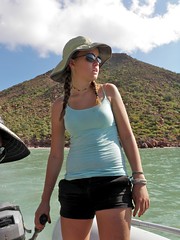
Emergency Plan – We have been very successful training the Don Quixote crew on emergency roles. Depending on the type of emergency, each person has a specific series of tasks. If someone is unavailable for their assignment, we know who is to take their place. For example, when there is a Man Overboard, Aeron's responsibility is to stand on the deck and point to the victim, never ever taking her eyes off the victim. She might be the only reason we are able to back track and find someone who has gone overboard. If she -is- the victim or otherwise unavailable, Mera takes her place... and so on. We will develop “Abandon Ship” and “Pitch Poled” assignments and responsibilities and then regularly drill the crew as we have historically done for MOB, fire, and navigational hazard emergencies.

From the Bottom Up
From the Bottom Up
Originally uploaded by toastfloats.
Lamintated Checklists – From s/v Capaz, we learned of the wonders of lamination. They make checklists, inventories, and radio scripts, laminate these instruction cards and place them near the radio and in emergency kits. This is brilliant and deserves an entire, well thought out article of its own that I'll tackle next week. For now, it's just on my list to review the Capaz list, update for Don Quixote needs, and include in the ditch kit(s).

Ditch Kits Plural – Another by-product of research was the notion of individual kits. These are small dry bags with individual water and food, emergency gear, and personal items. The hall mark of several survival accounts I've read is an individual escaping a sinking vessel where other crew and the principle ditch kit and/or life raft is lost, but the individual had their own, much smaller bag of gear which prove instrumental in their own survival.

* * *

Additions, suggestions, and deletions welcome! What do you have in your ditch kit?

Tuesday, October 26, 2010

Here's the Pitch

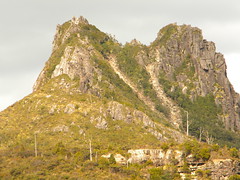
The Peaks We Didn't Climb
Originally uploaded by toastfloats.
I slam the book down on the table, frustrated beyond measure. "This is no good. I can't figure out what the hell they mean."

DrC mumbles something supportive but wholly incoherent.

There is the sound of stataco typing as I bang away at the laptop for a few minutes punctuated periodically by, "Yes... yes!... YES!!!"

Now DrC looks up. In retrospect, I suppose my vocalizations were suspiciously similar to something more interesting to DrC than immigration regulations. "You okay?"

I nod vigoursly and start copying and pasting like a mad fiend. "Two '10 jumpers blogged it."

DrC's eyes narrow as he parses this out, "Two of the boats puddle jumping this year wrote about the immigration requirements in their blogs."

"Uh huh."

"But how do you know it's true?" he asks.

This stops me absolutely cold. After 20 years, there are few moments in which I feel that my husband and I are not in sync. Even rarer are there times where I feel the man is living on a completley different plant. And now, here in this little kitchen in suburban New Zealand, existence shimmers like a Scobby retrospective into two distinctive planes of existence. In one, research is conducted in libraries and with government agencies. Academics and intellectuals ponder the evidence, write their results, and dispense their knowledge in academic journals and printed books.

And then there is where I live.

In the world I live in, the wisdom of the crowds is almost inevitably better than the research of any individual. This is the world of Wikipedia, Yelp, Facebook, Digg, slash dot and Twitter. This is a place where when I want a Word template for product planning, I can simply ask the hivemind, and four arrive within the hour in my inbox. Now that doesn't mean the crowd is always right. The crowd can make monumental errors; lolcats comes to mind. It also doesn't mean that you should take as writ that everything you read on Wikipedia is correct. It's not. We all know that. However, I'd take a Wiki entry over most static books as a starting point. Start poking the referenced resources at the bottom of the entry, and now you're getting to some serious solid research.

I'd also take a blog entry from a fellow cruiser over a 10 year old cruising guide. Every time.

It's not the author's fault. I find the whole concept of cruising guide authorship challenging at best. Even if the area about which you are writing is your favorite haunting ground, there is no practical way to visit each marina and anchorage every year to update the book. For parts of the world that are practical to visit only as a way point on a much longer, non-replicable journey, such as crossing the South Pacific or transiting the Panama Canal, there is no way at all that the author can maintain the accuracy of the content. Sure, the charts may stay essentially the same. Information about the facilities, paperwork, or local ameneties are too fluid to maintain.

This is why I have been monitoring with such glee the introduction of tools such as Active Captain and Wikitravel. I really want these efforts to succeed. There are, however, two problems with these resources:

* South Pacific - So far, no one has really started contributing to the South Pacific part of the map. Since this is where we are going, I feel like we're stuffed.

* Portability - Neither company/project has come up with a way to copy the entire database down to a local laptop, let alone print the relevant bits. Cruisers halfway across the Pacific have lousy Internet access.

So here I am, pouring over the three "must have" cruising guides for our Puddle Jump, and at least once every 10 minutes I slam them down on the table and retreat to Google. And when I can't get my question answered by the experts, I find that Quest or Tenaya or Ken and Cathy answered it. Browsing the blogs of this year's jumpers, I'm able to answer even the most changeable, challenging questions. All it requires is hours and hours of browsing, reading, trolling, and googling. And a constant connection to the Internet.

"What the hell are we going to do when we get there? No Internet." I've leaped past explaining to my husband his ludditic handicap; Twenty years has at least taught me that much.

"Write a book."

Recursive Photo Editing
Originally uploaded by toastfloats.
I do not groan when he says this. It is stupid and the trees are weeping, but I do not groan. I just point out that, "It, too, will be obsolete the instant I write it."

And at that moment, my lover redeems himself and proves why I used his genetic code to make the girls, "Well, put it online. Give it to next year's folks to maintain."

Wow. That could work. I could crowd source it. I could make it interactive. It could have a user forum and downloadable pages and people could print it using an on demand printer if I put into a PDF format and I could add links and there would be amazon affiliate links and a twitter feed and a faceboscr.a.bajkafd.cvja....*cough*

So rather than do anything useful for the rest of the day, I do what every good social media wonk does, I go buy the domain.