Showing posts with label maintenance. Show all posts

Saturday, January 12, 2013

His, Hers, and Theirs

I am holding in my hands the Jabsco replacement kit for our toilet -- which in the nautical world we call a 'head'. The story of how yachties came to call the crapper a head is just gross. Let's not go into it today. The kit looks nothing like a toilet or even parts of a toilet. It actually appears that a dog ate a box of Legos seasoned with a bicycle tire and vomited them back up again. Fortunately, it comes with a sheet of instructions.

I believe firmly in the principle of RTFM (read the f*ing manual). For many years, I wrote manuals for a living. I figure I have a vested interest in devoting at least a modicum of my time to ensuring the gainful employment of my professional peers. However, I immediately note something missing in the user guide for the Jabsco.

"I don't see where in this little booklet it says, 'Make your wife do it'", I inform my husband and captain.

DrC glances up from his latest multi-millionaire dollar investment in Nigel Calder's editorial future and reminds me, "You did say we should divide up responsibility for the systems on the boat, Toast. You agreed plumbing would be yours."

"Yeah," I protest, "but I meant the sink, the water pumps, maybe the bilges..." I trail off weakly as really there is no getting around the salient point. The toilet is the very definition of plumbing. Muttering darkly, I spend the next hour more or less covering myself, the port head, and every tool we own in shit. Literally.

And so we learn our jobs on the boat.

While Don Quixote has a very firm policy of cross-training, it is also true that virtually all jobs fall into three categories: his, hers, and theirs. This division of labour evolved over time and not without a few rather heated discussions. And despite other more forward thinking and 21st century cruisers on the Raft Up rolls and our family's otherwise liberal to point of absurdity politics, the truth is that Don Quixote assignments have a misogynist, old school feel with the macho tasks firmly in my husband's grasp while I tackle the girly chores.

On the the hand, the boating world is an arduous and oft-times unforgiving one. It makes sense to split tasks in the most efficient way policy. In other words, sometimes you need a guy to man-hand something. Sometimes you need a gal to finesse it. And it is always easier to have the person work on a system who has a talent, an interest or a personal vested investment in its success or failure.

DrC is essentially all things mechanical; He supplies water, power, and motion to the boat. I am all things organisational; I do the navigation, provisioning, and scheduling. He makes sure things work; I make sure we have all the right things. The girls keep all the things clean. To be fair, they also get all the things dirty in the first place.

But there are notable exceptions. As mentioned, I do the plumbing. I also seem to gradually be taking over the lighting for reasons that escapes me. We negotiate the weather, routing, and overall itinerary. I am SSB and radio-girl, finances, insurance and visas. DrC is rigging, haul out, and diesel maintenance. We all haul stuff, wash stuff, rig stuff, and move stuff. We squeeze and pull and scrub and polish stuff. The kids never got paid a dime until we landed in New Zealand. Now we pay them to do major maintenance tasks that we would otherwise hire someone to complete, such as end-to-end wax job or revarnishing the salon wood.

Technically, there is another category of work: expensive guy jobs. The expensive guy really needs to visit our boat. Maintenance takes you only so far. At some point, he, she and they can't fix it. Someone with special skills, magic hands, and a box of insanely pricey technical toys must come make a new one. A better one.

So as I stand in front of the starboard head with a second Jabsco maintenance kit in my hand, I can't help but ask DrC plaintively, "Are you sure there isn't such a thing as a boat plumber guy?"


 * * * * * * * * * * * * * * * * * * * * * *

January's Raft-Up Writers

The topic this month is allocation of labour. We all have different strategies to divvy up chores, responsibilities, and worries. If you haven't already subscribed to these authors, I encourage you to explore the excellent writing my fellows in Raft-Up:

4 Stacey http://sv-bellavita.blogspot.com
5 Steph www.sailblogs.com/member/nornabiron
7 Behan sv-totem.blogspot.com
8 Diane www.maiaaboard.blogspot.com
9 Jessica http://myfelicity.blogspot.com
10 Lynn sailcelebration.blogspot.com
11 Verena pacificsailors.com
12 Toast http://blog.toastfloats.com
14 Ean morejoyeverywhere.com
15 Dana svnorthfork.blogspot.com

Sunday, August 12, 2012

Raft-Up: Laundry Day on Don Quixote

by toastfloats
White Trash Boating
by toastfloats

"It's not that I don't love them," I muse while shifting roughly a million pounds of stinking, moldy, food encrusted clothing from the hulls into the cockpit. "It's that I would love them more if they did the laundry."

My husband apparently agrees, "They're old enough. Make them."

I am properly incredulous, "Make them." Make them. Wow. That's simple. Make three girls aged 9, 12, and 14, do something smelly, tedious, and hard. Okay. 

"You make them."

Proving that my daughters are not the only children on the boat, "No, you make them." 

I glare at my husband, hands on hip. "I cooked, I cleaned out the refrigerator, AND…" and here is the triumphal feather in my cap, "I rebuilt the starboard head." Firmly and without any hesitation, I consign DrC to hell, "You Make Them." And with that, I metaphorically wash my hands of the dish towels, panties, and shorts and head below to play World of Goo. 

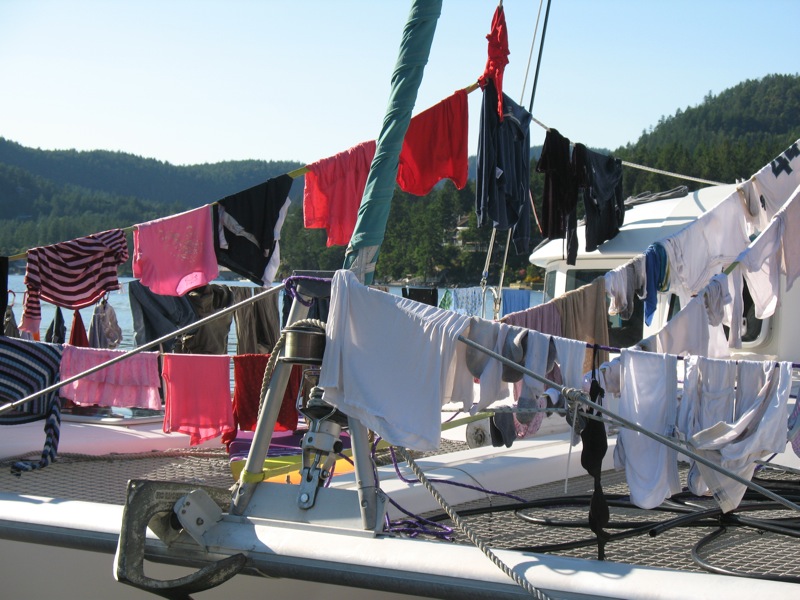
The problem with laundry on a boat is that it's hard. It's laundry without a net. Actually, it's laundry without a washing machine, a dryer, or good quality, environmentally friendly soap. In fact, it's laundry without water since we start with nothing but salt water, a cranky water maker, and an attitude. The problem with laundry on our boat is that we have a lot of it.

I know people who put washing machines on their cruising sail boats. We call them weekenders. Real cruisers use their washing machines to store foulies or mangos or a replacement halyard. The chandleries sell little jokes called washing tumblers which are both too small and waste far too much water to provide a practical solution to the mountains of filthy clothing produced by three active girls and a pirate. 

I, of course, am laundry-less. While cruising, I live in an pair of hi-tech REI shorts (panties built in) and a sports bra, both of which I can wash with a bit of dish soap in a coffee mug and dry by waving them at my husband in a tauntingly sexy fashion. I don't believe there is such a thing as a boat under 100 feet  with a clothes drier. This is, of course, why safety lines were invented. It sure as hell wasn't to prevent you or your expensive boat gear from falling off the boat as we have repeatedly proven.

So. Washing on Don Quixote is an all day affair… at least. Sometimes several days. We pull out several gargantuan plastic buckets. Normal folk in the Real World buy these at WalMart to store things that they don't want but are afraid to throw away. They accumulate like drier lint in the back of closets and in garages and in attics. We fill the buckets about half full of water and a toxic Mexican laundry soap, then jam in every item of clothing we own, an indeterminant number of towels and several pillow cases. 

Then we wait. There is a theory amongst the DQ clan that if we wait long enough, the laundry will wash itself. Sometimes, this works… as in the time that the laundry was taken over by a desperate colony of thirsty bees who sucked the water out. Then there was the time it sat long enough that the smell made us dump the entire lot into the ocean rather than touch it to retrieve our belongings. 

However, mostly, the wait is for an hour or two and then the hard slogging work begins. Using a toilet bowl plunger or bare feet, we stomp the dirt out. It's like making wine the old fashioned way but without the production of palatable beverages. Then in three-man teams, we wring the sludge out using our hand crank Dynajet wringer. Load up some fresh water, repeat the stomp, repeat the wring. And again. And sometimes again because let's face it… we're filthy. 

Drying involves clipping a carabiner to each and every item of clothing. We used to use clothes pins but a 25 knot breeze one evening reduced our underwear stock by roughly 70% and took out my only push-up bra so now we clip everything to the lines in a fashion that would withstand a hurricane. Several hours later, we pull the fresh, hand-washed, line-dried linens off the halyards and sheets, completely faded of all color and with the elastic blown to hell but with the bright smell of chemical lavender.

Laundry Girls
by toastfloats
Only a short while passes while I take on the challenge of moving little balls of electronic, physics challenged goo from one location to another on my laptop, but no sounds of war upstairs is promising. DrC pops his head down into the cabin, and says, "Let's move the boat. We'll go to Bahia El Coyote."

My eyebrows go up, "What about the laundry?"

The pirate smile starts to creep through his beard, eyes dancing he says, "I had an idea." 

Twenty minutes later, we are steaming very slowly south to a new bay. Behind us, the dinghy is full of water, laundry, soap, and children, the mix gently agitating in our steady, bouncy wake. Sitting at the helm while my grinning husband drinks a beer at my side as the girls scream with laughter, I admit, "You're brilliant, you know."

Monday, March 07, 2011

Investing in a Future

Daddy is Home
Daddy is Home
Originally uploaded by toastfloats.
DrC calls it deferred maintenance. I call it B.O.A.T. days. We keep buying stuff. We keep fixing things. Spending money is becoming a way of life. I really want this phase of preparing for the Puddle Jump to be over. The combination of no income, downward spiraling economies, and repeated hot exposure of our credit cards to merchants all over La Paz is causing me to lose sleep and burn holes in my stomach.

My good friend Behan (s/v Totem) reassures us that this is a temporary phenomena and must be done to keep us safe and happy. I know she is right… and I know this at both the intellectual, objective level as well as the instinctive twitchy level. When I was a whipper snapper n00b five years ago and almost divorced my husband on the spot when he spent an insane amount on our windlass, I was in error. Yelling about all the purchases of books, parts, oils, and tools over the year was a mistake. The Toast of today preparing for the jump does not complain to DrC while paying the Visa, Defender, West Marine, Moore Medical, and Gallery Marine bills. All of these decisions are the correct ones.

Buy the immersion suits.
Haul and paint the boat and replace the sail drive seals.
Get the third reefing points added to the main.
Replace the 200' of G40 chain with new chain, not used. Keep only the best 100' of the old chain for the stern hook.
Get the second computer, the GPS units both USP and handheld, the extra paper charts, and the backup radio units.
Load nearly 6 months worth of staple goods and household supplies, deferring only the purchase of fresh items for the crossing.
Add diesel and water capacity to the boat and get a replacement throttle head for the outboard.
Pay the stainless steel guys to build the frame for the wind generator and buy that second pair of blades from Maitairoa.

I do not regret any single purchase. However, collectively we are spending more in six weeks than we did in the prior six months. We are spending more specifically on Don Quixote than we have in five years… which is probably why DrC is correct; Many of the additions, changes and fixes are simply deferred maintenance on a cruising sail boat. Other major purchases are specifically and solely for disaster mitigation and recovery which -- I admit it here publicly -- we should have undertaken prior to leaving Elliot Bay in Seattle. Mea culpa.

On the the hand, I read the news and listen to the Morning Talk here in La Paz and recognize a simple truth: the Zombie Apocalypse started years ago. I don't know why DrC and I thought we were preparing for its coming when in reality it started long ago. Like a frog slowly being brought to a boil, we weren't paying enough attention to get out of the pot before getting hurt. Now, however, I go online to transfer the last of my US dollars into my visa to pay off bills to Amazon, Seattle Fabrics and Fisheries Supply and reassure myself that I'm buying the nautical equivalent of gold. These things we are investing in are portable wealth. And unlike gold, Don Quixote can sustain us and feed us. She provides shelter, water, power, and sewage disposal. She is a form of safety net.

On the whole, we are very fortunate. When all is said and done, we'll have a well-equipped, well-founded sailing vessel which we can take nearly anywhere. The boat will be stocked with enough food and supplies to keep us going for a half year, longer if we push it. With the oil market going berserk in the face of revolutions throughout the Arab world, I think it's time the Conger family started going all Purist Sail-All-the-Way rather than loading up on more jerry cans.

Let's see… If I extend our fresh food supply for the first leg from 4 to 5 weeks, we could simply drift along until we get there. I think there might be a tiny bit of room left in the locker under Jaime's bed...

Thursday, June 17, 2010

Guest Post: Just A Minute Needs Parts

Boat Kids!
Boat Kids!"
Originally uploaded by toastfloats.
INTRODUCTION: s/v Just A Minute is a sister ship Lagoon 380. In fact, she was built the same year, just two hulls down. We stumbled on s/v Just A Minute two winters ago in the Sea of Cortez at Isla San Francisco's seaside anchorage. After a pleasant breakfast, they pulled the hook and ran away. This either indicated that they were new to cruising or that s/v Don Quixote terrified them. Probably both. After over a year kicking around in Mexican waters, however, they've settled into an enviable cruising rhythm. In addition to sharing boat geekery and Lagoon 380 tips, we share cruising-with-kids notes as JaM is another kid boat. The girls speak very highly of 12 year old Jack who is growing like an absolute weed into a handsome young man. Recently, Cap'n Patrick contacted us regarding replacing a broken rudder cable. We told him what we knew and then he ventured off into the Mexican countryside to replace it. This is his story.

Jack and I went into FerreMar in Loreto, and they had a decent assortment of small cables. They told us to try another place down the dirt road pass the cow on the right just before the river. So we did.

After finding a semi trailer with an old Mercury sign hanging on it all locked up, I went around back through the goats, chickens and dogs and found a very nice lady doing her laundry. Have you ever noticed how some Mexicans don't speak English a lot worse than others? Well, we spent the next half hour convincing this nice lady doing laundry to let us into the trailer.

It was very hot inside the trailer but Jack and I found piles of cables to dig through. All too small. After another half hour and I was ready to give up when a Mexican man came in and started talking to the lady as if we were not there. He started digging through the cables as well. It was all very strange.

He finally looked at me and in perfect English said, "How long is it?".

I said, "28 feet."

He replied, "Oh, I have one of those." He then marched passed me out the door.

We followed him around back passed the goats and chickens into the mercury grave yard and then into a large shop with brand new shrink wrapped Mercury 200 outboards lying on pallets and lots of other boat stuff. He reached up on the wall and took down a gray cable and handed it to me. Volvo Penta 28' stamped on the side of it. Used, but for 200 pesos I couldn't pass it up!

You can literally get anything in Mexico. At the risk of repeating something I've said in this blog about a berzillion times, if you plan to cruise Mexico, then just get the boat seaworthy enough to get it down there. Then park in La Paz until your boat is cruiser ready. My overwhelming impression of La Paz after my brief 4 day whirlwind return is that Mexico is a wonderful place to provision, and Mexicans are fantastically helpful people.

Saturday, February 20, 2010

(Recent) Lessons Learned About Boats

Our New Tramp
Our New Tramp
Originally uploaded by toastfloats.
Every phase of our boat life has been marked by a series of very hard won lessons. Even though DrC tends to be absolutely pathologically diligent with the research and study routine, even though I have tendencies as an OCD project manager, we still manage somehow to break shit, forgot stuff, screw up by the numbers. It's a Thing We Do. So it is without too much surprise that I report to hitherto unexpected trials in prepping the boat for sale and moving back to land.

Catamaran Tramps are Structural -- Don't let anyone tell you that catamaran tramps are just a pretty little play space at the front of the boat. It took DrC and I two and half days working sun rise to sun set to install the new tramp on Don Quixote. To string the tramp from edge to edge, we had to put the webbing on a winch and pulley system… every two loops. DrC estimates we put at least a 1000 pounds of strength into the corner. Our hands were raw, back sore, muscles aching. No amount of tequila made it easy to sleep at night. There is no question that our boat must be designed to account for the tramp quite literally holding the front of the hulls together in rough seas.

Confirm the Presence of Hot Water Before Picking a Haul Out Yard -- I really don't think this requires elaboration.

Don't Clean Anything Until You Move Off -- Every time I think something or somewhere on the boat is clean and ready for the new owner, DrC smashes a bloody mosquito on it, the girls walk on it, or the cat rolls in it. I've had it. We're going to find a really cheap motel in town, and I'm going to move the family off before I clean even so much as a single additional square inch.

Things Break Because You Plan to Sell Them -- For no particular reason, systems that were otherwise 100% functional have decided to behave like gimpy pieces of crap. Murphy moved on to the boat about three weeks ago. We're spending a lot of time cleaning up after him.

Don't Attend A Swap Meet Until You Are Actually Done -- We sold everything about three weeks ago at the monthly swap meet. Then -- as I noted in the previous point -- stuff started breaking. And of course, the part we need? We sold it. Murphy tipped back a pint and snickered at us when the spark plug on the outboard decided it needed to be replaced. It's not hard to get a new one, and we'll have it installed within an hour… after shlepping into town to buy it and bring it back to the boat.

The Boat Smells - Actually, every place we humans live stinks. Your home has a unique odor that is probably just fine for you and your loved ones. You may not even notice it. When you walk into another home, however, your nose is assaulted by the odor of different soap fragrances, variations on cooking themes, and someone else's farts. Boats are more pungent than houses and not just because people are living in a more constrained space. Add to normal home smells the piquancy of a mobile sewage system, two diesel and one gas engine with associated fuel tanks, and the unique eau de bilge -- an unavoidable miasma of damp goo, mold, and wet wood of which no boat is completely free. However, when a buyer arrives for a sea trial it's not a good idea if his first thought is, "Oh my god this boat stinks." The Cruiser Dream just doesn't extend to the reality of Boat Smell. I've been trying to figure out how to fix this on Don Quixote. I think the only solution is again… move everyone off the boat and explode an incense bomb in every cabin and locker.

It's Expensive to Sell Your Boat -- Did you know that brokers take 10% when they sell your boat? I didn't. Call me just royally big-word-starting-with-an-F stupid, but this was a surprise to DrC and I. So let's say you buy a boat for $100,000. The day you take ownership… even if you could sell it for the same amount you purchased it for… your boat has depreciated $10,000. Hate this. I was figuring the broker fee would be similar to housing in the 4 to 6% range. Somehow, however, brokers have managed to maintain a stranglehold on the 10% price point. I have no idea how they do it.

No More Procrastination -- Another way your boat costs money to sell is that you have to do all the deferred maintenance tasks you never bothered to get around to while you were living on it. In the case of Don Quixote, these items are largely aesthetic. For example, we replaced a bent lifeline, took the sails to a loft for patches on spots which were starting to show a little wear, sanded and varnished the table, touched up the paint on the outboard mount and the windlass case. The boat looks fantastic, but it all adds up to money, work and time. One of my readers said there is a 95% point where only the previous owner sees the problems. Other than the layer of boatyard/child/cat dirt coating every surface, I think Don Quixote is ready for her new owner. It's true that the remaining items are mostly bits that only DrC and I know and care about. The next owner might not ever notice those items and instead find other reasons entirely to curse us.

Mexican Gotcha
Mexican Gotcha
Originally uploaded by toastfloats.
It's Emotional -- A boat is more than a home. We pour so much of ourselves into our boat identity. We pour so much of our time into just keeping the thing functional. It is very hard to let go. Then suddenly, you're done. You've let go. But the boat -- stupid, expensive bitch that she is --still sits there sucking up money like a high power ShopVac. I've begun to resent all this work and time and money. Worse are the moments when I regress and start crying when I see her on the horizon as we dinghy back after an evening at the taqueria. Don Quixote is a beautiful home. I panic sometimes that we will never have anything even fractionally as nice ever again. Talking me off this particular ledge is one of DrC's most challenging ongoing tasks.

* * *

I don't want to learn any more boat lessons for a long long while. The family is ready to start screwing up our transition to New Zealand with glorious failures of cultural understanding and financial ignorance. The countdown to our departure is well underway.

Tuesday, February 02, 2010

Hard Times

Butt First
Butt First
Originally uploaded by toastfloats.
"Where's the key to the showers?" asks DrC after yet another day on the hard. The family looks around helplessly. There are tools, plates, dirty clothes, rags, cleaning supplies, painting supplies, wood scraps, and chandler receipts scattered on every surface. The key is a silver needle in a nautical haystack.

I muse, "I know it's here. I saw it." Once. A few days ago. Somewhere.

Here is how I explain being "on the hard" to folks who are not familiar with boating. Take your house. Put it on stilts 5 to 15 feet off the ground in the middle of an auto repair shop. Make sure the shop also does body work from 8AM to 5PM which involves a great deal of sanding and spraying of highly toxic substances. Put the repair shop downwind of an open air sewage treatment facility. Disconnect the electricity and the water and make it clear to the entire family that yellow, brown and everything else must mellow until you put the house back in the water or live monsters emerge from the stew to strangle you in the night, whichever comes first. Now while your house is on stilts without water in the midst of the loudest, dirtiest place on earth, set yourself a list of tasks which require concentrated, highly physical labor for 16 hours a day. Finally, locate the only possible place to shower, piss, and wash dishes at least 200 yards away with two temperatures, cold and frigid.

We have tried two different methods to live and work on the hard. Our first attempts involved paying as little as possible to the yard. We paid for a "round trip", e.g. pull us out of the water and put us back in, and we also paid a daily rate for sitting on the hard. While there, we did all the painting, sanding and engine work ourselves. This was possibly the least expensive way to do this, but it was astonishingly hard on the family. I don't think Dean and I have ever worked so hard in our entire lives. We were pulling out flood lights at night and working round the clock. I remember the alarm going off at 3AM once so that we could go down and put another coat of paint on the sail drives at the interval recommended on the can.

Here in Mexico, however, many of the yards do not let you do your own work. Instead, you arrange a preset price for them to round trip plus do all the sanding, painting, and other hard manual labor needed. The advantage to a pre-negotiated price is that you know precisely what you are getting and how much it is going to cost. It's also a huge relief not having to do the sanding and painting ourselves. However, unless the yard has a line of boats waiting to have work done is roughly a mile long, they have little incentive to get you off the hard quickly. It doesn't really cost them to have you sitting there, and if a bigger, sexier, more profligate boat comes along, your work gets bumped to the bottom of the work sheet.

We have been on the hard in Marina Singular Fidepaz de La Paz for eight hellish days now. The dirt on my feet has ground in so deep and so permanently that even shaving my heel with a razor has failed to reveal pretty clean skin. The deck is black with yard dirt despite drop cloths and paper barriers. The sinks are crusty, it's not a good idea to look at the dishes too closely before using them, and I know something died in the refrigerator but there is absolutely nothing I can do about it.

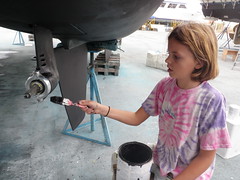
Mera Painting the Sail Drives
Originally uploaded by toastfloats.
To compound our misery, DrC's work ethic is a combination of Capn Bligh, a road crew prison guard, and the holier than thou self-righteous rectitude of a virgin, non-smoking member of the Sierra Club. I don't think he's stop moving since we were pulled from the water. When we started to run out of tasks that were on our haul out list, he insisted we tackle other enjoyable projects such as replacing the tramp, servicing the outboard, and scraping the barnacles off the dinghy bottom. The bad news is that our hands our sore, our clothing destroyed, and we're exhausted. The good news is that the 479 tasks in the PrepForSale project are down to a mere 253, most of which involve cleaning things right before we get off the boat.

The key is a potentially expensive casualty of emptying out the lockers in the salon, though. DrC gets his Big Voice, "Who Was the Last Person to Take a Shower?"

I sniff my armpits experimentally. Okay definitely, "Not me."

Tuesday, November 24, 2009

You Break It, You Bought It

Twinkies and Hoseclamps
Originally uploaded by toastfloats.
Editor's Note: Written during our Summer Without Daddy up in Bahia de Los Angeles.

DrC has left us alone before. Twice in fact. The first time he left us for a month to work, he planted us in Port McNeil on Vancouver Island. We spent our time going on hikes, swimming in the local pool, visiting the library, and studying. Twice, we pulled the anchor and went on a brief foray over to Alert Bay. Basically, we didn't move and nothing broke.

The second time DrC was forced to work, he left us in Zihautenejo. We hardly moved the boat at all during that visit, but we were more adventurous in other ways. We explored Zihua and Ixtapa, participated in the Zihua Sail Fest '09, and became entwined in the lives of several cruisers. This is where we met Uncle Glenn, adventured with Bay Wolf to Ixtapa, and managed to get ourselves invited to just about every gringo hotel pool within 50 miles. The month zipped by very rapidly and pleasurably, though I'll grant you for the most part we didn't move and nothing broke.

This third – and final – extended period of DrC working time was completely different. For one thing, it was actually two months broken in the middle by a month spent on a road trip with daddy in the States. DrC left in June and didn't return until October. For another, hurricane season necessitated that we motor the boat a good long distance from Santa Rosalia up 130 miles north to the Bahia de Los Angeles area.

This time, we had to move. This time, everything broke. I don't know if the two issues are related. Had we moved the first two times DrC was not on the boat, it's possible everything would have stayed together. It's also possible that leaving the boat for a month then having the thing ride out Hurricane Jimena contributed to the delinquency of our minor boat. Whatever the causes, the effect was almost daily breakage – an endless series of more or less panicky mechanical crises during which I had to simultaneously fix the diesel engines and maintain my spotless nail care regime.

Okay, that last bit is a lie. I don't have a nail care regime. On the other hand, I also know precisely nothing about diesel mechanics.

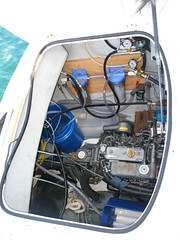
Or knew precisely nothing. Now I know something. I know how to fix a frozen throttle and how to prime the raw water system. I know that the impellers can get squashed and need to be replaced regularly and that the little black belt thingie around the end of the water pump shouldn't be loose. There's a sea cock for the sail drive, and the raw water strainer has plastic fittings that break if you are not super careful. There is also a little light for the engine room that magically turns itself on and runs down the batteries, and there are two extra switches in the port which have nothing to do with the engines and are used exclusively for the water maker.

Other gems I've picked up. Salt water rusts things. Fresh water does not make the rust stop rusting. Don't get lubricant on your belts. Don't stand on the heat exchanger in your bare feet. Metal hose clamps are made of the world's sharpest metal and will shred your hands. My husband keeps all the tools in the starboard bow in a series of boxes. The item you want will always be in the box on the bottom of the pile. There are three manuals to go through every time you want to touch the diesels; Calder's will be the most thorough but completely inexplicable while the Yanmar shop manual has the most useful pictures and the most poorly written instructions.

In the cruising community, pink and blue are well established. It's not really sexism or misogyny, it's just practical. There is too much to learn on a boat so the world gets divided. Using traditional gender roles isn't much of a stretch. At potlucks, guys stand in a circle with beers in hand discussing motors, mounts, tools, and electrolysis. They remind me of scenes at the fraternities at Cal Berkeley just 30 years older and missing the signature keg. The women gather around tables and at picnic blankets. Their conversation, mind you, is just as technical but involves navigation, provisioning, timing weather, and radio nets. Those are the pink jobs. During my summer of breakage, I would shuttle back and forth all night. I needed the weather info, but I also needed to know how to fix the port raw water system.

Faced with Morning
Faced with Morning
Originally uploaded by toastfloats.
In both camps, the support was profound and reassuring. The men welcomed my presence and willingly answered my basic and often quite stupid questions. The women were admiring, praising my courage. But I'm not courageous. It is not heroic. There are many single handers out here who handle all the jobs, pink and blue. There are even a few who do it with children. If I hadn't known there were a hard stop in a few weeks when DrC arrived back from the States, I don't know how I would have pulled myself together and kept going. Also, I didn't always handle the breakage gracefully. I cried one time the port raw water system stopped working. After hours of popping in and out of the transom, my back started to hurt, and I got very snippy with the girls. I'm not actually good at this.

But I did it. I fixed engines and water systems, the water maker and the outboard, the deck light, the starboard head and the port bilge pump. Every day we cleaned the boat, we finished our school, and we moved to the next anchorage. We provisioned, we made bread, and we ate it. All the work got done even without the girls' incredibly capable daddy.

So the message to the girls must be the right one. It's okay to be girly, to sigh and to cry and to get frustrated. It's not okay to be helpless.

Thursday, April 09, 2009

One Bite at At Time

You Want Me to What?
Originally uploaded by toastfloats.
Believe it or not, cruising is not a vacation. It feels like it should be, but it isn't. After all, we're on the Mexican Riviera in the middle of winter while everyone else is slogging through sleet and snow. We enjoy pleasant company, great surfing, and wonderful weather. And we don't work for a living. Which is the problem. We're not working.

See what happens is this. You leave your home port after many years of preparation. The boat was at the dock while you outfitted, prepped, primped, polished, and laid in fifty cans of diced tomatoes. Then you left the comforts of home and started cruising. Which is great, mind you, but cruising is hard on the boat. Mexico is really super dirty. Children and cats and husband notwithstanding, it is fair to say I could be down here on Don Quixote all by myself and the boat would be covered in grime from bow tip to stern step in grime within a month.

And did you know the ocean is salty? And full of sand?!

Every day you live on your boat something gets worn down, dinged, scratched, or a little dingier. Every day the salt water gradually eats away the finish on the metal shiny parts, and the Mexican dust scrapes away at the plastic buffed parts. One day the dinghy oars scrape down the side of the starboard hull. Another night, the cat gets hold of a rug and tears it to shreds. Two weeks ago, every thread on the sail cover decided to simultaneously self-destruct in a puff of reinforced DB-92, sun-resistant dust. The electronics randomly quit, not always permanently but more or less in a fashion to render them useless as reliable tools. The sail locker builds a layer of mud and ocean gunk which ripens in the hot sun to a stench that rivals the kitty litter. Your children forget to use a cutting board one day and leave scratches on the counter top, your husband doesn't wipes his hands when changing the oil and leave stains all over the stairs. A pin box explodes and scatters pins everywhere which subsequently rust leaving long pin-sized shadows in odd locations in the cockpit like the outlines of murder victims etched into the white fiberglass floor.

The only way to combat this inevitable, inexorable process is with an equal, sustained maintenance effort. Every day, a little here... a little there. But no one does this the first year. Actually, there are a few who do. Beach Access does. His boat looks new. I don't know anyone else in their first year of cruising, however, who has managed to get anything constructive done this season, let alone set up a regular, consistent maintenance schedule which fixes as much as the cruising life destroys.

No... we're all dreadfully far behind. The world is fast destroying our floating homes. We're watching them literally shake themselves apart under our feet and now that the end of the first season approaches, panic is starting to set it. Because frankly, there is no effing way any human alive can catch up. We're in the 14th week of a 16 week semester, and we haven't read any of the course list. We talked the graduate assistant into giving us a passing grad on the mid-term then downloaded 95% of the contents of a mid-semester paper. We can barely remember from one day to the next what time the class meets. With two weeks left, we have to master the economic and political history of Western Europe from 1600 B.C. To 1950 A.D., and we can't remember if the Black Plague came before Joan of Arc or after the invention of the printing press.

Except it's worse. This floating monstrosity is not only our home; It represents roughly 50% of our net worth. With the market for yachts presently about as active as the market for the toenail clippings of dead fat white guys, we can't sell the boat to pay off debts, revert to a land based life, or otherwise escape the nautical trap into which we dropped our sorry asses. Cruisers who fail to adjust to the reality of their self-destructing floating investments, lose them. The boats sink. This is not a metaphorical literary device to induce sympathy. It is a literal truism.

I'd rather not go down with the ship, so after hyperventilating, screaming in my pillow for an hour, and indulging in a good cry, I set us up with a schedule. The way to eat an elephant is one bite at a time. The way to get Don Quixote back in trim is to do a little bit more than a little bit every day. Just as we spent nearly a year not doing enough, we're going to have to spend nearly a year doing just a little bit too much. Mathematically speaking, this should result in a fine cruising vessel with functioning equipment and decently maintained deck by roughly this time next year.

Better At A Distance
Originally uploaded by toastfloats.
Our first week of what I think of as Routine Maintenance Plus went very well. DrC changed the oil and oil filters, fixed the water maker, replaced a fitting on the starboard traveler, and installed the dinghy wheels. I decided to recover the cleanliness and “beauty” of the boat first through reinstituting our “Make It Light” program. The purpose of Make It Light is to both improve boat performance and trim while also controlling crap. Each and every locker and cubby on the boat is periodically emptied, wiped out, inventoried and reorganized. All the tasks in my iGTD Make It Light project were roughly six months over due, but this week I made inroads. I purged and cleansed the medicine cabinet, pantry, under and behind stove, navigation table, salon center seat, under galley sink locker, and master cabin. I also scrubbed the starboard hull since the bottom paint has basically cried Uncle on its attempt to keep the hull free of grass and barnacles.

It's a start. We can not afford for this renewed maintenance energy to go the way of similarly well-intentioned New Year's Resolutions. It's okay be fat and drunk. It is not okay to be fat, drunk, and sinking.

Editor's Note: After writing this post, DrC and I got a super deal on a boat cleaning in La Cruz. All the crud was gone in a spasm of work by the fantastic team of Remington and Crew. All hail Manuel Labor! This allows us focus on the real "fixer upper stuff" for the next few months instead of cleaning cleaning cleaning.

Sunday, January 04, 2009

TechTip - Water Sweet As Wine

Our Water Maker
Our Water Maker
Originally uploaded by toastfloats.

Short Answer: Make your own water maker. It’s cheaper, it makes more water, and you’ll know how to fix it without a high-priced mechanic.

Long Story: DrC just finished making our water maker. We downloaded the plan off the Internet a few years ago. I understand you can now pay to download this plan. I recommend it highly. We’ve met three boats to date who successfully followed the instructions to build and maintain a high-volume water maker. Now we are the fourth who can make the case for a home built job.

In the interest of fair disclosure, building your own water maker is not for the faint of heart. It took a long time and a lot of hard work. It is also not exactly cheap. The parts for our water maker totaled just under two boat bucks. DrC estimates it took him roughly 50 hours of work effort from start to finish not including what felt like 100s of trips to the hardware store. He does recommend that you build your water maker before you leave the dock. The critical tool is apparently a car to get to a really good hardware store. The most expensive parts are the filter, the pressure vessel, and the pump. The pressure regulator and clutch can also run you some change. You’ll also need space for the installation (~1.5 cubic feet), a thru hull or T off an existing raw water intake, and hydraulic hose to get the water to your tank.


Proud Papa
Originally uploaded by toastfloats.
There are two major advantages to building your own water maker: price to output ratio and maintenance. Even two thousand dollars is cheap for a water maker that puts out thirty gallons an hour. A comparable volume Spectra will run you at least $4,000. For roughly another ~$400 we could double our output to 60 gal/hour with a second filter. We’re considering it, but we’re going to wait until we live with what we have for awhile. Also, we hear folks on the cruiser nets almost daily asking about how to get maintenance for their water makers. There is something of a black box feeling for these devices down here. However, all the boats with hand built jobs tell stories about how a trip to the hardware store solved this problem or that. When you build it yourself you know how to fix it; It’s that simple.

Yesterday, we stood on the deck passing around a glass of clear, clean water. The entire family was grinning like loons. The water tasted like ambrosia after all the effort DrC had put in. So maybe a third advantage of DIY water makers is the sweet taste of accomplishment.

Saturday, October 11, 2008

That Didn't Work

It's Always Something
Originally uploaded by toastfloats.
If Murphy owned a boat, he would have been considerably more pessimistic. Our haul out experience in San Francisco was not particularly successful.

PHASE 1: Select a Yard
Jason: You can haul a catamaran in Napa.
Napa Shipyard: That will be a jillion dollars, please.
Toast: Let’s go somewhere else. Ooo... Bay Marine will do it.
Don Quixote: Okay, whoppeeeee, I’ll take you to Bay Marine.
Bay Marine: What a beautiful boat! Tie up here. We’ll haul you as soon as you get done with our pricey and unhelpful electrician. (In fairness to Bay Marine, they were really helpful... except for their electrician.)
DrC: Where are the parts?
Toast: What parts?
DrC: The parts I ordered which are critical to us hauling out.
Toast: Oh. Those parts.
Seattle Parts Guy: OH! Those parts. You wanted THOSE parts. We back ordered those parts. They’ll be in Emeryville in two weeks. When did you want them?
DrC: I wanted them yesterday in Richmond.
Parts Guy: You can have them Thursday...
DrC: We’ll be gone by Wednesday.
Parts Guy: So sorry.
DrC: *deep sigh* Okay, send them to Sacramento. We’ll have our land contact forward them to a yard.
Bay Marine: Not hauling? Oh. Here’s your bill, what’s your hurry.

PHASE 2: Find a Mechanic
DrC: Let’s fix everything else over here at this yard where all the boats look like they dropped out of Sail magazine.
KKMI: Sure! Come on over! We’ve got your basic economy package. Tie up to this incredibly rickety dock with no water and power and we won’t even charge you! We also have expensive mechanics and electricians. But here’s the deal... ours know what they are talking about!
Don Quixote: Whoopppeee! I’ll move you 20 yards.
Girls: Why? What? Huh? Do we have to do school?
Ron the Electrical Guy: You wired the alternators wrong. See if you’d just followed these cryptic installation instructions you wouldn’t have burned out two alternators and 15 fuses. Yes those instructions -- the ones written by a complete dimwit possessing the IQ of a rock. The one Toast would have fired 15 minutes after delivering the first draft and that’s assuming she hired the illiterate to begin with.
DrC: Toast, I really think you should go into the business of rewriting boat gear manuals and selling them to cruisers on the side.
Toast: I’ll take that under consideration.

PHASE 3: Convince the Experts
DrC: So about this auto pilot... It’s the brain or the panel computer.
Toast: I think it’s a mechanical problem.
Kurt the Hydraulic Guy: It could be the pilot brain. Or an electrical problem.
Toast: No. It’s a mechanical problem.
DrC and Kurt in harmony: If we only had a brain.
Toast: NO. It’s. A. Mechanical. Problem.
Kurt: Hey! Look at this ball joint! It totally can’t move.
DrC: Oooo.....
Kurt: HEY! Look at these brushes in the motor. They are completely gone! The motor can’t operate.
DrC: Ooooo..... Toast, look at Kurt the Hydraulic Guy! He figured out our problem with the autopilot. You’re not going to believe this, but it’s a mechanical problem!

PHASE 4: Wait for the Mechanical Problem Parts
Toast: So how long to fix the brushes and the alternators?

KKMI Guys: Oh we can get you out of here by Thursday, maybe Friday.
Toast: Not Wednesday?
KKMI: Nope. Gotta build these babies from scratch. Love the French.
Toast: So we could have gotten the magic sail drive parts and hauled Thursday if we’d had them sent to Richmond?
DrC: Yep. Looks like it.
Toast: If we only had a brain.

PHASE 5: Find a New Yard
Toast: I’ll call every yard between here and the Mexican Border.
Long Beach: This boat’s too long.
Newport: This boat’s too tall.
Ventura: This boat’s too late.
Santa Barabara: This boat’s too fat.
San Diego: This boat is just right and we’re going to charge you three times more than the boat yard in San Francisco! And you’re just going to take it up the bank account because You Have No Choice! Isn’t that great! Aren’t you happy! We’ll throw in a paint job with really really bad paint for an extra $700 if you’d like. What day will you be here?

* *

The cure for the disease of Boat Envy is to spend a week trying to get one fixed. If you have a friend, relative, or spouse who needs a vaccination, just send them to live with us for awhile. We are highly contagious.

Tuesday, July 29, 2008

Get a Cat* - Redunancy

Pacific Crest
Pacific Crest
Originally uploaded by toastfloats.
Two men stand on a field of white. The one on the left is a handsome white man, about 50, distinguished, knowledgeable, and stylishly dressed for dinner at a seaside restaurant. The one on the right is much younger, casually attired in Bermuda shorts, Crocs, an open T-shirt, and hailing from some mixed Pan-Pacific ancestry. A pleasant jingle plays unobtrusively in the background.

Both men are jogging quickly in place. They've jogged long enough to ruffle their hair and look a bit sweaty and tired. The younger man speaks first:

Catamaran pants, “Hello, I’m a Catamaran.”

Monohull says breathily, “And I’m a Monohull.” He gulps down air between each sentence as he continues, “Today was sunny and calm. No seas. No wind. But we need to get to the next big marina. Restock, showers. Water.”

Catamaran pumps for a moment gathering his breath, “So we decided to motor. It's a long way for a beer run. But what are you going to do?...” Abruptly, Catamaran starts coughing and slows down to a walk.

Monohull glances over, concerned, and slows his pace as well, “Are you all right, Catamaran?” He begins a slow walking circle around Catamaran as he looks over his companion.

Catamaran shakes his head ruefully, “'Fraid not. Lost the port engine.” He continues to walk as he shakes out his left arm. “I think it's the impeller.”

Monohull's expression changes to a knowing look, “Time for some maintenance, heh? Well it happens to all of us. There's a little anchorage just there you can hole up in till you fix it.” While he tries to appear sympathetic, it's quite clear that he's delighted to show up the younger man. “I guess if you don't need me, I'll just be heading off to La Paz.” His pace starts to increase.

Catamaran smiles and also increases his pace to match that of Monohull. “No need. I'll just fire up the starboard, and we can be off.”

Monohull looks chagrined as the two increase to their former rapid jog. He mutters, “Oh right. The starboard engine. How could I forget.”


Aerial View of Don Quixote
Originally uploaded by toastfloats.
That second engine is going to cost you: Time, money, maintenance. On the other hand, it's also a backup engine that pretty well ensures you won't get left out there without a motor. This redundancy vs. cost equation is true of many aspects of your catamaran. Two engines, two heads, two hulls. Break one and the other holds you up. I'm reminded of a concept from that luminary of the sailing world Lin Pardey. She talks about being “unstoppable.” Unstoppable isn't so much a state of equipment as one of attitude.

I, for one, have a much better attitude when I get to my anchorage on time.


* Author’s Note: All credit to the Get a Mac marketing team whose incredibly clever work inspired this series. This will be the last one unless something inspires me.

Sunday, June 29, 2008

Clever or Kludge?

Solar Panel Frame
Solar Panel Frame
Originally uploaded by toastfloats.
My husband was never meant to be a doctor. He probably should have been a carpenter or a mechanic. Lately, I’ve come to believe he perhaps should have been a code monkey simply for his impressive ability to throw together a kludge. A kludge is “an ill-assorted collection of parts assembled to fulfill a particular purpose.” In the computer world I come from, a kludge is what you do when doing it right takes too long or involves rewriting fast sections of code. Apocryphally, a perusal of the Windows source code returned 100s of references to a hack or a kludge.

Dr C is either the King of Kluge or the most impressive improvisational cruising sailor on the high seas. His source of motivation for all these oddities which fill our boat is tax evasion -- in particular, Dr C is even more offended by the Marine Tax than I am. This is saying a great deal since I find the marine industry’s propensity to triple the price of even such prosaic items as deck brushes not simply offensive but actually the only instance in which I’ve seen the word usury appropriately applied. Dr C, however, takes his marine tax evasion one step farther than I. While I just buy the cheaper version at Home Depot ten times, Dr C actually invents entirely new contraptions to replace the marine solution.

This is how it happens. We determine that we need something Important... let’s say for example, a frame to hold the solar panels. We do some research, visit some folks who make or sell such things, and get a price. Then Dr C invents an alternative.

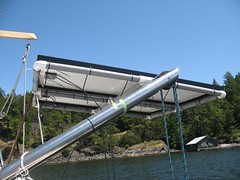
The only realistic place to put the panels was on or above the davits in the back for which we were quoted $1,000 to $3,000. Dr C didn’t like these answers. So he sat at the nav table with a glass of wine, a pencil, a scrap of paper, and a faraway look for several nights. Then he went to the hardware store. More sitting, more wine, more hardware. Pieces of PVC and bags marked True Value and Ace sprung up everywhere. Then one morning he emerged from his cabin and started putting all the miscellaneous pieces together. Forty bucks and a lot of elbow grease later, we have a solar panel frame mounted securely between the davits, our panels pumping out electricity with enthusiastically green abandon. Dr C assures me all the bits are UV resistant and anticipates the contraption will last at least two years after which he’ll build a new one. If and when it fails, there are safety straps all over everywhere to make sure we don’t lose anything important.

Now is this utterly brilliant or just a hack?

Boom Extender
Boom Extender
Originally uploaded by toastfloats.

It’s hard to say. Some of his creations undoubtedly enhance the market value of the boat. The beautiful shelves in the cabins, the way the salon table now drops to form an extra bed, and the new panels custom fit to accommodate the SSB and Pactor modem are clear improvements. Others DrCisms, like the solar panels and the helm locker, definitely exude a look of “loving hands made at home.” On the other hand, even his hacks work really well. Even the most annoying of the lot, the boom extender, is functional and replaces an otherwise very expensive piece of gear.

Time will tell. I’ll be fascinated to watch people walk past the solar panel frame in marinas or drive past in a dinghy to boggle. Either they will laugh and point and snicker, or they’ll be asking Dr C aboard for dinner to pick his brains on how he built it. Or both. You better believe Google runs on quite a few impromptu kludges. It’s amazing how frequently genius and madness coincide.

Tuesday, June 17, 2008

That Which Doesn't Kill Us

Dodd Narrows
Dodd Narrows
Originally uploaded by toastfloats.
We passed a semi-insignificant milestone this week -- we’ve officially been “cruising” for one month. The girls remarked on the anniversary at dinner last night. We shared a familial moment of “huh?” as we contemplated the impossible notion that we had only been out and about for a single month. The consensus reached was that we had been cruising since roughly the dawn of time. Proof was found in the smell of Mera and Aeron’s cabin, and the fact that we had already run out of peanut butter.

The purpose of this summer’s cruising has always been to “break stuff and learn a lot” while still in relatively familiar territory. You’ll be happy to know that Dr C and I are succeeding admirably. A short, incomplete list of what we’ve broken includes: the alternator, the chart plotter, the jib furler, the camera, the starboard head, the sail cover, the hinges on the cabinet door under the sink, the pencil sharpener, the oven solenoid, the wind direction indicator, the forestay, starboard hatch latch #2, Dr C’s back, the port jib line, all of my nails, and the broom. With the exception of my nails and the B&G electronic wind indicator, to date we’ve fixed everything we’ve broken.

What we’ve learned would fill a cruising book. Depressingly, what we’ve learned actually does fill a cruising book. I suspect now that reading all those tomes was a serious waste of time. It didn’t just go in one ear and out the other. The information apparently went whistling through our heads stripping brain cells like a pin ball run amuck in the machinery of our cruising expectations. Had we read nothing whatsoever, we would at least have gone out scared spitless. We probably should be scared spitless. We’re really bad at this.

Here’s the problem. Fundamentally, the cruising life involves a rather short list of repetitive behaviors that are so deeply steeped into the very fiber, fabric and essence of your soul that you replicate them each and every time. Unfortunately, Dr C and I have all the memory retention capacity of a terrier on anti-depressant doggy dopers.

Let’s take, for example, leaving an anchorage. It shouldn’t be hard. Engines on, pull up anchor, drive off. Not so fast! Did you fly the dinghy on the davits? Release the boom swing preventer? Shut the salon windows so the jib sheets don’t rip them off? Bring in all the blue clothes and towels from the lifelines? Stow the inflatable alligator in the forward locker? Is the swim ladder up? The dinghy painter carefully stowed so it can’t tangle the props? The nav and autopilot instruments turned on? Do you have Mera?

Before pulling anchor, you also need to know where you’re going, check charts, weather, and cruising guide then plan a route and program it into the nav station. Woo, there skipper. You forgot to check the tide tables and the current tables. It wouldn’t hurt to stow the computers, get the kids settled for school, and put on some decent music as well. If this is going to be a long slog, make sure you get your socks on, grab the iPod and a book of Sudoku, and throw some sewing supplies on the helm so there’s something to do. If you fail to do even one of these tasks, something bad will happen. The highest probability is that something will involve breaking something expensive.

Man at Work
Man at Work
Originally uploaded by toastfloats.
I can’t remember all that crap. I can barely remember how to count to 10 in Spanish. Like an airplane pilot, each and every time we pull out our “Leaving Anchor” to do list and run through it ticking off all the details. And each and every time, we add at least one more item as we find yet another creative way to break something.

What is the most important thing we’ve learned during our first month of cruising? It is possible to survive as a cruiser even in the face of seemingly insurmountable incompetence.

Thursday, January 31, 2008

Daddy? What Are You Doing?

Daddy? What Are You Doing?
Originally uploaded by toastfloats.
“Daddy, what are you doing?” the girls chime, then laugh hysterically.

This has become a mantra on Don Quixote. Actually, it predates the boat, the midlife crisis, and even possibly my third child. You see, Dr C is a handy man.

Oh yes, he spent nearly 30 years and an amount approximately the the sizeof the annual GDP of a small South American nation on his education to become that oh so exalted member of the medical community: an ophthalmologist. But really, it probably would have served society better – and certainly his wife – had he simply bowed to the dictates of his inner nature from the beginning and become a general contractor.

Dr C is not particularly brilliant at any specific type of repair. He's not a plumber, for example, or an electrician or a drywall expert. You might want to hire a tile guy or a window glazer for some very persnickity jobs. But on the whole, he pretty much knows how to do anything and everything around the house, office or boat. What he doesn't know, he knows he doesn't know. Then he hires an expert, watches the poor guy, asks a metric buttload of questions, and then tips the professional munificently in the unstated but mutually obvious knowledge that Dr C will never require the services of said expert again.

Dr C knows how, for example, to install a new light fixture in your ceiling. He can take apart the hot tub pump and put it back together. He can tape, spackle and sand, build a new wall, or fix a leaky faucet. There are jobs which consume too much of his time. For these, he hires folks that Republicans insist we don't need and should ship back to their home countries in a convoy of Greyhound buses, and then he pays them a good living wage to do things like pour concrete, strip paint, and sand siding down to bare wood. In this effort, his fluency in Spanish serves us in good stead.

Moreover, Dr C does not know how to sit still. He positively avoids fiction, finding it a complete and utter waste of time. His idea of a good time on vacation is to install a water tank on the roof or build a new outhouse. I had to strong arm him into a vacation on a cruise ship a few years ago... actually, I bribed him with the promise of multiple scuba dives, an historical tour, and an eight hour hike to a remote water fall on some island mountain.

This can make him a very uncomfortable companion when what you seek is a vacation whose most mental and physical challenge is putting up one finger for cerveza or two for pina colada. The worst days of that cruise ship trip were those spent traveling between the islands. God forbid we should just relax on the deck of the boat even a single day. Even on a boat roughly the size of a Holiday Inn in downtown Vegas, Dr C couldn't find enough to do. I think he would have been happier if they'd put him to work in the engine room replacing all the gaskets on the secondary.

Hence, the girls and their delighted laughter as their build daddy buries himself in yet another major project.

Now those who are already out there, living their cruising dreams, wipe the drool off your chin. You can't have him. For the rest of you, let me explain.

Boats break. Boats break frequently. Boats break in ways that defy statistical probability and push the boundaries of even toddler creativity for sheer destructive, monetarily bankrupting power.

And what every boat – EVERY boat – on the water needs is a compulsive handyman. Every boat needs a full time repairman. Every boat needs a plumber, electrician, and carpenter. It needs a diesel mechanic, HAM radio enthusiast, amateur astronomer. It needs someone who enjoys reading electronics user guides and anything ever published by Nigel Caulder.

In other words, every boat needs a Dr C.

What is daddy doing, girls? He's keeping us afloat and enjoying absolutely every slogging minute of it.

Tuesday, January 22, 2008

Questions from the Class - Heater

Al Thompson asks in response to It Just Gets Worse: OK, fess up: What brand of heater are you being tortured by? Guess: Espar, or perhaps Webasto.

He's not the first to ask the really important question: What is that heater that's causing so much trouble and how can I avoid ever purchasing one by the same company?

We have a Eberspächer Hydronic 10* installed by the previous owner. It's a specialty heater mostly used by buses, RV, boats, and trucks -- basically any 12 Volt system. It's a diesel burner with a circulating pump which circulates anti-freeze into each cabin. At the cabin, there is a little radiator with a fan which goes off when it hits a certain temperature.

Now for the first year and half or so, it worked like a charm. The only problem we had was the first time we ran out of fuel and didn't realize it. Very embarrassing to call a mechanic to explain to us that we were complete idiots. Turns out the heater has it's own, dedicated 12 gallon tank of diesel. In the future, we're going to use this as a spare jerry can.

This recent series of breakage is due to air in the water pump. The original highly engineered Germanic beauty of a pump -- also sold to BMW for gorgeous finely tuned and ridiculously expensive cars -- decided that it didn't know how to function without water in the system and promptly self-destructed. The impeller simply melted.

Of course, even enterprising do-it-yourself cruisers can't fix this problem because you can't buy the impeller by itself. No, you can only buy the entire water pump. So we bought a new water pump.

The second pump lasted 48 hours. Not having another $360 to throw at the problem and clearly recognizing now that the impeller was a symptom of the problem rather than the problem itself, we decided to find a less perfectly designed, robust and cheap Ahmayreekcan pump. The new pump has the advantage of being poorly designed, clunky and not pretty at all, costs a mere $170, and is designed to stop gracefully in the absence of water in the system. It also has the stellar advantage that you can purchase each and every part separately from each and every other part.

Let this be a cardinal lesson to cost conscious cruisers. If you can't order the component parts, do not buy the assembled device.

I can also vouch for the fact that it does fail as gracefully as designed. In fact, it has done so repeatedly. What it does now is blow warm lovely air for about 5 minutes and then with a sign and a clank, it stops annoyed with our inability to consistently feed it water.

So then we started doing clever things we should have started with like completely pumping out all the existing coolant and replacing it with fresh. We also installed air bleeders at every bump and turn. Air bubbles in the system are bad news. Air bubbles result in locks of the pump. We also defensively installed resisters because apparently this good ole boy USA pump sucks amps like a vacuum and can potentially burn out the fine, sensitive and delicate brain of the Hydronic.

DrC and the mechanic still think it's air in the system - even though DrC purged the system so it ran nothing but pure water. We would purge it again, but the marina turned off the water this afternoon due to the sub zero temperatures plaguing the city.

Which brings us to tonight wherein we are officially in a Catch 22. We can't get heat until the marina turns on the water to the dock enabling us to flush the bubbles out of the system again. And we can't get water on the dock until the temperature reaches a point where we don't care if the heater works.

And before you ask, we have also discovered to our dismay that despite all math to the contrary, you can not run two 15 amp radiant space heaters on a 30 amp plug. I suppose that's another story.

* Points to Al, BTW, as Espar is the American branch of German Eberspächer.

Monday, October 22, 2007

Why is It Always the Impeller?


Warm Hands
Originally uploaded by brainswax.
We broke the boat again. Specifically, we broke another diesel engine. Yet more specifically, we broke the impeller on the diesel engine that drives hot water through pipes in the boat to heat us all to a toasty warm, happy state.

As breakages go, this one is only to cost us roughly 1/3 of a boat buck. We also do not need to have the mechanic install the part. I am rather proud of Us. Us as in We. We as in Dr C and I both diagnosed the problem and then he figured out what part we need to fix it. We as in hopefully he'll let me do some of the replacing of said part when it finally arrives from its home in the Black Woods of Prussia.

It is unfortunate that this break could not have taken place some other time. Say six months from now when a heater on Don Quixote will be a fundamentally obsolete piece of technology. However, October in the Pacific Northwest is not the time to play footsies with hypothermia. You will lose, and it will be an unpleasant, humiliating loss.

It's also clear to me now that we are not truly boat worthy. Had we been truly boat worthy, we would be on the boat still... heating our hands on the kerosene lantern, drying our clothes and bedding in the shore laundry, and attempting to sleep through the sound of our snot condensing on the cieling and dripping down the walls. But we are not boat worthy at all and completely wimped out. We packed up the kids, the perishable food items, and the gold fish and decamped to the basement of our former home.

Where upon the pipe to the bathtub above us promptly burst and filled our basement head with a steady drizzle of foul smelling liquid and splats of dissolved dry wall.

Someone is trying to tell me something. Translators welcome.

Tuesday, August 21, 2007

Stop Blowing Holes in My Boat!!

“Stop blowing holes in my boat!” I scream at my otherwise innocent husband.*

Dr C looks over his shoulder where he is not blowing anything up but merely vigorously sawing through a bulkhead. “What?”

“You. You are a menance,” I inform him, complete with aggressive fists on hips and jutting chin. “You keep cutting holes in this boat and we're going to sink. SINK! I tell you.”

Dr C looks at his work in surprise, as if considering for the first time the connection between a hole in a boat and the basic principle of watertight integrity. “It's just a little hole to run wire to connect the blah blabity blah...” I lose the rest as it drifts into techno-babble and my temper starts to reach the point where little bees are buzzing around in my ears and the world is going a rosy red.

On every boat, there is a basic conflict between the need to improve its safety and functionality and the requirement to make it comfortable. This conflict is frequently gender based, with a sailor-guy installing gear, improving the running rigging, swapping out ground tackle, and the sailor-gal sweeping up fiberglass shavings, buffing gel coat, and recovering the salon cushions in child-proof material. If you don't own a boat, don't worry. The tension all this activity causes is precisely the same as a kitchen remodel. And we've all been there and done that.

I know of several cruising families in the preparatory phase who are in the midst of their “Boat Remodel.” Now of course the husbands call this “outfitting.” Outfitting, my ass. “Outfitting” is visiting R.E.I. and buying a sun hat, a hand crank blender, and new tent spikes. “Remodel” more closely reflects the sheer destructive power of a sailor bent on improving the seaworthiness of his boat. In the case of one family we know, we might as well call it a rebuild.

Note to sailor dreamers: Do NOT buy a “fixer upper” boat. This isn't a Victorian which you can live in in a tent in the backyard while you fix it up. Your floating fixer upper is a hazard to health and happiness. Spend the extra up front and get a boat that is basically ready to go.

On s/v Don Quixote, our remodel proceeds with Dr C's usual flare for the utilitarian. My husband is big on functional improvements and is completely oblivious to aesthetics. In our first house, we had a wall mounted air conditioner unit that leaked. Dr C was brilliant and handy. He fixed that right up with flashing and spackle; Leak all gone. All that was left was spackle, sandpaper, and paint. The tub of spackle along with the pan, spackle knife, sandpaper, and a paint brush sat next to the air conditioning unit until we moved out two years later.

Since then I have learned that Dr C never does the last dish. He never touches up the paint. It would never occur to him to plug the holes from the weather fax we removed and sold. So as Dr C ticks through his outfitting list, I am delighted with his handiness, ingenuity, and steady progress. I am also frustrated by the increasingly long list of holes in my boat.

Just sitting here in the salon I see:
  1. Two 6” holes from the old speakers
  2. An unvarnished wood panel taped with blue tape to cover the gaping hole on the navigation table
  3. Two round and two square openings where the old stereo system used to live
  4. A friggin enormous cavern under the helm seat where Dr C decided we need access to the rudder chain and throttle cables
I've learned. These are now my problem. Like the Scooper Clown that follows the Budweiser Clydesdales down the parade route, I will work through the boat adding the finishing touch and cleaning up. To the horse goes the glory, to the clown goes the spoils.

* Is there a cruising sailor out there that does not want to park like Cap'n Ron and knock folks off our boat with the boom like Cap'n Jack? So, I think it's acceptable for me to channel my inner Sparrow and steal from Warner Brothers for the theme of this article.

Friday, August 03, 2007

Turn About is Fair Play

Author Note: As protected static pointed out, a repeat of something I posted awhile ago. Ugh. I'll leave it up because I've been DARED to delete the comment... Hah! Not me. At least I did different pictures.

There are two types of folks on a sail boat: those who twiddle the sails, and those who avoid it.

What is a sail twiddler, you ask? Well let me tell you. A sail twiddler is a person who can't leave the lines alone during a long tack. He trims the jib, twitches the main sheet, fiddles with the traveler. She constantly fidgets at the helm, adjusts the bearing and the course. His eye is always on the telltales and the knot meter, her attention never wavers from the GPS indicator for speed over ground. All of these actions are taken in the hope of coaxing additional teeny weeny fractions of a knot out of the sails.

A sail twiddler is the least relaxing human being you can possibly cruise with. The scenario looks like this: you are trapped in a boat with four people for five hours. The wind is 12 knots from the south 55 degrees off your starboard bow. Ideally, as helmsman you set the sails for a starboard close haul and put Auto in charge. Then you grab a good book, a glass of lemonade and a bag of pretzels, and settle in on the tramp, glancing up every few minutes to check for freighters, power boats, and stray seals.

But if there is a sail twiddler on board, you'll find that your starboard close haul is not the most efficient way to get from Point A to Point B. No, your boat is a catamaran and would go a lot faster if you were to fall off the wind a bit. Then you're going to let out this deelybob, slide over that thingamajig, tug on the other whatchamaclallit, and poof! now you are going at least a half knot faster.

The problem with this theory is that at some point in the not so distant future, you are going to have to tack. Tacking involves getting up off your cozy cushion on the tramp and shlepping to the back of the boat to mess with rope. There will be yelling even if everything goes well because that's what you do. You yell cryptic things like, "Helms alee!" and "Fire in the hole!" Then you yank on stuff. Inevitably when you get back to your cushions, the wind will have lost your page or knocked over your drink. But now you can sit, right?

Wrong. Because now you're whipping along in this broad zag toward a big rock in the middle of friggin’ nowhere and at some point you are going to have to zig to avoid it, then zag to get more wind and speed along, then zig to get back to your course, then zag into a tidal current, then zig to avoid running into an island.

And so on.

And the horrible thing to admit is that I always thought Dr C was a sail twiddler. I really expected him to be a sail twiddler. He sure as hell is an everything else twiddler. The man doesn't have the slightest clue how to sit still. On our first vacation down at his parents' cabin in Baja, I drank tequila on the deck and read romance novels for three days while Dr C moved the water tank and rebuilt the outhouse. His idea of relaxing at anchor is to install a new inverter.

So pardon me if my natural expectation was that I would expend a great deal of ingenuity in conjuring clever methods to avoid helping trim the sails. He would twiddle, I would drink lemonade, and basically we'd do same ole' same ole' at the Conger household... except on a boat.

However, this pleasant familiar scene does not play out on Don Quixote. Au contraire! Dr C has better things to do while we are underway. Take today, for example. During our three-hour trip from Seattle to Port Madison, Dr C reinstalled the galley foot pump, changed the lamp mantle, fixed the squeaky starboard doors, and installed a speaker for the VHF in the cockpit.

You know what I did? I twiddled the sails. And let me tell you, the pleasure I get from twiddling the sails makes it feels as pornographic as it sounds.

My name is Toast. And I'm a sail twiddler.

Friday, June 08, 2007

Role Reversal

There are two types of folks on a sail boat: those who twiddle the sails, and those who avoid it.

What is a sail twiddler, you ask? Well let me tell you. A sail twiddler is a person who can't leave the lines alone during a long tack. He trims the jib, twitches the main sheet, fiddles with the traveler. She constantly fidgets at the helm, adjusts the bearing and the course. His eye is always on the telltales and the knot meter, her attention never wavers from the GPS indicator for speed over ground. All of these actions are taken in the hope of coaxing additional teeny weeny fractions of a knot out of the sails.

A sail twiddler is the least relaxing human being you can possibly cruise with. The scenario looks like this: you are trapped in a boat with four people for five hours. The wind is 12 knots from the south 55 degrees off your starboard bow. Ideally, as helmsman you set the sails for a starboard close haul and put Auto in charge. Then you grab a good book, a glass of lemonade and a bag of pretzels, and settle in on the tramp, glancing up every few minutes to check for freighters, power boats, and stray seals.

But if there is a sail twiddler on board, you'll find that your starboard close haul is not the most efficient way to get from Point A to Point B. No, your boat is a catamaran and would go a lot faster if you were to fall off the wind a bit. Then you're going to let out this deelybob, slide over that thingamajig, tug on the other whatchamaclallit, and poof! now you are going at least a half knot faster.

The problem with this theory is that at some point in the not so distant future, you are going to have to tack. Tacking involves getting up off your cozy cushion on the tramp and shlepping to the back of the boat to mess with rope. There will be yelling even if everything goes well because that's what you do. You yell cryptic things like, "Helms alee!" and "Fire in the hole!" Then you yank on stuff. Inevitably when you get back to your cushions, the wind will have lost your page or knocked over your drink. But now you can sit, right?

Wrong. Because now you're whipping along in this broad zag toward a big rock in the middle of friggin’ nowhere and at some point you are going to have to zig to avoid it, then zag to get more wind and speed along, then zig to get back to your course, then zag into a tidal current, then zig to avoid running into an island.

And so on.

And the horrible thing to admit is that I always thought Dr C was a sail twiddler. I really expected him to be a sail twiddler. He sure as hell is an everything else twiddler. The man doesn't have the slightest clue how to sit still. On our first vacation down at his parents' cabin in Baja, I drank tequila on the deck and read romance novels for three days while Dr C moved the water tank and rebuilt the outhouse. His idea of relaxing at anchor is to install a new inverter.

So pardon me if my natural expectation was that I would expend a great deal of ingenuity conjuring clever methods to avoid helping trim the sails. He would twiddle, I would drink lemonade, and basically we'd do same ole' same ole' at the Conger household... except on a boat.

However, this pleasantly familiar scene does not play out on Don Quixote. Au contraire! Dr C has better things to do while we are underway. Take today, for example. During our three-hour trip from Seattle to Port Madison, Dr C reinstalled the galley foot pump, changed the lamp mantle, fixed the squeaky starboard doors, and installed a speaker for the VHF in the cockpit.

You know what I did? I twiddled the sails. And let me tell you, the pleasure I get from twiddling the sails makes it feels as pornographic as it sounds.

My name is Toast. And I'm a sail twiddler.

Thursday, May 31, 2007

Turning in My Credentials

I like to think of myself as a post-modern feminist. Or a post-feminine modernist. Or just someone for whom busting gender roles is not really a calling so much as an inadvertent Truth. I am an unabashed computer geek in a sea of gamers for whom the phrase “Frost Shock!!” actually means something. My best friends discuss the relative merits of GTD applications over IRC, and purchasing my first Mac in ten years was close to a sexual experience. I don't own a lacy bra, I selected a birthing center based on the speed of their WiFi, and I get new clothes only when my mother buys them for me. It's fair to say, I've earned my butch chops.

The move to boat life, as a result, has been fraught with opportunities to fail in my endless non-effort to be a model of all that is 21st century woman. For one thing, I like to cook. I like messing with our gimpy oven and experimenting with two-burner cooking. I also like to navigate, communicate with our land-based friends, and provision the linens. In the sailing world, these are the Girl Jobs. Dr C in turn loves to mess with the engines, tear apart and rebuild the electrical system, and build a water maker from scratch. These are Boy Jobs. I teach school and take care of the children; he works at the office and brings home the cruising kitty. It's like we threw away twenty years of marital equality and stepped into an episode of Leave it Beaver.

So when it came time to purchase an outfit for my eldest daughter's Irish dancing competition, I dug in my heels. Just because I'm the girl doesn't mean I should have to do the shopping. I hate shopping. I hate clothes. I especially hate clothes shopping. He's the one that gave me three girls and no little boy sperm. It's his fault they want to wear something frilly and hop up and down like flower fairies with backbones made of pogo sticks. He could just take them off to Target and take care of this little matter while I read through the manual on our new SSB.

Unfortunately about a half glass of wine after they left, the heater kicked on and a strong smell of diesel began to waft up from the starboard cabin. Boats often smell like fuel, but whenever you append the word “strong,” you've got a problem. I flipped off the heater, grabbed a flashlight, and headed into the starboard hull to figure out what was going on.

And it wasn't good. The bilge was bright pink.

Now here's the thing about the bilge. Bilge water comes in an array of colors that would do a paint store proud, and each color tells you something about what you're going to spend your next thousand dollars to fix. For example, let's say the water is green. Green means you've had standing water in that bilge for long enough to grow algae. Look to your bilge pump as the culprit since either the pump, the relay, the electrical attached to the relay, or the sensor is busted, loose, or missing in action. How about clear and getting higher at a visible rate? Well that would be a hole. Holes in a boat are Bad. Brown? Let's just remember what always slides down hill.

But pink. Pink is probably the worst. Pink equals diesel. The brighter the pink, the greater the spill. This is not something you can just pump out unless you don't mind being held by your fellow mariners in the same esteem as the captain of the Exxon Valdez. Pink means pulling out hazardous waste buckets, oil-soaked clothes, and a pair of gloves that go up to your elbows.

It took some crawling around to figure it out. A fitting on the top of the diesel fuel tank for the starboard engine had worked its way partially lose. Fuel had splashed out and down. Lots of fuel. Enough fuel to coat the hull beneath the tank and overflow into the bilge. As long as we didn't move the boat, no more would come out. Unfortunately, boats move. It needed to be fixed, the fuel mopped up and disposed of in the proper receptacles and with complete compliance to all the relevant statutes, laws, and ritual sacrifices to the gods of marina purity. Finally, the fitting needed to re-affixed in a way that would prevent a reenactment.

And it couldn't wait. The repairs took two hours of slogging work soaking up fuel, scrubbing everything with Simple Green and salt water, power sucking out the water, and disposing of all the waste. Dr C and the girls showed up just as I finished, all in great spirits with a really cute outfit, ice cream cones, and babbling about their pleasant evening with their father.

To hell with feminism. I should have gone shopping.