Showing posts with label education. Show all posts

Tuesday, May 15, 2012

Do It Yourself - Science


Hands Across Takapuna
Originally uploaded by toastfloats
.
I am not impressed with our global, political leadership. Actually, I am not particularly impressed with their economic leadership, their intellectual capacity, or really any important aspect of their personalities, politics, choices, or methods. In fact, I am becoming That Guy when it comes to politics. Cranky.

Basically, every single one of them appears to spend their day figuring out new ways to make me cranky.

Fortunately, my good friends in the computer world introduced me to ways of thinking that I find sufficiently utopian and anarchist to salve my bruised spirits. The open source movement gives me a nice tingly feeling every time I prowl around and download software or read a well-written blog. When I hear bits of news about progress driven by an X prize, learn of software bazillionaires funding private expeditions to mine asteroids, or monitor the progress of Diaspora, a wee bit of optimism returns.

Kickstarter rocks my world.

Now I have another in my list of reasons to not despair: the #SciFund Challenge. From their web site:

The #SciFund Challenge brings scientists together on RocketHub to raise money directly from people like you. The goal: To fund research in new ways and to connect everyone to the excitement of doing science.

Yeah! You want science to move forward, and you don't think your pet interest is getting enough love and attention in the form of public funding? Fine. Pay for it yourself. I like this idea at so many levels. As a serious skeptic, I'd like to see a lot of nonsense debunked with nice, double-blind, ultra-well constructed tests. While there will always be those who choose to ignore the results, having them in hand to argue with is certainly a starting point. Or maybe I would just like to see more SETI research or help some high school students do serious science or help someone design a better hospital gown.

See, it really doesn't matter, right? I can throw my $10, $20, $100 at whatever toots my horn, yanks my chain, drives my curiosity.

Actually, it's all a bit nepotistic on Don Quixote since I confess that we chose this year to fund a friend doing evolution research. One of those things that routinely has us banging heads on the desk is political leaders who think the world is only 6000 years old. Or 3000. Or ending in 2012. Anything that supports evolution science is yummy tasty to both DrC and myself. Siouxsie's project is a nicely blended mix of "support evolution science" and "figure out how to deal with the super bugs evolving to kill us" dripped liberally with flossies. I'm a cruiser. Small bits that float around and phoesforesce is near and dear. For our pledge, she says she will draw a few words of our choice in glowing bacteria. Be still my beating heart. DrC would like her to write "Fiat Lux" while I am rather partial to the completely self-aggrandizing Toast Floats.


Your opinion matters! Tell me... what should we have Siouxsie write in bug lights?

And PS, go fund science. Now.

Thursday, February 23, 2012

Friends of Friends

The crew of s/v Ceilydh is here in Auckland due to a completely unreasonable and absurd requirement of Australian immigration law. With very little forewarning, Evan, Diane, and Maia showed up on our transom looking for a place to stay while they sort out the kerfuffle. Unsurprisingly, they settled into our boat with grace, ease, and little disruption to our crew. Frankly, the best guests to have on a boat are fellow yachties. They know not to bring a lot of luggage and to immediately store the luggage out of the way. They never put toilet paper down the head, immediately start helping with boat chores, and when the time comes to leave the boat for the day, they don't leave the hatches open, the lights on, or their crap lying around. In fact, Ceilydh makes betters guests than my eldest daughter to whom I should probably secure everything she owns with a spring loaded, retractable tether.

The homeschool community routinely faces the question of socialization. Boat schoolers must address this issue to an even greater extent. How can we explain to land-based folk just how well socialized our children have become? Our children learn to play with kids of all ages, become instant play mates, enjoy the presence and company of adults. They can talk with anyone, share games and ideas regardless of age, race, or country of origin. Why did it not occur to me until tonight that the same processes that make my girls so capable -- such confident, well-spoken young people -- worked their magic on DrC and I as well?

Tonight as I watch Evan and Diane slip easily and comfortably into a group of Don Quixote's New Zealand friends, I recognize another truism of cruisers: We do well with strangers. Cruisers quite literally drift in and out of each others lives. We meet each other in one anchorage, have a dinner and sundowners, maybe go on a hike, and then we depart in different directions. It is a survival skill to become amiable, to take genuine interest in the lives of people known for less than a day. We learn how to be entertaining ourselves and in turn be diverted by newness, friendly and comfortable in a crowd of people formed of varying social strata, education, political or religious ideology. This isn't the artificial amiability of the politician, but rather a sincere adaptation to a transient social environment.

Just look at my husband. I remember the night years ago in Seattle when my good friend Wyatt looked at me over a glass of red and admitted, "I've known you for a long time. It's only now I think I understand why you married Dean." It took years for my husband to open up enough to let Wyatt know him, to reveal to someone outside our family the deeply sensitive, strong, and giving person inside. DrC has a wicked sense of humor, a keen and insightful intellect, and a wide ranging interest in the world. He is articulate, well read, and very current in his understanding of politics, economics, and society. But back in the day -- in those days before we become cruisers -- I was one of the only people in the world who knew this. He was shy, quiet, extremely private. At parties, he would functionally disappear, particularly in the presence of my loud, widely gesticulating, opinionated self. It was partially my fault, as I was unfortunately the obnoxious bore who would talk way too much, way too loudly, and with rarely a pause to listen. It was partially his fault, as he was a man who listened intently but almost never participated in the conversation.

Yet, here we are. I am settled on the couch listening to Deb tell me all about her broken leg. Moreover, I genuinely am interested; I am not just waiting until she takes a breath before I start in about me-me-me. Her story is actually a bit horrifying, a nasty break with lots of fits and starts in the healing process and the plot includes a great deal of morphine. My participation consists of a skill I learned from my husband, active and engaged listening, comments injected only to spur more revelations from Deb. It is such a pleasure to sit, sip my wine and listen to her voice, take inspiration from her strength both physical and emotional. In turn, DrC is actively engaged across the room sharing ideas about some dang thing with a man I know he's known for all of a half hour. His arms are waving, and he laughs at a comment while maintaining a running stream of dialog. We haven't switched places. I'm not silent, he's not loud and overwhelming, but we are also not the same people. Evan and Mark are sitting on the couch chatting about the performance characteristics of some old schooner Mark used to crew. Diane is giving Steve ideas how to get started in the travel writing business. My cruising friends have slipped seamlessly, effortlessly into this crowd of strangers. All four of us appear to be enjoying ourselves, and perhaps just as importantly give every appearance of providing interest, pleasure and mutual entertainment to the people with whom we interact.

"What about socialization?" The They of the world always ask.

"You mean ours, don't you?" I will now respond. DrC and I have finally completed our socialization, and for damn sure we didn't learn it in school. While DrC and I were out with our daughters on quiet anchorages and busy little port towns, our girls showed us what it means to be well socialized, highly functional members of society. I finally feel like a grown up.
Don Quixote and Ceilydh
by Toastfloats on Flickr

Sunday, January 09, 2011

Curriculum 2011

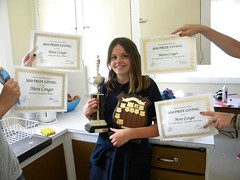
Math and Language Prizes
Originally uploaded by toastfloats.
Every year it gets a bit more challenging to homeschool the girls while it simultaneously gets much easier. After a year languishing in what passes for education here in Pukekohe, the girls have to get back to work.

2010 was a very enjoyable but essentially academically null year. #2 and #3 at least loved their school, respected their teachers, and learned how to reach out to children their own age. Aeron was her bouncy, generous, friendly self while reserved Mera nevertheless found ways to make connections. In particularly, Mera's experience of Kapa Haka was so positive that it would have served alone to make the school year worthwhile.

But I digress, we are talking about "Homeschooling: The Later Years." What gets easier is teaching our children. The unschoolers are essentially correct when they say that kids are information sponges when left to their own devices. Educating the girls grew easier and easier the less effort we put into it and the more we let them do it themselves. At this point, we simply put the content in their hands, set minimum targets for volume, and then let them have at it. Generally, they limp along grudgingly in topics of less interest while blowing out the targets when something engages.

Yet, there is the kernel of the problem as well. As the girls get older it gets harder to find good, self-guided instructional material... at an affordable cost. During the younger years, we relied heavily on workbooks. Workbooks were available in all subjects at the local children's educational book shop for quite reasonable prices. If we couldn't find it there, we could always go straight to the publisher and purchase our pick of workbooks in the $15 to $25 range.

The workbooks, however, start fading in about middle school and are essentially gone by high school. That's a shame because workbooks are a fantastically useful teaching tool at any age. In their place are $100 to $200 middle, high school, and college text books. When your student doesn't click with a $15 geography workbook, you try a different author or publisher. When she throws up her hands at a $100 textbook, it's tempting to bash her over the head with it.

Another problem we face as the girls get older is that they are starting to have Goals. It used to be we could select the books, the balance of one subject versus the next, and the volume and pacing with almost no input from the children. Sure, occasionally a book or program died in their hands and required replacement; Singapore Math and Calvert both immediately leap to mind. We listened and replaced, but we didn't really abandon the principle of, “Yes child... math is something we're going to master, as are spelling, writing, and science.” It's not like we ignored them, but unless the book or exercise was completely heinous (e.g. Elements of Language 1, 2 and 3), they didn't care much one way or another what we swapped out.

But now, there is a Plan. Jaime in particular has narrowly defined aspirations; Her current career objective is to become a Civil Engineer. The only question is which flavor, but the basics requirements are the same. To the end of getting admitted to a New Zealand, Australian, or U.K. University in the field, she presented me with a laundry list of subjects she wishes to study during our 2011 homeschool year. These include: Physics (NCEA 2), Statistics/Modeling, Economics, Chemistry (NCEA2), and Geoscience. I talked her into an art class only, but only after I found a really good textbook on Basic Technical Drawing. It took a visit to the iCivilEngineering web site to convince her that a computer class was essential; So we're also tackling AutoCAD next year. The later effort also required a bribe of fixing her laptop keyboard and an iTunes gift certificate. It took her father's intervention to drag her kicking and screaming into agreeing to a literature and writing survey course which he'll be conducting with Mera. God forbid we spend even a moment reading and savoring the classics. This will teach me to let my daughters hang out with engineering geeks.

Making Soap
Making Soap
Originally uploaded by toastfloats.
Mera's goals are less well formed. However, her critical opinion on topics and materials are considerably better articulated and delivered with a cool disdain when I somehow fail to meet her educational expectations. The literature course spearheaded by her father includes a reading list which required considerable massaging before attaining her coveted approval. She flat out veto'ed our grammar tomes and writing exercise books as both “poorly written” and “utterly useless.” And despite the fact that her mother is a professional technical writer, her father an English graduate from U.C. Berkeley, she requested that her Grandmother Nancy take responsibility for evaluating her non-fiction, Grandma Sue the fiction. She deigns to learn Science and Spanish from her father, Math from her mother, but she will teach herself Drawing, Music, and History thank you very much.

Thank all the little gods of parenting, Aeron still doesn't care.

We are hundreds of dollars into this project of School 2011. The books we've ordered are gathering at Chicken House and in the States at my mother's house. We will have no opportunity to swap out topics or texts once we leave the coast of Mexico. Our principle consolation is that old standby of cruising families everywhere. Even if they fail at homeschool, the Experience Will Educate Them. Surprisingly, this isn't sophistry. Just look at the girls' accomplishments in New Zealand. No question that somehow, some way, we are keeping up with the educational jones.

Friday, December 10, 2010

Mera is Our Academic Super Star

I can and will write about this later... something all retrospective and interesting about homeschooling versus public school in New Zealand. Reflections on our year here. Today, I just have to say, GO MERA! Your Mom and Dad are Very very VERY proud and impressed with your accomplishments.

Thursday, November 25, 2010

Dance Class at the Civic Centre

Go Away
Go Away
Originally uploaded by toastfloats.
Her hands frame her face then glide two inches over her breasts and then her butt, "Crown, beautiful, beautiful." This graceful movement is made to the somewhat Arabic sounding rhythm blasting from a boom box at the front of the room.

I'm in bellydancing class.

My attempt to mimic the movement is not nearly so graceful, though I like to think it's improved since my first effort at this step. It's been 7 weeks, and I have just about reached the point where I can move my hips completely independently of my shoulders. My shimmy no longer looks like a palsied octogenarian trying to get her pants down to go potty. And I've definitely figured out how to make my boobs jump up without moving my knees. You'd be surprised how resistant the boobs and the knees are to disassociating their movements.

I don't think it is possible to imagine a group of women more unlikely to bellydance. We are none of us spring chickens. We range from clearly overweight to just merely pie-laden, and the majority are dressed in loose shirts and forgiving dark sweat pants. There are no real dancers present. We're just a bunch of worker-bees, office drones, mothers and grandmothers.

Yet, our instructor Angie somehow makes this motley crowd beautiful. It's not that she is particularly stunning herself. She isn't. She's a tall, rather average looking woman with no lean figure herself. What saves Angie is that she knows how to move. Moreover, when she moves she believes she is beautiful, and it shows in very gesture and step.

It's incredibly inspiring.

I want to move like that, look like that. More importantly perhaps is that I want to feel like that. I want to lift my head and arms and glide around in the Princess walk like I own this room. I'd like to shimmy so that everything jiggles and gain the discrete control over the muscles in my core that enables a bellydancer to push her nipples straight at you without curving her back or poking out her butt. In short, I want to feel sexy.

DrC believes that bellydancing is a specifically female dance. Unlike ballet or jazz or ballroom, there is no room for the male physique or macho sensibility here in bellydancing world. Every pose and combination appears specifically designed to highlight the beauty of the female form, feminine movement.

What I should have known and seems blindingly obvious to me now is that beautiful, sexy women are made, not born. Take a slightly overweight former cruiser and teach her how to rotate her hips just so, lift the chin, tuck in the butt, smoothly jiggle, shimmy and quiver, and you've got something special. And it doesn't really matter whether or not you, the onlooker, agree with me that I am a beautiful sexy goddess. All that matters is I feel wonderful and beautiful when I hear the bangles on my skirt clash and see the fringe swirl as I turn. I feel special.

During this epiphany, Angie has moved on. We are now strutting around in a large circle, shoulders thrusting aggressively forward in a Goddess Walk -- unlike the pretty, sly and delicate Princess glide, this is a power move. We hold our heads high, breasts up, toe-heel, arms gracefully extended holding imaginary golden eggs. My egg is made of crystal, and there is a glowing green jewel in the center.

Of course it is. If I want to be a jewel toting Goddess in my mind, well that's precisely what I am. It's my imagination. Look at me strut!

Wednesday, August 25, 2010

Annie Played the Bucket Drum
Originally uploaded by toastfloats.
The application read as follows:
“Looking for families eager to host Korean exchange students. Our program seeks typical Kiwi families with healthy, clean homes who provide room and board for our young children.”

There was a small payment associated with the job awarded to the successful candidate families, but hardly enough to provide any real temptation. Feeding another kid would easily eat up the tiny stipend. So that isn’t our excuse. I don’t know why we applied. In our application, we noted:

“We are eager to host a Korean exchange student. We are an atypical American family with a rental lovingly dubbed Chicken House, because it is about as healthy to live in as a garden shed and chickens routinely wander down the halls.”

We were a bit surprised when the program coordinator called to schedule an interview and house visit. We were dumbfounded when we were put on the short list to host a student. Honestly, the level of desperation required of the program coordinator to declare us a healthy, clean home is a bit worrisome. Nevertheless, the Conger crew was excited about being selected to host a student. We may not be typical Kiwis nor do we own a home to which you’d want to board your household pets let alone your middle school age child. Yet, we are good people, eager for new experiences.

About a month ago, our student Annie arrived. Annie is not her Korean name. As happens with many students who study a foreign language, she adopted an “English” name for use during class. She said she wanted us to call her Annie while she visited. Annie is 12 years old, and her family lives in Seoul, South Korea. She attends school with Mera during most of the day. Her afternoons are largely spent with her fellow exchange students in math and language classes. It seems that the regular school day is insufficient -- to which homeschool mum that I am, I can only empathize.

On the weekends, Saturday is free choice and Sunday is family day. Annie’s presence has broken us out of what was fast becoming a suburban weekend rut. We’ve returned to explorations of the greater Auckland area. We took Annie on a tramp through the bush, to the Auckland Museum, and to a symphony concert at the hall downtown. Weather permitting, we hope to go on the rope climbing course this weekend.

Annie has been great. She speaks and writes far better English than any exchange student we have ever hosted. As she got to know the family, she gradually relaxed and opened up to all of us. She has a nice smile when you can catch her doing it. She is shy and reticent to engage DrC and I, but Aeron and Mera have completely taken her under their collectively noisy, charming wings. They watch movies, play, and shop together. I love to see the connections forming, and I hope sincerely Annie leaves us with a positive image of both New Zealand and American families.

Our Annie
Our Annie
Originally uploaded by toastfloats.
When I twittered about her arrival, not a few smart alecks commented on the craziness of the Conger family taking on yet one more thing in our lives. And I suppose it might seem that way, though Annie hasn’t been the slightest bit of extra work or effort. Maybe this is just an extension of a cruising attitude. We made an effort to host kids from other boats whenever possible to the point where the addition of one or two (or sometimes five or six) extra kids was normal. We became “That Boat” where folks could drop their kids, and our kids could host their friends. Annie is just now one in a long line of children we’ve let into our lives, our home and our hearts.

Do you hear me Isabel? Sam? Tim? Josh? Carolyn? Skylar? We miss you. Annie is no substitute. Come be an exchange student and move into our spare room. We’ll put you up any time, any place for as long as your parents will let us have you. We may not be clean or typical, but we are eager, friendly hosts.

Friday, August 20, 2010

Twiddling My Thumbs

Rotorua
Rotorua Station or Bathhouse?
Originally uploaded by toastfloats.
Commuting totally sucks. Well, commuting from one of end of the kitchen table to the end closer to the power outlet isn’t so bad. Commuting an hour and a half by train to the Auckland Central Business District (CBD) pretty much sucks donkey testicles.

New Zealand has made a very good faith effort to improve the commute through the provision of a very nice train. It’s clean, fairly priced, and generally on time. The rail line runs south all the way to Pukekohe. As I understand it, the line also runs out to western neighbors some considerable distance, as well as connecting to bus lines throughout the region. I don’t know if there are plans for expansion, but we can only assume so. The traffic here on the highway is just as bad (and in some places worse) than Seattle. Public transit options are the only long run solution to gridlock.


A surprising number of my fellow commuters are students. They shlep all the way from the outer suburbs and rural outlying regions into the city to attend decile 10 (high income) schools in the CBD such as Kings College and Auckland Grammar. I have trouble recognizing the motivation needed to stick a kid on a train for a 3 hour round trip commute just to get said offspring into a marginally better school. It seems to me that there are so many better ways a child could spend her time, the educational advantage lost with the time frittered away texting friends and watching the cows roll by every morning and evening. In that sentiment, DrC and I are clearly in the minority regardless of the country. Kiwi, American, or Aussie, all parents… or at least all Right Thinking Proper Parents… send their kids to the absolute best school available no matter the sacrifice.

My time is also too valuable to spend on this endless journey back and forth. Two hours a day sitting on my ass staring at the back of the head in front of me and listening to podcasts is going to drive me mad as beernuts and brie. I don’t mind the 15 minute walk on either end which can count towards my daily step goal. In fact, on the way home I’ve been rerouting for greater distance and increased difficulty just to make sure the exercise does me a bit of good. It’s only the train time that I feel needs to be booked end to end with something useful.

We
We Take History Seriously
Originally uploaded by toastfloats.
I’m tempted to write a book. As premature and ridiculous as it sounds, I think I’ll write a guide to cruising the South Pacific. Or I could write a steamy, sexually charged romance, though I’m thinking my seat mates idly peeking over my shoulder might report me to the authorities. There isn’t a science fiction story in me, though I love to read them, and I don’t even enjoy reading mysteries, let alone writing one. What I must avoid is buying a stand along computer game. For me, computer games are more addicting than a vanilla latte laced with nicotine and heroine. I somehow envision myself missing my stop even though both my starting and destination stations define the end points of the Southern Line.

I’ve got the weekend to sort this out. On Monday I resume the daily commute. Hopefully, inspiration will strike in the form of a fully realized plot or a perfectly imagined, mouth wateringly sexy hero. Otherwise, I’m doomed to a daily regime of 500 games of Spider Solitaire.

Friday, April 09, 2010

School Versus Learning

High Tech Training
High Tech Training
Originally uploaded by toastfloats.
"Mum, I need you to get me more math," Aeron informs me as she slides her backpack off and on to the kitchen table with a thud. The girls have been in the Pukekohe schools for three weeks. This afternoon's flood of noisy children into my peaceful job hunting and insurance-haranguing day is becoming quite routine.

"More math." This isn't really so much a question as a moderately dumbfounded repetition of her words.

"Yes," she informs me cheerfully as she helps herself to milk and cookies. "We're not really doing much math. Those algebra things were cool. More of those."

I confess that living in Chicken House with the girls in school has temporarily slipped me into a June Cleaver mode. I bake cookies, pies, or cake pretty much every day. Of course, part of the motivation is that the house is freezing cold, there is no central heat, and baking appears to be the only source of warmth legitimately possible during the day unless I'm ready to concede defeat and start living in a steamy bathtub eating chocolates and reading Harlequin romances. Absently, I mutter to my youngest, "Only two."

She knows this means two cookies and reluctantly puts one back, "Some science would be good, too."

"Okay, more math and some science. I can do that." At this point, Mera enters the kitchen, and she too immediately heads for the after school nod to suburban domesticity.

"Mom?" Mera asks in her I-want-to-say-something-but-I'm-afraid-you'll-get-upset voice.

Hmm. What now? My youngest wants me to do school after school. What can possibly go wrong now? "Yes, Mera."

"Mom, Mrs. Guise says I need to be accelerated in the accelerated class." Mera's voice is a combination of concern at my response and a vain attempt to suppress pride. She's been in Mrs Guise's accelerated class for one week after getting bumped out of the "normals" due to performing so far out of expectation on her qualifying math and reading tests that her school isn't really quite sure what she's capable of. "I'd like to do some more studying at home."

"Of course you do." Of course you do! Right. I muse, "I thought we were done homeschooling."

"Um… if it's okay with you, I'd like to do some history and science. The maths at school are okay, but they don't do any science really. And I think that not doing history in intermediate school is just wrong, don't you?" Mera is indignant. She is coming out of her modesty shell and pointing out the inadequacies of the curriculum set for an entire nation of people.

I scrub my face, "Well…" I know at this point I should be defending the school system, but we're having a bit of a problem. Can you really tell your kids they are wrong if they want to learn more than they are being offered? Chewing my lip I think for a moment, "Girls have I got this straight? You want me to get you more math, science and history to do after school."

Aeron explains to me, "Yeah. See, we'll just flip our day, okay? We'll play at school and then we'll do school at home. Okay?" Done with her cookies and apparently done with explaining how she's going to organize her day, Aeron disappears around the corner. Mera shrugs, smiles at me, nods her head and leaves as well, her voice trailing behind her as the kitchen door flaps back and forth, "That'll work!"

My Kiwi Kids
My Kiwi Kids
Originally uploaded by toastfloats.
That'll work. I guess more importantly, Mom will work and Dad will work and when we're done working we'll come home and be teacher. Homeschool families, beware. We made a big mistake. We taught our children to enjoy learning. Now they go to school where it's very fun but completely inadequate intellectually. So my want to play "school" for six hours with all their new Kiwi friends then come home and learn something. I can't imagine how long this bizarre state of affairs will last. I also am pretty sure it would be a good idea to not tell Mrs Guise and Mrs Almond -- not to mention any of their new girl friends -- that school is about as challenging as a construction paper project.

So until and unless this love of learning wears off, I must now add to our daily to do list: more math, some science, and history. So much for the cookies... time to get to work.

Friday, December 18, 2009

TechTip: Listen to a Book

Short Answer
Since good English language books are hard to find outside of English speaking countries, and you can’t read anyway when you are on watch, download and listen to an audio book from Audible.com.

Long Story
We on Don Quixote have heard too many horror stories of nit wits who set a course on the autopilot, walking away to read, watch a movie, have sex, or take a nap. So we are very careful. Someone is always sitting the helm watching the instruments and the horizon no matter how benign the conditions. If the seas are fairly large or it is the middle of the night, the primary helm is either DrC or myself. However, if the seas are relatively light, there is no significant traffic, or we’re doing rotating night watches, we’ll put one of the girls on the helm. All three can man the helm for at least a half an hour, and Jaime is capable of a full three hour watch. Even a half hour in the middle of the night can do wonders to rest your crew.

However, I have two problems as a sailor on the helm: I get bored easily, and I have a short attention span and get bored easily. No seriously. It’s horrible. I absolutely can not sit still on the helm, particularly on those fortunate days when Mr. Auto Pilot is ably running the show. My solution is podcasts and audio books.

Now if you listen to podcasts already, the rest of this blog is redundant. Audible.com is not only the leading provider of spoken word entertainment, but it is the single largest sponsor of podcasts on the Internet. Audible sponsors pretty much all my favorite podcasters including TWiT, Slate, and the Science Channel.

We download so many hours of free podcasts, it’s a wonder we have time to listen to yet more content. But if even the incredible wealth of free material is insufficient... for example if you are sailing to the South Pacific... then I recommend that you join Audible.com and start downloading books. They are not cheap. I don’t care how many times I hear about how you can get a free book or that it only costs $14.99 per month, that still seems expensive to me. A fifteen dollar book is expensive. On the other hand, an audio book can mean 15 to 30 hours of entertainment which when contrasted with a movie is not a bad price at all. This is also a great way to get best sellers which are otherwise completely inaccessible to a cruiser traveling in distant ports.

To sign up for an Audible account, browse to http://www.audible.com. You can get a code for a free month on sponsored podcasts such as the ones I mentioned above as well as many others. Just check their feeds.

As the sponsored ‘casters so often do when talking about Audible, I shall also include in my endorsement of Audible.com a recommendation of an Audible book. I am currently listening to David Sedaris read his own collection of essays Me Talk Pretty One Day. There is no question this book is better read by the author. Other books which sound better delivered by the author include Steve Martin’s autobiography Born Standing Up, Jon Stewart’s America: A Citizen's Guide to Democracy Inaction, and John Hodgeman’s great sequel More Information Than You Require.

CChummy Today
Chummy Today
Originally uploaded by toastfloats.
Audio books can make a long boring watch pass quickly. They enable a sailor to learn while contemplating the horizon and go a long ways towards easing the difficulty of staying awake through those graveyard shift anchor watches during a strong norther. Hitting a single freighter in the middle of the night would cost far more than a few years’ worth of Audible books. So arguably, it makes Audible a sound economic investment.

Saturday, November 28, 2009

Learning Spanish

Focus!
Focus!
Originally uploaded by toastfloats.
Cruisers can live in Mexico for years and never learn a word of Spanish. Finger pointing and other gestures combined with grunts and a surprisingly wide-spread knowledge of English even amongst your average street vendor combine to make it pretty easy to let your Spanish lessons lapse. You could hang out exclusively with other Americans and Canadians, shop at the large commercial supermarkets, and use a friend to help you with the occasional mechanic and never learn more Spanish than hola and adios.

However, I’m going to recommend that you make the effort to learn Spanish anyway. Learn at least the most useful few hundred words and phrases that differentiate the Ugly American from a savvy experienced traveler making the most of an experience abroad. You don’t have to speak it well. You don’t even have to understand what you are saying. What you must do is look like you’re trying.

In my professional life, I frequently consult for companies who are writing English language documentation destined for either an international, English as a Second Language (ESL) audience or for translation into multiple languages. In both cases, a key to reducing cost and improving usability is to restrict the source documentation to a simple, stripped down version of the English language. Instead of drawing upon the upwards of 30,000 words in our native tongue, I help clients identify the roughly 2,000 words they need to communicate every important concept, feature and task required of their product. For each industry, this core simplified English dictionary varies somewhat with roughly a third being industry specific and ten percent unique to the client or product.


But think about that. A mere 2,000 words is all that is needed to convey the most sophisticated of concepts in industries as diverse as airplane manufacture, medicine, or network security. When it comes to “simplified cruiser Spanish,” you could master everything you need to know by adding 20 words or phrases to your vocabulary every week for two years.

This is how the crew of Don Quixote is learning Spanish. We tried Rosetta Stone and school books. We did online programs, coloring books, little signs on everything on the boat. Nothing really stuck with either the girls or myself. Finally, I got smart. The very trick I have successfully implemented in company after company would work here. For us. In Mexico. We needed 2,000 words of cruiser Spanish, and we needed to learn them a little bit every week as the words became important to us. This would help us “mine” our lives for the appropriate palette of words and give us many opportunities to use the new words each week.

We began with a week of food. Followed by another week of restaurant. Then we did a week of more food. This family moves on its stomach. We pulled into Santa Rosalia for the first time and realized we needed a week of dock terms, then another week of town terms, and right before we left in the van, a week of traveling words. We returned to suck down two weeks of words in three days relating to wind, weather, hurricanes, forecasting, and tides. Then we drifted on our laurels for a few weeks slowly taking in boat parts, clothing, colors, and birthday words. Last week DrC insisted it was time I learned 20 words relating to sex, and so I felt compelled to give the girls their own list of non-related phrases having to do with holidays and cleaning tools. With relatives headed down in the coming weeks, we’ll tackle relationships, travel on planes, and words needed in thank you letters to grandparents.

This slow accretion of words and phrases is working. My accent is absolutely awful, but daily I find myself using my Spanish more, with increased comfort and confidence. The Mexicans laugh with me when I say bird beak (pronounced pee-ko) rather than small (poh-koh), but they appreciate the effort. Each day, a vendor teaches me a new word such as poblano (chile used for chile rellenos) or tornillo de ferrous inoxidable (stainless steel screws). Each day, my grasp of cruiser Spanish grows, and I am more comfortable moving around in Mexican markets and ferreterias (hardware stores).

Knowing the language in the country through which you travel makes good sense. You are safer. You are stronger. You are more courteous. Your depth of understanding of the people and culture you are encountering is considerably greater. Just because you can travel in Mexico without learning the language, doesn’t mean you should. If you are planning a trip to French Polynesia or Latin America, start now. Two thousand is just not a very large number.

Thursday, October 15, 2009

The Fittest

Editor's Note: Published today to support Blog Action Day 2009 an annual event held every October 15 that unites the world’s bloggers in posting about the same issue on the same day with the aim of sparking discussion around an issue of global importance. This year the theme is climate change.

Navajo National Monument
Originally uploaded by toastfloats.
Just how much of this planet is inhabitable? I suppose that as with so many other factoids, this bit of data is Googleable. On the other hand, it is a very sobering thought exercise to engage in as you travel. Since April, we've been traveling in the Sea of Cortez, up the Baja Peninsula, and through the American Southwest. And while much of it has been stunningly beautiful, very little of it is truly inhabitable. We are talking about a vast area stretching from La Paz to the Colorado Plateau, over to Death Valley, up through central Nevada, and all of Utah.

Of course, people do live here. Phoenix is the 12th most populous cities in the United States. Believe it. Wiki says so. There are oases of cool mountains and tree filled valleys. We tromped through ruins nearly 2,000 years old giving silent testimony to the presence of humans for millennia in these barren dry lands.

But I challenge anyone to drive across this countryside day after day without coming to the sober realization that most of the land is too dry to support and sustain life over the long haul. Communities like Hurricane and Farmington and Mesquite – booming now as snow birds flee south and subsisting on deep reservoirs of ground water built over the eons from the seepage of limited rains through thousands of feet of sandstone – these places terrify me.

What are these people thinking? The water will not last forever. It won't even last a generation. DrC just shakes his head as we drive by WalMarts and Burger Kings, Subway, Chevron, and Sonic Burger, “The shape of future ghost towns.” I can almost see the dust and sand and tumbleweeds blowing down the central street, the laundromat door creaking back and forth, a shopping cart catching the wind and rolling a few feet before banging into the wall of the empty casino.

Water is life, and there simply isn't enough to sustain the population here today let alone accommodate the vast numbers of people city planners seem hell bent in seducing down here. “Live where you vacation!” trumpets a road sign in Fredonia. “Retire in style!!” blasts another in St. George. The vivid green grass of these developments glows sharp and unnatural against the dessert background of tans, corals, pinks, and grays. People retiring from Indiana expect a lawn, those from Pennsylvania want to golf. Never mind that water falls in summer deluges to a depth of feet each year up north while these warm, sunny southern wastelands are prone to decades long droughts and the average in even a good year barely tops an inch.

Down Into the Canyon
Originally uploaded by toastfloats.
I don't expect these invaders to understand. They will recycle their cans and bottles, install low flow toilets, and call themselves environmentalists. All the cues of government, industry, and public policy encourage them in their delusional belief that they can endlessly flock down here each winter like a pack of wild birds to live harmoniously with nature during their declining years. No one is facing the harsh demographic hard stop date when the water runs out, and the land forces out all but the natives.

How many other places on our overburdened planet are like this? How many other myths are we spinning to comfort ourselves when we push into areas not meant to support our species? I see more clearly the disaster on the horizon than ever before. Even in the absence of global climate change, humans are fast approaching the tipping point. Driving across this great barren expanse, I am filled with a grinding horror at what my girls face in the coming decades. It is not enough to teach them math and science and history. We need to teach them how to survive what's coming.

Saturday, August 29, 2009

Wildlife Viewing Area

Yeah, We Know
Yeah, We Know
Originally uploaded by toastfloats.
“It's a deer,” my mother blurts out. She sounds excited. This encounter with wild life in a national park is a treat to be savored, a special part of the camping experience.

Aeron barely looks up to note calmly, “Mule deer.”

“What?” Mom glances over her shoulder. She stands posed at the edge of our camp site, straining to see better without taking the National Park Service forbidden step towards the ambling herbivore. She can barely contain herself, fingers itching to take a picture or touch the hide.

“Mule deer,” repeats my youngest, her head back in her coloring book. She explains without looking up again, “See the long ears and the markings on the coat?”

Mom checks the deer and sounds somewhat awed as she breathes, “Mule deer.” I'm not sure if it's the 8 year old naturalist or the two beautiful animals now striding slowly in our direction followed by a hyperventilating photographer from the Netherlands who clearly hasn't read the park rules.

Probably both. Aeron and Mera are now officially sworn Junior Park Rangers in nine national parks: Petrified Forest, Bandalier, Aztec Ruins, Navajo National Monument, Grand Canyon, Bryce Canyon, Zion, Devil's Post Pile, and Yosemite. They can recite chapter and verse regarding park protection and maintenance procedure, distinguish between a sparrow and a white breasted nut hatch, report on the history and cultural significance of the ancestral Pueblan peoples, and talk intelligently about the geological formation of the Colorado River Plateau. The one-two punch of a year on a cruising sailboat followed by a month in our nation's best and perhaps most important cultural export has producd accomplished amateur naturalists with a respectful but rather casual view towards wild life. It's fair to say that if there is a polar opposite to nature deficit disorder, my girls are the poster children.

I'm proud of Mera and Aeron for all their work on their ranger patches. We started the program initially as an alternative to doing school on the road. However, the accrual of badges, patches, and parks soon took on a life of its own. They now actively seek out the Junior Ranger programs in each park and complete the activities without fuss or argument. My mother promised to make them Ranger vests on which they can sew all their awards and stick all their buttons. Both girls have expressed an interest in becoming rangers themselves when they grow up. They could surely do worse as a career.

Yet More Information
Originally uploaded by toastfloats.
I highly recommend to all parents that you look into the educational programs available through our nation's parks and forests. Even when you can't visit a park, there are usually many learning opportunities online. My only suggestion to the folks at the National Park Service is that they develop a comparable curriculum for the high school age groups. Jaime was, unfortunately, somewhat left out of the fun this summer. And unlike her mother, she's too old to just roll with it and do the “little kid work” to young to not lose her dignity in coloring animal pairs.

“And what's that?” Grandma Sue asks pointing at the black shape flitting through the dusk darkened boughs of Zion's campground.

“Bat, of course,” Aeron informs my mother. “They see by echo-location and eat mosquitoes so you have to like them.”

Okay, Junior Ranger Aeron. We have to like them.

Saturday, August 08, 2009

What I Did At School Today

[Editor's Note: Written while we were still in Rosalia.]

Sand Studies
Sand Studies
Originally uploaded by toastfloats.
I didn't know that the cold could make you sleepy. Well, okay... we've all read the books or seen the movies where extreme cold makes people fall asleep. But this isn't extreme. I'm in the single air conditioned room accessible to the crew of Don Quixote at the Singlar Marina in Santa Rosalia. It's only 22C in here which is actually rather warm when you get right to it.

The girls and I worked hard all morning cleaning and purging and organizing, then moved to the Cool Room for a few hours of school. Whereupon, the three of us promptly fell asleep.

Not literally. We keep nudging one another to preserve a semblance of awareness. But there is something about finally escaping the unrelenting heat and humidity for even a few minutes that shuts the body down. Cold. We spent 20 consecutive hours growing weaker, more dehydrated, and more tired, then when we moved into this ice box, our bodies seem to have taken it as permission to finally relax and fall asleep.

I want the kids to complete some schoolwork. I want to correct that schoolwork. I want to write you a nice article about everything we are doing. I have ambitions to get the pictures on the hard drive organized, start learning how to record podcasts, update the map, pull down some Geocache sites.

*yawn* Um... update iGTD. Uh... *blink* write a letter to DrC and Jaime... … um... zzz .zzzzzzzz z

Wednesday, April 29, 2009

Homeschooling a Boat Kid

Mera Hard At Work
Mera Hard At Work
Originally uploaded by toastfloats.
“Well, so much for school,” DrC remarks sardonically as we climb out the dinghy and into the cockpit one afternoon. Schoolwork is scattered across every surface, abandoned hours earlier when our buddy boats proposed a kayak trip through the jungle. The girls were full of promises regarding their swift return and diligent pursuit of education after the eagerly sought trip through the mangroves.

It seemed like an acceptable idea at the time. We would all head out, enjoy a long trip through the forest, eat lunch on the other side, and return to our schoolwork renewed and revitalized. We could even legitimately call the trip a combination of P.E. and Science.

Except it's 16:30. DrC and I have already had one beer and too much time in the sun. The girls have either been rowing, swimming, body surfing, or digging enormous holes in the sand for nearly six hours, and are now at least a half hour behind us rowing their way out of the jungle. I'm having trouble mustering the energy to eat a Snickers, let alone correct math or struggle with Aeron's social studies phobias. It will take every particle of our combined intelligence, patience, and persuasion just to get all the school materials, breakfast dishes, and scattered sand covered beach gear stowed in the proper hold and cranny. We're not going to be attempting any algebra.

If we were unschoolers, we'd have a smug moment, waggling our fingers at those schooly types for their planned curriculum, work books, and delusions of competence. And we'd be justified. The girls learned a great deal today. They ooze healthy energy out of their very pores. They are obviously clever enough to get out of spelling tests. Unschoolers do have a way of making their point through the simple self-evident example of my children. It appears that DrC and I are largely superfluous to their needs.

However, we do try to educate the children in ways that provide at least the illusion of measurable progress. We use textbooks, workbooks, and essay assignments. We throw a major standardized test at the girls about once a year just for giggles. But no matter how hard we try, boat schooling has a tendency to make unschooling believers – or at least practitioners – out of all us. To those floating a boat with kids who would like to take an active role in their child's education while underway, I offer a few ideas:

Restaurant Math – No, I'm not going to wax poetic on how to teach kids advanced math through clever attempts to educate at the market or restaurant. That works, by the way, for the little ones, but once you start in on geometry and algebra, you either have to go abstract or you've got to start building swimming pools and opera houses to make your point.

Restaurant math is the simple rule that every time you plan a trip into a restaurant or palapa, you take the math workbooks. After ordering while you wait the interminable amount of time it takes every chef in Mexico to produce even the most simple of dishes, you pull out the books and make everyone get to work. Restaurant math both keeps the kids busy while they wait while simultaneously assuring at least one lesson of math gets done for the day no matter what else happens to screw with the educational schedule. I also think it may result in my daughters forever associating mathematics with tortas, salsa, and limonada... maybe to their long term advantage if some future college professor lets them eat during exams.

Take Over the Net – In many areas frequented by cruisers, a custom has developed for there to be a news and information broadcast on the VHF every morning. This “cruising net”, as it's known, is run by a net controller usually drawn from either the cruising community or a C.L.O.D. (cruiser living on dry land) who settled in the area and enjoys maintaining ties with boaters. Frequently, your children can take over the net. The net controller uses a basic script to prompt for check ins, priority traffic, local services, or swaps and trades. At just about any age, a child can control the net. This offers an amazing opportunity for public speaking, weather prognostication, mediation and negotiation. A side benefit is that the kids become extremely well known throughout the anchorage providing an extra layer of support and security.

Language Find-A-Word – DrC is more or less attempting to teach the girls Spanish. Probably rather less than more. It's a struggle. All the Mexicans we meet want to practice their English. It's quite simple to live down here for years and speak little more than “una cerveza y un jaro de limonado por favour”. We play a game to extend the girls' vocabulary which I call “find a word.” As we move through towns, hotels, marinas, or cities, we ask the girls to find a word on a sign or wall and figure out what it means from the context.

Strew Books – Before you leave the English speaking world, fill the hold with books... and not just the romance and science fiction. We now actively seek “literature.” By this, I include all books any teacher ever assigned me at any grade ever as well as anything with a Nebula, Hugo or other award. If those ever run out, we'll start working our way through the books in the Guggenheim project. Desperate for reading material merely days after leaving a big book exchange source like La Paz or Zihuatanejo, the girls are open to reading anything. Slipping some Asimov, L'Engle, Wells, Twain, or Frank into their hands works like a charm.

Sixthgrading – We don't have an elaborate ceremony or pin a medal on them, but when the kids finish a major academic milestone, we celebrate. We announce it during the morning net, invite other cruisers out to dinner or over for sun downers, and we find or bake something sweet. Recently, we had Mera's sixthgrading party as she finished the last of her 5th grade math workbooks. Aeron should be achieving her fourthgrading in the next few weeks. By making an occasion for the entire anchorage, you create an environment where your child wants to finish up a major bit of academic effort.


During the Race
During the Race
Originally uploaded by toastfloats.
Yet for all our cleverness, we still don't seem to be educating our children with anything like the rigor I'm sure their former teachers, our home state's school administration, and their grandparents would like. DrC grabs the VHF as Jaime checks in, “Don Quixote, Don Quixote Mobile.”

“Mobile go ahead,” says the stern taskmaster and father.

Jaime sounds bright and happy, “We just made it to Triumph. We're playing a game of Mexican dominoes.”

DrC looks at me. “Can we put dominoes down as a math check?” I ask rhetorically. Not sure how I'd explain that to the Seattle School District, to be honest. Never mind, I shrug. “Fine,” he snarls and glares over at me as he signs out. “So much for school.”

I yawn, “Dean, you're starting to repeat yourself.”

Friday, November 14, 2008

10 Ways to Piss Off Homeschool Parents

Musee Mechanic
Musee Mechanic
Originally uploaded by toastfloats.
A long time ago, I wrote an article entitled We're Not All Cut Out for Homeschool. This article generated the single largest number of hits of anything I’ve written. Those who follow my blog know that the article was an aberration. I actually don’t spend much time noodling on the education of my children. Either they’ll survive their young lives under our mismanagement, or they will fail miserably as adults. Really no point in worrying about it. On the other hand, I loved all the traffic. So in a shameless attempt to drive up the numbers again, I thought I’d tackle a really sensitive subject: the amazing sensitivity of homeschool parents.

Let me say in advance Thing 1 and Thing 2. Thing 1) Not all homeschoolers are created equal. There are as many ways to homeschool as there are families doing it. Thing 2) We’re a defensive lot with good reason since the world really is out to get us. And Thing 3) Counting is overrated, so don’t ask me to be consistent. There may or may not be ten things that piss me off as a homeschool parent.

Do NOTs With A Homeschool Parent

Ask About Math -- My eight year old starts having a temper tantrum every time we ask her to do a math check. I think is because we have some demented notion that “Math is Hard” and “Math is Real School.” Neither is actually true. Math is fascinating and sometimes challenging, but actually not particularly difficult. You do a problem, and you always get the same answer. Let’s compare that with a boat electrical system wherein you can do the same thing and get a different result every time. Most homeschool families are defensive about their math curriculum and education in no small part because they are deschooling the parents. The kids would have a lot easier time of it if none of us had ever had to do School Math.

Challenge Curriculum -- Don’t take on a homeschool parent regarding their choice of history or science books. While the homeschool movement is gradually going “mainstream,” there are still enough of the end point fundamentalists out there that talking about the age and origin of the earth is pretty well a topic not taken up in polite company.

Reminiscence About Prom -- Look, we frackin hated prom. It is an anachronistic ritual perpetuated by the rich elite to make the rest of us feel like ugly wallflowers. So don’t go on and on about how wonderful it is and how sad it will be when my daughters miss it. You’re starting to piss me off. In fact, let’s just generalize the prohibition to high school. High school sucked. Remember? It wasn’t like the Disney movies, and I see no reason to inflict that hell upon any child of mine.

Worry About Socialization -- Okay, that’s better. We’re not actually going to get upset about this topic. Every homeschool parent knows that our children are considerably more socially capable than your average schooler kids. Sure, we have our loners, geeks, whackos, and freaks just like the Regular World. But overall, our kids know how to interact with people at a much more mature and diverse level than children who spend all day with 29 other folk the same age and basic demographic.

Look Amazed When Our Kids Do Something Special -- This one knots my knickers. Every time my kids do something a little strange, highly advanced, or just plain spectacular, it is as if every normal in the room is struck dumbfounded. “A homeschooler can read at age 4?” they gasp. Or play a musical instrument, make and sell jewelry, paint spectacularly detailed miniatures, dramatically deliver Shakespearean sonnets, or read high school level fiction at age eight to name but a few examples from homeschool kids I’ve raised or met. Why are you so surprised? A homeschool kid gets the undivided attention of at least one adult as well as virtually unlimited time to explore their interests and hobbies. As a result, it should surprise no one that they tend to pick something they like and become exceedingly good at it. I don’t think this makes these kids prodigies so much as it demonstrates what all children are capable of given the time and attention.

Talk About Finances -- We’re broke. Most homeschool parents are broke. I don’t want to talk about it. Shut up. Whatever you do, don’t suggest that financially it would be more responsible for one of us to work. Mathematically (and YES, we can do math) there are very few markets and very few parents with the skill set to make it more economically responsible to have both parents working full time... particularly if the household has 3 or more children or one under three years of age.

Bring Up Team Sports -- Yeah, I’ve been wondering what I’m going to do about that one. While I can do without the 6 hours with 30 kids thing, a group sport really can’t be beat. Going to have to ponder a creative alternative. It would have been easier if we hadn’t left on a boat.

Mention Homeschool Law -- Some states make being a homeschool an absolute trial and misery. I am fortunate enough to have the kids registered in a state that is pretty straightforward and not particularly onerous. However, talking to parents in states with more stringent rules is like opening Pandora’s box of Political Hell.

* *

Truffles... ummmmm...
Originally uploaded by toastfloats.
All right I’m a little steamed, but not really pissed off yet. I encourage the homeschool families out there to pipe up with other comments or stories or issues that piss you off. I can always edit this to make me angrier later. Right now I think I’ll go look at whales with my girls.

Saturday, August 02, 2008

Don Quixote Academy Progress Report - Summer 2008

Hard at Work
Hard at Work
Originally uploaded by toastfloats.
During a visit to our boat in Campbell River, a fellow boater and Toast Floats reader Patricia asked the girls if they had the summer off. She’s lucky I didn’t pitch her overboard. It is a lot easier on Dr C and I if we let the girls forget that in the Real World children were let out of school two months ago. On our boat, the girls are still very much in attendance at the Don Quixote Academy. While regular children while away the heady days of summer swimming at the park, singing camps songs at the YMCA, and participating in an endless round of nonsensical games, my girls are stuck on our boat...

Swimming in lakes, singing camp songs on the deck, and making up an endless round of nonsensical games. Oh yes, the Conger Clan has a hard life, they do indeed. We make them “do school” all the time, year round, non-stop, without remorse, endlessly. We are vicious, boat schooling brutes.

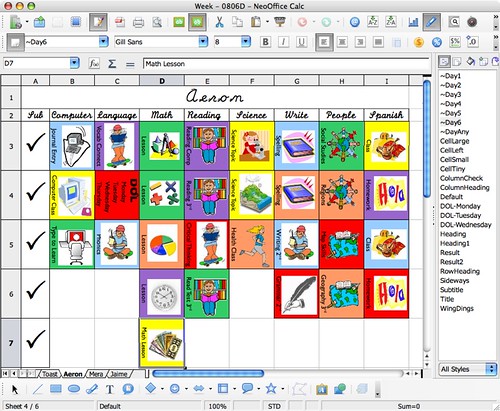
The school week is actually eight days long: three days on, one day off. On the fourth day, we clean the boat. On the eighth day, we rest. Even the Christian God got a day off occasionally. On school days, the girls generally roust out of bed when they hear us start to grind the coffee. Experience teaches them that if they do not get upstairs by the end of my first cup, they get cold cereal with reconstituted powdered milk for breakfast. Timely arrival at the breakfast table, however, yields rewards in the form of muffins, pancakes, hot cereal, or eggs and toast.

After we break our fast and clear the debris, the girls start work on their “checks.” We have a table of checks appropriate for each girl designed to balance out their workload. Despite all my exposure to unschooling, I’m still a big fan of eating your vegetables before you get dessert. With our girls, each has subjects she loathes and others she craves. We balance our conventional twisted need to control with their passionate need for freedom. Take thirty checks, divide by six days, and each girl gets to pick her five for the day as long as all thirty get done by the end of the week. School is over for the day when they finish their checks, generally by lunch.

A check can be a lesson in one of their work books, progress on a project, or a class with one of the adults. We have “Health” class once a week -- generally a time for family to learn health and safety relating to their boat lives. Last week, for example, we worked on fire prevention. Now the girls know how to shut off fuel to the Yanmar’s and put out a fire in the engine compartment without opening the hatch. At Dr C’s request, I teach a “Computer Class”, he teaches Spanish four times a week, and the girls are doing a large scale project on an imaginary country.
Aeron's Check Sheet
Aeron's Check Sheet
Originally uploaded by toastfloats.
In our land homeschooling life, we also had checks at the homeschool resource center for art, drama, music, pottery, and Irish Dance. Those are off the table. The girls do whatever they want with their own time. Progress is spotty in music and drama, but art and craft are galloping along as the girls’ interests diverge. Reading is never a problem since the girls are all voracious readers. I’ve strewn the hard drives of our computers with movies, music and software that fill in many of those cultural gaps. Our most recent success in strewing was Longitude, a fabulous movie about the invention of a clock that would work at sea. The girls watched that so many times they now pronounce longitude like the Brits with a soft g. Mera and Aeron are learning how to embroider. Jaime is still practicing her guitar as well as pumping out increasingly elaborate hemp and bead jewelry which is now of a quality and volume to render her a commercially viable business.

My own progress on weather fax interpretation, emergency medicine, and algebra is -- I’m afraid -- considerably spottier. I keep getting distracted by sail and canvass repair books, sewing projects, and new bread recipes. It’s probably time to set myself up on a check system, too.

Wednesday, April 23, 2008

Math and the Homeschooler

Today, a fellow cruiser and I discussed math programs for your boat schooled child. I should write a very long post on this subject, really I should. For now, however, I feel honor bound to post at least some of my thoughts -- unedited and unexpurgated. Brace yourself for a bit of profanity and some defensiveness. Selecting curriculum as a homeschooler appears to inevitably involve defensiveness.

Short Form: Two really important bits you must remember when you select workbooks and curriculum for your homeschooled child:

(1) Home schooling is NOT school at home. What works for schools will not necessarily work for homeschoolers. Conversely, a program that sucks in the schools will succeed admirably in the homeschool environment.

(2) Do not invest yourself emotionally in any program before your child gives you the approval. No program, book, worksheet, drill or web site you select will survive it's first encounter with the enemy - your children. Prepare yourself in advance for cycling through a variety of materials until you find something that makes her eyes light up and his face break into a wide grin.

Now, somewhat edited excerpts from my rather windy letter to my fellow cruising educator:

I will go this far with down the Unschooling parade with math: If Math is not fun, it sucks. In fact, if math is not fun it blows monkey chunks out of an ape's ass who is sick with a peculiar disease which renders everything so smelly you can't sit 10 miles down wind of it without a gas mask, a stick of incense, and a necklace of garlic.

Saxon is not fun. If there is a polar opposite to fun anywhere in this world, it is Saxon. In fact, under "fun" in the dictionary of life, "Saxon" is listed as an antonym.

Singapore is boring. Really really REALLY boring. You do the same thing over and over and over and over and over again with mangos and papayas until your eyes bleed and your brain flows out your butt. Do you have even the slightest comprehension what it means to present multiplication to a 3rd grader 1,076 times in a single year? I can not think of a single thing I would present to my 3rd grader 1000 times... not even the concept of elbows off the table merits that kind of focused attention.


* * *

In defense of Everyday Mathematics, many teachers HATE it. I've spoken with Seattle teachers who are using it. I can understand why they hate it; You can not teach a class of 30 using this program. The reason why 3rd graders do not see multiplication 1,076 times is that they are working on geometry, algebra, graphs, charts, factoring, temperature, clocks and dogz only knows what else. Every day you get a wee bit of something and a wee bit of something else. In other words, every day, the child does 10 different types of problems spread all over the mathematical landscape. It is an extremely rare lesson that makes a child do the same type of problem more than 2 or 3 times. No repetition makes Johny a happy student and Ms. Smith absolutely miserable teacher because the kids in the class are all over everywhere. There is no Lesson. There is no Assignment. There is no Quiz. There is no Test.

However, if you need/want a workbook and some structure, I think Everyday Mathematics might have been designed with homeschoolers in mind. It makes some basic assumptions about kids:
* They have the attention span of houseflies and will not want to do the same type of problem over and over and over again
* Math is not hard
* Math should be about something useful and familiar
* Repetition THROUGH TIME... i.e. doing the same type of problem scattered randomly throughout an entire year... in fact over the course of 6 years ... builds knowledge better than doing the same problem many times and then not revisiting the topic until next year
* Teachers have time to remind kids who haven't seen a problem in 2 months how they managed to solve those problems in the past
* 1st graders are just as capable of learning algebra and geometry and graphs as 6th graders
* There is no Right Age to learn certain mathematical strategies
* Calculators are not the enemy

BTW, I've seen the millions of links to folks excoriating Everyday Mathematics. All I can say is the homeschool families I know using it, including my own, are having a great time with happy math learners, excellent test results, and kids who can tell time, calculate prices and discounts, and figure out how much carpet we need to buy to cover the floor in the apartment.

* * *

I will also offer my general rule of thumb for all textbooks and curriculum: The more the program is detested by either: (1) the teachers' unions and/or (2) the religious fundamentalists, the more probable our family will find the material useful, educational, and entertaining. The former because teaching 30 is not teaching 3; they truly need different materials. The later because I'm pretty firm on the whole "world is older than 6000 years" thing which makes for a pretty binary approach re: science and history texts.

* * *

When you select curriculum, picture yourself at anchor off a warm shore with a light breeze, a glass of fruit juice and soft music on the stereo attempting to keep your child from jumping into the water until the lesson is done. Then pick which one is the least likely to require physical restraints.

Monday, March 31, 2008

We Don't Need No Stinkin' (Electronic) Toys

A few weeks ago, the owner of a beautiful Norhaven powerboat in our marina ordered a minion over to dump every personal good onto the dock in the name of a remodel. The worth of this nautical trash was roughly that of the annual GDP of a mid-sized Caribbean island. Fortunately, the minion could not bear to see this haul simply dumped into the garbage and hauled off to a land fill. He asked and received permission to leave the entire lot next to the dumpster for a day to let the seagulls and liveaboards scavenge.

We carted off at least a thousand dollars worth of additional stuff to sink our boat. Among the prizes were a dozen really nice plastic containers, four fishing rods complete with reels, and two Canon Powershot cameras including one underwater case. For the girls, the biggest prize was two Nintendo Gameboys.

To put this treasure in perspective, it is important to note that the girls do not have any game boxes, cubes, computers, or hand helds. Our only computer games are of the Jump Start/Chessmaster variety. It's not that Dr C and I are morally, ethically or religiously opposed to video games. In fact, the girls and I played World of Warcraft for a year with the consistency and dedication of novitiates in a nunnery. While Aeron only managed a level 14 priest, Jaime was up in the 40s hunter and I had a mid-60 shaman before boredom set in.*

We simply do not have the money. We do not have the space. And, it turns out, we do not have the inclination. For two days, the girls did nothing but play with those Gameboys. Actually, they did one other thing – they argued over whose turn it was to play with the Gameboy since we only found two and mathematically it just wasn't working out.

And then the arguing stopped. In fact, the Gameboys stopped. They didn't stop functioning... I actually tested one to make sure. No, they simply stopped using them. One got kicked under a seat, the other was lost in Jaime's capacious purse. No one cared. Now, I'll occasionally see one of them pull out a pair of headphones and start messing around with a controller, but for the most part, the Gameboy phase is officially over.

Which totally justifies my refusal to buy these things. The girls have never grown out of the mode wherein the packaging has more entertainment value than the present.

The behavioral arc with television is roughly the same. The day they show up at their grandparents, it is impossible to extricate them from the TV. They are stuck to it like starfish to a dock piling, all eight arms wrapped around the device with super glue strength. You can pry off one long arm with a wrench and a champagne cork pop only to find all previously detached limbs whipping around the base with renewed force.

So I don't even try. Because after about 48 hours of this, the girls get bored. They drift out of the TV room with glazed eyes and drool on their chins, grab a handful of Oreo cookies, and disappear outside. For the rest of the visit, they may be found watching a Disney channel movie or Nic @ Nite for a few hours before bedtime, but largely the cable industry has lost its hold on my children.

Attack of the Thing
Attack of the Thing
Originally uploaded by toastfloats.
The power of electronic toys to take over the intellectual lives of our selves and our children can be broken – and broken permanently. Remove them from your life but do not make them forbidden. Simply don't buy them. Don't bring them into the house. When the kids get access, they will play for awhile with this otherwise inaccessible distraction. But video games, Disney reruns, and the Wii are simply not as fun as play. Nothing, in fact, is as fun as play.

And you can't really play with something that doesn't play back. We don' need no stinkin' electronic toys. Just give us the real thing, two hours of parental neglect, and a handful of like-minded kids. Welcome to the next level.

* Of course, all Horde. I'm surprised you'd have to ask.

Wednesday, February 27, 2008

The Cheese Stands Alone

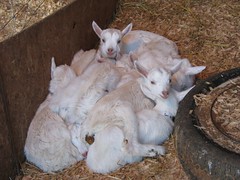
A Pile of Goats
A Pile of Goats
Originally uploaded by toastfloats.
For Valentine's Day this year, Dr C got me a trip to Chehallis to attend a goat cheese making class. This may not sound particularly romantic, but after 20 years, I'm just glad he routinely remembers these little Hallmarkian niceties. In fact, he must have struggled to out due last year's stellar V-Day gift – a t-shirt emblazoned with the slogan “Trophy Wife.”

I started making cheese last fall. We were all desperately seeking ideas for crafts to make for our Solstice gifts, and I stumbled on a cheese making kit. For several weeks, I explored the wonderful world of mozzarella. During my obsession phase, I made over a dozen batches, some of which were quite good. Others not so much.

Cheese making is a cross between cooking, alchemy and an exercise in bacterial faith. As with beer, you start with a startlingly short list of ingredients and straightforward, deceptively easy instructions. Then you spend the rest of your life trying to figure out where you screwed up. Unlike beer, even complete disasters can actually still be referred to as cheese. Cheese is a very forgiving food category.

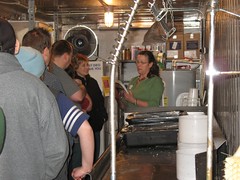
So on Saturday, I drove down to central Washington to visit the Blue Rose Dairy and extend my fromage-ilogical skills to chévre. Chévre is apparently French for goat and refers to any cheese made out of goat milk. Oddly for the French, this makes no sense whatsoever. Feta would technically be a chévre, while a jack, Gouda or blue would also be a chévre if you used a goat instead of a cow as your teat of choice. However, chévre in stores appears to also refer specifically to a goat milk cheese with a creamy texture and a slightly sour flavor which you mix with herbs or fruit to make spreads. Think of a cross between cream cheese and sour cream with a grainier texture and then add 10% bonus flavor crystals just for the heck of it. This is what we learned how to make.

First, goat milk is not skanky. Bad feta may have made you think that “goat” is a pejorative term for cheese that smells like the inside of an old basketball shoe and tastes worse. Actually, goat milk tastes a lot like cow milk except somehow inexplicably yummier. Second, goats don't smell. This seems impossible, but I stood in a barn full of 100 some odd goats, and it smelled like turned earth and warm milk. The goats were clean, friendly, and basically harmless. I've stood in similarly equipped barns full of cows and debated whether I'd be killed first by the smell or some stupid bovine backing into me and crushing me flat.

Some goat facts:
* Did you know that a goat doe in her prime produces two gallons of milk per day? Holy cripes.
* Goat milk is healthier than cow milk.
* Like human milk, goat milk changes flavor based on what the goat eats. This explains so much.
* Goat meat is yummy.
* Goats make really good pack animals and can carry their weight plus about 10 percent.

Rhonda of Blue Rose Dairy
Originally uploaded by toastfloats.
The day was a sterling success, not just because I spent a day without children, a paintbrush, or a tax accountant. The drive was beautiful, the weather glorious, and the creamy chévre we made during class astonishingly good. My favorite taste sensation was smearing it on crackers and drizzling honey over the top.

Today, I made my own batch of chévre. Unfortunately, it looks and tastes a lot more like yogurt. Back to the drawing board.

Wednesday, February 13, 2008

The Business Objective

Head of House
Head of House
Originally uploaded by toastfloats.
I've had some truly amazing bosses over the years. Amazingly good, amazingly bad. The goods ones were teachers, mentors and friends. The good ones still show up on my transom occasionally asking me to set up the docs departments for their latest startup. This is not why they are good, mind you, though it helps my maintain my positive opinion when you supply a steady source of ready cash. Those bosses are good, because they recognize quality and grow it. They were never threatened by competence or surprised by ignorance. They adapted.

Over the years, I distilled what they taught me into a few short, useful phrases which I would chant to myself any time I felt like losing my patience, my temper, or my sanity. It took me nearly eight years with my children before I began to recognize the applicability of these “Best Practices” as a playbook for parenting. With very little imagination, you can treat your children as challenging employees and your spouse as a difficult but basically well-meaning boss. And don't go all feminist manifesto on me. I've always managed my managers at least as diligently as my staff, sometimes to greater result.

I offer these as a free, snap course in management (or parenting) technique:

Always We, Never I
– Whenever possible, kids need to feel that the entire family is suffering the slings and arrows of outraged choredom. We need to clean the laundry. We need to get our work done before we play. We must visit the grandparents, go to the homeschool resource center, scrub bird crap off the forward deck. While our family is in no way a democracy, building a sense of shared suffering, effort and camaraderie works better than the top-down, “get your chores and checks done or else!” approach.

Take the Blame, Share the Credit – I try to take the blame. I try to apologize when I lose my temper, fitch a pit and jump in it, break something. I do far better in the work environment, because at home I'm pretty much convinced it's always their fault. It's easier to apply the share the credit portion. Kids love praise. So do husbands. Generosity in recognizing their accomplishments, lauding the daily bits of progress on projects, school work, or cabin organization, yields powerful downstream results.

Only Yell When You're Alone – This could also be known as the “United Front” clause. Basically, support in public and reprimands in private. Oh man, I truly wish I had this sort of self-restraint with my children. It's something I need to work on. Everyone – every single member of the family – deserves your support and respect in public. All those conflicts and frustrations should be kept private. I'd even like to keep them from one another... take them up quietly in a rational, calm one-on-one fashion. Good luck with that. With three kids, I'm far more likely to be frustrated with the entire lot of them and blow up, spattering motherly vile in every direction. Just because I like these guidelines, does not mean I'm universally successful following them.

Manage Your Staff to Take Over Your Job
– Finally! A rule I apply to my children with complete success. My kids are quite bright bulbs on the Christmas tree of life. I have no doubt that they will be considerably more successful than their parents, particularly if you measure success in terms of happiness rather than goods. They are learning very early in life how to make the hard choices that Dr C and I did not grapple with until we had our now moderately infamous mid-life crisis.

A Job is Not Worth Your Sanity – My children are not the most important relationship in my life. My husband has that dubious responsibility. I figure I'll live with them for maybe 18 years, while I've already lived with Dr C for over 20. And he'll be around for at least another 50! On balance, they have to take a back seat to the needs of our marriage. Turns out, they're good with that.

Do Not Pad Your Budget – Let your boss deal with the fact that your resources never meet the needs or expectations of Sales and Marketing. I translate this in parenting terms as not pretending that your children are something that they are not. Work with what you have, not what you want to have. Got a pubescent monster? Put her on chocolate and Ibuprofin and confine her to her cabin. Got a 10–year-old who keeps forgetting her schoolwork? Set her up with daily backpack lists and pray she becomes an absent-minded professor. My children are not perfect. They are not the best, the most, the greatest, the -est-est anything. And the only way that becomes a problem is if I'm not satisfied with who and what they are. Even then, it's my problem, not theirs.

Butter Won't Melt
Butter Won't Melt
Originally uploaded by toastfloats.
Define the Business Objective – Part of homeschooling for us has been a very thorough reinvestigation of the basic business objective for education. It seems we spend a great deal of effort in 1) scoring high on standardized tests, 2)getting admitted to the best university, and 3)socializing children to work well with others. But what do children really need to succeed in this world? More importantly, what will our children need to succeed in the world 15 years from now when the economy and society have shifted due to changes in climate, technology, and social norms? I am increasingly certain that traditional school does not provide our children with any of the tools they are going to need in that dimly glimpsed future. Mind you, I am not sure that homeschooling does either. Boatschooling, on the other hand, will at least provide the girls with many of the skills necessary to survive in some post-apocalyptic, dystopian hell world. God help them.

* * *

Children manage their parents as much as we manage them. Someone, however, must get paid the big bucks to make the hard decisions and to call the staff meetings. In our family, I'm the project manager and Dr C is the CTO. It remains to be seen which of my girls will grow into our jobs and take over. At least we'll know that they are capable of doing so.