A few mornings before Christmas, I woke suddenly and completely with a thought big and crystal clear in my head: We need to sell Don Quixote. I turned to my sleepy husband and pounced on him with this idea. DrC is not clear headed in the morning. Like most men, he can think of only a two things when awakened. One of them is coffee. If I were to get his full attention, it required that I dispose with these ideas first.
Moving on, the idea of selling Don Quixote fell on fertile emotional soil. We had seriously been noodling leasing her, but the logistics were a nightmare. Putting her on the hard for a year means a lot of expense and slow degradation of the boat without any real return to us. If we planned to cruise for several years after New Zealand, it would make sense to keep her. However, as I've mentioned before, we do not have that much cruising kitty left... maybe a year at most. Jaime is getting long in the tooth for cruising, Aeron would like to spend longer chunks of time in single locations. This summer tempted all of us with a glimpse of a nomadic land life. The absence of Don Quixote in our life would be a financial relief, but it could also be the lifting of a burden enabling us to consider completely different adventures going forward.
Christmas Day found me on the deck of s/v Totem talking with our good friends Behan and Jamie. We were discussing all the options for the future, New Zealand paperwork, and teenagers. Without any prompting, Totem asked me, “Have you thought about selling Don Quixote?” I was struck by this coincidence. Prior to this not a single soul – online or nautical – had asked me whether or not we wanted to sell her. In the cruising world in particular, boat selling and ending the cruising life are topics that no one brings up unless the owner opens the subject. I think it might be taboo. Yet, here was Totem asking about selling Don Quixote before I said anything.
“Why yes... we had just started thinking about it. But it seems... it seems like a really big idea.” I'm almost babbling.
Jaime was less sanguine. When we broached the idea with the girls, we met with mixed reactions. Jaime cried. In her deeply contemplative fashion, Mera thought about the idea and informed us that this made a great deal of sense. She was ready for a new experience. Aeron vacillated back and forth but was largely concerned about Dulcinea's reaction.
This is as far as we'd gotten when a note arrived in my Inbox three days later from a couple we'd met in the Sea of Cortez last summer. “Remember us? We're planning on cruising this fall, and we heard about New Zealand. Would you consider selling or leasing Don Quixote?”
Rule of Three* strikes again.
So if you asked me two weeks ago if we'd sell Don Quixote, I would have said, “Hell no!” And if you ask me today, I'm going to say, “What are you offering?”
The immediate plans do not change. We spend the next two weeks moving the boat back to La Paz. There we are going to clean and empty her out since – whether sold or on the hard – she needs to be empty and clean. Then we'll haul her, paint her bottom, and get a survey done. Again, this must be done. We can't sell her like she is, and we can't leave her on the hard without a new survey for insurance reasons.
But we'll also be exploring all the many varied options of how you list and sell a boat without spending a fortune. The first is, of course, the ubiquitous hive mind of my blog, Twitter feed, and Facebook account. If you know of anyone considering buying a Lagoon 380 in the Pacific, tell them now is the time to do so. There are very few of us out here, they rarely go on sale, and when they do, the owners are rarely as motivated and willing to do a good deal as we are. We will put together a web page with her specifications and equipment over the next week, and get it out to the hive mind with a URL as soon as possible.
The other thing that does not change is our status of “floating.” If cruising is way of thinking, a form of living without traditional boundaries and in a liquid state of adaptive learning, we continue our cruising life for the foreseeable future. Even without Don Quixote, we can cruise in a tramper in New Zealand or Australia, by train in Europe, via R.V in the United States. We can hike, bike, or park. Ironically, the cruising kitty can sustain us for many more years if we simply change the mode of transportation: Our boat is beautiful but like every boat afloat she is a black hole into which you pour money.
I think we needed the comfort and spacious beauty of our Lagoon catamaran to get us out of our incredibly plush, capacious and comfortable land lives. After nearly three years of living on her and two years of moving her from place to place, however, we know how to live much larger with much smaller accommodations, how to do a lot more with a lot less.
Believe it or not, the Conger family is ready to downsize and purge. Again.
* Rule of Three – If three things happen in quick succession that point you towards or away from a certain course of action, the Fates are trying to tell you something. It is a very good idea that you listen and obey.

Showing posts with label multihull. Show all posts
Showing posts with label multihull. Show all posts
Thursday, December 31, 2009


Sunday, December 06, 2009
Guide to Reviewing a Catamaran
I just completed a totally inadequate review of the Seawind 1160 in a popular cruising magazine and must now rant. Like just about every article written in recent memory about a cruising catamaran, this one told me nothing useful.
Let me first note what is consistently wrong with these articles which appear in everything from local free circulars and web sites to glossy, expensive sail publications: The author is probably an expert on monohulls with little to no expertise in multihulls in general and cruising catamarans in particular. He will be impressed by/happy with/surprised by the following:
- the spaciousness and comfort of the living quarters
- the speed with which the vessel accelerates to the wind
- the downwind performance
- the stability and comfort at anchor even in considerable ocean swell
- the excellent maneuverability in docking situations with two widely separated motors
He will be disturbed by/unhappy with/dissatisfied with the following:
- the poor upwind performance
- the loud boom or slap when water hits the bridge deck while underway
- the uneven, “hobby horse” motion in choppy seas
- the tendency to “sail around” at anchor
- the poor visibility of the far side of the boat during docking maneuvers
The only thing you have learned thus far is that the author was on a catamaran. Every single cruising catamaran -- ALL of them -- have the above listed advantages and disadvantages when contrasted with their cruising monohull brethren. Without exception. If the author is now done with his 3,000 word review, he shouldn’t get paid.
I am not the catamaran bigot I was two years ago. Years out here have shown clearly why reasonable people can look at multihulls versus monohulls and choose to purchase the later. There are benefits and disadvantages to every style of boat, every model, and category. Catamarans have issues just like ketches, schooners, sloops, fractional rigs, etc. But if you are going to review a catamaran, I need you to describe the performance characteristics of the specific catamaran you are looking at. Don’t tell me what I already know simply because the vessel you are looking at has two hulls.
I recommend that all reviewers of multihull craft -- including individuals considering a catamaran purchase -- ask and make sure you get answered these questions:
There are many more details I could add. However, even answering this short set of questions would go a long way towards improving the quality and utility of catamaran reviews. It would certainly assist a potential buyer with comparing catamarans across brands, models and years. If you are a catamaran owner seeking to sell your craft, a dealer or a manufacturer, I encourage you to immediately sit down and figure out how to answer these questions yourself. I assure you, DrC and I at least will insist on the answers before we purchase our next boat.
Let me first note what is consistently wrong with these articles which appear in everything from local free circulars and web sites to glossy, expensive sail publications: The author is probably an expert on monohulls with little to no expertise in multihulls in general and cruising catamarans in particular. He will be impressed by/happy with/surprised by the following:
- the spaciousness and comfort of the living quarters
- the speed with which the vessel accelerates to the wind
- the downwind performance
- the stability and comfort at anchor even in considerable ocean swell
- the excellent maneuverability in docking situations with two widely separated motors
He will be disturbed by/unhappy with/dissatisfied with the following:
- the poor upwind performance
- the loud boom or slap when water hits the bridge deck while underway
- the uneven, “hobby horse” motion in choppy seas
- the tendency to “sail around” at anchor
- the poor visibility of the far side of the boat during docking maneuvers
The only thing you have learned thus far is that the author was on a catamaran. Every single cruising catamaran -- ALL of them -- have the above listed advantages and disadvantages when contrasted with their cruising monohull brethren. Without exception. If the author is now done with his 3,000 word review, he shouldn’t get paid.
I am not the catamaran bigot I was two years ago. Years out here have shown clearly why reasonable people can look at multihulls versus monohulls and choose to purchase the later. There are benefits and disadvantages to every style of boat, every model, and category. Catamarans have issues just like ketches, schooners, sloops, fractional rigs, etc. But if you are going to review a catamaran, I need you to describe the performance characteristics of the specific catamaran you are looking at. Don’t tell me what I already know simply because the vessel you are looking at has two hulls.
I recommend that all reviewers of multihull craft -- including individuals considering a catamaran purchase -- ask and make sure you get answered these questions:
- Fully loaded, at what wind speed does this catamaran finally start moving?
- What is the standard sail package and is it sufficient for the vessel? For example, does it come equipped with a functional light air sail? A bow sprit?
- What is the boat’s predicted performance at various points of sail? There is “not going to weather”, and then there is never sailing very well forward of the beam.
- Are there dagger boards, and do they improve the performance of the craft?
- What provision for bulkhead isolation is standard? Some production catamarans have no sealable bulkheads from stem to stern while others do a very fine job of breaking the boat into discrete, secure chunks improving safety in the event of hull breech or turning turtle.
- Are there escape hatches?
- Is the galley up or down?
- What is the head room in the salon and in the cabins?
- What is the ratio of the length to the beam, and what is the beam of the individual hulls?
- What is the bridge deck clearance?
- Where are the water tanks, and what is their capacity? Ditto fuel tanks. Trim and weight load is a serious consideration on a catamaran.
- What is the forward visibility while seated at the helm?
- Describe the access to key systems such as the engines, the rudder and throttle controls, and the head plumbing.
- What is the theoretical hull speed?
- During your sea trial, what fraction of wind speed did you feel you could push the boat to with a strong degree of consistency?
- How challenging would it be to single-hand the boat? If the default rig is not configured to easily single-hand, how much would you need to invest to get it there?
There are many more details I could add. However, even answering this short set of questions would go a long way towards improving the quality and utility of catamaran reviews. It would certainly assist a potential buyer with comparing catamarans across brands, models and years. If you are a catamaran owner seeking to sell your craft, a dealer or a manufacturer, I encourage you to immediately sit down and figure out how to answer these questions yourself. I assure you, DrC and I at least will insist on the answers before we purchase our next boat.
Saturday, April 25, 2009
Questions from the Class - Catitude
One of my lady posse who lives on a beautiful monohull down here on the Mexican coastline with us, recently pushed me on an opinion I had casually tossed out: I'd written, “There is amongst even the older cruisers on cats a slightly different approach to cruising.” She replied, “I'm curious. How would you characterize this?”
The difference is subtle, unmistakable, and probably a temporary demographic oddity or maybe just a Winter 2008-2009 coincidence. However, there is something distinctive about this year's cruising class differentiating the multihull and monohull owners. I wrote on the subject long ago when I was naïve, and my skin was still had the pale healthy pallor of a Pacific Northwesterner. Living amongst a lot of monohull and multihull enthusiasts, it surprises me how much about that series still rings true.
Primarily for comedic effect, I characterized Catamaran guy as wearing Bermuda shorts, sun glasses, and a deep tan... the quintessential surfer dude. Weirdly, all the dedicated surfer-cruisers we have met thus far are on multihulls. That can't be right. There must be monohull surfers. But we haven't seen them yet. And all the surfing catamaran and trimaran owners dress like surfer dudes, sound like surfer dudes, look like surfer dudes complete with Polynesian beach wear, expensive sun glasses, and long bleach blonde locks. Except for Jimmie on Sea Level who looks precisely like Jean Luc Picard – in beach gear. Now all cruisers more or less look like beach bums down here. However, cruisers who surf look just a wee bit more so.
Catamarans and trimarans also show up in the anchorage with kayaks, boogie boards, dogs, cats, children, slides, floating islands, and surf boards. They look like mobile party platforms, and their crews take this responsibility very seriously.
"More room for toys makes us more like kids." -- Steve, Endless Summer
Multihull owners look at the coastline differently for a very practical reason; During the mild winters of the Mexican Riviera, a cat or tri can comfortably stop for the night just about anywhere from Punta Ipala to Acapulco. Now, any boat can stop just about anywhere along the coastline, but in most areas the swell will roll in all night long. If you're tucked in to the beach closely enough, you'll even experience rebound waves off the shore. This means the roadstead anchorages are rolly as all hell. Only the multihulls seem to be able to comfortably skip the microdot breakwaters and just drop a hook anywhere. This totally changes their planning horizon.
"Well, sure the anchorage was a bit bumpy ... but not for ... you know... us." -- Sue, Sun Baby
DrC's theory is that it's a minority group. Any time you are in a minority group -- for whatever reason -- there is a tendency to collect and bond over shared experience. Many in the multihull minority are also a bit defensive, since we prepped our boats in a culture of monohull dominance... negative monohull dominance. One evening in Barra lagoon, for example, we heard a captain bemoan on the net, "Well well, seven catamarans and a hippie tri. Time to party."
"There is still a multihull stigma. Since the 60's, they were homemade and not of good quality. It's going to take a long time for that image to go away." -- DrC
Another by product of being a minority is that multihull owners hang out with other multihull owners. So of course they tend to do the same things, visit the same places, enjoy the same restaurants and palapas.
"It's a choice to do something different. Seeing and hanging around with other multihulls validates that choice." -- DrC
"If you want to talk boat design, equipment and storm tactics, it's better to drink with someone whose boat has the same issues." -- Jim, Sea Level
Anecdotally, the average age of multihull owners and their crews is less than that of the monohull cruisers. I believe this is a demographic and economic shift rather than self-selection or any meaningful distinction. Multihulls are just starting to popularize outside of the Med and Caribbean. As new owners come into the cruising community, a higher percentage than in the past are multihulls. As time progresses, this demographic will distribute more evenly throughout the age range present out here. But for awhile, at least, the average age is lower.
“I'll admit it. We're an oddity out here. Even more than you are.” – Toby (24), captain of Triumph
Whatever the reasons, this year sees an unusually high number of catamaran and trimarans plying the coastline. Long time cruisers here regularly comment on the influx. Those familiar with cruising the Caribbean talk about how it looks like Pacific Mexico is starting to see the same transition to catamarans as happened long since in those cruising grounds. Tonight in Tenacatita, there were 27 boats, 13 of which were multihulls.
Look, it's easy to make too much of this. The hull preference distinction is no more or less significant than “hookers and dockers”, “retirees and sabbatical cruisers”, or “old couples and the rest of us.” Basically, it's human nature to play with these differences to create shifting social groups, not to mention it makes for entertaining shop talk during sun downers.
However, don't be surprised or alarmed if an anchorage near you suddenly fills up with a flotilla of masted tennis courts, blasting music and calling friendly insults and invitations to one another as they spread into the shallow and rolly spots near the beach.
Particularly if the surf is up.
The difference is subtle, unmistakable, and probably a temporary demographic oddity or maybe just a Winter 2008-2009 coincidence. However, there is something distinctive about this year's cruising class differentiating the multihull and monohull owners. I wrote on the subject long ago when I was naïve, and my skin was still had the pale healthy pallor of a Pacific Northwesterner. Living amongst a lot of monohull and multihull enthusiasts, it surprises me how much about that series still rings true.

Primarily for comedic effect, I characterized Catamaran guy as wearing Bermuda shorts, sun glasses, and a deep tan... the quintessential surfer dude. Weirdly, all the dedicated surfer-cruisers we have met thus far are on multihulls. That can't be right. There must be monohull surfers. But we haven't seen them yet. And all the surfing catamaran and trimaran owners dress like surfer dudes, sound like surfer dudes, look like surfer dudes complete with Polynesian beach wear, expensive sun glasses, and long bleach blonde locks. Except for Jimmie on Sea Level who looks precisely like Jean Luc Picard – in beach gear. Now all cruisers more or less look like beach bums down here. However, cruisers who surf look just a wee bit more so.
Catamarans and trimarans also show up in the anchorage with kayaks, boogie boards, dogs, cats, children, slides, floating islands, and surf boards. They look like mobile party platforms, and their crews take this responsibility very seriously.
"More room for toys makes us more like kids." -- Steve, Endless Summer
Multihull owners look at the coastline differently for a very practical reason; During the mild winters of the Mexican Riviera, a cat or tri can comfortably stop for the night just about anywhere from Punta Ipala to Acapulco. Now, any boat can stop just about anywhere along the coastline, but in most areas the swell will roll in all night long. If you're tucked in to the beach closely enough, you'll even experience rebound waves off the shore. This means the roadstead anchorages are rolly as all hell. Only the multihulls seem to be able to comfortably skip the microdot breakwaters and just drop a hook anywhere. This totally changes their planning horizon.
"Well, sure the anchorage was a bit bumpy ... but not for ... you know... us." -- Sue, Sun Baby
DrC's theory is that it's a minority group. Any time you are in a minority group -- for whatever reason -- there is a tendency to collect and bond over shared experience. Many in the multihull minority are also a bit defensive, since we prepped our boats in a culture of monohull dominance... negative monohull dominance. One evening in Barra lagoon, for example, we heard a captain bemoan on the net, "Well well, seven catamarans and a hippie tri. Time to party."
"There is still a multihull stigma. Since the 60's, they were homemade and not of good quality. It's going to take a long time for that image to go away." -- DrC
Another by product of being a minority is that multihull owners hang out with other multihull owners. So of course they tend to do the same things, visit the same places, enjoy the same restaurants and palapas.
"It's a choice to do something different. Seeing and hanging around with other multihulls validates that choice." -- DrC
"If you want to talk boat design, equipment and storm tactics, it's better to drink with someone whose boat has the same issues." -- Jim, Sea Level
Anecdotally, the average age of multihull owners and their crews is less than that of the monohull cruisers. I believe this is a demographic and economic shift rather than self-selection or any meaningful distinction. Multihulls are just starting to popularize outside of the Med and Caribbean. As new owners come into the cruising community, a higher percentage than in the past are multihulls. As time progresses, this demographic will distribute more evenly throughout the age range present out here. But for awhile, at least, the average age is lower.
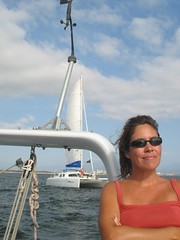
“I'll admit it. We're an oddity out here. Even more than you are.” – Toby (24), captain of Triumph
Whatever the reasons, this year sees an unusually high number of catamaran and trimarans plying the coastline. Long time cruisers here regularly comment on the influx. Those familiar with cruising the Caribbean talk about how it looks like Pacific Mexico is starting to see the same transition to catamarans as happened long since in those cruising grounds. Tonight in Tenacatita, there were 27 boats, 13 of which were multihulls.
Look, it's easy to make too much of this. The hull preference distinction is no more or less significant than “hookers and dockers”, “retirees and sabbatical cruisers”, or “old couples and the rest of us.” Basically, it's human nature to play with these differences to create shifting social groups, not to mention it makes for entertaining shop talk during sun downers.
However, don't be surprised or alarmed if an anchorage near you suddenly fills up with a flotilla of masted tennis courts, blasting music and calling friendly insults and invitations to one another as they spread into the shallow and rolly spots near the beach.
Particularly if the surf is up.
Tuesday, July 29, 2008
Get a Cat* - Redunancy
Two men stand on a field of white. The one on the left is a handsome white man, about 50, distinguished, knowledgeable, and stylishly dressed for dinner at a seaside restaurant. The one on the right is much younger, casually attired in Bermuda shorts, Crocs, an open T-shirt, and hailing from some mixed Pan-Pacific ancestry. A pleasant jingle plays unobtrusively in the background.
Both men are jogging quickly in place. They've jogged long enough to ruffle their hair and look a bit sweaty and tired. The younger man speaks first:
Catamaran pants, “Hello, I’m a Catamaran.”
Monohull says breathily, “And I’m a Monohull.” He gulps down air between each sentence as he continues, “Today was sunny and calm. No seas. No wind. But we need to get to the next big marina. Restock, showers. Water.”
Catamaran pumps for a moment gathering his breath, “So we decided to motor. It's a long way for a beer run. But what are you going to do?...” Abruptly, Catamaran starts coughing and slows down to a walk.
Monohull glances over, concerned, and slows his pace as well, “Are you all right, Catamaran?” He begins a slow walking circle around Catamaran as he looks over his companion.
Catamaran shakes his head ruefully, “'Fraid not. Lost the port engine.” He continues to walk as he shakes out his left arm. “I think it's the impeller.”
Monohull's expression changes to a knowing look, “Time for some maintenance, heh? Well it happens to all of us. There's a little anchorage just there you can hole up in till you fix it.” While he tries to appear sympathetic, it's quite clear that he's delighted to show up the younger man. “I guess if you don't need me, I'll just be heading off to La Paz.” His pace starts to increase.
Catamaran smiles and also increases his pace to match that of Monohull. “No need. I'll just fire up the starboard, and we can be off.”
Monohull looks chagrined as the two increase to their former rapid jog. He mutters, “Oh right. The starboard engine. How could I forget.”
That second engine is going to cost you: Time, money, maintenance. On the other hand, it's also a backup engine that pretty well ensures you won't get left out there without a motor. This redundancy vs. cost equation is true of many aspects of your catamaran. Two engines, two heads, two hulls. Break one and the other holds you up. I'm reminded of a concept from that luminary of the sailing world Lin Pardey. She talks about being “unstoppable.” Unstoppable isn't so much a state of equipment as one of attitude.
I, for one, have a much better attitude when I get to my anchorage on time.
* Author’s Note: All credit to the Get a Mac marketing team whose incredibly clever work inspired this series. This will be the last one unless something inspires me.
Both men are jogging quickly in place. They've jogged long enough to ruffle their hair and look a bit sweaty and tired. The younger man speaks first:
Catamaran pants, “Hello, I’m a Catamaran.”
Monohull says breathily, “And I’m a Monohull.” He gulps down air between each sentence as he continues, “Today was sunny and calm. No seas. No wind. But we need to get to the next big marina. Restock, showers. Water.”
Catamaran pumps for a moment gathering his breath, “So we decided to motor. It's a long way for a beer run. But what are you going to do?...” Abruptly, Catamaran starts coughing and slows down to a walk.
Monohull glances over, concerned, and slows his pace as well, “Are you all right, Catamaran?” He begins a slow walking circle around Catamaran as he looks over his companion.
Catamaran shakes his head ruefully, “'Fraid not. Lost the port engine.” He continues to walk as he shakes out his left arm. “I think it's the impeller.”
Monohull's expression changes to a knowing look, “Time for some maintenance, heh? Well it happens to all of us. There's a little anchorage just there you can hole up in till you fix it.” While he tries to appear sympathetic, it's quite clear that he's delighted to show up the younger man. “I guess if you don't need me, I'll just be heading off to La Paz.” His pace starts to increase.
Catamaran smiles and also increases his pace to match that of Monohull. “No need. I'll just fire up the starboard, and we can be off.”
Monohull looks chagrined as the two increase to their former rapid jog. He mutters, “Oh right. The starboard engine. How could I forget.”
That second engine is going to cost you: Time, money, maintenance. On the other hand, it's also a backup engine that pretty well ensures you won't get left out there without a motor. This redundancy vs. cost equation is true of many aspects of your catamaran. Two engines, two heads, two hulls. Break one and the other holds you up. I'm reminded of a concept from that luminary of the sailing world Lin Pardey. She talks about being “unstoppable.” Unstoppable isn't so much a state of equipment as one of attitude.
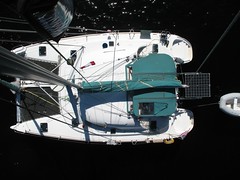
I, for one, have a much better attitude when I get to my anchorage on time.
* Author’s Note: All credit to the Get a Mac marketing team whose incredibly clever work inspired this series. This will be the last one unless something inspires me.
Thursday, July 10, 2008
Get a Cat* - Underway
Two men stand on a field of white. The one on the left is a handsome white man, about 50, distinguished, knowledgeable, and stylishly dressed for dinner at a seaside restaurant. He’s standing at an angle while trying with limited success to eat from a package of Cup-O-Noodles.
On the right is a much younger man, casually attired in Bermuda shorts, Crocs, an open T-shirt, and hailing from some mixed Pan-Pacific ancestry. He’s seated at a table with a glass of wine, a steaming bowl of what appears to be bouillabaisse, and a crusty loaf of bread.
A pleasant jingle plays unobtrusively in the background.
The younger man takes a sip and speaks first in a relaxed, cheerful tone of voice, “Hello, I’m a Catamaran.”
Monohull glances up and says wearily, “And I’m a Monohull.”
Catamaran addresses the audience, “Today, my friend Monohull and I have had a really nice sail down the coast. We left early this morning, but we are almost there. Good, strong winds and a bit of chop, but absolutely beautiful weather. I’ve been tacking a lot, but Monohull here has been having a great run pointed up into the wind. He’s made fantastic time!”
Monohull demurs, “Well, I don’t like to blast my own horn, but I do think I’ve made better time than you today. Just shows you, Catamaran, that you’re not as speedy as you thought, heh?”
Catamaran smiles and shakes his head in admiration, “You are so right, Monohull. This is your sea! You look great, sleek, fast!”
Monohull blushes and looks down, but clearly he’s rather proud of himself. “Well… you know… I am a trim vessel…” He pats his belly with a tired smile and allows, “It’s been a good day for both of us.”
Catamaran apparently agrees and stands, holding up his wine glass. “A toast to you, Monohull, for a well sailed trip!” The younger man is standing straight, throwing into sharp relief the slant of Monohull man. Catamaran looks full of energy and happy for his friend.
Monohull glances over, “A toast? What’s that?...” For the first time he notices Catamaran’s dinner, the elegant table setting, the steaming fragrant soup. He asks incredulously, “What are you eating?”
“Oh, we whipped up some soup from the shellfish we got at the market yesterday.” Catamaran glances at the table, then the glass in his hand. “Baked some bread, found a good bottle of Merlot in the starboard bow that I’d forgotten was there. I think we’ll make a crème brulee for dessert.” He turns his gaze to Monohull, “What are you having?”
Monohull glances at his Cup-O-Soup and then hurriedly hides it behind his back, “The same.”
Point of sail makes a difference. Catamarans do not point as high into the wind as monohulls. So depending on the wind direction, you can find yourself following a monohull all day long as you tack back and forth, or you can sail off on a downwind run at half again their speed but way out of your way. It is a rare day when you're lucky enough to turn the much ballyhoo'd speed differential of your multi-hull into an actual improvement in time to anchor.
Ditching the rail on a leaner represents the height of sailing excitement, and at times we regret the loss of that exhilarating feeling of speed and movement. However, for the long haul, we prefer to arrive refreshed and ready to dance the night away at the local cantina.
* Author’s Note: All credit to the Get a Mac marketing team whose incredibly clever work inspired this series.
On the right is a much younger man, casually attired in Bermuda shorts, Crocs, an open T-shirt, and hailing from some mixed Pan-Pacific ancestry. He’s seated at a table with a glass of wine, a steaming bowl of what appears to be bouillabaisse, and a crusty loaf of bread.
A pleasant jingle plays unobtrusively in the background.
The younger man takes a sip and speaks first in a relaxed, cheerful tone of voice, “Hello, I’m a Catamaran.”
Monohull glances up and says wearily, “And I’m a Monohull.”
Catamaran addresses the audience, “Today, my friend Monohull and I have had a really nice sail down the coast. We left early this morning, but we are almost there. Good, strong winds and a bit of chop, but absolutely beautiful weather. I’ve been tacking a lot, but Monohull here has been having a great run pointed up into the wind. He’s made fantastic time!”
Monohull demurs, “Well, I don’t like to blast my own horn, but I do think I’ve made better time than you today. Just shows you, Catamaran, that you’re not as speedy as you thought, heh?”
Catamaran smiles and shakes his head in admiration, “You are so right, Monohull. This is your sea! You look great, sleek, fast!”
Monohull blushes and looks down, but clearly he’s rather proud of himself. “Well… you know… I am a trim vessel…” He pats his belly with a tired smile and allows, “It’s been a good day for both of us.”
Catamaran apparently agrees and stands, holding up his wine glass. “A toast to you, Monohull, for a well sailed trip!” The younger man is standing straight, throwing into sharp relief the slant of Monohull man. Catamaran looks full of energy and happy for his friend.
Monohull glances over, “A toast? What’s that?...” For the first time he notices Catamaran’s dinner, the elegant table setting, the steaming fragrant soup. He asks incredulously, “What are you eating?”
“Oh, we whipped up some soup from the shellfish we got at the market yesterday.” Catamaran glances at the table, then the glass in his hand. “Baked some bread, found a good bottle of Merlot in the starboard bow that I’d forgotten was there. I think we’ll make a crème brulee for dessert.” He turns his gaze to Monohull, “What are you having?”
Monohull glances at his Cup-O-Soup and then hurriedly hides it behind his back, “The same.”
Point of sail makes a difference. Catamarans do not point as high into the wind as monohulls. So depending on the wind direction, you can find yourself following a monohull all day long as you tack back and forth, or you can sail off on a downwind run at half again their speed but way out of your way. It is a rare day when you're lucky enough to turn the much ballyhoo'd speed differential of your multi-hull into an actual improvement in time to anchor.
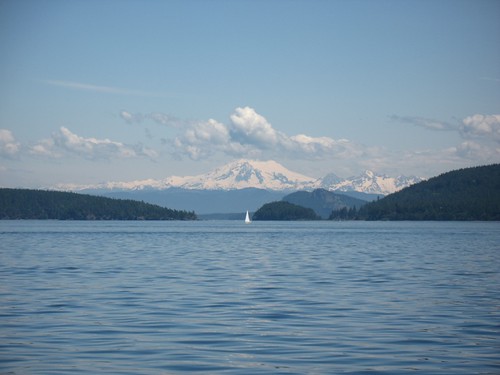
Ditching the rail on a leaner represents the height of sailing excitement, and at times we regret the loss of that exhilarating feeling of speed and movement. However, for the long haul, we prefer to arrive refreshed and ready to dance the night away at the local cantina.
* Author’s Note: All credit to the Get a Mac marketing team whose incredibly clever work inspired this series.
Subscribe to:
Posts (Atom)