Showing posts with label liveaboard. Show all posts

Thursday, March 15, 2012

How Do You Eat a Boat?

Obviously, one bite at a time... and invite absolutely everyone you know.
Time to Go by toastfloats
Our trip is over. As with any great life passage, we punctuated our journey with a big party at the beginning and end: opening and closing ceremonies at the Olympics, baby shower and wake, bridal shower and girls' recovery night out, bon voyage and fin du voyage. Our Bon Voyage party was in May 2008. We invited our neighbors, our friends, our family. It was a stunningly beautiful day as only Seattle can be when the weather is perfect. In fact, the mountain was out... a statement meaningful to anyone who has lived in the Puget Sound for any length of time. We were happy and scared, excited and absolutely ready to embark on completely new lives.

Our Fin du Voyage is a bit diferent. We are bringing to a close an amazing phase of our lives. We aren't quite moving forward into something utterly new and strange. Yet, we aren't really doing anything we've ever done before. Living aboard a boat, going to public schools, working... it's been a long time. Morever, when we did these things last, we were very different people with utterly different priorities. It's possible that our emotional roller coaster could be described using almost the same adjective: happy, scared, excited, ready for a new way of life.We broke our Fin du Voyage party into several separate gatherings. If we've learned anything over the intervening years, it is that there are a finite number of people you can host on Don Quixote at any given time. A few too many and she starts to sink. Her waterline way back when with all those people on her was a bit terrifying in retrospect. So we broke the party into bits hoping that the fickle weather gods of this Lousy Summer from Hell would cut us a break and at least one of our parties would be pleasant. Give those fickle gods credit for consistency. The weather sucked each and every time. As a rule, the weather was perfect either the day before or the day after each gathering. On the day of the BBQ, cruise, or gathering, however, it was either a) super windy, b) overcast and drizzly, c) colder than Idaho caves, or d) all of the above.
As a result, we had a far fewer guests joining us during our Fin du Voyage do's than we had hoped. It's also fair to say that we just don't know all that many people yet. We know a few amazingly cool people, mind you, but it's not like we spent our first year in New Zealand becoming the social life of the Auckland party. DrC and I are not all that good about getting out of the house as it is. Give us the mistaken notion that we're only going to be in New Zealand for "a few months", and we basically failed to extend our reach beyond a very tight, close circle in Pukekohe.It is probably time to change that approach, however. First, Pukekohe is 30km and 45 minutes south of here. We can't simply pop over for a glass of wine of an evening when we are in the mood. So as a start, we are making a concious effort to reach out to our marina neighbors. The summer (that really an inappropriate word for it but for lack of a better one...) is winding down. The fair weather sailors and the owners of stunning dock jewelry are gradually abandoning the liveaboards for the duration. The nights are chilly, the parking lots emptying out, and our sense of the marina as belonging only to the live aboards increases weekly. Time to dig in for the winter.
So to speak.

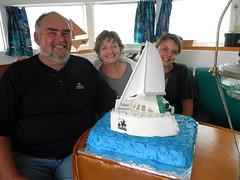
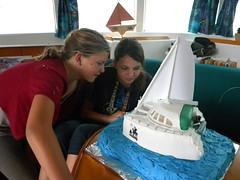
To kick off this spirit of neighborliness, I've been pushing for bi-weekly liveaboard dinners. I have read countless accounts of liveaboards who talk about their marinas as the best neighborhood possible. Liveaboards in good marinas take care of one another. They take care of the boats around them. So, we kicked off dinner this month at the lounge with a feast of boat cake.

The boat cake was the best idea ever. The genesis -- as with so many good things -- was over a glass or two or three of wine while we visited with a friend before leaving for Mexico. Peter's vocation is computer geekery. His avocation, however, is cake making. He crafts the most amazing cakes. We thumbed through pictures of his many creations ooo'ing and ahh'ing. Somewhere it just popped out, "You should make US a cake! When we get back!"

"What do you want?" asks Peter."I don't know... the sea, the Toast Floats logo, our navigation path..." my voice trails off.

Aeron pipes up, "Don Quixote! You should make Don Quixote."

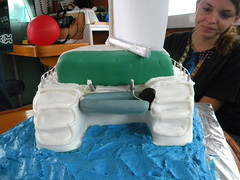
I think DrC and I laughed. Whoever heard of a cake boat. Or a boat cake. Far too fancy. Far too much time and trouble. Never mind. The Don Quixote cake was stunning.

My favorite bit was the dinghy on the davits at the back complete with a wee outboard motor. I think I'll just throw a bunch of pictures on this post and call it done.

The cake really speaks for itself.

Monday, November 28, 2011

Where the Hell is the Floor?

“I can’t get it,” I irritably inform my husband.

He retorts with some heat, “It’s right in front you!”

“Yes,” I agree with just the right amount of sarcasm, “I can see that it is right in front of me. And between me and the tool you want are 15 boxes, 5 pieces of plywood, a bag of cat litter, a large pile of dirty laundry, a snarl of rope, three fenders, and an unknown number of unmatched shoes.”

Yesterday, we retrieved the trailer from our friend’s house in Pukekohe and unloaded all the precious gear on to the boat. We’ve decided not to keep the trailer. For the cost of a rental space, we could buy the trailer and everything in it twice year. If it doesn’t fit on the boat, we have to get rid of it. Until then, the girls and DrC dumped all the gear into the cockpit for sorting, analysis, storage, and purging.

I question where my head was last February. Did I really think we were going to have any use for a radiant oil heater? Where the hell did I plan on storing not one but two electric whisks? And all these appliances with New Zealand plugs… what moron saves them for 8 months in a trailer to be used on an American boat?

Like a gopher with ADHD, DrC’s head pops up out of the transom and he points, “There. Walk there. You can get it from that angle.”

What is called for here is a yard sale. Challenging at best given that we have no yard, I think I can get rid of the vast majority of this crap by simply leaving it on the dock. There is a bench, in fact, at the gated entrance to our dock which is used as a sort of freecycle repository. Some of the items can no doubt be sold for cash on trademe. Others should just be taken directly to the trash.

“Can I throw away your old shirts?” I ask my husband, apropos of nothing apparently.

His head bounces up. “The needlenose pliers,” he reminds me.

We are combining two households: our accumulation of land-based goods from our year in Chicken House with the remnants of supplies purchased in Mexico to take us across the Pacific. It occurs to me as I pick past the rough ends of the plywood that we may never again need to buy soap, hand lotion, or bug repellent. I am not sure why the hell I ever thought we would wash our hands while sailing across the Pacific. “Big ones or little ones?” I ask, having finally reached the tool box.

“Both.” Smart man. He may not need it, but he knows there is no chance in hell I’m going to go back to the tool box after the first run.

As I retrace my path back to the 1 foot square clear space in the cockpit, I come to a decision, “Dean, we’re going to sell the children to make room for your tools.”

Thursday, November 24, 2011

Bayswater -- Our New Home

Bayswater Marina
This is a file from the Wikimedia Commons.
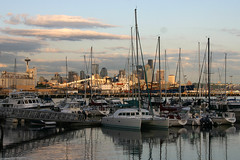
Bayswater Marina is located across the Waitemata Harbour from Auckland proper. For those familiar with the great bays of the western United States, this is equivalent to living in Sausilito, Berkeley or West Seattle. The view of the city skyline to the south is stunning, the air is crisp and clean, the bay is full ferries, small fishermen, and yachts at nearly all times of day.

The marina itself is a big half circle dredged into the surrounding tidal low. It is stuck out on the end of the thumb of the Bayswater peninsula. There is no protection from prevailing wind and very little from large wakes generated by passing ferries. This would prove problematic in a more aggressively nasty climate, but in Auckland it is reasonably comfortable. The marina hosts 7 docks and nearly 1200 boats ranging in size from the enormous fishing trawler Tom to a swarm of small power boats.

Our marina hosts quite a few liveaboards, including at least two other families with children. Most of us are on docks F and G as these docks support larger craft with attached water and power. They tell us we are extremely fortunate to have a liveaboard slip in Bayswater. Unlike Seattle and San Francisco where increasing NIMBY legal pressure is restricting liveaboards, the problem here at Bayswater is simply one of infrastructure. The shore facilities – laundry, showers, and toilets – can only support so many liveaboards. The staff here feels that we are more than a little over capacity, so they are strictly restricting new boats and families and in fact have a very long waiting list. We’re allowed only because I put our name on the list over a year ago.

However tight we might have slid under the deadline, the folks here have made us feel incredibly welcome. While we are only beginning the process of getting to know our fellow liveaboards, our relationships with the office staff, dock crew, and harbour master are already strong and positive. The whole lot of them are incredibly helpful, friendly, and supportive. Problems disappear when I walk in the office and start chatting with Ed or Magdelena or Kezia. I really like these people.

Which is good, because without a happy dock crew, I fear Don Quixote would not be an easy boat to slide into this marina. For one thing, we don’t fit. We never quite fit, but here we really don’t fit. First, they put us in an 18 meter catamaran slip way out at the end of the dock. Fantastically private and with enough wind to keep us going 24/7 with all the lights on, the computers plugged in and both fridges chugging away, it just wouldn’t suit for the long haul. For one thing, the 10 minute walk from deck to shore is fine in the mild spring and summer weather, but I fear it would have been a heinous slog in winter sleet. More importantly, they were charging us an 18 m price for that slip. We’re an 11 m boat. We were almost paying double for the privilege of privacy and a freezing walk.

So they kindly moved us all the way from the outermost slip to the innermost slip. This is what happens to catamarans. We get the outside or the inside. Now we are practically under the dock ramp. This puts us directly under everyone’s eye, including all the dock crew. Good and bad, right? If we have to stretch, bend, or even break a few dock rules, we’re going to get caught instantly. For example, technically we are not supposed to dry our clothes on the boat. But, we want to hang the towels for an hour or to dry after we use them. On F74, no one would see. On F3, well it’s rather obvious, isn’t it. We look like Po' White Boat Trash. Luckily, the staff is all Kiwi attitude all the time. At least with drying, it’s hard to imagine why the “no dry” rule was ever set up in the first place. This is a country where drier ownership is considerably less than really big, fancy BBQ ownership. But the best bit on this inner slip is the very short walk, and did I mention ½ the cost? Dogz knows that if DQ breaks free or starts to smoke, the entire marina will be on her in a second to help.

The only real problem is that we are wedged in so tight into this slip that we literally can not get in and out on our own. We also shouldn’t – potentially even can’t – get out on a low tide. I feel like a dumpy lady trying to fit into a bridesmaid’s outfit two sizes two small. Maybe once I slide my fat ass into the satin, I’ll look super good… or maybe I’ll just look like mutton masquerading as lamb. To make matters more absurd, the slip next to us has been converted from two slim slips into one monster wide for the beauteous, brand new, blindingly clean, 14 meter catamaran P’zazz. She’s the bride, and she is dazzling.

If you’re thinking of spending a few days or a week here, the facilities are pretty good for mariners. Nice lounge, ferry to Auckland on the same dock as your boat, strong (though moderately pricey) broadband wifi to your boat, super well kept shower ($1/5 min) and laundry ($4/load wash, $4/20 min dry), 24/7 security and gated parking. The downside is that there are absolutely no services within walking distance to Bayswater. We’re at the end of a suburban desert. You can ferry into town or you can take a bus, but there is no walking to get groceries. I can drive you around, if you’d like, but not for too much longer. I really need to get a job.

Speaking of jobs, Jaime immediately found gainful employment with the marina. She is working every day scrubbing decks and docks, cleaning the parking lot, and doing other man-about-the-marina labour. Her boss and co-workers appear quite happy with her work, and she is delighted to finally earn enough pocket money to keep herself in the electronic and clothing style to which she would like to become accustomed. It’s all good.

Thursday, July 09, 2009

He Woke Up With This Idea

[Editor's Note: This blog entry contains MATURE CONTENT. Usually my stuff is readable by the children as long as you're not too strict with the issue of profanity. This one, however, is about sex. Some folks are a little touchy about this issue...]

Kiss Kiss?
Kiss Kiss?
Originally uploaded by toastfloats.
My friend Meri of s/v Windfall noted with no small amount of exasperation, “He woke up with this idea, and it followed him all day.”

I nodded in agreement. “Men.” Men. Argh.

Okay, let's just take it as a given that no matter how much you love a man, the Imbalance of Sex thing is a problem. Women are romantic and would like to savor the experience on special occasions. Men would like to fornicate like bunnies every morning and every night. It is true: women are from Venus while men are from some planet on which sex is the only important functional task required of sentient life.

And don't think under normal circumstances that I'm not appreciative. I'm a forty something mother of three. I have stretch marks and flabby boobs and at least 15 pounds more than I should. I never wear make up, and I cut my hair like clock work every 6 months. I'm incredibly, unbelievably, amazingly lucky to have a sexy hot hunk of burning man like DrC interested in my battered and poorly kempt frame. He thinks I'm sexy. He wants my body! He finds me incredibly stimulating!! Woo hoo!!!

But, for crissakes, it's 90 degrees and overcast. I'm so hot that sweat is rolling down my neck and pooling under my breasts. My face looks like I took a wash cloth, soaked it in olive oil, and anointed myself. I smell bad, I feel sticky, two minutes out of the shower I feel like I've been dipped in pig shit. And if that isn't enough, my nose is running, my eyes itch, and my head hurts.

So pardon me if my first reaction to a firm bump in the rear portions by an interested male while my hands are buried deep in dirty dish water is to elbow him in the groin. I find the thought of sex in this climate about as unappealing as an after dinner snack of chocolate covered deep fried maggots. But nothing I say seems to discourage him. I can't slap his hands off my boobs without covering myself in suds and soap scum. Even growling does no good since in the strange language peculiar to men in heat, he interprets this as a come on.

So I completely sympathize with Meri. Men just wake up with this idea, and it's all you can do to get the idiots to come to their senses. Every woman reading to this point will not doubt sympathetically agree with Meri and I, “What the hell are they thinking?” While every man is probably asking himself, “Umm.... what's the problem? You're already hot, dirty and sweaty.”

Ugh.

Before we left, my husband and I wondered mightily what would happen to our sex life when we moved aboard the boat and sailed away with our children. On the one side, we were always more relaxed, uninhibited and – shall we say – active on vacation. More time, more energy. On the other hand, a boat is a really small echo chamber making noisy, uninhibited passion a bit awkward to say the least. Sound carries on water, by the way, so unless you want all your neighbors to also share in the moment... While there you go. On balance, I probably thought that we'd do it with approximately the same frequency but enjoy it more. DrC, of course, assumed we would simply do it more. Our vision of our sexual future was a direct by-product of our respective gender expectations and wistful hope rather than a pragmatic analysis of possible outcomes.

In the end, it's neither, both, and other. I'd have to describe us as healthier, our marriage stronger now than at any time in the 20 years we've been together. Part of that strength is an improved and healthier sex life. A really good reason to never go back to working full time is that when you're clocking 60 to 80 hours a week, there is not a particle of physical or emotional energy left for sex. Boat life does make for creative timing, interesting variations of doing it in utter silence, and no real necessity to ever have the “sex talk” with the children since I'm afraid all boat kids are inevitably exposed to a bit more of the practical complications of sexual activity than your average youngster. But I've spoken with enough boat couples on the subject to know, you too can have a good sex life out here cruising.

Go Away
Go Away
Originally uploaded by toastfloats.
However, there is absolutely NOTHING on earth – no possible improvement or modification of our sexual habits – which will induce a sane woman to mate with an otherwise sane male under the conditions we face here in Santa Rosalia. It's too hot. We're too smelly and dirty. There's too little privacy. It's sticky and stuffy and everything smells funny. It just isn't going to happen. These captains are complete frickin' male morons and we're not going to be putting out until mid-October when the temperature drops 20 degrees.

Really.

No, I mean it.

“Okay, but just this once and only if you promise to stop grabbing my tits for 24 hours as a sign of your appreciation of my sacrifice."

Sunday, May 03, 2009

Are You a Hooker?

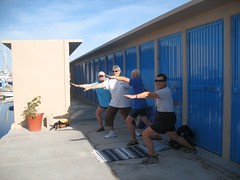
Yoga at Marina de La Paz
Originally uploaded by toastfloats.
When I spoke of this season's catitude, I think I depressed a few readers with my persistent combination of smugness and defensiveness about living on a multihull. Even at the time, I made clear that there are a lot of ways you can split the cruising community down demographic and philosophical lines. All are more or less “true” in the sense that the lines exist, the differences are real, and you can see the social dynamics play themselves out on a daily basis. However, it turns out that multihull versus monohull is not even one of the big players in the cruiser schism game.

Almost as profound as the division between sticks (sail) and smokers (power) is the gulf between those who spend the majority of their time at anchor and those who live on the dock. At times, this gulf is nigh on uncrossable since it goes to the heart of cruising philosophy.

Now, obviously there is no way a cruiser can completely avoid periodically throwing out the ground tackle and living on the hook. So we all invest in good ground tackle and learn how to use it. We endlessly sit over drinks and debate the merits of Rockna versus Bruce, scope ratios, storm tactics, bridling and holding ground. However, for all that effort and discussion, once you get out in the cruising grounds, the fleet tends to dissolve into two basic camps: those that live on the dock (dockers) and those that live on the hook (hookers).

Dockers prefer the convenience, comfort, and beauty of the marina. Dockers are clean: their boats are clean, the cloths are clean, their dishes are clean. Dockers know how to negotiate with the local harbor master to get the best weekly and monthly rates. They can tell you where to get Puddle Jumper discounts (12 bottles of dark rum for about $35USD is only my most favorite example). When they pull into a town, they spend weeks or months learning everything there is to know, participating in charitable events, going to all the amateur and professional musical nights, identifying each and every quality tienda, mercada, and restaurant. Their experience of any single city is deep, their knowledge wide, and their enjoyment manifest.

Hookers, on the other hand, prefer the nomadic, camping life of the hook. Hookers are filthy: their boats are salty, their clothes often stand up and try to walk away. Hookers know how to tuck into even the smallest bight to get protection from wind driven fetch and Pacific swell. They know how to negotiate with pangeuras to have fuel, laundry, beer, and fish delivered to the boat. They visit remote villages, natural parks, off shore islands, and open surfing road steads. When they come into a big town, they frequently stay only long enough to take on fuel, food, and clean clothes before letting the wind blow them back to quieter, more remote locations.

Now, nothing is absolute. Every once in awhile, a hooker spends a week on a dock. Even then, their lifestyle choice manifests itself. Hookers in dock work very hard; Docking is an expensive opportunity to complete maintenance that simply can not be accomplished without quick access to hardware stores, water, or other facilities. Their experience of the local town is dominated bysail makers, machine shops, or fabric stores. Of course, they'll have some fun, take in a show, go to a potluck in the marina lobby, but these activities are only at the end of a long, hard day with the expectation of more work on the dawn. Their conversations with one another focus on solving their maintenance problems and getting out from under the expense of marina life as quickly as possible. Hookers are often on extremely limited budgets, and even in the dock, they constantly trade methods to save money.

Periodically, a docker spends a week on the hook. Dockers on the hook seem to view their time out as opportunity to vacation from their vacation. It's not unusual to see them pull into an anchorage and never drop their dinghy. They enjoy sundowners on the deck, gently complain to one another about the rolliness of the anchorage, and struggle with deploying flopper stoppers. They take a million pictures, and are generous with their time, food, and booze to the hookers already in situ. Dockers anchor more tentatively, and they seek the recommendations and advice of hookers for where to go, what to do, and which palapas to visit. Even on the hook, dockers are clean, have the freshest and tastiest finger foods, and serve drinks with ice.

When we set out, Don Quixote anticipated being one of that unusual breed of boats which lives a hybrid, hooker-docker lifestyle. An informal survey suggests that this is a common cruiser dream, assuming the cruising life will be similar to long vacations on the boat. Most thought they would divide their time roughly evenly between hook and dock.

But that's not really what happens. In practice, you find your life sliding into a docker or hooker pattern. Docking is so much cheaper here than in the States, that if you really like the dock lifestyle, you should be able to afford it. It's a wonderful way to live, to raise children, to enjoy and participate intimately with the Mexican and ex-expatriate communities along the water front. Hooking, however, also has an unexpectedly seductive appeal. A hooker can reduce a family's living expenses to less than $USD1000 per month, and the longer you live on the hook, the easier it becomes, the more liberating the pull away from land based concerns.

Contemplating the View
Originally uploaded by toastfloats.
I apologize if I have failed to be objective in this article; we are hookers. Even last summer in the Northwest, our time between dock visits grew steadily longer, but now here in Mexico, we basically do not dock at all. From the time we said goodbye to Victory Cat in December to the time we pulled next to Totem in March, our fenders never came out. After a week of intense scrubbing and maintenance, we abandoned the pull of the La Cruz marina in favor of bobbing around in the La Paz Magote or swinging on the hook out in the southern Baja islands. We empathize with and admire those who drop the lines in late October and do not pull again into a marina until it's time to put the boat to bed for the hurricane season the following July.

The hardships of hooking are well repaid in the economic savings and the sense of empowerment and freedom providing by life outside of the box. On the other hand, the dock box is a lot cleaner. And you can't really overestimate the pull of ice cubes in the rum punch.

Wednesday, February 18, 2009

Radio Protocol

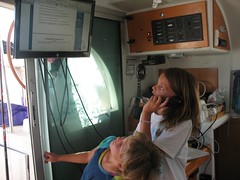
The Girls on the Net
Originally uploaded by toastfloats.
The VHF is hooked to my backpack strap, volume low but the speaker only about eight inches from my ear. This is a compromise; I can listen for the girls while not disturbing the people at the market as I do the morning shopping. I am surrounded in fast talking, short older Mexican women who are haggling with the produce seller, waving pieces of fruit and bunches of carrots as they argue over quality, price, or the weather. I have no idea; They all speak Spanish.

“Don Quixote Mobile, Don Quixote Mobile, this is Don Quixote Niñas.” Aeron is on the VHF, her voice so very young and high and -- let’s face it -- girly. The mamas pay no attention, sorting multicolored peppers using criteria I find completely unfathomable.

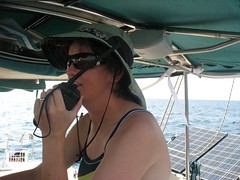
With the ease of much practice, I reach up to my shoulder and key on, “Don Quixote Niñas, this is Don Quixote Mobile.”

“One seven?” the small voice asks.

“One seven,” I agree. This is a favorite channel and preprogrammed into the handheld so I switch in two clicks. “Don Quixote Mobile on 17.”

“Don Quixote Niñas on 17. Can we spend the afternoon doing play practice on Kamaya?” A whispered conference then, “And maybe a sleep over?”

For the girls, staying in an anchorage for any length of time is a license to move on to other boats. Jaime disappears with the ten to tween crowd, Mera and Aeron generally stick to the elementary set. Out of a sense of obligation, I routinely attempt to get them to bring the kids back to our boat. Sometimes this works, sometimes it doesn’t. “School checks all done?”

There is a dramatic sigh on the other end of the radio and more urgent consultation. “Mera says she has one check left, and I finished everything except my math.” Aeron’s voice changes to a plea for understanding and generosity which she knows will not be forthcoming. Yet, nevertheless she will try. My girls are not quitters. “Mom... we can do an extra check tomorrow. Please?”

Silence. I don’t even bother to key in to sigh. There is no point.

“Pleeeeeeeeaaaaaszzzzzz.....”

It’s easier to just let her hang there while I proceed to select fruit from the large produce display in front of me. The Mercado Municipale is a busy, noisy place. My conversation with the girls is largely going unheeded by the locals, though I suspect DrC may be paying closer attention. I also suspect the woman in front of me is impugning the ancestry or manhood of our produce vendor. He doesn’t look happy.

“Okay,” comes the resigned voice. “We will finish our checks.”

At this point, Don Quixote Jaime pipes in, “Break break! Info!” At the sound of Jaime’s voice, DrC cocks an eyebrow, his attention drawn from the display of tomatoes and cilantro he is picking through.

“Don Quixote Jaime, go ahead,” I say.

Jaime reminds us, “You said we could watch Blue Planet as a science check tonight. I’ve got to babysit on Love Song this afternoon.”

I don’t remember saying this. I don’t remember much of the morning at all. Did I say that? I ask DrC with a look. He shrugs. I might have. He can’t remember either. The morning is a blur. It was at least two hours ago. In cruiser time, this might as well be infinity ago. Crap. Executive decision time. Bottom line, do we want the afternoon to ourselves messing around with the sewing machine and water maker, or do we want to do something responsible like take the kids on an expedition to the local museum.

“Right. Go ahead.” I’m a lightening fast decision maker. The avocados, a cabbage, and a hicama drop bang bang bang into my plastic shopping bowl as I start to demonstrate the program management authority for which I used to get paid the big bucks. With a sharp shake of my head, I reject DrC’s attempt to include a watermelon. Who the hell wants to carry that back to the dinghy dock? “Check in...”

I’m interrupted as the girls burst out, “Don Quixote Niñas clear to 22 alpha.” “Don Quixote Big Girl back to two two.” DrC throws me a disgusted look as I mumble, “Clear to 22,” and fumble with the VHF. While the marketing is going well -- our vendor happily taking money from the argumentative old women and then reaching for my selections -- I could perhaps have been a bit more thorough in establishing the location and plans of my offspring before signing out.

Give Em Sh* Mom!
Give Em Sh* Mom!
Originally uploaded by toastfloats.
“That’s if you can get them back,” DrC warns as he reluctantly releases the melon. My children are free spirited wild animals wafting through the marina, the old town and the anchorage. They’ve been adopted by fifty pairs of cruising grandparents, sworn oaths of lifelong friendship with children on boats we haven’t even met. They earn money baby sitting and scrubbing bottoms; they help Meercat prepare finger foods for a potluck, ferry guests to a party on Vltava, and attend jam sessions around campfires with Hipnautical. Our control over them is remote and dicey at best.

Faced with another childless afternoon, DrC hands me a bag of limes and asks, “Internet or sex?” Suddenly, it appears that everyone in the produce section knows English after all and activity pauses for a moment while the group of shoppers awaits my executive decision.

The mamas nod approvingly and the vendor laughs as I reprimand my husband, “You know, Dean. This is how we got into this trouble in the first place.”

Monday, January 12, 2009

Doing More With Less - Electricity

The boat teaches many lessons in conservation. This is part of an ongoing series of posts about how we boaters do more with considerably less. The tips are valid for land based life as well, though, so hopefully folks can use some of these ideas.

Solar Panel Frame
Solar Panel Frame
Originally uploaded by toastfloats.
We have to make every erg of electrical energy we use. Not surprisingly, this makes us very stingy consumers of electricity. On a boat, there are five ways to produce electricity:

Hook to shore power - You can buy electrical at a marina. Sometimes it comes with the dock fee, sometimes there is an extra charge. In either case, it costs a lot of money to tie up. We anchor out as much as possible so it does not behoove us to rely too heavily on topping off the batteries on a dock.

Generators and engines - You can use alternators to charge your batteries by burning fossil fuels either in your engines or a generator. In both cases, however, you are engaged in that environmentally icky and incredibly expensive process -- converting dinosaurs to lumens. We prefer to charge our batteries this way only as a by-product of moving the boat. It is depressing how often weather and timing force our sail boat to be a very slow motor boat. When this happens, we call the energy that flows into our batteries “bonus points.”

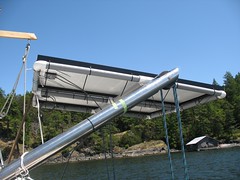
Solar panels - We have two panels and a solar charge controller. The entire setup, including DrC’s nifty kludge of a mounting panel, cost us roughly two boat bucks. We consistently get about 15 amps an hour during the day. Let’s call it about 100 per day. More panels gets you more power. On a boat, it’s rather challenging figuring out where to put them. The great thing about solar panels is that if you set them up correctly, you can then forget their very existence. They just keep pumping out power.

Wind generator - Many cruising boats travel with a wind generator. We do not, but maybe someday we’ll add it to the boat. The principle advantage of a wind generator is that it can produce energy 24 hours per day. The disadvantages are the noise and that they require a lot of baby sitting. It is a very bad idea to forget you have a wind generator when you are in high winds. Even so, it’s very tempting to add one to the boat.

The final way to generate power is the most important -- don’t use it. Just as on land, the amp you don’t use is the cheapest one to generate. Boaters in general are pretty clever about reducing consumption. I’d like to think on Don Quixote we’re doing a reasonably good job. I’ll start with a list of ways we conserve, but this is one of those times where I would really like people to actively contribute additional suggestions. Other boaters have no doubt developed very creative ways to reduce their use of electricity.

LEDs - An expensive but very efficient way to reduce consumption is to switch all the lights on the boat from incandescent to LED. The masthead light, for example, burns all night to alert boats moving through the anchorage of our location. At 2 amps per hour, that’s roughly 24 amps a day. The LED version consumes roughly 2 amps for the entire night.

Ditch the Power Toys - Some power tools make for a much safer cruise as you can fix your own equipment, sew your own covers, or build your own furniture. Others just take up space and weight and consume a lot of power. Ditch the microwave, bread maker, hair dryer, coffee maker, and blender. Dispense with every power sucker and change your lifestyle. As an example, we use a manual coffee grinder from the Lehman’s catalog. It’s beautiful and slows our consumption considerably.

Guard Against Vampires - Chargers for phones, iPods, laptops, GPS and VHF handhelds, and other such little toys consume energy, even after your device is fully charged. Surprisingly, the amount of energy they draw even fully charged is actually quite substantial. We put all these devices on a single power strip. We control the entire strip with a single button. This enables us to charge everything for a few hours, then cut off the charger vampires in one swift stroke. A side benefit is safety since batteries, battery chargers, and transformers have a well-deserved reputation for periodically setting themselves ablaze.

Change Your Sleeping Habits - Wake with the dawn, go to bed at sunset. There is something satisfying about this from a biorythmical standpoint, and it saves a great deal of juice. Another benefit of going to bed early is you watch a lot less television. We thought we’d watch movies regularly. Instead, we’ve been traveling for seven months and have watched a mere handful.

Plan the Refrigerator - We still haven’t mastered Ninja Refrigerator Stowage, but done correctly you can substantially reduce consumption. Organize the fridge so that the things you need are in the front, easy to get to. Meals are grouped on back shelves. True ninjas can actually restrict opening the fridge to a three times a day activity, once for each meal. We know of one family that has it down to once a day. I dream of this capacity for advanced thinking.

So, now you. Boaters, tell me how to save more power. We had reached that enviable state where we could live on the hook for nearly a week, but as we dropped to warmer latitudes, the increased power to fridge and freeze tipped us over into running the engine every third day. Help me out!
Time For Bed
Time For Bed
Originally uploaded by toastfloats.

Thursday, July 03, 2008

Liveaboard vs. Cruiser

At Least We're Warm
At Least We're Warm
Originally uploaded by toastfloats.
Jim Trefethen, author of The Cruising Life: A Common Sense Guide for the Would Be Voyager, argues that you should probably not live aboard your boat before you go cruising. His argument is based on the notion that living aboard a boat is very different from cruising on a boat. He feels that the difference is so dramatic that the first does not prepare you for the second. Moreover, he argues that you might be deceived by your live aboard life into thinking you can be a cruiser.

Jim and I are going to have to agree to disagree on that second bit. While I agree wholeheartedly that the live aboard lifestyle differs dramatically from the cruising life, I am convinced that our time aboard Don Quixote prior to departure was key to our transition to cruising.

Before I explain why a popular author with one of the better cruising books out there is wrong and I -- a complete novice and dilettante -- am right, it might help to elucidate some of the key differences between these two, superficially identical ways of life. A live aboard is someone who lives on a boat but who otherwise lives an essentially “normal” mainstream life. Her boat is probably tied to a dock near a large town or city. He goes to work five days a week, probably commuting via bus or car. Liveaboards shop at the grocery, go to the movies, and check out the opposite sex at the local bar just like folks who live in houses.

A key to being a liveaboard is that the boat is tied up, often semi-permanently. Many liveaboard craft are directly plugged into power, water, and sewer systems. Showers are readily available on the boat or at shore-side facilities, and the trash is regularly picked up from the shared shore-side dumpsters.

The Pacific Northwest is a haven for liveaboards. Other locations with many live aboards include Florida, the Great Lakes, and any place where good marinas, high land prices, and a love of boating exist.

Cruisers, on the other hand, do not hold regular jobs. They may make money, but it’s definitely in a more ill-defined, contract sort of way. The boat is rarely tied to anything for more than a month. Their homeport is a distant memory. They have no regular phone service, Internet access, power, water, or trash. They definitely do not own a car. Cruisers are highly independent drifters who have managed to drift with their homes. Entertainment comes in the form of the company of fellow cruisers, books, saved movies, and contemplation of the navel.

And when you write it all out like that, you can understand where John is coming from. Basically, he’s pointing out the obvious. Liveaboards are regular folk with weird houses. I’ve lived in weird places before -- big houses converted into 15 “student apartments”, a remodeled backyard shed, the basement. Arguably, living on a boat does not prepare you to cruise. The car and job alone make the liveaboard life completely different from cruising.

However, John is in my opinion discounting the utter weirdness of living on a boat -- what distinguishes it from any other form of odd housing. This is probably because he’s done it for nearly two decades. I think he’s forgotten just how difficult it is to move on to a boat.

A boat is small. It’s wet. It smells a lot. The stove sucks, the oven is worse, and for some damn reason the entire marine industry hasn’t come up with a way to make a comfortable bed that doesn’t rot. The refrigerator is 4 feet tall, 2.5 ft wide and 15 feet deep. Sounds carry in the water, on the water, through the hull. You can hear your children breathe at night from 20 feet away, inspiring the invention of an entirely new form of sexual pleasure based on the principle of absolute and utter silence.

Most of all, the boat -- she moves! Even at a dock, your boat home moves. Little moves add up to chafe. You hear stories all the time of liveaboards pulling out their “best wear” which had hung for a year in a hanging locker only to find that those small movements added up to literally wearing the shoulders out of their jackets. It takes awhile to learn how to pack so things won’t chafe, filter out all the little sounds of water on hull and items clanking to identify those you really need to hear, and sleep even when the boat is rocking back and forth and the mast is singing in the wind.

So Wannabe Cruisers, go ahead and live on your boat at the dock for a few months or even a year before you head out. You will learn a great deal about what you can do and what you like about living on the boat while you still have an opportunity to change it up. You’ll get a chance to hit up Ikea for floor mats and storage boxes, Costco for bedding, and Target for bathroom accessories. Then by the time you cut the lines, all you’ll need to sort is how to live on only 400 amps of power for a week.
Sunset in Smuggler's Cove
Originally uploaded by toastfloats.

Monday, January 21, 2008

Doing More With Less - Water

The boat teaches many lessons in conservation. This is the first in a series of posts about how we boaters do more with considerably less. The tips are valid for land based life as well, though, so hopefully folks can use some of these ideas.

* * *

Water, water everywhere but none of it fit to drink. Did you know that the American household consumes roughly 70 gallons of potable water a day? Did you know that our water tank only holds 80 gallons? This is a mathematical conundrum we must solve before we can credibly live aboard for any length of time.

We debated adding a second water tank. On the plus side, it would be nice to have more water. On the down side, water is heavy and catamarans do not do so well with extra weight. Water weighs a lot more than you think. In fact, our full water tank weighs considerably more than a Yanmar engine and slightly less than the family's laundry pile at the end of a particularly busy week. When you stand ashore on a windy day watching the surf flip your dinghy around like plastic toys in a bathtub, the thought of shlepping hundreds of pounds of water from shore to ship is a daunting one.

So while another tank is probably inevitable, we also committed to investing in a water maker. Typically, Dr C doesn't want to just outright buy a water maker. That's way, way too simple. Instead, he's been accumulating the parts for a water maker in the space beneath our bunk like outsized, electronic lint. Sometime over the next year, he and the girls will undertake “Build a Water Maker” as a class project. This is, more or less, an outstanding idea. If you can build it, the water maker costs roughly half as much as store-bought. And when it breaks – as it will inevitably – there will be at least four persons on the boat who know how to fix it.

The problem with water makers is that you are essentially converting fossil fuel (diesel) into water at a 1 to 3 ratio. Some are more efficient, some less. This is probably not the best way to get water on to the boat. It's also not particularly environmentally friendly, and it costs a fortune. Never mind. This alternative is moot for at least a year until Dr C and the students of Don Quixote Academy actually build the thing.

In the meantime, we work diligently on reducing our water consumption. The following are my water conservation tips:

Enjoy Dirt – Why do we feel compelled to be so clean? I'm not sure I ever truly bought into the OCD-like insistence on sanitizing and disinfecting everything so prevalent in our country, but now I find it utterly baffling. “God made dirt and dirt don't hurt,” is a phrase to live by on a boat. If you can't get clean by swimming in the ocean or stealing time quarter by quarter in a marine shower, then stay dirty. Swipe a damp blue cloth over the really smelly parts every day or so, and get used to smelling bad. Incense and fragrant candles help.

Use Salt Water First – Just about everything you need to clean, you can clean first with ocean water and reserve fresh water for a last bit of rinse. The notable exception is your teeth.

Use Less Soap – This is actually a post for this series all by itself. There are literally dozens of ways to use less soap. The important issue in water conservation, however, is that the less soap you use, the less water you need to get rid of it.

Catch Rain – We haven't started doing this yet, so I'll hold off relating how successful the technique will prove to be. Our research tells us that it should work pretty well as long as you are someplace that rains. So the strategy will probably work well next spring in the Desolation Wilderness but fail miserably down in Mexico. Also, you need to let it rain long enough to wash the salt off your rain catcher before you start capturing it for rinse and drink water. Otherwise, you might as well be pulling a bucket up from the side.


Okay, we need less of this...
Originally uploaded by toastfloats.
Drink Beer – We could generalize to wine or rum as well, but calorie for calorie, I think beer is includes more H2O. We've also learned that beer is cheaper than water in many Mexican coastal towns.

* * *

Water is not free. In truth, it never actually was. It always came from somewhere, and taking it out of the water cycle to use on our clothes, cars, and faces on a grand scale didn't do anyone any favors. Our record thus far is ten days on eighty gallons plus one trip to a shore bound laundry mat. Take the Don Quixote challenge and see if you can do the same in your house.

Wednesday, August 08, 2007

When Your Basement is Like Your Boat

A good friend of ours recently posted to one of our many cruising lists a copy of a cruising favorite -- The Liveaboard Simulator. I wish I'd written that. The green gremlin of professional jealousy springs up whenever I read that article. However, I think I would make it funnier, because as it's written, it's not very funny. It's totally depressingly True. If you do not yet live on a boat and would like to empathize more closely with our life style, I encourage you to set up your own simulator. Merely reading the instructions is for wimps.

We actually did this, by the way. Live in our basement. All five of us. In fact, at least on the books we still do. It happened like this: Our marina does not allow full time, liveaboard families. The waiting list for marinas that accept liveaboards in the Pacific Northwest is roughly as long as the waiting list for a Toyota Prius, which is somewhere north of three million last time I looked. So after a long discussion with our fine harbor master, we moved on to our boat part time. The other half of the time, we live in our basement.

The basement is bigger than the boat but smaller than a breadbox. We never actually got around to finishing the finishing work to make it habitable. So it has a clammy, faint whiff of cat smell vaguely reminiscent of a boat head on a warm day. Dr C and I are wedged into a double in one room while the three girls pile like kittens on a king in the other room. We purchased a European refrigerator. I can assure you that does not mean it's full of fine cheeses and fine chocolates. The German idea of cold things is a small box which can hold approxrimately one liter of sparkling water, a package of Wheat Thins, and a sausage. The unit sits on the ground in such a way as to ensure that your plus-six-foot husband has to contort himself into a Bavarian pretzel shape in order to retrieve his beer.

The basement is always dirty. The entrance is from the backyard, so it appears that the children are incapable of entering the rooms without tracking in a metric buttload of woodchips and pea gravel.

Also. I believe that dust settles downward. Thus, every particle of grit generated by our upstairs tenants floats gently down into our living space like Seattle pollution drifting in black sooty waves onto the deck of our boat. As with Don Quixote, there is no dishwasher, the sinks are impossibly annoying to use for that purpose, and we share the laundry appliances with people whose constitutional makeup includes a gene for keeping panties in the washing machine at every possible moment we might choose to wash our own underthings.

Again, shades of living on Don Quixote, we find our expulsive tendencies result in a spillage of miscellaneous crap out of the living quarters and into the surrounding environment. On the boat, we leave our lines draped in towels, wet suits and blue cloths, tools are scattered in the cockpit, and bags of garbage line the helm like dishonorably discharged soldiers awaiting transport to shore. In the basement, we spew construction materials, gardening tools, and endless boxes of Stuff awaiting freecycle pickup across the lawn and down the street. And the result is so similar: Our slip neighbor pointedly told us we couldn't possibly be good boaters as we didn't keep our boat up to sparkling snuff while our land neighbor asked our tenants, “Don't you have any house pride?” To which I really just have to snort, “Oh yeah. Just wait until I move in the dead truck and the broken tractor.”

And the girls are irrepressible, unstoppable, energetic heathens no matter where you put them. Like three whirling Tasmanian devils, they explode out of the confines of the basement or boat and spin off into incredibly loud, semi-destructive forces of little girl goodness. Sure they break things, lose things, and hurt themselves in every conceivable way. They also loop into their sphere of influence every other child within a radius of one mile, suck into their Charm Maw many of the stray adults, and identify with the instincts of blood hounds every dog, cat, hamster and gecko available for play, care and cuddling. They locate dead things, find hiding places, and introduce themselves to store owners, marina staff, neighbors and fellow boat owners. They routinely drag these reluctant adults back to boat or basement for introductions and fellowship, wine or chips or vanilla wafers. And while our both our basement and boat worlds are messy, gritty and essentially microscopic, our reputation for hospitality grows with each passing month.


toast_boat_Jun07-32
Originally uploaded by rolling2hills
So The Liveaboard Simulator works. You get all the dirt, the confined quarters, and the inconvenience. You also get a similar sense of family squishedness, members banding together in the face of extreme adversity. However, I must say the view on the boat is better and the backyard is larger.

Tuesday, July 17, 2007

Tell It Like It Is


toast_boat_Jun07-29
Originally uploaded by rolling2hills
Do you remember the uproar when Mattel produced a Barbie that whined in a gratingly chipper voice, “Math is hard!”? I remember. I remember virtuously supporting the NOW call to action, boycotting the errant toy company, and prohibiting Barbie shoes in the house. Okay, truth be told the Barbie shoe prohibition technically predated the Barbie Math fiasco. Those high heeled shoes with their strong affinity for the bottom of bare feet should be classified as one of America’s most powerful cultural weapons.

The thing is… in retrospect this particular social tempest not only did not deserve a teacup, it also missed a key point. Math is hard. So is biochemistry, astrophysics, and getting the top off a bottle of Advil. Somehow Barbie stating the obvious was offensive because a woman admitted it – a pretty woman with small feet and big breasts.

In much the same way, there is a strong social pressure among those of us preparing to cut the lines to avoid admitting to Regular People how difficult it is to leave. It is easier to perpetuate the myth that the cruising adventure is a lark, a whim – expensive navel gazing combined with extended camping trip and lots of rum.

It is also probably easier for the shore-bound to watch us go if they believe that cruisers are not like Regular People. Regular People would find the whole process of selling everything, saying goodbye to everyone, and leaving all that is well known and understood daunting to the point of intestinal clenching terror.

But here’s your Barbie moment straight from Toast: Leaving is hard.

In for a penny, in for a pound, let me further state that: Leaving is harder for women.

There you have it. I’ve said it. I’ve obviously lost my mind, my feminist credentials, and my captain’s license. I brace myself for the pending boycott from the Seven Seas Sailing crowd. Shoot me. Drum me out of the women’s seminars at Strictly Sail. The real shame is I don't have big breasts. Nor do I have small feet, more's the pity.

But stating the obvious, gut churning truth does not make it any less true, because the bottom line is that wannabe cruisers are regular people with a bug up their ass. Whatever our current motivation, most of us start out with careers, real estate, and white-picket-fence goals. By far the majority of cruisers do not self-identify as heroic, brave, or adventurous. We send our kids to school, we go to the Church of Home Depot on Sundays, and we carefully deposit a small amount into our 401(k) each month. Our starting point is so banal, it is unimaginable that in a mere few years we’ll be thousands of miles away hauling in a tuna off an azure coast to the dulcet strains of our children’s urgent screams of encouragement.

And why is it harder for women? I've heard a variety of theories. The one that resonates most strongly for me is the lack of a bathtub on a boat. However, perhaps you identify with the hypothesis that for men there is more support for reaching for the “exotic adventure.” Or maybe you're in the “woman are nesters, men are not” camp. Some of you might find compelling the claim that “women have stronger social ties and rely on them more deeply than men.” Or maybe you've been surrounded by folks who support the theory that children are proof of fragility. Obviously, if you are a mother, you can't be strong, self reliant, and highly capable.

Whatever your personal pet theory, there is broad consensus among the female sailing community that the whole letting go thing is much harder for women. Mind you, there is not unanimity! You can't put five sailors of any gender in a dinghy and get them to agree on the time of day, let alone something as fundamental as this. However, I've got the anecdotes to support my theory. And if you doubt me, go take a poke at the startling volume of cruising literature devoted to the dragged aboard spouse.

But women are not fragile. Women make great sailors. Women are spectacularly adept at making a life of value and passion and interest even under the worst conditions and in the mankiest of boats. And if women were afraid to do hard things, the species would have long since withered away.

Wow, this is starting to sound like a motivational video. So I’ll conclude with a a gratingly chipper shout into a virtual mike as I bounce at the front of the class, “Leaving is HARD! Feel the burn, ladies!! No pain, no main!!!”

Thursday, May 10, 2007

Moving Day

“Get the gate. Get the gate! GET THE GATE!” bellows my husband at my youngest daughter. He’s hauling the boat box from the van and down the ramp towards our catamaran on the near end of L2. So much for a quiet sneak aboard transition to our summer living quarters.

Our marina doesn’t allow live aboards. Frankly, most marinas in the Pacific Northwest prohibit them. It’s a combination of insane insurance rates, Dept of Natural Resource restrictions, and economic self-preseveration that drives this. The problem started a few years ago and grows worse each year as more live aboard boats chase fewer and fewer slips.

So just after the holidays, I approached our harbor master and explained the Great Escape Plan. We lucked out. First, our harbor master at Elliott Bay is a very nice man. Second, our harbor master spent a few years himself kicking around the Sea of Cortez. He’s sympathetic to our plight, and we can basically live aboard this summer. As long as we don’t let the children run wild, he and his staff will support our efforts to prepare ourselves and the boat for the cruising life. We make token forays to our land based basement apartment to make it legitimate.

But that means the last barrier to moving aboard has been removed.

My god, that boat is small. It looked a lot bigger in June of last year when we set the moving date to April 2007. It looked a lot bigger when it was empty. Filled with two van loads of stuff – one entire load consisting of the bedding and stuffed animals the three girls insisted were essential to their very survival – my entire perception of the boat has narrowed to a pin point. I feel like we’re an episode of a serial called Honey, I Think I Shrunk the Boat. It is now just as easy to lose the kids as ever. However, now we lose them in a sea of gadgets, goods, and groceries. Actually, I think I did lose Mera. I haven’t heard from her in hours.

As the van disgorges bags and boxes and books, Jaime and I frantically wrestle them into crevices in the boat in a rapid fire, real-life game of three dimensional Tetris. With one wary eye, I watch Don Quixote’s water line. Interestingly, most of what we’re moving aboard now to change our boat from weekend cabin to primary home is more bulky than it is heavy. I thought the boat boxes would ground us in the slip, but our boat seems made for this sort of clutter and sits in the water just fine.

I can’t say the same for the family temper. Dr C is frazzled and overworked bearing the brunt of the physical labor since I broke my back falling off the boat. Mera keeps escaping the leash to read fantasy novels, and Jaime and Aeron would rather be collecting dead, smelly things on the shore. My former concerns about the lack of convenient galley storage space pale to the reality of trying to find room for even the most essential items in places that do not require reaching under and around someone’s butt in the salon. I caught Dr C stashing the olive oil under Jaime’s bed in the port bow, and I don’t have the heart to ask where the kids have hidden the dish soap.

At the end of the day, we’re aboard. We will spend the next six months in this slip or nearby anchorages trying to figure out how to be boat people. A glance into the kids’ hull yields the horrifying conclusion it will take at least that long to find a place for all their toys. And we ended up getting teriyaki from a place down the street as I couldn’t face the daunting task of filling five plates with wholesome, home cooked food… let alone find the plates.

On the other hand, I did find the salsa, a bag of tortilla chips, and a leftover six pack of cervesa. There is a light breeze filled with the smell of the ocean and the sounds of a guitar played by a cruiser on M dock while the snow on the Olympics turns pink and purple as the sun blazes down to our west through a forest of masts.

I could get used to this.

Thursday, March 22, 2007

The Marine Tax


It's Only Money
Originally uploaded by toastfloats.
B.O.A.T. We've all heard the jokes. Bring Over Another Thousand. A hole in the water into which you throw money. My personal favorite is: “Owning a boat in the Pacific Northwest is like standing in a cold shower ripping up $100 bills.” And pretty much every boat owner knows that B.O.A.T currency is $1,000 per unit since everything seems to sell in increments of a thousand. But the underlying truth stems from the little known but widely applied Marine Tax. What? Never heard of that one? You know about income tax, sales tax, property tax, and estate tax, but you've never heard of the marine tax? Oh you poor fool.

You see, I am familiar with the Marine Tax because it is so similar to the Doctor Tax. The Doctor Tax is the premium charged for any item which is destined for a medical office simply because the purchaser is assumed to be both (1) richer than God and (2) stupid.

I will grant that assumption two is a gross oversimplification. The marketing gurus from the medical manufacturing companies do not sit in their board rooms musing, “Those doctors are such bone brain dead simpletons we can mark this up 400% and they will never know the difference.” No, I imagine it goes something more like this, “Those doctors are so busy and they make so much money, they will never pay any attention to the price, and it'll just disappear like piss in the Pacific Ocean into the insane amount they spend to keep their offices open.”

In the boating community, it is our very sense of humor that prevents us from rising up in a Yachting Tea Party to throw the bastards overboard. In the offices of the marine manufacturers, they are no doubt chortling, “Those boat owners are so busy making money to pay for their boats and telling jokes about how much all the equipment costs, they'll just suck it up and pay whatever we charge assuming that it's both fair and just and even noble to pay through the nose for our products.”

The Marine Tax can range from 10% to 500%. Need an example? You can purchase a WiFi amplifying antenna from a good marine broadband service provider for $300. You can purchase the identical unit from a Web site for gray hat, war driving, computer hackers for $70. And anything sold at an official boating store is going to cost twice as much as the exact same item available at a hardware store, WalMart, or online book store.

So in the long standing tradition of good Americans everywhere, I strongly advocate tax evasion whenever and where ever possible. Fortunately, for the clever, penny-pinching, tight-wad cruiser, there are many loopholes in the Marine Tax. And you won't need your tax accountant to find them. Just ask yourself a few questions every time you consider a purchase related to your boat:

Do I really need it?
I think Americans in particular have forgotten how to ask this most basic of questions, but it is perhaps the first and most important. Now that I've started asking, I'm routinely surprised how frequently the answer is, “Nope.” Just as you do not need matching his and her underwear, you also do not need perfectly fitted sheets, custom curtains, or hand crafted rugs. Your fenders do NOT need to all be the same size. They don't even need to be the same color. Don Quixote supplements our fender inventory nearly every time we go out with what the girls now refer to as “driftfenders”. Note: It is not necessary to color coordinate your lines, either.

Does the item look anything like something I can get at Home Depot?
One of the more environmentally friendly and cost effective ways to clean your fiberglass boat is with a bucket, a scrub brush and a box of baking soda. I did some price shopping online and you can buy all three items at your local marine store for $28.97 or from the local hardware store for $17.15. Do I really need to explain further?

Can I make the item from things I can get at Target?
A corollary to the Home Depot recommendation is that sometimes you can make small changes to an item and suddenly it goes from being land based stuff to Marine Grade Product. My favorite example of this is, believe it or not, plates. Turns out that a Marine Grade Plate is a plastic plate decorated with blue anchors and includes a gasket glued to the bottom. That's a pretty clever idea – the gasket, not the anchors which I find insipid – because it keeps the plates from slipping while in use and reduces their rattling while stowed. You can purchase one of these nifty plates from your marine store for $7.99 per plate. Of course, you could instead purchase a $1.99 plastic plate, a $.99 gasket, and a bottle of rubber cement. In addition to the obvious price advantage, you also get a wider choice than blue anchors or nautical flags.

Can I buy a lesser quality item multiple times instead of the marine grade item?
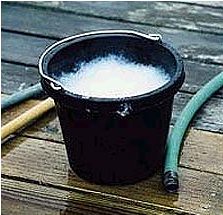
A boat combines electrical power plant, water treatment facility, transportation system, and hotel all in one small package that floats on the most corrosive substance on earth and shakes like maracas on a Saturday night in Cabo San Lucas. Everything in the marine marketing world is about convincing you to buy the ruggidized, indestructible, undissolvable, marine-tested, reinforced, sun-resistant, highly expensive widget. For example, let's take the 8-quart Super Bucket Fortex available for only $23.99. Looking like Darth Vader on the deck, this black beauty is “Reinforced for ruggedness. For extended use in demanding conditions. Constructed of fiber-reinforced natural rubber that won't crack, chip, dent or rust. The heavy gauge, double-galvanized handle lays neatly along the rim, where it's easy to grab.”

In sweeps our Ewok flower fairies at Backyard Style, this Plastic Utility Pail costs $4.99. It's “lightweight” and “ideal for calf feeding.” Better yet, it comes in eleven bright happy colors! Just call me Calf Feeder Girl!!


So with some cleverness, a bit of research, and a willingness to think outside of the boat, you too can shave dollars off sundry items essential for boating life. This month my efforts probably saved us close to $200!!

Which means in ten short months I will pay off the two B.O.A.T. dinghy Dr C bought last week at Strictly Sail.

Thursday, March 01, 2007

Things That Go Boom in the Night


tea candle
Originally uploaded by KNMwt15000.
There are three major categories of boom on a boat: combustible fluids, electricity, and large swinging objects. All three things are destructive. All three things can and do kill people. All three things horrify any right-thinking adult who contemplates a child on board a boat.

While I can largely dismiss the hazards of surrounding children in billions of gallons of water, it is far more difficult for me to dismiss the dangers inherent in surrounding children in things that go boom at the slightest provocation. It strikes me as particularly insane to put 900 amps of battery power, 100 gallons of diesel fuel, and a fire extinguisher in the same room as an 8-year-old and her 6-year-old sister.

You are a boat owner with children or grand children aboard. What do you do? What DO you do?

I cannot tell you what to do. I can only tell you what we are doing which is essentially nothing. All right, it is closer to absolutely nothing than to essentially nothing but saying “essentially” gives me sufficient wiggle room in any legal action. The good news is that children are essentially indestructible. The bad news is that all protestations to the contrary, essentially is a really lousy word.

Now one thing I have long since learned about children – or at least my children – is that seeing is believing. Another way to state this, danger is only dangerous if it has actually bitten you on the ass. Okay, even simpler: your children won’t believe you. You can repeat, “Matches BURN!” until you are blue in the face and unless a child manages to set her cabin on fire, she will not believe you.

My suggestion is that the way you protect your children from the things that go boom on your boat is to let them hurt themselves -- in a controlled, structured, and well monitored environment replete with soothing words and a suitcase of medical supplies. Fortunately, live aboard cruising offers abundant opportunities to teach your children about the dangers of live aboard cruising. It is hard to imagine a life style more replete with wondrous moments for applied lessons in self-preservation.

Take for example the category of things that go boom that involves combustible fluids. Most boats carry at least three – and sometimes four – separate flavors of fuel: diesel, propane, gasoline, and kerosene. Each boat beverage is packaged with its own unique combination of disastrous potentialities. What you need to do is identify those that are most likely to entice junior into blowing up your home.

On our boat, we quickly learned that the girls couldn’t care less about diesel. Diesel was daddy’s problem. They weren’t much more impressed by gasoline. That was mommy’s problem. Kerosene, however, meant heat and light in the salon. Candles and matches meant warmth, light and coziness in the cabins. And propane! Wow. Propane is the source of all heated edibles.

The priority became clear. The girls received a crash course in how to use matches in combination with the propane stove. At every possible opportunity, we used them to open the valves, turn on the solenoid, and start the stove burners or oven. Matches matches matches! Tea candles are the ideal testing ground for good match manners. Scatter them around the salon and you not only learn how to avoid burning bitty fingers, but you also create a charming atmosphere for yourselves and all distant observers watching your boat bob at anchor lit up like an old fashioned Christmas tree.

Electricity follows the same pattern. Though, frankly, the real problem with electricity and children is not the high voltage lines running everywhere, the exposed plugs in every room, or the enormous batteries in the foot of their bed. The real problem is that they never turn out the damn lights. I’m far more concerned with teaching the little twits to conserve energy then I am about them electrocuting themselves.

Nevertheless, I advise getting the children involved in electrical production and maintenance as soon as feasible. They can quickly learn how to handle the electrical panel, hook up to shore power, and manage the battery switches. Teach them how to monitor the battery capacity, and you’ll never need to worry about forgetting to check again.

The real bummer boomer, though, is momentum. I find that where children are particularly prone to disaster is when they take on the basic laws of physics. In other words, chemistry and electricity are too complicated to hurt boat kids. It’s the physical physics that get them every time. Leverage, inertia, mass times acceleration, and good old gravity work wonders for moving your boat through the water and anchoring it to the ground, but against the soft tender skin of young human beings these forces are swift and evil.

I caution parents to spend far less time worrying about drowning and blowing up your offspring and concentrate more on toes crushed in an anchor rode, heads bashed by a swinging boom, or fingers stripped of skin by a line on a bucket dropped into the water at seven knots. Teach your kids basic physics, people, or your boat will do it for you.

Thursday, February 01, 2007

Project Escape Route

In the wee small hours of the morning, I woke up abruptly in a cold sweat, muscles twitching and thoughts crashing around in my head. Our self-imposed deadline of April 2007 to move aboard the boat full time loomed a mere six months ahead. Six months to sort, sell, throw away, store or move on to Don Quixote nearly twenty years of accumulated goods. Six months to prepare the house for rental. Six months during which I would also be working fifteen hours a week for my clients, twenty hours a week for my husband’s practice, and twenty-five hours a week as a home school teacher. (Add ‘em up, folks!) The prospect was sufficiently daunting to cause anyone with a heartbeat to waken in the middle of the night in a panic.

Six months was also so much less time than the original eighteen months envisioned when we set the deadline. It’s funny how that works. You look out into the future and set arbitrary goals for yourself, giving ample time to accomplish all the many tasks necessary to make a dream come true. And like any student, you procrastinate your way straight into an impossible situation. Like most freshmen before finals, I lay rigid in my bed – alternating between an absolute state of panic and a depressing sense of futility.

The advantage I have over your average college dropout is that I’ve spent decades working with some of the finest project managers in the software industry. I studied this subject for years. I was bred of a brilliant program manager, born by a single mother, and polished to a fine survivalist shine by years working with phenomenally incompetent senior executives. I immediately directed all that nervous, twitchy energy into scoping the project, setting the time line, and assigning resources. Right there. In the middle of the night. In bed. Then I went back to sleep.

It occurred to me as I sat on the stick-to-your-butt-cold head the next morning, that in the event of a future middle of the night panic attack during which I lay out a six month project plan, I should make a point of pulling out the laptop and getting it all down. What seems so clear in the night as you listen to the wind make the mast vibrate takes on a dim, fuzzy vagueness in the cold light of morning.

I do not recommend using Microsoft Project to plan your live-aboard cruising transition unless you are both incredibly anal retentive and a complete program management wonk. Otherwise, you’ll find you spend all your time trying to get the tasks to link correctly… never mind the complete waste of energy devoted to leveling your six year old daughter. However, for those of us familiar with controlling the world through a Gantt chart, there is no reason to give up those basic skills just because we are fleeing from them like leaves before the wind.

Note to fellow program managers: I did consider scrumming the project, but first I knew that my husband’s capacity for estimating his work effort is non-existent, and second, absolutely no one in the family would agree to attend daily scrum meetings. I have enough trouble getting them to sit down long enough to divvy up weekend chores.

But whether you use Project, Excel, Google apps, a Wiki or *cough* paper, the first and most important step is to write it all down. All of it. Everything you must do and everything you think you should do. There are house chunks, boat chunks and kid chunks. You probably have a few “relative chunks” and endless numbers of paperwork chunks. You might have a business to dispense with or cars to sell or property to offload. Write down absolutely all of it.

Use a tool you can sort, stack, and categorize. If you don’t (or won’t) do this on a computer, then my recommended tool is sticky notes. Because what you need to do after writing down every possible task you can think of is to start grouping them into manageable chunks. Okay, maybe the tasks aren’t manageable. Maybe they are completely overwhelming. You have to start somewhere, however, so start grouping them into their categories and then lining them up in priority order.

Figure out if you have any task dependencies. Do you have to move out of the basement before you remodel it? Do you need to “accidentally” release your spouses’ pet canaries into the wild to be eaten by raccoons before you can possibly live on a boat with him? Make these connections and sort your tasks.

Then despair.

Really. Give up right then and there.

There is no possible way to get this done before your target date. There just isn’t. It’s as if you are working for an American company during the dot bomb, and they’ve laid off 60% of the work force but they want you to work smarter and get the same amount of work accomplished in less time. Face the fact that you are not going to get all of it done and half of what you do manage to tackle will be done half-assed.

But who the hell cares? You are leaving, my friend. You are cutting the lines and sailing South. And when you come back – if you come back – you are SO not going to give a rat’s ass that you failed to pack the crystal in bubble wrap and instead opted for the expedient newspaper. The crystal didn’t move the entire time you were gone. And now that you look at it on your return, you most likely wonder why you kept it.

Most of your life here is non-essential, overpriced, and way too commercialized. You are leaving it for a reason. Throw it all in a bunch of U-Haul boxes, stuff it in a storage space, and call a cleaning service to prep the house for a tenant. You’re going to have to repaint when you get back anyway. Let the tenants in their “real world” deal with the crayon on the walls.

YOU will be sipping rum, ginger ale and lime juice off an atoll in the Caribbean.