I wouldn't say that DrC and I are experts at being crew or hiring crew. We've taken on a few, volunteered ourselves on occasion. We've read numerous accounts and spent hours and hours drinking beer with both captains and crews. Over time we've developed a laundry list of attributes and behaviors which we believe make “good crew.” I'd like to offer these to readers of my blog as a starting point for a discussion. For those in particular with experience on either side, let me know what you'd add or change about this list.
A lot of being good crew is about being a courteous guest. It is also about being a competent, contributing employee. Crewing on someone else's boat can open opportunities to learn, travel, and expand your understanding of the cruising life. It is not, however, an easy role to undertake. Here are our thoughts:
Pack Light – Add-on crew doesn't live on the boat. As a result, your stuff is extra, and it will be hard to wedge into existing lockers which are chock-o-block with stuffed owned by the owner's family. Ideally, all you bring with you can fit into a single duffle which you can comfortably fit on your bunk … even when you are yourself lying in that bunk. A small day pack with your electronic toys (e.g. laptop, iPod, books) is also acceptable if it too can fit on the bunk and do double-duty as a pillow.
Be Prepared – Like a Boy Scout, assume responsibility for your own gear. From foulies and life jacket to iPod/laptop chargers and reading material, supply it yourself. Ask the captain in advance regarding linens (towels, bedding), fishing gear, and items. Personally, I'd also take my own GPS, charting tools, handheld VHF, and personal EPIRB since no boat can have too many redundant safety and communication systems.
Food Issues – It is really amazing how many captain-crew relationships die on the issue of food. Set expectations between you and the captain regarding your dietary requirements, food preparation, and clean up responsibilities before you leave the first port and the last grocery store. The more open-minded and less picky an eater you are, the better. And while you shouldn't expect surf-and-turf with fine cabernets every night, you should be fed well. At minimum, crew and captain should eat from the same trough – and yes, we have heard of boats with the captain drinking the expensive chardonnay and the crew expected to survive on reconstituted gatorade drink mix. If you have special, specific dietary requirements, it is your responsibility to be up front in advance. For some items such as your favorite salad dressing, salsa, or tea, bring your own. Someday remind me to explain to you why I must have rice cakes during night helm watches.
Set Expectations in Advance – The pre-negotiation required for food can and should be extended to just about every boat issue. In particular, make sure you understand what the captain expects regarding watch schedules and boat maintenance. You don't want to learn two days out of port that the captain plans to sand down and revarnish the teak deck during your voyage... and you've been volunteered to do the work.
You Are a Consultant – I have a rule as a consultant which I believe applies well to being a crew member. You are on the boat because you know stuff and can do things. In exchange for your labor and expertise, you are “paid” in room, board, transportation, and sometimes even money. If you believe a captain is making a mistake and you have experience and advise to offer, it is your responsibility to do so. Once. However, if the captain chooses to ignore you and your life is not in any danger, keep your mouth shut. Captains need to break things; It's part of their learning process as both sailors and managers. The title captain – like manager, director, vice president, team lead, or doctor – does not confer infallibility, but for most newbies, it feels like it should. Only after breaking something expensive and/or inconvenient do most newly minted authority figures understand that nothing magical happened to transform them when their title changed.
When to Mutiny – On the other hand, no matter how valuable the lesson is to your manager, a captain doesn't have the right to break crew in the process. This isn't the British Navy in the 1700's. No, a boat in the middle of the ocean isn't a democracy. But if your life is in danger and your captain is a royal flaming idiot, you have the right to mutiny. We read about these accounts in sailing magazines, online, and in books. Sometimes, you really have no other choice. While I don't want to blame the victim, my recommendation here is not get on a boat with a captain whose expertise is considerably below your own AND the captain appears to be completely disinterested in taking your recommendations in serious conditions. Hard to figure that out in advance; Try anyway.
Take the Drugs – If you have any tendency to nausea, start taking Meclazine a day before you board. Keep taking it until I tell you to stop. If you start to feel gimpy, take the drugs immediately. Do not use the trip as an opportunity to experiment with holistic herbs, naturopathic patches, acupressure bands, or tantric chants. Unless you know that one or more of these work on you already, save them for your own boat. You have the right to drive your own family nuts, but you have a responsibility on someone else's boat to not vomit on the cabin sole if you can possibly avoid it.
Pitch In – As crew, you should help whenever and where ever you can. Show up prior to departure ready to assist with loading and provisioning. Contribute to cooking, K.P. and boat maintenance during the journey. Don't leave the boat on arrival until the boat is clean and buttoned down tight. Your contributions will ease relations between you and the rest of the crew. More practically, it'll give you something to do and an opportunity to see that the work is done carefully and correctly the first time.
Entertain – Find some way to contribute to the social well-being of your boat as well. Do you play an instrument? Sing? Tell stories? You could bring cards or small, lightweight games such as Yahtzee, chess or mancala. Be generous with the use of the media – music, books, or movies – that you packed. Maybe no one will take you up on your social offers, but the offers nevertheless indicate your desire and willingness to be a part of the lives your fellow travelers.
* * *
Now your turn. What would you add, remove or change about this list?

Showing posts with label boating. Show all posts
Showing posts with label boating. Show all posts
Saturday, December 11, 2010



Saturday, February 20, 2010
(Recent) Lessons Learned About Boats
Every phase of our boat life has been marked by a series of very hard won lessons. Even though DrC tends to be absolutely pathologically diligent with the research and study routine, even though I have tendencies as an OCD project manager, we still manage somehow to break shit, forgot stuff, screw up by the numbers. It's a Thing We Do. So it is without too much surprise that I report to hitherto unexpected trials in prepping the boat for sale and moving back to land.
Catamaran Tramps are Structural -- Don't let anyone tell you that catamaran tramps are just a pretty little play space at the front of the boat. It took DrC and I two and half days working sun rise to sun set to install the new tramp on Don Quixote. To string the tramp from edge to edge, we had to put the webbing on a winch and pulley system… every two loops. DrC estimates we put at least a 1000 pounds of strength into the corner. Our hands were raw, back sore, muscles aching. No amount of tequila made it easy to sleep at night. There is no question that our boat must be designed to account for the tramp quite literally holding the front of the hulls together in rough seas.
Confirm the Presence of Hot Water Before Picking a Haul Out Yard -- I really don't think this requires elaboration.
Don't Clean Anything Until You Move Off -- Every time I think something or somewhere on the boat is clean and ready for the new owner, DrC smashes a bloody mosquito on it, the girls walk on it, or the cat rolls in it. I've had it. We're going to find a really cheap motel in town, and I'm going to move the family off before I clean even so much as a single additional square inch.
Things Break Because You Plan to Sell Them -- For no particular reason, systems that were otherwise 100% functional have decided to behave like gimpy pieces of crap. Murphy moved on to the boat about three weeks ago. We're spending a lot of time cleaning up after him.
Don't Attend A Swap Meet Until You Are Actually Done -- We sold everything about three weeks ago at the monthly swap meet. Then -- as I noted in the previous point -- stuff started breaking. And of course, the part we need? We sold it. Murphy tipped back a pint and snickered at us when the spark plug on the outboard decided it needed to be replaced. It's not hard to get a new one, and we'll have it installed within an hour… after shlepping into town to buy it and bring it back to the boat.
The Boat Smells - Actually, every place we humans live stinks. Your home has a unique odor that is probably just fine for you and your loved ones. You may not even notice it. When you walk into another home, however, your nose is assaulted by the odor of different soap fragrances, variations on cooking themes, and someone else's farts. Boats are more pungent than houses and not just because people are living in a more constrained space. Add to normal home smells the piquancy of a mobile sewage system, two diesel and one gas engine with associated fuel tanks, and the unique eau de bilge -- an unavoidable miasma of damp goo, mold, and wet wood of which no boat is completely free. However, when a buyer arrives for a sea trial it's not a good idea if his first thought is, "Oh my god this boat stinks." The Cruiser Dream just doesn't extend to the reality of Boat Smell. I've been trying to figure out how to fix this on Don Quixote. I think the only solution is again… move everyone off the boat and explode an incense bomb in every cabin and locker.
It's Expensive to Sell Your Boat -- Did you know that brokers take 10% when they sell your boat? I didn't. Call me just royally big-word-starting-with-an-F stupid, but this was a surprise to DrC and I. So let's say you buy a boat for $100,000. The day you take ownership… even if you could sell it for the same amount you purchased it for… your boat has depreciated $10,000. Hate this. I was figuring the broker fee would be similar to housing in the 4 to 6% range. Somehow, however, brokers have managed to maintain a stranglehold on the 10% price point. I have no idea how they do it.
No More Procrastination -- Another way your boat costs money to sell is that you have to do all the deferred maintenance tasks you never bothered to get around to while you were living on it. In the case of Don Quixote, these items are largely aesthetic. For example, we replaced a bent lifeline, took the sails to a loft for patches on spots which were starting to show a little wear, sanded and varnished the table, touched up the paint on the outboard mount and the windlass case. The boat looks fantastic, but it all adds up to money, work and time. One of my readers said there is a 95% point where only the previous owner sees the problems. Other than the layer of boatyard/child/cat dirt coating every surface, I think Don Quixote is ready for her new owner. It's true that the remaining items are mostly bits that only DrC and I know and care about. The next owner might not ever notice those items and instead find other reasons entirely to curse us.
It's Emotional -- A boat is more than a home. We pour so much of ourselves into our boat identity. We pour so much of our time into just keeping the thing functional. It is very hard to let go. Then suddenly, you're done. You've let go. But the boat -- stupid, expensive bitch that she is --still sits there sucking up money like a high power ShopVac. I've begun to resent all this work and time and money. Worse are the moments when I regress and start crying when I see her on the horizon as we dinghy back after an evening at the taqueria. Don Quixote is a beautiful home. I panic sometimes that we will never have anything even fractionally as nice ever again. Talking me off this particular ledge is one of DrC's most challenging ongoing tasks.
* * *
I don't want to learn any more boat lessons for a long long while. The family is ready to start screwing up our transition to New Zealand with glorious failures of cultural understanding and financial ignorance. The countdown to our departure is well underway.
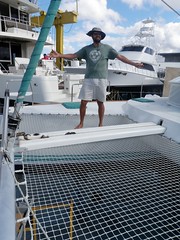
Catamaran Tramps are Structural -- Don't let anyone tell you that catamaran tramps are just a pretty little play space at the front of the boat. It took DrC and I two and half days working sun rise to sun set to install the new tramp on Don Quixote. To string the tramp from edge to edge, we had to put the webbing on a winch and pulley system… every two loops. DrC estimates we put at least a 1000 pounds of strength into the corner. Our hands were raw, back sore, muscles aching. No amount of tequila made it easy to sleep at night. There is no question that our boat must be designed to account for the tramp quite literally holding the front of the hulls together in rough seas.
Confirm the Presence of Hot Water Before Picking a Haul Out Yard -- I really don't think this requires elaboration.
Don't Clean Anything Until You Move Off -- Every time I think something or somewhere on the boat is clean and ready for the new owner, DrC smashes a bloody mosquito on it, the girls walk on it, or the cat rolls in it. I've had it. We're going to find a really cheap motel in town, and I'm going to move the family off before I clean even so much as a single additional square inch.
Things Break Because You Plan to Sell Them -- For no particular reason, systems that were otherwise 100% functional have decided to behave like gimpy pieces of crap. Murphy moved on to the boat about three weeks ago. We're spending a lot of time cleaning up after him.
Don't Attend A Swap Meet Until You Are Actually Done -- We sold everything about three weeks ago at the monthly swap meet. Then -- as I noted in the previous point -- stuff started breaking. And of course, the part we need? We sold it. Murphy tipped back a pint and snickered at us when the spark plug on the outboard decided it needed to be replaced. It's not hard to get a new one, and we'll have it installed within an hour… after shlepping into town to buy it and bring it back to the boat.
The Boat Smells - Actually, every place we humans live stinks. Your home has a unique odor that is probably just fine for you and your loved ones. You may not even notice it. When you walk into another home, however, your nose is assaulted by the odor of different soap fragrances, variations on cooking themes, and someone else's farts. Boats are more pungent than houses and not just because people are living in a more constrained space. Add to normal home smells the piquancy of a mobile sewage system, two diesel and one gas engine with associated fuel tanks, and the unique eau de bilge -- an unavoidable miasma of damp goo, mold, and wet wood of which no boat is completely free. However, when a buyer arrives for a sea trial it's not a good idea if his first thought is, "Oh my god this boat stinks." The Cruiser Dream just doesn't extend to the reality of Boat Smell. I've been trying to figure out how to fix this on Don Quixote. I think the only solution is again… move everyone off the boat and explode an incense bomb in every cabin and locker.
It's Expensive to Sell Your Boat -- Did you know that brokers take 10% when they sell your boat? I didn't. Call me just royally big-word-starting-with-an-F stupid, but this was a surprise to DrC and I. So let's say you buy a boat for $100,000. The day you take ownership… even if you could sell it for the same amount you purchased it for… your boat has depreciated $10,000. Hate this. I was figuring the broker fee would be similar to housing in the 4 to 6% range. Somehow, however, brokers have managed to maintain a stranglehold on the 10% price point. I have no idea how they do it.
No More Procrastination -- Another way your boat costs money to sell is that you have to do all the deferred maintenance tasks you never bothered to get around to while you were living on it. In the case of Don Quixote, these items are largely aesthetic. For example, we replaced a bent lifeline, took the sails to a loft for patches on spots which were starting to show a little wear, sanded and varnished the table, touched up the paint on the outboard mount and the windlass case. The boat looks fantastic, but it all adds up to money, work and time. One of my readers said there is a 95% point where only the previous owner sees the problems. Other than the layer of boatyard/child/cat dirt coating every surface, I think Don Quixote is ready for her new owner. It's true that the remaining items are mostly bits that only DrC and I know and care about. The next owner might not ever notice those items and instead find other reasons entirely to curse us.
It's Emotional -- A boat is more than a home. We pour so much of ourselves into our boat identity. We pour so much of our time into just keeping the thing functional. It is very hard to let go. Then suddenly, you're done. You've let go. But the boat -- stupid, expensive bitch that she is --still sits there sucking up money like a high power ShopVac. I've begun to resent all this work and time and money. Worse are the moments when I regress and start crying when I see her on the horizon as we dinghy back after an evening at the taqueria. Don Quixote is a beautiful home. I panic sometimes that we will never have anything even fractionally as nice ever again. Talking me off this particular ledge is one of DrC's most challenging ongoing tasks.
* * *
I don't want to learn any more boat lessons for a long long while. The family is ready to start screwing up our transition to New Zealand with glorious failures of cultural understanding and financial ignorance. The countdown to our departure is well underway.
Tuesday, February 09, 2010
TechTip: Get Yourself A Good Ride
Short Story
Your dinghy is the only way off the boat short of swimming. Do not skimp.
Long Story
Our first opportunity to prove ourselves and our dinghy mojo came in San Simeon as we travelled down the West Coast. We failed miserably. It wasn't just embarrassing. We made a costly mistake, lost some valuable gear, and nearly decapitated our youngest. It was not a good time had by all. However, dumping our dinghy in the surf early in our Pacific career taught us a very valuable lesson in caution and the value of appropriate equipment for the dinghy. Before you consider cutting corners, remember this important relationship: car is to house as dinghy is to boat. Unless you want to remain housebound throughout your entire cruising life, I strongly encourage thoughtful and copious investment in a quality launch.
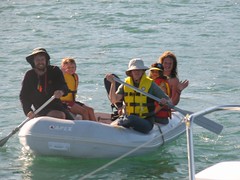
Size Matters -- As with an anchor, invest in a dinghy at least one size larger than the directions on the package call for. Don Quixote carries a rigid inflatable which is rated for eight people. We have five. That's about right. We discuss whether or not we'd want a smaller dinghy were it just the two of us, and frankly, neither of us is convinced. A ten foot dinghy for a couple is essentially like owning a minivan or an SUV as a couple. You don't really need it all the time, but when you need to haul something around, it's very nice to have.
Power Up -- It probably goes without saying that a bigger dinghy needs a bigger motor. This is another place you do not want to skimp on either size or quality. When you consider a motor, put it on your dinghy, load up your entire crew plus two bags of groceries, laundry or garbage. If you can plane, the motor is big enough. If you can not, keep looking. Have a mechanic look it over from top to bottom to make sure there are no hidden gotchas. Outboards are pretty easy to maintain, but you want to start with one in very good shape. If you are cruising down to Mexico, I recommend Yamaha motors only because they are absolutely everywhere so finding parts and a mechanic are very easy.
It's Nice to Stay Dry -- Some landings and traverses are going to be drier than others. Equip your dinghy with at least one dry bag. We also recommend a Pelican Case for transporting your computer.
Keep It Together -- When you flip your dinghy -- and you will someday, some place, in some swell -- everything is going to want to escape into the depths. Create a simple clipping system to tie down your dry bag(s) and cases. It doesn't hurt to also have a quick and easy way to nail your shoes into the boat though the ubiquitous presence of Crocs down here pretty much assures your footwear will float. You might have to go swimming, but you'll recover your goods.
Night Lights -- We've seen a few dinghies with really nice navigation lights, usually mounted on the motor. While I like these, you don't have to get that fancy. You do, however, want to have at least a flash light or head lamp for after dark passages. Don't tell me you won't have your dink out at night. We all lose track of the time over sundowners and suddenly realize that the sun is actually down, we're more than a bit snookered, and our boat home is over there in a westerly direction… I think. Use the light to keep other launches from smacking into you as well as a tool to find your own boat. For ideas on how to make your boat uniquely visible at night with a flashlight, see my article on anchor lights.
Tie It Down -- Do not underestimate the power of your dinghy to spontaneously launch itself off a cleat and wander around the anchorage. We use both a strong primary painter which we monitor assiduously for chafe as well as a secondary chunk of line. Double tying the dinghy at night has a secondary advantage in that it makes it a wee bit harder to steal.
Security System -- It's not as dangerous out here as folks might lead you to believe, but of all the types of crime you might be exposed to while traveling, the most probable is "dinghy ransom." You wake up one morning to find your dinghy has miraculously come out of its two ties and moved upwind and across a bar into the care of a very friendly local who will charge you a 300 peso tip to give it back. I've seen several ways to discourage this type of blackmail. Some cruisers actually lift their dinghy on davits or with their main halyard up the side of the boat at night. Others like ourselves cable the dinghy to the boat and the motor to the dinghy. Another creative way to prevent theft is to paint your motor entertainingly obnoxious colors and mark up your dinghy so that it's resale value is minimal.
Wheels Rock -- Retractable dinghy wheels are a hugely valuable addition to your dinghy. They enable a single adult to relatively easily move a large heavy dinghy and motor from the surf up the beach and out of the tide line. A secondary benefit is that as you move into the shallow water, dinghy wheels can partially protect your prop since by the time it's shallow enough to eat your prop, your wheels are hitting the bottom. Without reservation, I recommend getting your dinghy wheels from DaNard Wheels. In addition to an awesome product, he provides unparalleled customer support. The guy is fantastic.
Hoisting System -- In the northwest, folks often just drag their dinghy around. You don't really see that as much once you head out. The distances you travel are long enough that the loss of efficiency is a big problem, and it's simply dangerous to drag a dink in big wave or swell. So you'll need a simple and highly functional method to move your boat from its secure "passage position" into the water with its motor. An infrequently mentioned yet obvious advantage to catamarans is that you can easily put davits on the back of the boat and haul the dinghy up between the hulls. We've seen similar systems on monohulls with wide afts, and there isn't really any question that davits are the easiest solution. However, I've seen many clever methods to use halyards and lines to quickly move the dinghy from deck to water and back again. Ideally as a safety measure, you'll be able to do this procedure single-handed. I like our boom extender for moving the motor, however it requires two people. Our "next boat" will have a method for me to splash or haul the dink and motor without aid.
* * *
Our dinghy system isn't perfect, but it has served us well for nearly two years. Frankly, our only real problem with Rocinante is our eldest daughter. Watching her zoom around the anchorage makes me dread the looming challenge of teaching her how to operate a car. Ugh. Teenage drivers.
Your dinghy is the only way off the boat short of swimming. Do not skimp.
Long Story
Our first opportunity to prove ourselves and our dinghy mojo came in San Simeon as we travelled down the West Coast. We failed miserably. It wasn't just embarrassing. We made a costly mistake, lost some valuable gear, and nearly decapitated our youngest. It was not a good time had by all. However, dumping our dinghy in the surf early in our Pacific career taught us a very valuable lesson in caution and the value of appropriate equipment for the dinghy. Before you consider cutting corners, remember this important relationship: car is to house as dinghy is to boat. Unless you want to remain housebound throughout your entire cruising life, I strongly encourage thoughtful and copious investment in a quality launch.
Size Matters -- As with an anchor, invest in a dinghy at least one size larger than the directions on the package call for. Don Quixote carries a rigid inflatable which is rated for eight people. We have five. That's about right. We discuss whether or not we'd want a smaller dinghy were it just the two of us, and frankly, neither of us is convinced. A ten foot dinghy for a couple is essentially like owning a minivan or an SUV as a couple. You don't really need it all the time, but when you need to haul something around, it's very nice to have.
Power Up -- It probably goes without saying that a bigger dinghy needs a bigger motor. This is another place you do not want to skimp on either size or quality. When you consider a motor, put it on your dinghy, load up your entire crew plus two bags of groceries, laundry or garbage. If you can plane, the motor is big enough. If you can not, keep looking. Have a mechanic look it over from top to bottom to make sure there are no hidden gotchas. Outboards are pretty easy to maintain, but you want to start with one in very good shape. If you are cruising down to Mexico, I recommend Yamaha motors only because they are absolutely everywhere so finding parts and a mechanic are very easy.
It's Nice to Stay Dry -- Some landings and traverses are going to be drier than others. Equip your dinghy with at least one dry bag. We also recommend a Pelican Case for transporting your computer.
Keep It Together -- When you flip your dinghy -- and you will someday, some place, in some swell -- everything is going to want to escape into the depths. Create a simple clipping system to tie down your dry bag(s) and cases. It doesn't hurt to also have a quick and easy way to nail your shoes into the boat though the ubiquitous presence of Crocs down here pretty much assures your footwear will float. You might have to go swimming, but you'll recover your goods.
Night Lights -- We've seen a few dinghies with really nice navigation lights, usually mounted on the motor. While I like these, you don't have to get that fancy. You do, however, want to have at least a flash light or head lamp for after dark passages. Don't tell me you won't have your dink out at night. We all lose track of the time over sundowners and suddenly realize that the sun is actually down, we're more than a bit snookered, and our boat home is over there in a westerly direction… I think. Use the light to keep other launches from smacking into you as well as a tool to find your own boat. For ideas on how to make your boat uniquely visible at night with a flashlight, see my article on anchor lights.
Tie It Down -- Do not underestimate the power of your dinghy to spontaneously launch itself off a cleat and wander around the anchorage. We use both a strong primary painter which we monitor assiduously for chafe as well as a secondary chunk of line. Double tying the dinghy at night has a secondary advantage in that it makes it a wee bit harder to steal.
Security System -- It's not as dangerous out here as folks might lead you to believe, but of all the types of crime you might be exposed to while traveling, the most probable is "dinghy ransom." You wake up one morning to find your dinghy has miraculously come out of its two ties and moved upwind and across a bar into the care of a very friendly local who will charge you a 300 peso tip to give it back. I've seen several ways to discourage this type of blackmail. Some cruisers actually lift their dinghy on davits or with their main halyard up the side of the boat at night. Others like ourselves cable the dinghy to the boat and the motor to the dinghy. Another creative way to prevent theft is to paint your motor entertainingly obnoxious colors and mark up your dinghy so that it's resale value is minimal.
Wheels Rock -- Retractable dinghy wheels are a hugely valuable addition to your dinghy. They enable a single adult to relatively easily move a large heavy dinghy and motor from the surf up the beach and out of the tide line. A secondary benefit is that as you move into the shallow water, dinghy wheels can partially protect your prop since by the time it's shallow enough to eat your prop, your wheels are hitting the bottom. Without reservation, I recommend getting your dinghy wheels from DaNard Wheels. In addition to an awesome product, he provides unparalleled customer support. The guy is fantastic.
Hoisting System -- In the northwest, folks often just drag their dinghy around. You don't really see that as much once you head out. The distances you travel are long enough that the loss of efficiency is a big problem, and it's simply dangerous to drag a dink in big wave or swell. So you'll need a simple and highly functional method to move your boat from its secure "passage position" into the water with its motor. An infrequently mentioned yet obvious advantage to catamarans is that you can easily put davits on the back of the boat and haul the dinghy up between the hulls. We've seen similar systems on monohulls with wide afts, and there isn't really any question that davits are the easiest solution. However, I've seen many clever methods to use halyards and lines to quickly move the dinghy from deck to water and back again. Ideally as a safety measure, you'll be able to do this procedure single-handed. I like our boom extender for moving the motor, however it requires two people. Our "next boat" will have a method for me to splash or haul the dink and motor without aid.

* * *
Our dinghy system isn't perfect, but it has served us well for nearly two years. Frankly, our only real problem with Rocinante is our eldest daughter. Watching her zoom around the anchorage makes me dread the looming challenge of teaching her how to operate a car. Ugh. Teenage drivers.
Wednesday, October 29, 2008
Pacific Dinghy Dash - Qualifying Round
Two sports announcers sit on a set framed by a wide expanse of California beach. They smile into the camera as the male begins:
“We’re here today in lovely San Simeon for the qualifying round of the Pacific Dinghy Dash. The weather is perfect for today’s competition: sunny, with 9 knots of wind blowing offshore. Our competitors have been dropping anchor since Tuesday, drinking wine and exchanging boat cards as they prepare for this key round of the year’s competition.”
The female announcer is dressed casually in upscale athletic clothing. As color commentator, she is a former participant in this sport. “Jack, it’s a great day to start the Pacific Dinghy Dash and a great place to do it. The surf is breaking about 10 yards out consistently at 3 feet every 7 seconds. We should see the crews relying on a straight in approach, riding the last wave with a strong push of their motors and largely keeping their feet dry.”
Jack nods sagely, “I agree, Julie. Points will be awarded today largely on style and dryness. I doubt we’ll see much in the way of innovative approaches.”
Julie looks out over the water, “Our first crew is off the s/v Sea Horse. You’ll notice the captain’s classic slow approach. He’s got a hard bottom dinghy with two crew... and there you see him slide up to the back of the wave... a hard throttle...”
“Oh yeah! Look at that!” exclaims Jack.
Julie agrees, “That was lovely, Jack. Did you see how his forward crew came in with one leg curled up on the outside. He put it down just as they hit the shallows.”
“And the captain throttled his engine at precisely the right moment. Those are going to be high scores, Julie. Sea Horse is really setting the bar high today,” Jack points out.
“Yes, but we’ll have to go some way to compete with s/v Vindsong. Look at that dink!” Julie cries, “We’re looking at an old fashioned, wooden row boat.”
“That’s a beauty, Julie. The line glued along the teak edge is both handsome and dramatically increases the difficulty for his crew.” Jack continues ominously, “Getting out of that craft is going to be a challenge.”
“But his approach is solid, Jack. Look at him come in with his bow crew talking him up to the edge of the swell. That’s nice.” Julie watches for a moment, “Yes! There they go!!! Vindsong is rowing hard hard hard.... And THERE! Great elan. Fantastic exit! They both just elevated straight out of that boat and over the side.” Her partner comments, “I don’t think they’ll be getting much for dry feet, Julie, but they sure get points for level of difficulty.”
Jack continues, “Now we have newcomers to the event, s/v Don Quixote. This crew has competed before -- and quite successfully -- in the Pacific Dinghy Dock and Dinghy Drag. They in fact medaled in the Drag not once but twice. They are considered a force to be reckoned with here in San Simeon.”
Julie is doubtful, “I don’t know, Jack. I’ve seen too many crews come down from the Pacific Northwest who think they know how to handle their dink after competing in high tide and strong current. Then they encounter the surf of the southern California beaches and have to start learning their sport all over again.”
Jack nods sagely, “I see your point, Julie. The Dock and Drag really require different skills don’t they.”
Julie explains, “Yes, the Dock is about gauging distance and the relative speed of the many moving craft in the harbor while the Drag is a very physical event requiring great strength and a hard bottom. The Dash is all about timing and feeling your way through the waves. Let’s see how these newcomers do.”
Jack warns, “It doesn’t look good for Don Quixote. Look at that...”
“The captain is coming on too strong. He’s not waiting for the waves. See how he allows his helm to just power in?” Julie observes.
“Isn’t that crew a bit young for this event, Julie? They’ve got three juveniles.”
“No no,” she replies, eyes on the Don Quixote boat, “family crews are common in this sport. My sister and I started at 9 and 12. Oh look,” her voice shades to a bit of horror, “they’ve timed it all wrong. Jack, they’re going to... oh no...”
Jack exclaims, “They’re going over they’re going over!!!” He pauses as if unable to believe what he’s seeing, “Oh that’s tragic! Look there’s gear everywhere!”
Julie interjects, “It’s okay, Jack. Look at that crew scramble. They can stay in the competition if they can just recover well. Remember, we average their scores over several beaches throughout the next three months. They just need to recover their gear and get ashore unharmed.”
Jack calms, “Yes, Julie, and now we see a crew who’s been working together hard up north. Look at them scramble.”
“They’re doing well, Jack. They got that dinghy back over in less than 5 seconds. I see all five crew. See how they automatically divided responsibility. Captain, helm, and first mate have got that dinghy aligned and ashore. The younger crew are gathering Crocs, towels, and hats.”
“Let’s shift to Bob on the beach. Bob?”
Bob holds a microphone near the drenched Don Quixote crew who are gathering and checking gear, “Captain? Can you tell me what happened?” He thrusts the microphone in DrC’s face.
“We were just &#*ing stupid,” DrC looks grim. Salt water drips from his beard. “I didn’t wait and time the waves, and Jaime gunned it just a bit too late. We should never have gone over. Stupid.”
Bob switches to Toast, “And you? How’s it look?”
Toast looks around and her eyes narrow, “Good. We’re good. In gear we lost two pairs of sunglasses and a baseball hat. Not bad. We’re definitely going to use the dry bag and a lot more tie downs in the future. The kids are all right. No one is hurt. I’ll be able to rescue all the electronics except maybe the cell phone, and it’s insured.” Aeron jumps up into the view of the camera, bouncing to pop into the screen and mostly just the top of her head appearing as she blurts out, “That was AWESOME! I want to do it again! Let’s do it again and again and again!”
Julie’s voice off camera reminds Bob, “What about the equipment?”
Bob asks the captain, “DrC? Your boat?”
DrC nods slowly, “We’re okay. Lost an oarlock and the seat, but Toast wanted to replace those anyway. I think the motor’s okay.” Julie agrees and as the camera pans back to reveal Jaime, Mera and Aeron cavorting in the surf while DrC and Toast drape shirts, towels and hats over driftwood to dry, “While this was a hard introduction to the Dash for the Don Quixote crew, their experience has earned them a spot. They reacted quickly, gathered their gear, and they chose their hardware well. The engine is an old Yamaha two stroke. DrC can spend an hour cleaning it out, and it’ll start right back up. This isn’t so true of some newer, lighter more maneuverable hardware. What the crew sacrificed in speed, they made up in durability.”
Jack chuckles, “Well clearly they are going to need it. Don Quixote may be putting a lot more dents in that dink before we see them coming in smoothly.”
Julie laughs in agreement as Jack tells the camera, “Now let’s go to Steve who is monitoring the preliminaries for the Smooth Jybe @ 25 Knots.”
“We’re here today in lovely San Simeon for the qualifying round of the Pacific Dinghy Dash. The weather is perfect for today’s competition: sunny, with 9 knots of wind blowing offshore. Our competitors have been dropping anchor since Tuesday, drinking wine and exchanging boat cards as they prepare for this key round of the year’s competition.”
The female announcer is dressed casually in upscale athletic clothing. As color commentator, she is a former participant in this sport. “Jack, it’s a great day to start the Pacific Dinghy Dash and a great place to do it. The surf is breaking about 10 yards out consistently at 3 feet every 7 seconds. We should see the crews relying on a straight in approach, riding the last wave with a strong push of their motors and largely keeping their feet dry.”
Jack nods sagely, “I agree, Julie. Points will be awarded today largely on style and dryness. I doubt we’ll see much in the way of innovative approaches.”
Julie looks out over the water, “Our first crew is off the s/v Sea Horse. You’ll notice the captain’s classic slow approach. He’s got a hard bottom dinghy with two crew... and there you see him slide up to the back of the wave... a hard throttle...”
“Oh yeah! Look at that!” exclaims Jack.
Julie agrees, “That was lovely, Jack. Did you see how his forward crew came in with one leg curled up on the outside. He put it down just as they hit the shallows.”
“And the captain throttled his engine at precisely the right moment. Those are going to be high scores, Julie. Sea Horse is really setting the bar high today,” Jack points out.
“Yes, but we’ll have to go some way to compete with s/v Vindsong. Look at that dink!” Julie cries, “We’re looking at an old fashioned, wooden row boat.”
“That’s a beauty, Julie. The line glued along the teak edge is both handsome and dramatically increases the difficulty for his crew.” Jack continues ominously, “Getting out of that craft is going to be a challenge.”
“But his approach is solid, Jack. Look at him come in with his bow crew talking him up to the edge of the swell. That’s nice.” Julie watches for a moment, “Yes! There they go!!! Vindsong is rowing hard hard hard.... And THERE! Great elan. Fantastic exit! They both just elevated straight out of that boat and over the side.” Her partner comments, “I don’t think they’ll be getting much for dry feet, Julie, but they sure get points for level of difficulty.”
Jack continues, “Now we have newcomers to the event, s/v Don Quixote. This crew has competed before -- and quite successfully -- in the Pacific Dinghy Dock and Dinghy Drag. They in fact medaled in the Drag not once but twice. They are considered a force to be reckoned with here in San Simeon.”
Julie is doubtful, “I don’t know, Jack. I’ve seen too many crews come down from the Pacific Northwest who think they know how to handle their dink after competing in high tide and strong current. Then they encounter the surf of the southern California beaches and have to start learning their sport all over again.”
Jack nods sagely, “I see your point, Julie. The Dock and Drag really require different skills don’t they.”
Julie explains, “Yes, the Dock is about gauging distance and the relative speed of the many moving craft in the harbor while the Drag is a very physical event requiring great strength and a hard bottom. The Dash is all about timing and feeling your way through the waves. Let’s see how these newcomers do.”
Jack warns, “It doesn’t look good for Don Quixote. Look at that...”
“The captain is coming on too strong. He’s not waiting for the waves. See how he allows his helm to just power in?” Julie observes.
“Isn’t that crew a bit young for this event, Julie? They’ve got three juveniles.”
“No no,” she replies, eyes on the Don Quixote boat, “family crews are common in this sport. My sister and I started at 9 and 12. Oh look,” her voice shades to a bit of horror, “they’ve timed it all wrong. Jack, they’re going to... oh no...”
Jack exclaims, “They’re going over they’re going over!!!” He pauses as if unable to believe what he’s seeing, “Oh that’s tragic! Look there’s gear everywhere!”
Julie interjects, “It’s okay, Jack. Look at that crew scramble. They can stay in the competition if they can just recover well. Remember, we average their scores over several beaches throughout the next three months. They just need to recover their gear and get ashore unharmed.”
Jack calms, “Yes, Julie, and now we see a crew who’s been working together hard up north. Look at them scramble.”
“They’re doing well, Jack. They got that dinghy back over in less than 5 seconds. I see all five crew. See how they automatically divided responsibility. Captain, helm, and first mate have got that dinghy aligned and ashore. The younger crew are gathering Crocs, towels, and hats.”
“Let’s shift to Bob on the beach. Bob?”
Bob holds a microphone near the drenched Don Quixote crew who are gathering and checking gear, “Captain? Can you tell me what happened?” He thrusts the microphone in DrC’s face.
“We were just &#*ing stupid,” DrC looks grim. Salt water drips from his beard. “I didn’t wait and time the waves, and Jaime gunned it just a bit too late. We should never have gone over. Stupid.”
Bob switches to Toast, “And you? How’s it look?”
Toast looks around and her eyes narrow, “Good. We’re good. In gear we lost two pairs of sunglasses and a baseball hat. Not bad. We’re definitely going to use the dry bag and a lot more tie downs in the future. The kids are all right. No one is hurt. I’ll be able to rescue all the electronics except maybe the cell phone, and it’s insured.” Aeron jumps up into the view of the camera, bouncing to pop into the screen and mostly just the top of her head appearing as she blurts out, “That was AWESOME! I want to do it again! Let’s do it again and again and again!”
Julie’s voice off camera reminds Bob, “What about the equipment?”
Bob asks the captain, “DrC? Your boat?”
DrC nods slowly, “We’re okay. Lost an oarlock and the seat, but Toast wanted to replace those anyway. I think the motor’s okay.” Julie agrees and as the camera pans back to reveal Jaime, Mera and Aeron cavorting in the surf while DrC and Toast drape shirts, towels and hats over driftwood to dry, “While this was a hard introduction to the Dash for the Don Quixote crew, their experience has earned them a spot. They reacted quickly, gathered their gear, and they chose their hardware well. The engine is an old Yamaha two stroke. DrC can spend an hour cleaning it out, and it’ll start right back up. This isn’t so true of some newer, lighter more maneuverable hardware. What the crew sacrificed in speed, they made up in durability.”
Jack chuckles, “Well clearly they are going to need it. Don Quixote may be putting a lot more dents in that dink before we see them coming in smoothly.”
Julie laughs in agreement as Jack tells the camera, “Now let’s go to Steve who is monitoring the preliminaries for the Smooth Jybe @ 25 Knots.”
Friday, October 03, 2008
It's a Big Deal
s/v Excellent Adventure invited the girls and I for a sail Saturday. There were a number of really good reasons I did not want to go:
Aeron fitched a pit and jumped into it, refusing to bathe. This not only induced in her mother a strong desire to strangle her, it also resulted in one of those cowboy western standoffs wherein I was stupid enough to say, “If you do not take a shower, you can not go with the Hudsons.” Ugh. I should know better.
Mera slammed my head between the sliding glass door and the navigation table while I was cleaning the scum out of the tracks. I had a splitting headache and a rather scary lancing pain from my neck to my butt.
Hello! I own a sailboat. I live on a sailboat. Why the heck would I want to “go sailing” for the afternoon. Bah humbug!
But the kids really superduper wanted to go, and I’m basically in love with Laureen and Jason. So we strongarmed Aeron into s/v EA’s shower, and I boarded for an afternoon of sitting in an ibuprofinic stupor in the cockpit with a cherubic baby catatonic in my lap. The Hudsons fortunately had a few other friends aboard to help with lines and helm. The wind was brisk, the sun was shining. It was a perfect day for a sail on the Bay.
Jason pointed his 47’ Lagoon straight for the Golden Gate Bridge and ZOOM! off we went. Excellent Adventure is a wonderful boat in the old school of Lagoon manufacture. Back in the day, Lagoon was well known for racing catamarans and the only thing compelling about the otherwise horrid movie Waterworld - the protagonist’s spectacular blade thin catamaran. It was not long before we were ripping out to the Bridge at plus 10 knots.
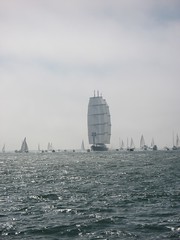
As we approached the Bridge, all the adults started getting excited and pointing. This struck me as peculiar in a group of otherwise rational crew members who had probably been under the Gate a million times. They mustered me out of my seat to see “It.” It was a 290 foot sailboat under full sail escorted by a fleet of hundreds of small pleasure craft, buzzing around like bees around a hive.
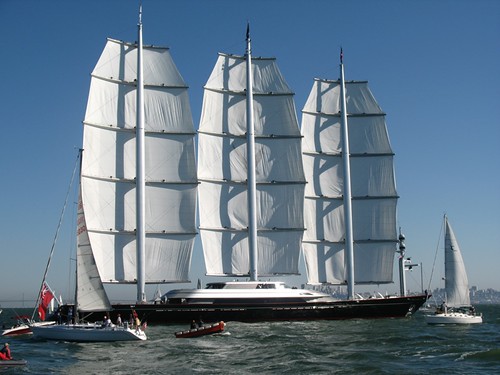
s/y Maltese Falcon is one of the most stunning craft on the water today. She has the proportions of a sailing vessel of yore, but the sleek, modern lines of a 21st century craft. She stands nearly 200 feet with three enormous, independently rotating masts. The pictures -- mine, Jason’s and those of the many professional photographers present on Saturday -- do not do her justice. In person, she is simply amazing.
Our intrepid Cap’n Jason did his standard bold and heart stopping maneuver, positioning us to swing across her bow just before she passed into the Gate zone. We took a lot of photos, had our breath stolen by her beauty, and pissed off a lot of other craft whose bows we zoomed in front of. Later as the Falcon rounded Angel Island, we had another opportunity at low speed to get up close and personal. We even exchanged very happy words with the crew, and a few warning honks with the captain.
Trail magic begins when you are ready to open yourself to experience. Had I not grudgingly agreed to shlep my children over to EA, I would have missed the high point of our visit to the San Francisco Bay area. Thank you, Jason and Laureen. What a treat!!!
Aeron fitched a pit and jumped into it, refusing to bathe. This not only induced in her mother a strong desire to strangle her, it also resulted in one of those cowboy western standoffs wherein I was stupid enough to say, “If you do not take a shower, you can not go with the Hudsons.” Ugh. I should know better.
Mera slammed my head between the sliding glass door and the navigation table while I was cleaning the scum out of the tracks. I had a splitting headache and a rather scary lancing pain from my neck to my butt.
Hello! I own a sailboat. I live on a sailboat. Why the heck would I want to “go sailing” for the afternoon. Bah humbug!
But the kids really superduper wanted to go, and I’m basically in love with Laureen and Jason. So we strongarmed Aeron into s/v EA’s shower, and I boarded for an afternoon of sitting in an ibuprofinic stupor in the cockpit with a cherubic baby catatonic in my lap. The Hudsons fortunately had a few other friends aboard to help with lines and helm. The wind was brisk, the sun was shining. It was a perfect day for a sail on the Bay.
Jason pointed his 47’ Lagoon straight for the Golden Gate Bridge and ZOOM! off we went. Excellent Adventure is a wonderful boat in the old school of Lagoon manufacture. Back in the day, Lagoon was well known for racing catamarans and the only thing compelling about the otherwise horrid movie Waterworld - the protagonist’s spectacular blade thin catamaran. It was not long before we were ripping out to the Bridge at plus 10 knots.
As we approached the Bridge, all the adults started getting excited and pointing. This struck me as peculiar in a group of otherwise rational crew members who had probably been under the Gate a million times. They mustered me out of my seat to see “It.” It was a 290 foot sailboat under full sail escorted by a fleet of hundreds of small pleasure craft, buzzing around like bees around a hive.
s/y Maltese Falcon is one of the most stunning craft on the water today. She has the proportions of a sailing vessel of yore, but the sleek, modern lines of a 21st century craft. She stands nearly 200 feet with three enormous, independently rotating masts. The pictures -- mine, Jason’s and those of the many professional photographers present on Saturday -- do not do her justice. In person, she is simply amazing.
Our intrepid Cap’n Jason did his standard bold and heart stopping maneuver, positioning us to swing across her bow just before she passed into the Gate zone. We took a lot of photos, had our breath stolen by her beauty, and pissed off a lot of other craft whose bows we zoomed in front of. Later as the Falcon rounded Angel Island, we had another opportunity at low speed to get up close and personal. We even exchanged very happy words with the crew, and a few warning honks with the captain.
Trail magic begins when you are ready to open yourself to experience. Had I not grudgingly agreed to shlep my children over to EA, I would have missed the high point of our visit to the San Francisco Bay area. Thank you, Jason and Laureen. What a treat!!!
Thursday, July 17, 2008
Tied in Knots
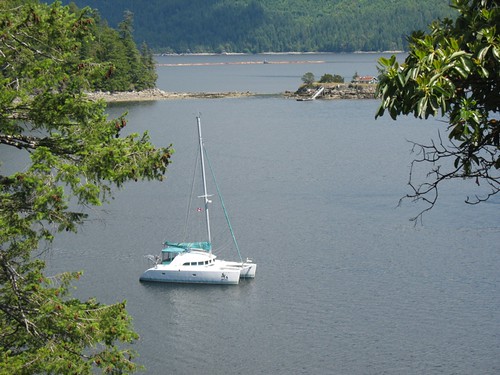
“I’ll anchor. You take the stern tie line in the dinghy and loop it around that tree,” Dr C orders as we come into the tiny inlet near Hardy Island. He continued, “The girls can help with the anchoring.”
I don my life jacket, wrestle the dinghy off the davits and into the water, and transfer the million pounds of yellow stern tie strap into the wobbly boat. “Dinghy away!” I shout up to the helm as I push off and start frantically rowing towards shore.
The first phase of this project does not go well. Wind and tide grab the dinghy and send it winging at an angle completely orthogonal to the direction in which I want to go. I’ve never quite grasped rowing to begin with -- the notion of doing everything with my back to the direction in which I want to travel striking me as completely counter intuitive -- but even I can tell that the far shore is getting closer instead for farther away indicating negative progress towards my objective. I mentally gird my loins, dig in my heels, invent new cliches, and start vigorously rowing back towards the tree. I finally get into a rhythm and, with a brief lull in the breeze, make it to shore.
Getting up on shore to tie the line presents yet another challenge. The tide is out, the sheer wall of the inlet covered in barnacles, seaweed, and indescribably stinky goo. There is no place to tie the dinghy painter so I take it with me as I scrabble up the face of a large granite rock to the designated tree. Chafe protection in place, stern tie looped around the tree, I make a less than graceful descent back down to the dinghy only to find my home boat is gone. Don Quixote is miles away down the inlet anchoring in what appears to be the next county.
“Dean! DEAN!!!” My voice echoes off the canyon walls, unfortunately sounding like a panicked fish wife on market day when the ice man doesn’t show up. I clear my throat, take a deep breath, quell my fear, and try again, “Dr C!!” That was better. He leaves Mera and Jaime on the bow with the anchor to come back and see what I need.
Using hand gestures, I somehow make it clear that there is no way on earth I’m going to make it back to the boat with the stern line. For one thing, the stern line is only 300 feet long. At this point, Don Quixote is probably a half mile away. He points to another tree, closer to the boat but about 30 feet up the sheer wall of the inlet. A gecko lizard crossed with a star fish might make it up that cliff with a 100 feet of high quality line and a bosun’s chair. It was out of my skill set. Vigorously shaking my head and nearly knocking myself off the ledge, I communicate how little I think of this new plan.
Much heavy sighing takes place on Don Quixote. Much yelling at the girls to raise the anchor, much backing and forthing to get the boat positioned to haul up 200 feet of rode. The canyon reverberates to the rattling of the chain. I squat uncomfortably on a ledge near the tie. God only knows where he’ll have me go next. There’s no point getting settled.
Finally, DQ has her anchor firmly set in 60 feet of water not 100 feet perpendicular to my precarious perch. I get back in the dinghy and start to row back to the boat. This simple act proves impossible. I’m rowing against the wind, against the tide, trying to pay out 300 feet of soaking wet line from a tangled heap at my feet. The line keeps ensnaring the oars, and as it drops out of the boat, it takes on the weight and consistency of lead window glazing. One oar pops out of its mount, then the other. The wind grabs me, spins the boat around, and tangles the stern line in the end of the painter.
It is at this point, I completely lose it. I grab one recalcitrant oar and shout a four letter word which starts with F and inevitably makes a grown adult look like an utter idiot. To complete the picture, I bang the oar on the side of the dinghy a couple of times to emphasize my repeated and utterly heartfelt use of my chosen profanity. Just for good measure, I also stomp my feet. I might have stomped them twice. I don’t know. Dr C later tells me he had rarely more desired a video camera than at that moment. This comment does not earn him any nooky credit.
Temper released, I take a few deep breaths and start hauling and coiling the two ends of the stern line. With both ends properly stowed, I pause to catch my breath, orient the dinghy, and then row like a bat out of hell towards Don Quixote, the line gradually trailing out behind me. The effort required is asymptotic to my proximity to our catamaran. Each foot closer to our transom increases the rebounding drag of the stern line towards shore. In the last few feet, the girls and Dr C start chanting, “You can do it! You can do it! YOU CAN DO IT!” Frantic, I toss the painter at the boat, desperate to be hauled in the last few inches. With a lurch and a grab, they get the painter, only to see one end of the stern line unravel and go winging off the dinghy and whipping towards shore.
“Quick!” Dean shouts, “Go get it! Grab the end before it comes undone.” Jaime leaps into the dinghy, grabs one oar, and helps me send the dinghy shooting after the rapidly receding tail of line. We speed towards the tail, grab it up, and then with Jaime pulling us back to Don Quixote hand over hand, I hang on to the errant end with every fiber of my being. On our arrival, Dr C moves quickly to tie off both ends and gradually reduce the slack. When all is said and done, with the anchor snugged up on the bridle and the stern tie tightened from aft to tree, our transom is about 20 feet from the canyon wall. Wet and exhausted, Jaime and I collapse on the deck to admire our work, while the captain stands on the bow to evaluate the condition of our anchor and the lie of the boat.
Ten minutes go by. The wind, hard on our beam, yanks Don Quixote down into the inlet, eagerly tugging at the stern line and anchor. Dr C doesn’t come inside. This is never a good Anchoring Sign. Like an omen of impending doom, Dr C puts his life jacket back on. “This isn’t going to work.”
“No?” I ask. Jaime looks resigned.
Mera pipes up, “I didn’t feel comfortable with this wall near the back anyway.”
“No,” Dr C says, “We’re beam on and pulling the anchor out of position. We’ll drag.”
We couldn’t have thought of this before I put in a half hour of some of the most intense physical exercise of my life? Of course not. Today’s Cruising Lesson: Never use a stern tie to position the boat beam on to the wind. “Okay.” I release one end of the line and start hauling in the stern tie hand over hand. Fifteen minutes later we’re firmly anchored in the middle of the bay in 65 feet with a million feet of chain out and enough room to swing more than just our cat around.
From a limp heap in the cockpit, I inform the captain, “Next time, I’ll drive.”

I don my life jacket, wrestle the dinghy off the davits and into the water, and transfer the million pounds of yellow stern tie strap into the wobbly boat. “Dinghy away!” I shout up to the helm as I push off and start frantically rowing towards shore.
The first phase of this project does not go well. Wind and tide grab the dinghy and send it winging at an angle completely orthogonal to the direction in which I want to go. I’ve never quite grasped rowing to begin with -- the notion of doing everything with my back to the direction in which I want to travel striking me as completely counter intuitive -- but even I can tell that the far shore is getting closer instead for farther away indicating negative progress towards my objective. I mentally gird my loins, dig in my heels, invent new cliches, and start vigorously rowing back towards the tree. I finally get into a rhythm and, with a brief lull in the breeze, make it to shore.
Getting up on shore to tie the line presents yet another challenge. The tide is out, the sheer wall of the inlet covered in barnacles, seaweed, and indescribably stinky goo. There is no place to tie the dinghy painter so I take it with me as I scrabble up the face of a large granite rock to the designated tree. Chafe protection in place, stern tie looped around the tree, I make a less than graceful descent back down to the dinghy only to find my home boat is gone. Don Quixote is miles away down the inlet anchoring in what appears to be the next county.
“Dean! DEAN!!!” My voice echoes off the canyon walls, unfortunately sounding like a panicked fish wife on market day when the ice man doesn’t show up. I clear my throat, take a deep breath, quell my fear, and try again, “Dr C!!” That was better. He leaves Mera and Jaime on the bow with the anchor to come back and see what I need.
Using hand gestures, I somehow make it clear that there is no way on earth I’m going to make it back to the boat with the stern line. For one thing, the stern line is only 300 feet long. At this point, Don Quixote is probably a half mile away. He points to another tree, closer to the boat but about 30 feet up the sheer wall of the inlet. A gecko lizard crossed with a star fish might make it up that cliff with a 100 feet of high quality line and a bosun’s chair. It was out of my skill set. Vigorously shaking my head and nearly knocking myself off the ledge, I communicate how little I think of this new plan.
Much heavy sighing takes place on Don Quixote. Much yelling at the girls to raise the anchor, much backing and forthing to get the boat positioned to haul up 200 feet of rode. The canyon reverberates to the rattling of the chain. I squat uncomfortably on a ledge near the tie. God only knows where he’ll have me go next. There’s no point getting settled.
Finally, DQ has her anchor firmly set in 60 feet of water not 100 feet perpendicular to my precarious perch. I get back in the dinghy and start to row back to the boat. This simple act proves impossible. I’m rowing against the wind, against the tide, trying to pay out 300 feet of soaking wet line from a tangled heap at my feet. The line keeps ensnaring the oars, and as it drops out of the boat, it takes on the weight and consistency of lead window glazing. One oar pops out of its mount, then the other. The wind grabs me, spins the boat around, and tangles the stern line in the end of the painter.
It is at this point, I completely lose it. I grab one recalcitrant oar and shout a four letter word which starts with F and inevitably makes a grown adult look like an utter idiot. To complete the picture, I bang the oar on the side of the dinghy a couple of times to emphasize my repeated and utterly heartfelt use of my chosen profanity. Just for good measure, I also stomp my feet. I might have stomped them twice. I don’t know. Dr C later tells me he had rarely more desired a video camera than at that moment. This comment does not earn him any nooky credit.
Temper released, I take a few deep breaths and start hauling and coiling the two ends of the stern line. With both ends properly stowed, I pause to catch my breath, orient the dinghy, and then row like a bat out of hell towards Don Quixote, the line gradually trailing out behind me. The effort required is asymptotic to my proximity to our catamaran. Each foot closer to our transom increases the rebounding drag of the stern line towards shore. In the last few feet, the girls and Dr C start chanting, “You can do it! You can do it! YOU CAN DO IT!” Frantic, I toss the painter at the boat, desperate to be hauled in the last few inches. With a lurch and a grab, they get the painter, only to see one end of the stern line unravel and go winging off the dinghy and whipping towards shore.
“Quick!” Dean shouts, “Go get it! Grab the end before it comes undone.” Jaime leaps into the dinghy, grabs one oar, and helps me send the dinghy shooting after the rapidly receding tail of line. We speed towards the tail, grab it up, and then with Jaime pulling us back to Don Quixote hand over hand, I hang on to the errant end with every fiber of my being. On our arrival, Dr C moves quickly to tie off both ends and gradually reduce the slack. When all is said and done, with the anchor snugged up on the bridle and the stern tie tightened from aft to tree, our transom is about 20 feet from the canyon wall. Wet and exhausted, Jaime and I collapse on the deck to admire our work, while the captain stands on the bow to evaluate the condition of our anchor and the lie of the boat.
Ten minutes go by. The wind, hard on our beam, yanks Don Quixote down into the inlet, eagerly tugging at the stern line and anchor. Dr C doesn’t come inside. This is never a good Anchoring Sign. Like an omen of impending doom, Dr C puts his life jacket back on. “This isn’t going to work.”
“No?” I ask. Jaime looks resigned.
Mera pipes up, “I didn’t feel comfortable with this wall near the back anyway.”
“No,” Dr C says, “We’re beam on and pulling the anchor out of position. We’ll drag.”
We couldn’t have thought of this before I put in a half hour of some of the most intense physical exercise of my life? Of course not. Today’s Cruising Lesson: Never use a stern tie to position the boat beam on to the wind. “Okay.” I release one end of the line and start hauling in the stern tie hand over hand. Fifteen minutes later we’re firmly anchored in the middle of the bay in 65 feet with a million feet of chain out and enough room to swing more than just our cat around.
From a limp heap in the cockpit, I inform the captain, “Next time, I’ll drive.”
Thursday, May 17, 2007
A Failure of Saltiness
Just in case prior articles have somehow left the impression that I am an Experienced, Salty Sailor, let me just state for the record that I am not. Experienced, that is. Technically, I’m not even sure it’s appropriate to call me a Sailor unless you can loosely define the term as “someone who pulls the jib line on a sailboat when forced to do so at the point of a gun.”
Real Sailors (trademark pending) are also known as Salty Sailors, and these fine men and women are full of pithy advice. (I did NOT say “pissy.”) They drip these pearls of wisdom liberally over your ego like corrosive splats of bird guano on the shining deck of your vessel. These unlooke- for gems of information have the power to simultaneously save your life and ensure your utter lack of confidence to put it at risk. Their collective wisdom is priceless but daunting, both in its scope and its power to terrify.
I, on the other hand, lack a certain depth of knowledge on this subject. Prior to purchasing s/v Don Quixote, my entire sailing resume consisted of an overnight on the Chesapeake, the chief memorable moment being running aground on a sand bar. There was also a week in the San Juan Islands on a Cal 28’ for our honeymoon during which I believe I threatened to divorce my new husband no less than four times. So it’s pretty much impossible to say that I know what I’m talking about when it comes to all things nautical. Certainly, salty sailors will inform you that I don’t know my aft quarters from a whirlpool in the water.
Thus, to those lured to this web site with notions of learning how to sail, live aboard, or cruise in a catamaran, so sorry. I’m not really capable of telling you the safe, sane, and proper way to do it. I can only offer my own creative commomns protected, honed in the fine crucible of the real world, and orthogonal to anything officially supported by Real Sailors (trademark still pending) techniques. My admittedly naïve approach to the subject is – as with so many things in life – stubbornness uber alles.
You can.
You will.
You just need to want it badly enough.
A question I often hear when people learn that in my salad days I rode my bike across the United States is, “How do you prepare for a trip like that?” And I reply, “You can’t.” Or more accurately, the way to prepare to ride your bike across the United States is to buy some equipment, get a map, read a book, and get on the bike. Ride 70 miles. Camp for the night in a field or park. Get up the next morning and get on the bike. Ride another 70 miles. Rinse, repeat for roughly a month. Two things happen: First, you will have ridden from Yorktown to the Mississippi River; and second, you will know how to get across the next two thirds of the country.
So when I tell you that the way to learn how to be a cruising sailor is to buy some equipment, get a map, read a book, and get in a boat, I speak with some experience, although none particularly useful to the endeavor. It’s pretty safe to assume that you can move the boat to the next inlet, drop anchor and spend the night. Get up, put up the sails, pull up the anchor (maybe even in that order), and move down the coast another few nautical miles. Rinse, repeat for a season. Two things will happen: First, you’ll probably make it from Seattle to someplace south of Mexico; and second, you’ll know how to cruise.
And while you may not be Salty, I can assure you that you will be a Sailor.
Real Sailors (trademark pending) are also known as Salty Sailors, and these fine men and women are full of pithy advice. (I did NOT say “pissy.”) They drip these pearls of wisdom liberally over your ego like corrosive splats of bird guano on the shining deck of your vessel. These unlooke- for gems of information have the power to simultaneously save your life and ensure your utter lack of confidence to put it at risk. Their collective wisdom is priceless but daunting, both in its scope and its power to terrify.
I, on the other hand, lack a certain depth of knowledge on this subject. Prior to purchasing s/v Don Quixote, my entire sailing resume consisted of an overnight on the Chesapeake, the chief memorable moment being running aground on a sand bar. There was also a week in the San Juan Islands on a Cal 28’ for our honeymoon during which I believe I threatened to divorce my new husband no less than four times. So it’s pretty much impossible to say that I know what I’m talking about when it comes to all things nautical. Certainly, salty sailors will inform you that I don’t know my aft quarters from a whirlpool in the water.
Thus, to those lured to this web site with notions of learning how to sail, live aboard, or cruise in a catamaran, so sorry. I’m not really capable of telling you the safe, sane, and proper way to do it. I can only offer my own creative commomns protected, honed in the fine crucible of the real world, and orthogonal to anything officially supported by Real Sailors (trademark still pending) techniques. My admittedly naïve approach to the subject is – as with so many things in life – stubbornness uber alles.
You can.
You will.
You just need to want it badly enough.
A question I often hear when people learn that in my salad days I rode my bike across the United States is, “How do you prepare for a trip like that?” And I reply, “You can’t.” Or more accurately, the way to prepare to ride your bike across the United States is to buy some equipment, get a map, read a book, and get on the bike. Ride 70 miles. Camp for the night in a field or park. Get up the next morning and get on the bike. Ride another 70 miles. Rinse, repeat for roughly a month. Two things happen: First, you will have ridden from Yorktown to the Mississippi River; and second, you will know how to get across the next two thirds of the country.
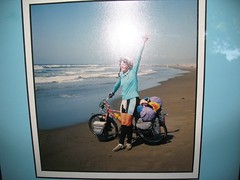
So when I tell you that the way to learn how to be a cruising sailor is to buy some equipment, get a map, read a book, and get in a boat, I speak with some experience, although none particularly useful to the endeavor. It’s pretty safe to assume that you can move the boat to the next inlet, drop anchor and spend the night. Get up, put up the sails, pull up the anchor (maybe even in that order), and move down the coast another few nautical miles. Rinse, repeat for a season. Two things will happen: First, you’ll probably make it from Seattle to someplace south of Mexico; and second, you’ll know how to cruise.
And while you may not be Salty, I can assure you that you will be a Sailor.
Thursday, May 03, 2007
If Not You, Then Who?
Naturally, a question posed and answered in the memoirs of every author about the cruising life is: "Why did you do it?" Since I’ve consumed a good fraction of that literature, it strikes me that the motivation can be categorized into three nouns: escape, dream, or challenge.
#1 – Run Away! Run Away!
In this category we have those who take a deep breath, look around at the wonders of modern civilization, and ask themselves why the hell they are here. What does it all mean? Is there a better life? On balance, what happens if I trade my wide screen TV and daily shower for poverty, quiet, and ports unknown?
These are the people who work 60 hours a week to pay for their “things,” only to realize that the one with the most toys doesn't actually win. In fact, the game has rules no one explained when we were young and ambitious and on our way up the corporate ladder. These are people who watched their parents work hard their entire lives only to die within months of retirement. They pull up the profit and loss statement on their lives to realize that they spend four months working for the IRS, one month for the state, three months for the bank, and one month for their health insurer. They see their children growing up without them, maturing more rapidly than a parent would have thought possible during those early sleepless nights.
Squeezed in with these folks, I will also lump those folks who have more money than God and decide to run away just because they can. I suppose technically they could have their own category, but let's face it. I'm not one of them. You're not one of them. All we know about those folks is that they made money somehow, some way, and it would be very nice if we knew they did it illegally so we could feel morally superior. Instead, we're just going to drink rum in their cockpit because it's the most spacious and has the ice cubes and pretend they are like us. Running away from it all.
#2 – A Star to Sail Her By
The seas are awash with boats owned by dreamers. Actually, the marinas are afloat with them. I'm not clear that there are a large number of these owners actually living the dream. For many, the mere fact of the boat is enough. However, for every boat full of people running away from the busy life (see #1 above), you have at least two with a sailor on board who always longed to go to sea and live the cruising life.
It is an unfortunate statistic that the majority of sailor dreamers are men. A depressing number of these men are accompanied by women who have been dragged aboard against all their objections to the contrary. In fact, an entire sub-genre of cruising literature is devoted to the reluctant female spouse: How to get her on the boat, how to keep her there, how to make her feel empowered. To date, the small cadre of intrepid female sailor dreamers is lost in the cacophony of put-upon spouses.
Never mind.
A sailor dreamer buys a boat and, if all the stars are in alignment, eventually lives the dream. By far the majority of these dreams are a retirement plan. “When I get my pension and fund the IRA and we sell the house for a tremendous profit, we'll leave!” Cutting the lines on a sailor dreamer's boat can be a difficult process. Dreamers have rather high standards which makes sense when you think about it. Your dreams should be bigger and better than life. It is unfortunate when your boat cannot be.
#3 -- Because It's There

Adventurers of All Sorts
Uploaded by toastfloats.Of course, there are still heroes and madmen in the world. These are the ones who like to throw on a backpack and hike the Appalachian Trail for fun. They take a year off to live in Nepal or volunteer to help victims of natural disasters in mosquito-infested places with unpronounceable names. We admire these bold adventurers while simultaneously thinking to ourselves, "Holy bananas, that guy is a fruitcake!"
And there are a lot of adventurers dinking around in boats out there. They are often young with no roots and a taste for danger. I think the more fascinating ones are the folks trying something different -- a single-handed trip never before attempted, a voyage in a boat patterned after something from 2000 years ago, a cruise entirely funded on the proceeds of an unproven educational Web site. To me, their stories hold a horrible fascination much like that of a multi-car wreck on the autobahn.
#4 – Other
I take it back. It's four not three. No categorical list is actually complete without the elastic clause of “other.” In the boating world, it is hard to describe these others. They are the genetic anomalies for whom Darwinian principles were established. Either they make it in this world and reproduce more oddities like themselves who eventually build AI robots to take over the world, or they don't. Simplicity itself. So far I've met only one, and even after roughly half a bottle of rum and a bag full of limes, I'm still not clear how this individual ticks. You just have to take it as an article of blind faith that these folks know what they are doing.
* * *
Ultimately, why you do something is less important than the established fact that you have. Why did you go to college? Daddy made me. Does that diminish the value of the lessons you learned there? Does it diminish your accomplishments -- mastering the separation of laundry, frying of eggs, or drinking a beer bong without vomiting on your shoes? Of course not. If delusional fantasies were a deterrent to garnering respect, we would never have dot com CEOs, toaster strudel, or shoes that tell you whether you’ve had a good workout.
So don't ask me why I do it! Simply marvel that it can be done by people less capable, less grounded, and less stable than you.
#1 – Run Away! Run Away!
In this category we have those who take a deep breath, look around at the wonders of modern civilization, and ask themselves why the hell they are here. What does it all mean? Is there a better life? On balance, what happens if I trade my wide screen TV and daily shower for poverty, quiet, and ports unknown?
These are the people who work 60 hours a week to pay for their “things,” only to realize that the one with the most toys doesn't actually win. In fact, the game has rules no one explained when we were young and ambitious and on our way up the corporate ladder. These are people who watched their parents work hard their entire lives only to die within months of retirement. They pull up the profit and loss statement on their lives to realize that they spend four months working for the IRS, one month for the state, three months for the bank, and one month for their health insurer. They see their children growing up without them, maturing more rapidly than a parent would have thought possible during those early sleepless nights.
Squeezed in with these folks, I will also lump those folks who have more money than God and decide to run away just because they can. I suppose technically they could have their own category, but let's face it. I'm not one of them. You're not one of them. All we know about those folks is that they made money somehow, some way, and it would be very nice if we knew they did it illegally so we could feel morally superior. Instead, we're just going to drink rum in their cockpit because it's the most spacious and has the ice cubes and pretend they are like us. Running away from it all.
#2 – A Star to Sail Her By
The seas are awash with boats owned by dreamers. Actually, the marinas are afloat with them. I'm not clear that there are a large number of these owners actually living the dream. For many, the mere fact of the boat is enough. However, for every boat full of people running away from the busy life (see #1 above), you have at least two with a sailor on board who always longed to go to sea and live the cruising life.
It is an unfortunate statistic that the majority of sailor dreamers are men. A depressing number of these men are accompanied by women who have been dragged aboard against all their objections to the contrary. In fact, an entire sub-genre of cruising literature is devoted to the reluctant female spouse: How to get her on the boat, how to keep her there, how to make her feel empowered. To date, the small cadre of intrepid female sailor dreamers is lost in the cacophony of put-upon spouses.
Never mind.
A sailor dreamer buys a boat and, if all the stars are in alignment, eventually lives the dream. By far the majority of these dreams are a retirement plan. “When I get my pension and fund the IRA and we sell the house for a tremendous profit, we'll leave!” Cutting the lines on a sailor dreamer's boat can be a difficult process. Dreamers have rather high standards which makes sense when you think about it. Your dreams should be bigger and better than life. It is unfortunate when your boat cannot be.
#3 -- Because It's There
Adventurers of All Sorts
Uploaded by toastfloats.
And there are a lot of adventurers dinking around in boats out there. They are often young with no roots and a taste for danger. I think the more fascinating ones are the folks trying something different -- a single-handed trip never before attempted, a voyage in a boat patterned after something from 2000 years ago, a cruise entirely funded on the proceeds of an unproven educational Web site. To me, their stories hold a horrible fascination much like that of a multi-car wreck on the autobahn.
#4 – Other
I take it back. It's four not three. No categorical list is actually complete without the elastic clause of “other.” In the boating world, it is hard to describe these others. They are the genetic anomalies for whom Darwinian principles were established. Either they make it in this world and reproduce more oddities like themselves who eventually build AI robots to take over the world, or they don't. Simplicity itself. So far I've met only one, and even after roughly half a bottle of rum and a bag full of limes, I'm still not clear how this individual ticks. You just have to take it as an article of blind faith that these folks know what they are doing.
* * *
Ultimately, why you do something is less important than the established fact that you have. Why did you go to college? Daddy made me. Does that diminish the value of the lessons you learned there? Does it diminish your accomplishments -- mastering the separation of laundry, frying of eggs, or drinking a beer bong without vomiting on your shoes? Of course not. If delusional fantasies were a deterrent to garnering respect, we would never have dot com CEOs, toaster strudel, or shoes that tell you whether you’ve had a good workout.
So don't ask me why I do it! Simply marvel that it can be done by people less capable, less grounded, and less stable than you.
Thursday, March 22, 2007
A Typical Day Afloat
Editor's Note: Written Fall 2006
We are out here in the San Juan Islands, bobbing around with little wind in lovely anchorages. The trip is the last long cruise of the year, a 10-day extravaganza of floating around and breaking the boat.
Par for the course. We’ve broken several things already. Probably the most critical item was the windlass, which abruptly decided this morning not to work. Nearly two hours of troubleshooting later, Dr C determined that the relay is at fault. He now has the windlass hotwired, god help us, so that it can run even if we don’t have the batteries on. This is probably not the best long-term solution, but it means that we can comfortably anchor in more than 2 fathoms without worrying how the hell we’re going to pull up nearly 200 feet of thick chain and anchor.
The way it operates – and I use that word in the loosest meaning possible -- is that Dr C stands on the tramp watching the anchor. He yells, “Go!” to Aeron standing at the mast who in turn shouts in the window to Jaime kneeling in the salon. She passes this down the line to me crouching in the port aft cabin next to the switch. When this verbal bucket brigade gets to me, I toggle the breaker. God help us if we have to anchor off a Seattle Yacht Club outstation. I'll never live down the shame.
The girls broke the head. Twice. I fixed it without getting covered in shit up to my knees, which I consider an enormous accomplishment. In fact, thus far I have not had to actually unscrew and dump crap even once. A fantastic step forward in head mastery, if I do say so myself.
In addition to breaking things, Dr C engaged in a laundry list of repairs to the boat. He got out a gel coat kit and patched the starboard hull. He just about fully installed the inverter, and for dessert he replaced the broken hinges on the two port hatches. The man is proving endlessly useful on the boat. All he asks in return is good food and frequent sex.
On the first item, I’m making progress. I didn’t overstock the boat this time, which feels good. We had three days of food for three days of travel and then went shore shopping. More significant perhaps, Jaime saw an unfamiliar vegetable on sale in the market today at Friday Harbor. Rather than avoiding it, I agreed to purchase the thing and bring it back to the boat. Sautéed in a bit of shallot, olive oil and garlic, the rainbow chard proved to be a savory and nutritious addition to dinner. This proves that ages old maxim that even shoe leather tastes good with enough fat and garlic.
We’ve enjoyed the San Juans Islands. Had two marvelous days of sailing before the blue hole for which this area is renowned settled into a complete calm. Since then, we’ve been playing the tidal currents to move from place to place. We bucked a serious rapid this morning around the west side of San Juan Island from Garrison Bay to Friday Harbor. At one point, we were getting swept along a 4 knot current. It pays to watch your tide tables around here, let me tell you. It pays to keep your eyes open for rocks, too. Rocks are not your friend.
The kids are playing a wrestling game in the cabin while Dr C and I relax in the cockpit sipping wine and contemplating our navels. The boat resonates with the harmony of children's screams and two seagulls squabbling over a Ritz cracker on the starboard bow. It's not perfect, but it might just be as good as heaven gets.
Editor's Note: Written Fall 2005
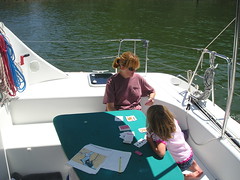
We are out here in the San Juan Islands, bobbing around with little wind in lovely anchorages. The trip is the last long cruise of the year, a 10-day extravaganza of floating around and breaking the boat.
Par for the course. We’ve broken several things already. Probably the most critical item was the windlass, which abruptly decided this morning not to work. Nearly two hours of troubleshooting later, Dr C determined that the relay is at fault. He now has the windlass hotwired, god help us, so that it can run even if we don’t have the batteries on. This is probably not the best long-term solution, but it means that we can comfortably anchor in more than 2 fathoms without worrying how the hell we’re going to pull up nearly 200 feet of thick chain and anchor.
The way it operates – and I use that word in the loosest meaning possible -- is that Dr C stands on the tramp watching the anchor. He yells, “Go!” to Aeron standing at the mast who in turn shouts in the window to Jaime kneeling in the salon. She passes this down the line to me crouching in the port aft cabin next to the switch. When this verbal bucket brigade gets to me, I toggle the breaker. God help us if we have to anchor off a Seattle Yacht Club outstation. I'll never live down the shame.
The girls broke the head. Twice. I fixed it without getting covered in shit up to my knees, which I consider an enormous accomplishment. In fact, thus far I have not had to actually unscrew and dump crap even once. A fantastic step forward in head mastery, if I do say so myself.
In addition to breaking things, Dr C engaged in a laundry list of repairs to the boat. He got out a gel coat kit and patched the starboard hull. He just about fully installed the inverter, and for dessert he replaced the broken hinges on the two port hatches. The man is proving endlessly useful on the boat. All he asks in return is good food and frequent sex.
On the first item, I’m making progress. I didn’t overstock the boat this time, which feels good. We had three days of food for three days of travel and then went shore shopping. More significant perhaps, Jaime saw an unfamiliar vegetable on sale in the market today at Friday Harbor. Rather than avoiding it, I agreed to purchase the thing and bring it back to the boat. Sautéed in a bit of shallot, olive oil and garlic, the rainbow chard proved to be a savory and nutritious addition to dinner. This proves that ages old maxim that even shoe leather tastes good with enough fat and garlic.
We’ve enjoyed the San Juans Islands. Had two marvelous days of sailing before the blue hole for which this area is renowned settled into a complete calm. Since then, we’ve been playing the tidal currents to move from place to place. We bucked a serious rapid this morning around the west side of San Juan Island from Garrison Bay to Friday Harbor. At one point, we were getting swept along a 4 knot current. It pays to watch your tide tables around here, let me tell you. It pays to keep your eyes open for rocks, too. Rocks are not your friend.
The kids are playing a wrestling game in the cabin while Dr C and I relax in the cockpit sipping wine and contemplating our navels. The boat resonates with the harmony of children's screams and two seagulls squabbling over a Ritz cracker on the starboard bow. It's not perfect, but it might just be as good as heaven gets.
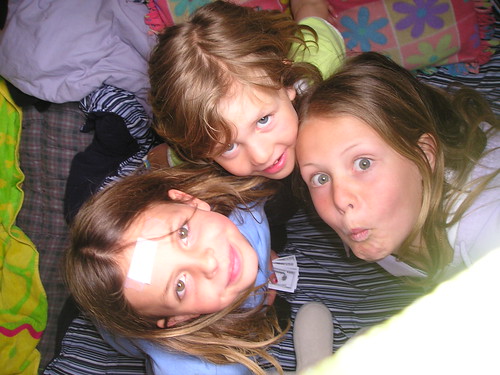
Thursday, February 22, 2007
What You Really Need to Know to Charter a Catamaran
A catamaran isn't like a normal boat. In fact, I have a monohull captain friend who insists it isn't a boat at all. Actually, he calls it a French, production, plastic catamaran. If we break that down, it's clear that all four words are – in his experience and deeply held opinion – highly insulting terms. The opposite would possibly be a New England, hand built, wooden, deep keeled, big butted, fat beamed, cramp quartered, dark tube leaner.
I tried. I really did. But I lost it there toward the end.
The point is that a catamaran does not behave the way a standard monohull sail boat behaves. And while you experienced single-hull sailors expect this when you charter a catamaran for yourself and your fifty in-laws out of Tortuga for a week, it can be deeply surprising when you turn the boat to port and the boat doesn't actually turn -- or more entertainingly, it turns to starboard. The good news on our sailing vessel is that I have not the slightest clue how to sail a monohull and that my husband learns quickly.
Actually, neither statement is strictly accurate, but it stands as a good starting point for a discussion of the principle 'gotchas' that will getcha when you scramble aboard the deck of your average charter cat for the first time. And while I am certain that many of you are interested in points of sail, safety, and performance, I think we should focus on the really salient issue: space.
Probably the single most important difference between a catamaran and a monohull of similar length is that on the former you can lose your children and on the later it quickly becomes necessary to drown them to preserve your sanity. I recommend a strategy of divide and conquer. Some people prefer to put the brother–in-law and his children in the port hull while you and your family take the starboard. Instead, let me suggest this alternative.
Despite the fact that your brother-in-law is a pompous ass whose sexual antics with your sister make you want to vomit and whose standards for personal hygiene leave something to be desired, he is still a better companion on an extended boat trip than your own offspring. Put him in the forward starboard cabin and throw all the children over into the opposite side of the boat. On most charter configurations there are two heads and a long companionway between you and your in-law which is a sufficient buffer for an adult. Children, however, are capable of penetrating shrieks that can stun a dolphin. Placing a dead air zone and fifteen feet of water between you and the younger generation goes a long ways toward saving your vacation.
Another tip for traveling with children aboard a catamaran is to avoid 'their hull' for the duration. Of course, you'll need to turn on the batteries and open the through hulls and check to make sure nothing is leaking before you leave the dock on Day One. After that, however, simply abandon that hull to the under-15 set. Think about it, Monohull Man. You have TWO. You don't need that one. Just let them have it. Don't even try to get them to divide the rooms along any principle of fairness. Just allow that hull to descend into Lord of the Flies chaos while you sip Mai Tais in the cockpit. On your return, hire some teenagers to swill out that hull with buckets of sea water and disinfectant.
A far more serious concern is displacing the rum. On a traditional leaner there are only so many places your family can stow gallon jugs of premium island rum. Generally, they end up under the seats in the central cabin. Occasionally you'll find one stowed under the sink. And once I found one tucked into the magazine rack next to the navigation station, bringing an entirely new dimension to the phrase “drink and drive.”
On your charter cat, however, you've got a considerably bigger problem. In addition to the above-mentioned locations, you have pantry shelves, cabin closets, the laundry room, the starboard recreation room, and, in those monster 50 footers, the upper-deck seating area. We once lost two half–gallon jugs of tequila and a bag of tortilla chips in a pantry closet for nearly three months.
My recommendation is to store your liquor with something that rots. My personal candidate is a lime, as the logical synergy between limes and alcohol make for imaginative drinks when I do find the bottles. The problem with limes is they really do keep well in a cool dark spot. So you would perhaps be better served by stashing the booze with something that both rots faster and smells really bad when it does so. Suggestions include onions, fish sticks, or oranges. Note: Unlike their green counterparts, oranges do not keep and when they go, the smell will knock you flat.
The point is, you can never lose the bottles for long as long as you have a good sniffer. In the end, you can always follow the trail of fruit flies. Just make sure they don't lead you into the children's hull.

I tried. I really did. But I lost it there toward the end.
The point is that a catamaran does not behave the way a standard monohull sail boat behaves. And while you experienced single-hull sailors expect this when you charter a catamaran for yourself and your fifty in-laws out of Tortuga for a week, it can be deeply surprising when you turn the boat to port and the boat doesn't actually turn -- or more entertainingly, it turns to starboard. The good news on our sailing vessel is that I have not the slightest clue how to sail a monohull and that my husband learns quickly.
Actually, neither statement is strictly accurate, but it stands as a good starting point for a discussion of the principle 'gotchas' that will getcha when you scramble aboard the deck of your average charter cat for the first time. And while I am certain that many of you are interested in points of sail, safety, and performance, I think we should focus on the really salient issue: space.
Probably the single most important difference between a catamaran and a monohull of similar length is that on the former you can lose your children and on the later it quickly becomes necessary to drown them to preserve your sanity. I recommend a strategy of divide and conquer. Some people prefer to put the brother–in-law and his children in the port hull while you and your family take the starboard. Instead, let me suggest this alternative.
Despite the fact that your brother-in-law is a pompous ass whose sexual antics with your sister make you want to vomit and whose standards for personal hygiene leave something to be desired, he is still a better companion on an extended boat trip than your own offspring. Put him in the forward starboard cabin and throw all the children over into the opposite side of the boat. On most charter configurations there are two heads and a long companionway between you and your in-law which is a sufficient buffer for an adult. Children, however, are capable of penetrating shrieks that can stun a dolphin. Placing a dead air zone and fifteen feet of water between you and the younger generation goes a long ways toward saving your vacation.
Another tip for traveling with children aboard a catamaran is to avoid 'their hull' for the duration. Of course, you'll need to turn on the batteries and open the through hulls and check to make sure nothing is leaking before you leave the dock on Day One. After that, however, simply abandon that hull to the under-15 set. Think about it, Monohull Man. You have TWO. You don't need that one. Just let them have it. Don't even try to get them to divide the rooms along any principle of fairness. Just allow that hull to descend into Lord of the Flies chaos while you sip Mai Tais in the cockpit. On your return, hire some teenagers to swill out that hull with buckets of sea water and disinfectant.
A far more serious concern is displacing the rum. On a traditional leaner there are only so many places your family can stow gallon jugs of premium island rum. Generally, they end up under the seats in the central cabin. Occasionally you'll find one stowed under the sink. And once I found one tucked into the magazine rack next to the navigation station, bringing an entirely new dimension to the phrase “drink and drive.”
On your charter cat, however, you've got a considerably bigger problem. In addition to the above-mentioned locations, you have pantry shelves, cabin closets, the laundry room, the starboard recreation room, and, in those monster 50 footers, the upper-deck seating area. We once lost two half–gallon jugs of tequila and a bag of tortilla chips in a pantry closet for nearly three months.
My recommendation is to store your liquor with something that rots. My personal candidate is a lime, as the logical synergy between limes and alcohol make for imaginative drinks when I do find the bottles. The problem with limes is they really do keep well in a cool dark spot. So you would perhaps be better served by stashing the booze with something that both rots faster and smells really bad when it does so. Suggestions include onions, fish sticks, or oranges. Note: Unlike their green counterparts, oranges do not keep and when they go, the smell will knock you flat.
The point is, you can never lose the bottles for long as long as you have a good sniffer. In the end, you can always follow the trail of fruit flies. Just make sure they don't lead you into the children's hull.
Thursday, January 18, 2007
There is No Door Knob Cover for a Boat
A common reaction of parents on learning that my husband and I live on a boat with our three kids is a look of unabashed horror. “Is that safe?” My instinct is to scoff, “Of course not, you moron.” What idiot would think you could child-proof a boat? Clearly you face insurmountable obstacles. For example, the boat is surrounded by a many–bazillion-gallon swimming pool for which there is no cover. And even if you could find a cover large enough, you'd get in a lot of trouble if you carefully locked it down with a padlock when not in use.
A boat is full of sharp corners, accessible electrical connections, and poisonous liquids. It combines all the dangers of gallons of flammable fluids and megawatt deep cycle batteries with combustion engines, open flames, and cupboards that absolutely cannot be locked. Boats are no place for the faint of heart, children under the age of 60, or small pets. There is no question that any Child Protective Service agent worth her weight in salt would declare your boat hopelessly unsafe for children.
The good news is that there are no CPS agents on the open seas. You can simply float away and snicker, because the solution to child-proofing your boat is actually boat-proofing your child. You see, it is my opinion that a boat is in a lot more danger from your children than your children are from the boat. Boats are expensive, finicky, high performance machines on which every single object costs five times more than a reasonable person would expect.
Your boat is afraid of your children, and your pocketbook is afraid of your boat's frequent encounters with their creativity. Having said that, I do have a few practical tips to achieve a mutually assured destruction detentes between your children and your boat.
Throw Them Overboard – It's not a matter of if your child falls overboard, but when. All children who spend any time living on a boat fall overboard. Sometimes they do this on purpose. Sometimes it just happens. We know a child who fell overboard twice in one day. You might think this happens only to very young children. He was seven. Some children just can't grasp the basic concept that a boat moves, and it is not possible to travel in a straight line for any serious length of time without running out of boat.
It turns out that children fall off of docks, too. Maybe it's just easier to assume that children fall. Out of trees, off ramps, over the end of the pier, through hatches, down shore side cliffs, out of the rigging, and over the side of the dinghy. Gravity is stronger for children.
The solution is to teach them how to land. This is similar to the drop techniques taught special force troops in boot camp. If you know how to fall and spring back up again, falling becomes a strategy, rather than a mistake. We routinely throw our children off the side of the boat. When they go swimming, we encourage them to jump off the bow, slide down the transom, and slip off the side. It's a long way down from the deck of our catamaran. In a pinch, you don't want to be surprised by how long it takes you to hit the water.
Try to Drown Them – A corollary to throwing them off the boat is to make sure they can swim. Now most reasonable writers attempting to get published in the sailing trades will talk about life jackets. Whenever we visit with our Seattle Yacht Club friends, we spend a lot of time getting the kids in and out of life jackets to simply enable them to walk from the slip to the shore head.
But realistically, life jackets are horribly uncomfortable. They are worse for children, I think, because you can't buy them in the conveniently thin, self-inflatable tubes available for adults. Instead, you encase your children in a yellow and red straight jackets complete with hoodie. This makes them drift around the dock looking like brightly colored beach balls. As a result, you can scream, preach, bitch and yell all you want, but some day your child is going to slip outside the cockpit without her jacket. Like a cold war spy, she'll wait until you are distracted -- changing oil in the engine room or buried elbow deep in the head fixing the crapper -- and then she'll pop out on to the deck “for just a minute.”
Combine lesson one above (gravity is stronger for children) with Murphy's Law (anything that can go wrong, will...) and add MacGillicuddy's Corollary (...at the most inopportune time), and it is inevitable that your darling baby will end up in the drink. Without a life jacket. By herself.
Your best bet in this situation is a child who assumes that you as a parent are a strong proponent of
Lest you think I'm cruel, remember that it's not likely you will even know your child is in the water. They don't slip out without their life jackets when you are watching them from the helm. They do this only when they know you are preoccupied. So it's best if they know precisely how to fend for themselves.
- Your children can swim without touching bottom -- preferably with clothes on and for as a long as possible. By ten years of age, test them for a half hour with shorts and t-shirt on, no life jacket. Remember, if darling is somehow magically ejected from the boat without a life jacket while you’re underway, it's going to take you time to get back to him. If you don't have the patience or talent to teach your children yourself, enroll in classes at your local YMCA. Those folks are brilliant, and they never give up.
- Your children must be able to swim all the way around the boat. Don't assume a child will fall off conveniently near the swim ladder. No, if they are going to fall like Real Children, they will do so as far from easy egress from the water as possible.
- Whenever possible, drop your swim ladder. Keep it in the water at anchor and in the marina. Then put a very large sign next to the ignition switch that reads, “Raise the swim ladder!”
- Consider investing in marine dog ramps. If you haven't already visited PupGear at http://www.doggydocks.com/, now is the time. Let's be honest. The difference between children and dogs is a subtle one.
Subscribe to:
Posts (Atom)