Showing posts with label conservation. Show all posts

Thursday, February 23, 2012

Friends of Friends

The crew of s/v Ceilydh is here in Auckland due to a completely unreasonable and absurd requirement of Australian immigration law. With very little forewarning, Evan, Diane, and Maia showed up on our transom looking for a place to stay while they sort out the kerfuffle. Unsurprisingly, they settled into our boat with grace, ease, and little disruption to our crew. Frankly, the best guests to have on a boat are fellow yachties. They know not to bring a lot of luggage and to immediately store the luggage out of the way. They never put toilet paper down the head, immediately start helping with boat chores, and when the time comes to leave the boat for the day, they don't leave the hatches open, the lights on, or their crap lying around. In fact, Ceilydh makes betters guests than my eldest daughter to whom I should probably secure everything she owns with a spring loaded, retractable tether.

The homeschool community routinely faces the question of socialization. Boat schoolers must address this issue to an even greater extent. How can we explain to land-based folk just how well socialized our children have become? Our children learn to play with kids of all ages, become instant play mates, enjoy the presence and company of adults. They can talk with anyone, share games and ideas regardless of age, race, or country of origin. Why did it not occur to me until tonight that the same processes that make my girls so capable -- such confident, well-spoken young people -- worked their magic on DrC and I as well?

Tonight as I watch Evan and Diane slip easily and comfortably into a group of Don Quixote's New Zealand friends, I recognize another truism of cruisers: We do well with strangers. Cruisers quite literally drift in and out of each others lives. We meet each other in one anchorage, have a dinner and sundowners, maybe go on a hike, and then we depart in different directions. It is a survival skill to become amiable, to take genuine interest in the lives of people known for less than a day. We learn how to be entertaining ourselves and in turn be diverted by newness, friendly and comfortable in a crowd of people formed of varying social strata, education, political or religious ideology. This isn't the artificial amiability of the politician, but rather a sincere adaptation to a transient social environment.

Just look at my husband. I remember the night years ago in Seattle when my good friend Wyatt looked at me over a glass of red and admitted, "I've known you for a long time. It's only now I think I understand why you married Dean." It took years for my husband to open up enough to let Wyatt know him, to reveal to someone outside our family the deeply sensitive, strong, and giving person inside. DrC has a wicked sense of humor, a keen and insightful intellect, and a wide ranging interest in the world. He is articulate, well read, and very current in his understanding of politics, economics, and society. But back in the day -- in those days before we become cruisers -- I was one of the only people in the world who knew this. He was shy, quiet, extremely private. At parties, he would functionally disappear, particularly in the presence of my loud, widely gesticulating, opinionated self. It was partially my fault, as I was unfortunately the obnoxious bore who would talk way too much, way too loudly, and with rarely a pause to listen. It was partially his fault, as he was a man who listened intently but almost never participated in the conversation.

Yet, here we are. I am settled on the couch listening to Deb tell me all about her broken leg. Moreover, I genuinely am interested; I am not just waiting until she takes a breath before I start in about me-me-me. Her story is actually a bit horrifying, a nasty break with lots of fits and starts in the healing process and the plot includes a great deal of morphine. My participation consists of a skill I learned from my husband, active and engaged listening, comments injected only to spur more revelations from Deb. It is such a pleasure to sit, sip my wine and listen to her voice, take inspiration from her strength both physical and emotional. In turn, DrC is actively engaged across the room sharing ideas about some dang thing with a man I know he's known for all of a half hour. His arms are waving, and he laughs at a comment while maintaining a running stream of dialog. We haven't switched places. I'm not silent, he's not loud and overwhelming, but we are also not the same people. Evan and Mark are sitting on the couch chatting about the performance characteristics of some old schooner Mark used to crew. Diane is giving Steve ideas how to get started in the travel writing business. My cruising friends have slipped seamlessly, effortlessly into this crowd of strangers. All four of us appear to be enjoying ourselves, and perhaps just as importantly give every appearance of providing interest, pleasure and mutual entertainment to the people with whom we interact.

"What about socialization?" The They of the world always ask.

"You mean ours, don't you?" I will now respond. DrC and I have finally completed our socialization, and for damn sure we didn't learn it in school. While DrC and I were out with our daughters on quiet anchorages and busy little port towns, our girls showed us what it means to be well socialized, highly functional members of society. I finally feel like a grown up.
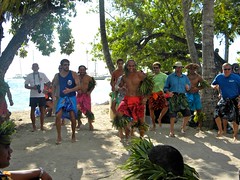
Don Quixote and Ceilydh
by Toastfloats on Flickr

Sunday, May 02, 2010

Doing Less with More - Water

Topping Off
Topping Off
Originally uploaded by toastfloats.
Boat life taught many lessons in conservation, so I often wrote about how we could do more with less. Returning to land life in New Zealand has been a lesson in humility; It is ever so much harder to use less when surrounded in abundance. As I continue this series, I revisit the original posts with an eye towards applying boat lessons to land life.

In January 2008, I noodled on how to use less water. This seems a particularly good place to start our effort to translate boat lessons in conservation to land life as the North Island of New Zealand experienced a particularly severe drought this summer. In fact, many here say it is the driest summer and fall since World War II. Farmers are selling their cattle, their land, and their homes as the entire north country dries out. Roads are cracking and fields browning all around us. Late April brought some relief in the form of a series of squalls, but the papers tell us this rain is too little too late for many Kiwi ranchers.

For the Conger clan, however, clean potable water is everywhere. We are virtually swimming in opportunities to profligately pour it down the drain. We don't have to make it, water is super cheap at the tap and of excellent quality, and the country seems to lack the basic infrastructure and social capital to conserve this precious resource. Even in the midst of drought, fountains splash and fixtures leak in every public venue. Conserving water has never really been a high priority in traditionally wet New Zealand; It will take some time before they become accustomed to the notion that "water water everywhere" does not equal "endlessly renewable resource."

Our own contributions to water conservation at Chicken House are very modest and largely economically motivated. While water is not expensive, it is also not free. And as with so many of the resource lessons hard won on Don Quixote, we don't want to lose our good habits. So, here is what we are focusing on:

Dirt is Good - We remain diligent on the subject of dirt and poor personal hygiene. We like it. Look it up… bathing less frequently is actually good for your hair and skin as well as the environment. Pre-boat, we bathed daily -- showers in the morning for the adults, sometimes shared but always taken. Baths in the evenings for the children, always shared, sometimes really loud. On the boat, we'd go weeks... okay, that was probably gross. Back in civilization once more, we bathe twice a week. We make an exception for family members who complete a hard, sweaty workout which, among other things, provides additional incentive to exercise.

Don't Substitute - Don't use water to solve some other problem. For example, if the driveway is dirty, don't wash it down with a hose, sweep it. For us, the seduction is heat. The hot water heater in Chicken House is so hot, so deliciously gloriously hot, that it is tempting to shower daily, bathe nightly, soak in the kitchen sink and roll around in the washing machine. Heat is good. Recognizing that the passion for cleanliness is merely a misguided attempt to thaw out, we've redirected our attentions to other, cheaper and less resource intensive ways to stay warm. Fleece. I have a lot to say about fleece.

Fix Stuff - Everything in this country leaks. Certainly, everything in Chicken House leaks. We are slowly making our way through all the plumbing in an attempt to reduce the volume of lost water. I encourage every reader to do the same in their own home or apartment. It is truly astonishing the amount of water lost by households due to simple leaks in faucets, toilets, and outdoor fittings. We also make a point of reporting every leaky toilet and sink we come across. I don't know that this personal campaign of ours will have any immediate impact, but we have to start somewhere. I'm almost ready to go vigilante on the sinks at the park across the street.

Need Less - Of course, we continue to be parsimonious with water usage for laundry, dishes, household cleaning, and yard work. As with so many conservation "techniques", using less is really a question of getting your head around the fact that you need less. An example that comes to mind is our kitchen sink. We could fill it twice to the brim to do the dishes -- once to wash and once to rinse. However, unless we've dirtied every dish in the house, we need only fill it about a third or halfway to accomplish the same task. The rinse water also does double duty as all the water needed to wipe down the counters.

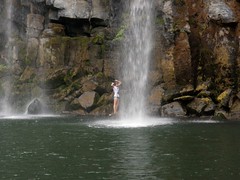
Jaime in the Falls
Jaime in the Falls
Originally uploaded by toastfloats.
Reuse - The previous example also demonstrates the "reuse" principle so profoundly important in the "reduce, reuse, recycle, renew" mantra. Few people do a good job of reuse of water, but there are easy ways to pour once, use twice with your water. In particular, bath water is basically an endless source of goodness as long as you don't let the kids wash their hair in it. Without all that added soap, the water can be used that evening or the next day for mopping, cleaning, presoaking laundry, and watering plants. It's just sitting there in the bath, ready to be scooped up.

* * *
I can't honestly say we're consuming anything like the incredibly low volume of 20 gallons a day which was our norm on Don Quixote. However, I do think we are probably maintaining at least half the consumption of the typical household… and hopefully less. Now if you'll excuse me, I'll just go do the dishes to thaw out my fingers.