Showing posts with label saving money. Show all posts

Wednesday, August 15, 2012

Another Self Portrait

Another Self Portrait
by toastfloats
The answer to why we stopped sailing is highly dependent on a number of factors: who you ask, when you ask, and whether or not we have had anything to drink.

The short answer most consistently proffered is that we ran out of money. It's easy to understand. Frankly, most folks can't imagine how we could afford to take off so many years anyway. Admitting that the cash is gone seems a logical barrier to further adventuring. But of course, it isn't strictly true. We didn't run out of money so much as we ran out of liquid cash. We could have stopped and worked briefly then continued (as did our good friends Totem). We could have made money en route (as do our good friends Ceildyh). We could have sold everything we still own and liquidated the rest of our savings (as have too many boats to name). The last thing I want to do is discourage people from cruising based on the mistaken notion that it can't be done on limited funds. It can.

And weirdly, the real problems with money started on landing in New Zealand. It's like Murphy -- having largely left us alone for major problems for nearly five years -- decided to move in. It started with just landing in the country: cat ($1300), medicals for immigration ($750), immigration ($1500? I can't remember… I was in a daze), Dean's medical reinstatement (a couple of thousands to various folks… and yes it was all legal), and a thousand dollar transformer so we could plug into New Zealand shore power. Then my nose decided to implode ($5000 USD deductible), the heater melted ($2700), and the batteries exploded (will be ~$2500). Self inflicted wounds include a latte'd laptop ($1000), a trip to the States (~$6000), and an iPhone ($350… yes, I got a 3GS unlocked ). The van was a few grand, school uniforms and "donations" another two, and a business wardrobe for me which probably set us back at least 50 dollars.

It's hard not to buckle. We can not can not can not get ahead which is an awful feeling. I try to console myself with the knowledge that if even half of this crap went down while we were sailing around last year, it would have bankrupted us. With money coming in, we can basically -just- keep up. But it would be nice to catch a break.

Or a job. A job would be good.

The radio silence on the blog these past months resulted from the fact that I finally did get some work. A former employee of mine moved on to bigger and better things, then revisited his past by to hire me as an editor. It was surprisingly fun work to dig into my technical writing roots. The documents were some of the most technical I've ever read, let alone edited. I learned about touch sense capacitors, oscillators, and methods to send IP packets over an electrical power line. I totally geeked out. I actually -- wait for it -- learned how to use the Equation Editor in Word. The single most important lesson from this experience was that Microsoft Word sucks. It is horrible. I will pay clients from now on to switch applications.

Aeron Peace Out
Aeron Peace Out
by toastfloats
Now, I have a new client, the IS team at Tegel Foods. For Americans, think Foster Farms with a Kiwi accent. They want to upscale the docs and training for the self-rolled software systems. I very much look forward to this. The project is in my favorite zone of work -- build awesomeness from raw materials and get paid.

Paid is good.

So if Murphy will just park his ass someplace else for a few months, maybe we can finally start saving for Jaime's college education. Gotta start somewhere.

Sunday, August 12, 2012

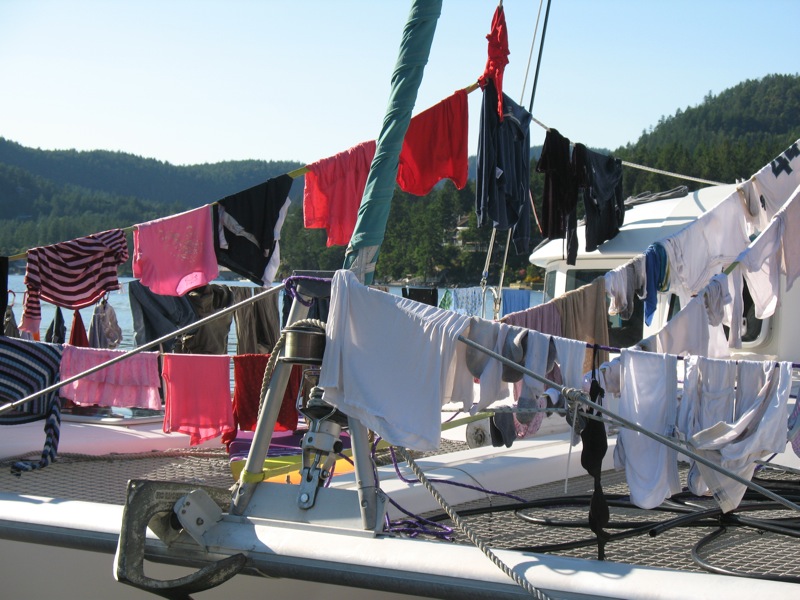
Raft-Up: Laundry Day on Don Quixote

by toastfloats
White Trash Boating
by toastfloats

"It's not that I don't love them," I muse while shifting roughly a million pounds of stinking, moldy, food encrusted clothing from the hulls into the cockpit. "It's that I would love them more if they did the laundry."

My husband apparently agrees, "They're old enough. Make them."

I am properly incredulous, "Make them." Make them. Wow. That's simple. Make three girls aged 9, 12, and 14, do something smelly, tedious, and hard. Okay. 

"You make them."

Proving that my daughters are not the only children on the boat, "No, you make them." 

I glare at my husband, hands on hip. "I cooked, I cleaned out the refrigerator, AND…" and here is the triumphal feather in my cap, "I rebuilt the starboard head." Firmly and without any hesitation, I consign DrC to hell, "You Make Them." And with that, I metaphorically wash my hands of the dish towels, panties, and shorts and head below to play World of Goo. 

The problem with laundry on a boat is that it's hard. It's laundry without a net. Actually, it's laundry without a washing machine, a dryer, or good quality, environmentally friendly soap. In fact, it's laundry without water since we start with nothing but salt water, a cranky water maker, and an attitude. The problem with laundry on our boat is that we have a lot of it.

I know people who put washing machines on their cruising sail boats. We call them weekenders. Real cruisers use their washing machines to store foulies or mangos or a replacement halyard. The chandleries sell little jokes called washing tumblers which are both too small and waste far too much water to provide a practical solution to the mountains of filthy clothing produced by three active girls and a pirate. 

I, of course, am laundry-less. While cruising, I live in an pair of hi-tech REI shorts (panties built in) and a sports bra, both of which I can wash with a bit of dish soap in a coffee mug and dry by waving them at my husband in a tauntingly sexy fashion. I don't believe there is such a thing as a boat under 100 feet  with a clothes drier. This is, of course, why safety lines were invented. It sure as hell wasn't to prevent you or your expensive boat gear from falling off the boat as we have repeatedly proven.

So. Washing on Don Quixote is an all day affair… at least. Sometimes several days. We pull out several gargantuan plastic buckets. Normal folk in the Real World buy these at WalMart to store things that they don't want but are afraid to throw away. They accumulate like drier lint in the back of closets and in garages and in attics. We fill the buckets about half full of water and a toxic Mexican laundry soap, then jam in every item of clothing we own, an indeterminant number of towels and several pillow cases. 

Then we wait. There is a theory amongst the DQ clan that if we wait long enough, the laundry will wash itself. Sometimes, this works… as in the time that the laundry was taken over by a desperate colony of thirsty bees who sucked the water out. Then there was the time it sat long enough that the smell made us dump the entire lot into the ocean rather than touch it to retrieve our belongings. 

However, mostly, the wait is for an hour or two and then the hard slogging work begins. Using a toilet bowl plunger or bare feet, we stomp the dirt out. It's like making wine the old fashioned way but without the production of palatable beverages. Then in three-man teams, we wring the sludge out using our hand crank Dynajet wringer. Load up some fresh water, repeat the stomp, repeat the wring. And again. And sometimes again because let's face it… we're filthy. 

Drying involves clipping a carabiner to each and every item of clothing. We used to use clothes pins but a 25 knot breeze one evening reduced our underwear stock by roughly 70% and took out my only push-up bra so now we clip everything to the lines in a fashion that would withstand a hurricane. Several hours later, we pull the fresh, hand-washed, line-dried linens off the halyards and sheets, completely faded of all color and with the elastic blown to hell but with the bright smell of chemical lavender.

Laundry Girls
by toastfloats
Only a short while passes while I take on the challenge of moving little balls of electronic, physics challenged goo from one location to another on my laptop, but no sounds of war upstairs is promising. DrC pops his head down into the cabin, and says, "Let's move the boat. We'll go to Bahia El Coyote."

My eyebrows go up, "What about the laundry?"

The pirate smile starts to creep through his beard, eyes dancing he says, "I had an idea." 

Twenty minutes later, we are steaming very slowly south to a new bay. Behind us, the dinghy is full of water, laundry, soap, and children, the mix gently agitating in our steady, bouncy wake. Sitting at the helm while my grinning husband drinks a beer at my side as the girls scream with laughter, I admit, "You're brilliant, you know."

Monday, March 07, 2011

Investing in a Future

Daddy is Home
Daddy is Home
Originally uploaded by toastfloats.
DrC calls it deferred maintenance. I call it B.O.A.T. days. We keep buying stuff. We keep fixing things. Spending money is becoming a way of life. I really want this phase of preparing for the Puddle Jump to be over. The combination of no income, downward spiraling economies, and repeated hot exposure of our credit cards to merchants all over La Paz is causing me to lose sleep and burn holes in my stomach.

My good friend Behan (s/v Totem) reassures us that this is a temporary phenomena and must be done to keep us safe and happy. I know she is right… and I know this at both the intellectual, objective level as well as the instinctive twitchy level. When I was a whipper snapper n00b five years ago and almost divorced my husband on the spot when he spent an insane amount on our windlass, I was in error. Yelling about all the purchases of books, parts, oils, and tools over the year was a mistake. The Toast of today preparing for the jump does not complain to DrC while paying the Visa, Defender, West Marine, Moore Medical, and Gallery Marine bills. All of these decisions are the correct ones.

Buy the immersion suits.
Haul and paint the boat and replace the sail drive seals.
Get the third reefing points added to the main.
Replace the 200' of G40 chain with new chain, not used. Keep only the best 100' of the old chain for the stern hook.
Get the second computer, the GPS units both USP and handheld, the extra paper charts, and the backup radio units.
Load nearly 6 months worth of staple goods and household supplies, deferring only the purchase of fresh items for the crossing.
Add diesel and water capacity to the boat and get a replacement throttle head for the outboard.
Pay the stainless steel guys to build the frame for the wind generator and buy that second pair of blades from Maitairoa.

I do not regret any single purchase. However, collectively we are spending more in six weeks than we did in the prior six months. We are spending more specifically on Don Quixote than we have in five years… which is probably why DrC is correct; Many of the additions, changes and fixes are simply deferred maintenance on a cruising sail boat. Other major purchases are specifically and solely for disaster mitigation and recovery which -- I admit it here publicly -- we should have undertaken prior to leaving Elliot Bay in Seattle. Mea culpa.

On the the hand, I read the news and listen to the Morning Talk here in La Paz and recognize a simple truth: the Zombie Apocalypse started years ago. I don't know why DrC and I thought we were preparing for its coming when in reality it started long ago. Like a frog slowly being brought to a boil, we weren't paying enough attention to get out of the pot before getting hurt. Now, however, I go online to transfer the last of my US dollars into my visa to pay off bills to Amazon, Seattle Fabrics and Fisheries Supply and reassure myself that I'm buying the nautical equivalent of gold. These things we are investing in are portable wealth. And unlike gold, Don Quixote can sustain us and feed us. She provides shelter, water, power, and sewage disposal. She is a form of safety net.

On the whole, we are very fortunate. When all is said and done, we'll have a well-equipped, well-founded sailing vessel which we can take nearly anywhere. The boat will be stocked with enough food and supplies to keep us going for a half year, longer if we push it. With the oil market going berserk in the face of revolutions throughout the Arab world, I think it's time the Conger family started going all Purist Sail-All-the-Way rather than loading up on more jerry cans.

Let's see… If I extend our fresh food supply for the first leg from 4 to 5 weeks, we could simply drift along until we get there. I think there might be a tiny bit of room left in the locker under Jaime's bed...

Wednesday, March 02, 2011

Pwnd

Comic DQ
Comic DQ
Originally uploaded by toastfloats.
Pwn is a leetspeak slang term derived from the verb "own", as meaning to appropriate or to conquer to gain ownership. The term implies domination or humiliation of a rival. - Wikipedia

Perhaps the single lesson that defines our entire last five years -- which I should have engraved on my forehead so as to never forget -- is the following:

Your things own you.


It is a mistake to believe the common myth that you buy things and then you own them. In reality, you work very hard at some task and then convert that effort into stuff which then consumes your very reason for being. You pile and store and stash. You organize and inventory and display. It lives in your basement and under the bed. It sits in the driveway or hangs on the wall. And every bit of that stuff has ties to your soul, your reason and your sanity. It requires effort to keep it and money to sustain it. It needs a place to live, and it builds friends and a following and a life of its own. Your things are alive in your life, influencing your behavior and decisions in ways that even your family frequently fails to achieve.

I remember walking down the long Marina de La Paz dock a year ago with two distinct thoughts warring in my mind. First, I will never live in a house as nice as Don Quixote ever again. Second, I never want to own another house or boat again. It was simultaneously sad and freeing -- the depressing realization that the era of free money and living profligately as only two young professionals with very high salaries in the early 20 oughts were able combined with a sense of elation that we were now only responsible for the clothes on our back and the bags we dragged banging along the dock with us.

In New Zealand, we didn't have much in the way of material goods. In fact, arguably we started with nothing. We brought those few bags of things and then some ass hat stole them. Some of it was found; Thanks to insurance we replaced a lot of it, but we had the new versions sent to my Mom in the States. And as a side note having now said "Hello, how are you?" to these new things, they are not the same. The binoculars, in particular, look and act just like the old ones but don't have a whiff of the fine people who worked for me and with me for seven years and gave me the original pair. I don't like them, and they don't like me. We can tell we're not going to get along. But to the main point… We had a few beds, a table, some smelly couches and a pressure cooker. A stack of boat cookware I couldn't part with and a cast iron skillet. That cast iron skillet was DrC's first priority purchase on our arrival, by the way, which speaks volumes for his priorities. On those infrequent occasions when we would have people visit us in Chicken House, I remember a vague feeling of embarrassment. I'd wave helplessly at the battered dining room chairs and invite my guests to sit down and drink from the Kiwi equivalent of BamBam glasses and jelly jars. With just the family, however, it didn't feel empty. We tossed our clothes into misshapen piles at the bottom of built-in closets and considered it well stored and well cared for.

That moment was probably the nadir of the trajectory of Conger Family Ownership. We will never be associated with such a small number of things again. When it came time to leave, we gave a bag or two to Debbie for her church, delivered a box of condiments and spices to Deb, and sold five things on TradeMe. Then we flew away.

Don Quixote was waiting. She missed us. On our arrival, she was dusty, dry, and petulant. It's taken me nearly two weeks just to get all the basic systems to a point where she'll admit that she is a boat and not simply a large piece of semi-white plastic floating in apparent relationship to a dock in Mexico. She's always been a cranky bitch, so it comes as no surprise that getting her engines going has been a herculean effort. Every day, Don Quixote reminds me that she didn't like being left alone. She complains. It's in the sticky shackles and the squeaky hinges, the clouds of dust that poof up when I sit on her cushions or the way all the really important tools have managed to settle into the bottom of the back end of the deepest part of whatever locker I look in.

We've spent more in the past 60 days prepping this boat to cross the Pacific than we did during our entire year in New Zealand. We arrived in Mexico with a van full of stuff, more stuff then we ever possessed while living on the hard last year. Why spend so much? Why so many items? You could say it's because we need all these things to cross the Pacific safely. Arguably that's true, though no doubt purest sailors would point out that Kon Tiki made it across in a raft so all of this expenditure is superfluous. In reality, we bought all this stuff because Don Quixote is a really expensive lady who requires boat jewelry. Our mistress exudes dominatrix level power over our submissive, awed and beaten selves. We bow down before her line wielding superiority. We are pwnd by the boat we call home.

I don't really like it. I like being here in La Paz. I actually love being back on the boat. We all snapped into place, the girls noting within days that it felt as though we had never left. I'm comfortable here at a bone deep level I never achieved in Chicken House. It is possible that I might actually BE a sailor and not just play one on the interwebs. So the thing I don't like is that I am constantly spending money now to take care of this place, this house, this boat, this thing. Money pours through my fingers like mercury in a glittering torrent returning in the form of more things to take care of, more items to stow, more bits to keep track of. I'm not sure this is an improvement. The verdict is out on whether or not on balance being owned by this beautiful, French, production, plastic catamaran is a boon and salve to my sailing soul or merely another pile of bricks in the backpack of life.

Sunday, May 02, 2010

Doing Less with More - Water

Topping Off
Topping Off
Originally uploaded by toastfloats.
Boat life taught many lessons in conservation, so I often wrote about how we could do more with less. Returning to land life in New Zealand has been a lesson in humility; It is ever so much harder to use less when surrounded in abundance. As I continue this series, I revisit the original posts with an eye towards applying boat lessons to land life.

In January 2008, I noodled on how to use less water. This seems a particularly good place to start our effort to translate boat lessons in conservation to land life as the North Island of New Zealand experienced a particularly severe drought this summer. In fact, many here say it is the driest summer and fall since World War II. Farmers are selling their cattle, their land, and their homes as the entire north country dries out. Roads are cracking and fields browning all around us. Late April brought some relief in the form of a series of squalls, but the papers tell us this rain is too little too late for many Kiwi ranchers.

For the Conger clan, however, clean potable water is everywhere. We are virtually swimming in opportunities to profligately pour it down the drain. We don't have to make it, water is super cheap at the tap and of excellent quality, and the country seems to lack the basic infrastructure and social capital to conserve this precious resource. Even in the midst of drought, fountains splash and fixtures leak in every public venue. Conserving water has never really been a high priority in traditionally wet New Zealand; It will take some time before they become accustomed to the notion that "water water everywhere" does not equal "endlessly renewable resource."

Our own contributions to water conservation at Chicken House are very modest and largely economically motivated. While water is not expensive, it is also not free. And as with so many of the resource lessons hard won on Don Quixote, we don't want to lose our good habits. So, here is what we are focusing on:

Dirt is Good - We remain diligent on the subject of dirt and poor personal hygiene. We like it. Look it up… bathing less frequently is actually good for your hair and skin as well as the environment. Pre-boat, we bathed daily -- showers in the morning for the adults, sometimes shared but always taken. Baths in the evenings for the children, always shared, sometimes really loud. On the boat, we'd go weeks... okay, that was probably gross. Back in civilization once more, we bathe twice a week. We make an exception for family members who complete a hard, sweaty workout which, among other things, provides additional incentive to exercise.

Don't Substitute - Don't use water to solve some other problem. For example, if the driveway is dirty, don't wash it down with a hose, sweep it. For us, the seduction is heat. The hot water heater in Chicken House is so hot, so deliciously gloriously hot, that it is tempting to shower daily, bathe nightly, soak in the kitchen sink and roll around in the washing machine. Heat is good. Recognizing that the passion for cleanliness is merely a misguided attempt to thaw out, we've redirected our attentions to other, cheaper and less resource intensive ways to stay warm. Fleece. I have a lot to say about fleece.

Fix Stuff - Everything in this country leaks. Certainly, everything in Chicken House leaks. We are slowly making our way through all the plumbing in an attempt to reduce the volume of lost water. I encourage every reader to do the same in their own home or apartment. It is truly astonishing the amount of water lost by households due to simple leaks in faucets, toilets, and outdoor fittings. We also make a point of reporting every leaky toilet and sink we come across. I don't know that this personal campaign of ours will have any immediate impact, but we have to start somewhere. I'm almost ready to go vigilante on the sinks at the park across the street.

Need Less - Of course, we continue to be parsimonious with water usage for laundry, dishes, household cleaning, and yard work. As with so many conservation "techniques", using less is really a question of getting your head around the fact that you need less. An example that comes to mind is our kitchen sink. We could fill it twice to the brim to do the dishes -- once to wash and once to rinse. However, unless we've dirtied every dish in the house, we need only fill it about a third or halfway to accomplish the same task. The rinse water also does double duty as all the water needed to wipe down the counters.

Jaime in the Falls
Jaime in the Falls
Originally uploaded by toastfloats.
Reuse - The previous example also demonstrates the "reuse" principle so profoundly important in the "reduce, reuse, recycle, renew" mantra. Few people do a good job of reuse of water, but there are easy ways to pour once, use twice with your water. In particular, bath water is basically an endless source of goodness as long as you don't let the kids wash their hair in it. Without all that added soap, the water can be used that evening or the next day for mopping, cleaning, presoaking laundry, and watering plants. It's just sitting there in the bath, ready to be scooped up.

* * *
I can't honestly say we're consuming anything like the incredibly low volume of 20 gallons a day which was our norm on Don Quixote. However, I do think we are probably maintaining at least half the consumption of the typical household… and hopefully less. Now if you'll excuse me, I'll just go do the dishes to thaw out my fingers.

Wednesday, February 24, 2010

Doing More With Less - Entertainment

Crossing the Sea
Crossing the Sea
Originally uploaded by toastfloats.
The boat teaches many lessons in conservation. This is part of an ongoing series of posts about how we boaters do more with considerably less. The tips are valid for land based life as well, though, so hopefully folks can use some of these ideas.

* * *

No matter how long I cruise and no matter how many times and in how many methods people ask this question, the answer to "How do you entertain yourself on a boat?" remains a helpless shrug. In the Real World™ we had so many distractions, even after we turned off the television and discontinued cable. We could go to the movies, a museum, the zoo, the beach. There were restaurants and cafes. Our friends were nearby, our shelves filled with books…. oh god the libraries. The libraries.

Let's pause for a moment to contemplate the duel wonders of the Internet and Libraries. You people who live with ubiquitous access to both resources should never ever EVER take them for granted.

After you cut the lines and head out into remote anchorages, foreign countries whose primary language is not your native tongue, places where going out for pizza really isn't an option, it is an interesting question just how to spend copious free time. However, despite the paucity of civilized amusements and the wealth of free time available, I have yet to meet a bored cruiser. Tired, frustrated, dirty, miserable, or unhappy, but never bored. I haven't even met a bored boat kid which -- given the nature of children -- seems somewhat miraculous. So just what are we doing?

Read Anything -- At this point, I think every member of this family is willing to read absolutely anything published in English, up to and including computer user guides. If you start your cruising life as a lover of science fiction or fantasy, you'll soon learn to enjoy mysteries, diesel mechanic manuals, and even… say it isn't so… romance novels. Alternatively, if you enjoy a good bodice ripper but haven't read great literature since English 101 in college, you'll start to find yourself reading H.G. Wells and Shakespeare. Reading taste for cruisers is largely determined by what you find at the many book exchanges along the way. Every marina, yacht club, restaurant, and laundry room patronized by the cruising community has at least one shelf… in some cases an entire wall… devoted to casual literature. It is crucial to your happiness that you become agnostic regarding genre and open to new literary experiences. Consequently, I can now list Two Years Before the Mast as one of my favorite books of all time. However, I never want to read another account of sailors lost at sea again. Ugh.

Get a Hobby -- We've seen cruisers that knit, quilt, cook, and bead. There is one that crochets handbags out of plastic grocery bags and another who specializes in shell earrings. Like DrC, many cruisers take up an instrument or revisit one they learned many years ago. Others write stories, poetry, or blogs, carve wood, work on their photography, make videos, or build elaborate web sites. It is a good idea to become invested in your hobby before you leave, particularly if the materials and tools are going to prove difficult to find in other countries. Also, be open to discovering new hobbies while you are out here.

Walk… A Lot -- Hiking is our passion. We walk everywhere. One of the limitations of cruising the Pacific Northwest is that it is far more challenging to walk around up there than it is down in Mexico. In the desert, the horizon is literally limitless. We walk in the wilderness and in towns, up ridge lines and over to remote anchorages. Walking is good for the health, kills hours of time, and enables you to dramatically expand your horizons. A pastime which we did not take up but which many of our fellow travelers endorse is kayaking. I think of this as walking on water providing similar benefits and pleasures.

Learn to Play -- I think adults outgrow games and play as we age. Forgive me for saying so, but I attribute this loss in no small part to the industrialization of education. Somewhere between 6th grade and graduation, we tell our children to stop screwing around, stop having fun and get to work. It's a shame. We should never stop playing. From play comes some of our best ideas and our happiest moments. DrC and I, and even to a lesser extent our daughters, have reacquainted ourselves with the pleasure of play. We play Scrabble and Sorry, Gin and Rummy. We enjoy video games on our computers and handhelds as well as solo logic puzzles such as Sudoku and Crosswords. Mera and Aeron have sustained The Game long after I think most children would have abandoned it. One of our favorite games is Mexican Train which we enjoy with our cruising buddies on warm evenings.

Do It Yourself -- Boat life requires constant work and maintenance. It forces you to think creatively about how to fix, create, repair, replace and build it yourself. Once you start down that path, it seems increasingly stupid to buy. Don Quixote sports shelves, curtains, lockers, hooks, and covers all made by a member of this family. We make our winter Solstice gifts each year, and we spend a lot of time sanding, painting, varnishing, cleaning, polishing, waxing, and lubing. You can either suffer through all this work (which I do) or you can try to enjoy it. I'm working on this. I enjoy some of it.

Knitting Solstic Gifts
Originally uploaded by toastfloats.
Relax Your Mind -- The need for speed in the real world drives our entertainment consumption as much as it does our work life. There is an urgency to everything, a constant requirement of movement and activity. Cruising life teaches lessons about patience and relaxation. It is okay just to sit still for awhile and listen to the water sluice past the hulls, to lie in bed and watch the sun rise through the port hole, to sit in a palapa and watch the children play on the beach. This one catechism is so difficult for me; I am a Type A, hyperactive, pressure addict. DrC, though considerably more silent, is arguably even less capable of sitting still. It has been hard for us to learn passivity. However, the most elusive yet satisfying moments of our lives are those wherein we just sit side by side contemplating the horizon and feeling warm, happy, loved, satisfied with a moment requiring no embellishment.

Hours go by, days vanish, entire weeks and months simply slip into the past and never do we hear or feel the plaint, "Are we there yet?" When the journey is the destination, it's easier to be entertained by the present.

Saturday, February 20, 2010

(Recent) Lessons Learned About Boats

Our New Tramp
Our New Tramp
Originally uploaded by toastfloats.
Every phase of our boat life has been marked by a series of very hard won lessons. Even though DrC tends to be absolutely pathologically diligent with the research and study routine, even though I have tendencies as an OCD project manager, we still manage somehow to break shit, forgot stuff, screw up by the numbers. It's a Thing We Do. So it is without too much surprise that I report to hitherto unexpected trials in prepping the boat for sale and moving back to land.

Catamaran Tramps are Structural -- Don't let anyone tell you that catamaran tramps are just a pretty little play space at the front of the boat. It took DrC and I two and half days working sun rise to sun set to install the new tramp on Don Quixote. To string the tramp from edge to edge, we had to put the webbing on a winch and pulley system… every two loops. DrC estimates we put at least a 1000 pounds of strength into the corner. Our hands were raw, back sore, muscles aching. No amount of tequila made it easy to sleep at night. There is no question that our boat must be designed to account for the tramp quite literally holding the front of the hulls together in rough seas.

Confirm the Presence of Hot Water Before Picking a Haul Out Yard -- I really don't think this requires elaboration.

Don't Clean Anything Until You Move Off -- Every time I think something or somewhere on the boat is clean and ready for the new owner, DrC smashes a bloody mosquito on it, the girls walk on it, or the cat rolls in it. I've had it. We're going to find a really cheap motel in town, and I'm going to move the family off before I clean even so much as a single additional square inch.

Things Break Because You Plan to Sell Them -- For no particular reason, systems that were otherwise 100% functional have decided to behave like gimpy pieces of crap. Murphy moved on to the boat about three weeks ago. We're spending a lot of time cleaning up after him.

Don't Attend A Swap Meet Until You Are Actually Done -- We sold everything about three weeks ago at the monthly swap meet. Then -- as I noted in the previous point -- stuff started breaking. And of course, the part we need? We sold it. Murphy tipped back a pint and snickered at us when the spark plug on the outboard decided it needed to be replaced. It's not hard to get a new one, and we'll have it installed within an hour… after shlepping into town to buy it and bring it back to the boat.

The Boat Smells - Actually, every place we humans live stinks. Your home has a unique odor that is probably just fine for you and your loved ones. You may not even notice it. When you walk into another home, however, your nose is assaulted by the odor of different soap fragrances, variations on cooking themes, and someone else's farts. Boats are more pungent than houses and not just because people are living in a more constrained space. Add to normal home smells the piquancy of a mobile sewage system, two diesel and one gas engine with associated fuel tanks, and the unique eau de bilge -- an unavoidable miasma of damp goo, mold, and wet wood of which no boat is completely free. However, when a buyer arrives for a sea trial it's not a good idea if his first thought is, "Oh my god this boat stinks." The Cruiser Dream just doesn't extend to the reality of Boat Smell. I've been trying to figure out how to fix this on Don Quixote. I think the only solution is again… move everyone off the boat and explode an incense bomb in every cabin and locker.

It's Expensive to Sell Your Boat -- Did you know that brokers take 10% when they sell your boat? I didn't. Call me just royally big-word-starting-with-an-F stupid, but this was a surprise to DrC and I. So let's say you buy a boat for $100,000. The day you take ownership… even if you could sell it for the same amount you purchased it for… your boat has depreciated $10,000. Hate this. I was figuring the broker fee would be similar to housing in the 4 to 6% range. Somehow, however, brokers have managed to maintain a stranglehold on the 10% price point. I have no idea how they do it.

No More Procrastination -- Another way your boat costs money to sell is that you have to do all the deferred maintenance tasks you never bothered to get around to while you were living on it. In the case of Don Quixote, these items are largely aesthetic. For example, we replaced a bent lifeline, took the sails to a loft for patches on spots which were starting to show a little wear, sanded and varnished the table, touched up the paint on the outboard mount and the windlass case. The boat looks fantastic, but it all adds up to money, work and time. One of my readers said there is a 95% point where only the previous owner sees the problems. Other than the layer of boatyard/child/cat dirt coating every surface, I think Don Quixote is ready for her new owner. It's true that the remaining items are mostly bits that only DrC and I know and care about. The next owner might not ever notice those items and instead find other reasons entirely to curse us.

Mexican Gotcha
Mexican Gotcha
Originally uploaded by toastfloats.
It's Emotional -- A boat is more than a home. We pour so much of ourselves into our boat identity. We pour so much of our time into just keeping the thing functional. It is very hard to let go. Then suddenly, you're done. You've let go. But the boat -- stupid, expensive bitch that she is --still sits there sucking up money like a high power ShopVac. I've begun to resent all this work and time and money. Worse are the moments when I regress and start crying when I see her on the horizon as we dinghy back after an evening at the taqueria. Don Quixote is a beautiful home. I panic sometimes that we will never have anything even fractionally as nice ever again. Talking me off this particular ledge is one of DrC's most challenging ongoing tasks.

* * *

I don't want to learn any more boat lessons for a long long while. The family is ready to start screwing up our transition to New Zealand with glorious failures of cultural understanding and financial ignorance. The countdown to our departure is well underway.

Tuesday, November 10, 2009

TechTip: Night Lights


Short Answer: Supplement your LED masthead anchor light with reflective tape and sidewalk lights.

Long Story:
When you live on a boat, you start to count every amp and erg and become quite resentful of energy hogging devices. In this category, the masthead anchor light is a surprising pig. By law and necessity, these lamps are very bright – at least 60 lumens for the average sail boat. An incandescent bulb will draw .8 to 2 amps per hour while an expensive LED variety will pull roughly .1 to .5 amps per hour. Translated, you'll burn through 8 to 20 amp hours a day with an incandescent anchor light or 1 to 5 with an LED. To put that into context, your average solar panel set up is only going to yield 8 to 13 amps an hour during the hottest part of the day. So the first and most obvious tip regarding the masthead anchor light is to switch to LED the next time you fly the mast. As a side note, this will probably take two trips: the first to figure out precisely what kind and size bulb you have, the second to install the new one.

But there are additional considerations when contemplating lighting your boat at night. First, can you find your boat by starlight amongst all the other similar white hulls? Second, will your lights go on automatically when it gets dark? Third, it is useful to know that pangueras do not look up. If your boat isn't lit at the water line, there's a good chance a panga will hit it.

We address all three concerns using very cheap, light-sensitive, solar-powered sidewalk lights. DrC installed mounts made of PVC and zipties on all four corners of the boat. As soon as we drop anchor, the girls drop the lights into their mounts. Our distinctive four orange points make Don Quixote easy to find and to see at night. They are so lightweight, we make a point of removing them while underway. They also do double duty as amber night lights on night passages as we stick them head down around the salon and heads.*

Another trick used by many Mexican cruisers including ourselves is to hang a high-powered LED light from the mid-boom. The law in many anchorages south of the border is not quite as strict regarding the use of an anchor light. Low power, high lumen lights closer to the deck replace high power mast lights on many boats. A little extra money and you can find solar-powered, light-sensitive models. Just don't forget to take these boom lights down before you put up the sail. And remember, you can't use them exclusively as anchor lights in the States or some highly trafficked international ports.

A final suggestion from the Don Quixote files is reflective tape. DrC placed highly reflective, silver tape strips just below the toe rails, on the transom steps, and at intervals up the mast. You can't really see the strips against the white hull and aluminum mast during the day. However, at night you need only sweep a small head lamp or flashlight in our direction and the shape of the whole boat lights up. We've repeated the treatment with our dinghy on the notion that you can never be too visible at night to passing traffic.

Evening in El Burro
Evening in El Burro
Originally uploaded by toastfloats.


Note: It appears that West Marine now has a little solar sidewalk light complete with rail mount for which you will pay $49.99/each. Don't do it. Just get out your saw blade, some zip ties, and a length of PVC, and go to town.

Monday, November 02, 2009

Cooking Tip: Use the Sun

Baked Children
Baked Children
Originally uploaded by toastfloats.
In a comment on my last cooking tip, a cruiser-to-be noted that she was considering investing in a solar oven for her boat. I don't want to discourage such investments – if you've got room, the money and the inclination, go for it. We've been lucky enough to taste the output from s/v Totem, and it's a fine addition to any boat cruising south of San Diego. On the other hand, the sun is so intense down here, there are a great many options for solar cooking even without adding a dedicated oven to your lockers.

Sun Tea -- The most obvious thing you can do with the sun is make tea. Add two to four tea bags to a soda bottle full of water. Toss it on the tramp in the morning. Put it in the fridge in the evening. Drink chilled tea all the next day. I recommend using 2 liter green soda bottles for this purpose as the darker color takes up more heat. Any mint, black, or green tea works. Some folks profess to like the fruit teas. I'm not one of them. You can add sugar or honey as a sweetener when you set up the brewing, and it will dissolve into your tea. However, this shortens the useful life of your soda bottle. Since it's not really possible to clean the bottoms and sides of a soda bottle very easily, we get maybe a dozen batches before we give up and drink more Fresca.

Sun Coffee -- Believe it or not, you can use the exact same method to brew a decent batch of iced coffee. Add the grounds directly to the bottle then decant in the evening into a second bottle through a drip coffee filter. The only real challenge is getting the last of the grounds out of your brewing bottle.

Yogurt -- The problem with using a sun-soaked spot on the boat to make yogurt is that it gets too hot. If you've never made yogurt before, it's really easy. Don't panic. Fill a jug, jar, or pot with milk heated to 110 to 120 Fahrenheit. Drop in a big spoonful of active yogurt, usually the last bit from your previous batch or a scoop from a commercial, unsweetened, active brand. Maintain the milk at 110 to 120 degrees for several hours until it gels up. We keep ours under the helm where it is out of the sun but trapped in a hot spot under the bimini.

Heat Bread -- If you have a dark cookie sheet, you can do a really nice job heating and reheating breads, pastries, and tortillas. Put them on paper towels, plates, or napkins in a sunny spot on the deck. Lay the cookie sheet on top. Wait an hour. If you're willing to wait two hours, you can use this same technique to make quesdillas.

Bean Dip -- The kids invented Solar Bean Dip a few weeks ago. In a pan, layer refried beans, minced onions, shredded cheese, and olives. Sit in the sun from about noon till it's time to visit a fellow boat for the cocktail hour. Top with fresh chopped tomatoes, cilantro, salsa, and sour cream. Serve with tortilla chips or tostas.

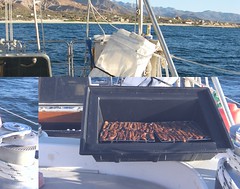
Drying Fish Jerky
Drying Fish Jerky
Originally uploaded by behang.
Slow Cooking -- Combine the hyper efficiency of your pressure cooker with the insane intensity of the sun to slow cook soups, pot roasts, stews, and bean dishes. Pre-soak beans the night before. Then prepare a soup or stew in the morning. For example, the recipe may call for browning the meat and onions. Put all the ingredients in your pressure cooker and bring to pressure for at least five minutes. Without opening the pot, stick it out on the deck in a sunny spot. At dinner time, you can retrieve your pot and serve. We've averaged between 140 to 180 degrees Fahrenheit for dishes prepared in this fashion indicating that the contents of the pot were slow cooking throughout the day. In other words, the pot never drops below the routine temperature maintained by a crock pot. To date, I've used this technique to make pot roast, chowders of both vegies and meats, chili, and bean soup.

Pizza Box Oven -- If you have kids, don't buy an oven; Have them make one. These things work super well if you start with Bobolli or sliced bollo and build from there, but they do also bake raw dough. The girls recommend that you put your pizza in the “real oven” for the last 5 minutes just to get a browner, drier crust. The pizza box oven is another way to do tasty quesidillas.

* * *

Solar cooking is as much about creativity as it is about harnessing the power of the sun to cook. I have to admit, though, as I swing in the water on a line strung between the hulls trying desperately to stay cool, my real problem is figuring out why you'd want hot food to begin with.

Thursday, June 04, 2009

And Now A Word From Our Sponsor

Mera Hard At Work
Mera Hard At Work
Originally uploaded by toastfloats.
I stare at the screen befuddled for a moment, trying to remember how to generate an em dash in FrameMaker. It used to be second nature. Em dash, en dash, copyright, registered and trademark are all symbols so hideously counter-intuitive to generate in FrameMaker that it is a constant source of amazement that Adobe ever succeeded in establishing the application as the preeminent tool of technical writers. More bewildering is how long the program stayed at the top of the heap. Even today, when they swear that the last update is long behind them and other tools – commercial and open source – pop up like daisies on the authorial landscape, Frame is still used by the majority of my clients.

Which actually brings us to the real problem I face this afternoon: I have clients. Clients are the companies which keep Toast afloat. Clients want stuff. Clients ask questions, set deadlines, and need things. Clients are like children with bank accounts and an attitude. Clients are simultaneously my best friends and my worst enemies.

Technically speaking – and as a technical writer I should try to speak technically, albeit more or less inaccurately – I have had clients since the day I quit my full time job. For the most part my clients come from people who worked with me in the past and then scattered to the four winds after leaving our shared employer. Former employers, employees, and coworkers find themselves in a bind with a product to get out the door and either no user guide or a really spectacularly bad user guide. While I'm a bit pricey on the technical writer pay scale, I work fast, independently, and generally leave a client with documentation in fine shape to hand over to a less senior, less experienced writer... for example, the engineers.

Since I quit my job, I can name a double handful of companies for whom I consulted on documentation, training, or simplified English. Ironically, during those years I was a documentation consultant for the largest, most complicated training development project in my career. I've done little quick start brochures and a command line interface guide. I've written help in Robo, Wiki, CHM, and a text file. I developed a database used to direct the development effort of a team of 22 content producers, and I contributed to the documentation on a number of open source projects.

However, when you get right down to it, my resume or LinkedIn profile is a white lie, a bit of true stretching, or total and unmitigated bull shit depending on your perspective. At any given time out here floating around off the coast of Mexico, I have two or three ongoing projects or active clients. String them all end to end, the number of hours I bill out each year probably only amounts to 8 man weeks. Or woman weeks. It's not enough work to keep us in limes and honey roasted peanuts, but it is enough to make the resume look really good.

Because the real reason I work is insurance. Working is a back door to the real world in case something bad happens. If the boat is destroyed, DrC injured, or family reasons force us to make a quick return to the States, I don't have to tell anyone that I've been playing footloose and fancy free for four years. I can truthfully point to these professional experiences and say that I'm still active, I know my stuff, I'm still growing. Hire me. I'll find the em dash... really
Candeleros Heading South
Originally uploaded by toastfloats.
Which was a great theory until the market crashed and the economy went to hell and the unemployment rate in the tech industry skyrocketed and technical writers started hitting the streets in record numbers. No matter how good I look on paper, there are a hundred applicants for every full time job in my business, a hundred hungry people with children to feed and a roof to keep over their heads with whom I would rather not compete. I'll take my five hours here, my interesting project in London there, and continue to work part time, staying out of the way of the people who need that full time work for as long as I possibly can. I cross my fingers, try to keep DrC out of trouble, and keep my handful of steady, resume-padding clients happy while we wait for the world economy to sort itself out.

Ah ha! Found it. Ctrl-Q then shift-Q and you get an em dash. What idiot thought that was a good idea?

Wednesday, May 27, 2009

Doing More With Less - Money

San Francisco South Anchorage
Originally uploaded by toastfloats.
Everything about doing more with less is about not spending money, resources, or both. Less food, less soap, less water, less electricity, less clothing. Less less less. It's all about money. On the other hand, there are ways to just stop spending money by the simple expedient of Not Spending the Money.

Now, I'm not an expert at this. There are experts. There are probably hundreds of web sites now devoted to helping folks save – or simply stop spending – money. I feel like an amateur in a growing cottage industry. All I have to offer is how the Conger family stops spending money... for which there is only one real tip:

Do not go to town.

For a cruiser, town presents a kaleidescope of pleasures and temptations, each of which is associated with a price tag. There is the marina – a safe haven of showers, clean laundry, endless water, and constant Internet access. There are grocery stores, chandlers, and hardware stores. There are fabric stores, clothing stores, electronic stores, and the granddaddy of all consumptive rat holes: WalMart. You can find taquerias, taco stands, and restaurants, panaderias, coffee shops, and bars. How about dinner out with friends? Or an evening listening to music at the local bar?

But pull the hook, drop the lines, motor sail out of the harbor and down the coastline ten miles, and all opportunities to spend money disappear. There may be a palapa from which you can purchase a beer or limonada... and then again, maybe there won't. Make your own water, cook all your own meals, sail from place to place, entertain yourselves and each other. There is literally no place to spend money.

In fact, I have tracked our expenditures for over a year now, and the data supports this conclusion. The total monthly spending for Don Quixote increases in direct proportion to the number of days we spend near a town. The longer we spend bobbing around in the middle of nowhere, the less we spend. And this isn't just a delayed gratification effect. You can see some of that in the data as we either provision before going out or fix things on our return. However, putting aside equipment purchases for boat repair, you still see a very strong correlation between increased expenses and town life.

When we go to town, we spend money. When we don't go to town, we don't.

That seems absurdly simplistic, but I wonder at times if we can use this as a metaphor for life. Even in the city – living in a house in the suburbs – we could pretend we are at anchor. Pretend like you can't run to the store for deli dinner, swing by the coffee shop on the way to work, or call for pizza. Imagine a house fifteen miles from the nearest civilization and no car to get there. What can you eat? How can you entertain yourself? Do you really need retail therapy in the form of new shoes or clothes or electronics or furniture or a night at the multiplex? If you couldn't connect to the Internet to buy something, would you buy it today? After thinking about the purchase for a week, would you still buy it or decide you could do without?

Personally, I plan to make a commitment on our return to civilization to declare “anchor out weeks” for the family. During those weeks, we absolutely won't buy anything. We'll provision and fuel up in advance, we'll make lists of what we need to buy when we “get back.” During those weeks, we will empty our wallets of cash and leave the credit cards at home. No doubt, anchoring out within walking distance of our favorite cafes is going to be more challenging with pitfalls, perils and temptations galore. On the other hand, we know we can do it, we've done it many times before, and it turns out that each and every time we've had to go for a few weeks without, we've survived. Perhaps more importantly, our checking account has done more than survived... it's thrived.
Agua Verda with a Catamaran
Originally uploaded by toastfloats.

Sunday, May 03, 2009

Are You a Hooker?

Yoga at Marina de La Paz
Originally uploaded by toastfloats.
When I spoke of this season's catitude, I think I depressed a few readers with my persistent combination of smugness and defensiveness about living on a multihull. Even at the time, I made clear that there are a lot of ways you can split the cruising community down demographic and philosophical lines. All are more or less “true” in the sense that the lines exist, the differences are real, and you can see the social dynamics play themselves out on a daily basis. However, it turns out that multihull versus monohull is not even one of the big players in the cruiser schism game.

Almost as profound as the division between sticks (sail) and smokers (power) is the gulf between those who spend the majority of their time at anchor and those who live on the dock. At times, this gulf is nigh on uncrossable since it goes to the heart of cruising philosophy.

Now, obviously there is no way a cruiser can completely avoid periodically throwing out the ground tackle and living on the hook. So we all invest in good ground tackle and learn how to use it. We endlessly sit over drinks and debate the merits of Rockna versus Bruce, scope ratios, storm tactics, bridling and holding ground. However, for all that effort and discussion, once you get out in the cruising grounds, the fleet tends to dissolve into two basic camps: those that live on the dock (dockers) and those that live on the hook (hookers).

Dockers prefer the convenience, comfort, and beauty of the marina. Dockers are clean: their boats are clean, the cloths are clean, their dishes are clean. Dockers know how to negotiate with the local harbor master to get the best weekly and monthly rates. They can tell you where to get Puddle Jumper discounts (12 bottles of dark rum for about $35USD is only my most favorite example). When they pull into a town, they spend weeks or months learning everything there is to know, participating in charitable events, going to all the amateur and professional musical nights, identifying each and every quality tienda, mercada, and restaurant. Their experience of any single city is deep, their knowledge wide, and their enjoyment manifest.

Hookers, on the other hand, prefer the nomadic, camping life of the hook. Hookers are filthy: their boats are salty, their clothes often stand up and try to walk away. Hookers know how to tuck into even the smallest bight to get protection from wind driven fetch and Pacific swell. They know how to negotiate with pangeuras to have fuel, laundry, beer, and fish delivered to the boat. They visit remote villages, natural parks, off shore islands, and open surfing road steads. When they come into a big town, they frequently stay only long enough to take on fuel, food, and clean clothes before letting the wind blow them back to quieter, more remote locations.

Now, nothing is absolute. Every once in awhile, a hooker spends a week on a dock. Even then, their lifestyle choice manifests itself. Hookers in dock work very hard; Docking is an expensive opportunity to complete maintenance that simply can not be accomplished without quick access to hardware stores, water, or other facilities. Their experience of the local town is dominated bysail makers, machine shops, or fabric stores. Of course, they'll have some fun, take in a show, go to a potluck in the marina lobby, but these activities are only at the end of a long, hard day with the expectation of more work on the dawn. Their conversations with one another focus on solving their maintenance problems and getting out from under the expense of marina life as quickly as possible. Hookers are often on extremely limited budgets, and even in the dock, they constantly trade methods to save money.

Periodically, a docker spends a week on the hook. Dockers on the hook seem to view their time out as opportunity to vacation from their vacation. It's not unusual to see them pull into an anchorage and never drop their dinghy. They enjoy sundowners on the deck, gently complain to one another about the rolliness of the anchorage, and struggle with deploying flopper stoppers. They take a million pictures, and are generous with their time, food, and booze to the hookers already in situ. Dockers anchor more tentatively, and they seek the recommendations and advice of hookers for where to go, what to do, and which palapas to visit. Even on the hook, dockers are clean, have the freshest and tastiest finger foods, and serve drinks with ice.

When we set out, Don Quixote anticipated being one of that unusual breed of boats which lives a hybrid, hooker-docker lifestyle. An informal survey suggests that this is a common cruiser dream, assuming the cruising life will be similar to long vacations on the boat. Most thought they would divide their time roughly evenly between hook and dock.

But that's not really what happens. In practice, you find your life sliding into a docker or hooker pattern. Docking is so much cheaper here than in the States, that if you really like the dock lifestyle, you should be able to afford it. It's a wonderful way to live, to raise children, to enjoy and participate intimately with the Mexican and ex-expatriate communities along the water front. Hooking, however, also has an unexpectedly seductive appeal. A hooker can reduce a family's living expenses to less than $USD1000 per month, and the longer you live on the hook, the easier it becomes, the more liberating the pull away from land based concerns.

Contemplating the View
Originally uploaded by toastfloats.
I apologize if I have failed to be objective in this article; we are hookers. Even last summer in the Northwest, our time between dock visits grew steadily longer, but now here in Mexico, we basically do not dock at all. From the time we said goodbye to Victory Cat in December to the time we pulled next to Totem in March, our fenders never came out. After a week of intense scrubbing and maintenance, we abandoned the pull of the La Cruz marina in favor of bobbing around in the La Paz Magote or swinging on the hook out in the southern Baja islands. We empathize with and admire those who drop the lines in late October and do not pull again into a marina until it's time to put the boat to bed for the hurricane season the following July.

The hardships of hooking are well repaid in the economic savings and the sense of empowerment and freedom providing by life outside of the box. On the other hand, the dock box is a lot cleaner. And you can't really overestimate the pull of ice cubes in the rum punch.

Monday, April 13, 2009

Doing More with Less: Clothing

The boat teaches many lessons in conservation. This is part of an ongoing series of posts about how we boaters do more with considerably less. The tips are valid for land based life as well, though, so hopefully folks can use some of these ideas.

It Was Nothing
It Was Nothing
Originally uploaded by toastfloats.
I found a bag of winter clothes this week while cleaning out the master cabin lockers. I should say “another bag of winter clothes.” We lived in Seattle for so long, I begin to think I could pull fleece, flannel, and long sleeved shirts out my butt for a year before completely shedding the old life. A fellow cruiser from the same part of the country admits she carries on her boat at least a full bag of her favorites from the old life... as if a boat which for the foreseeable future will never travel north of 38 ever needs a pair of wool socks. I nearly pitched the found treasure full of jeans, sweatshirts, and two scarves overboard until my charitable self agreed to keep it until the next time we find a place to donate the stuff. Ironically, when the temperature drops to 60 in Mexico, they actually pull on these gifts from overheated Pacific Northwesterners.

But it got me to thinking about how dramatically our family has reduced the quantity of clothing we own. Granted, we don't have jobs or school driving us to enhance our wardrobe. On the other hand, I've learned so much about living with less, I can't see that I'll ever need a walk in closet again. Even my clothes-horse eldest child agrees that there are many ways to reduce the volume and cost of your garment bag. The following are our ideas on the subject of doing more with less clothing:

One Year Rule – Throw it away if you haven't worn it in one year. If you live in a location with a relatively tame climate, you can reduce the time horizon to six months. The point is that the stories you tell yourself about wearing an item are self-delusional lies. You won't wear the pants that don't fit you today. You won't need the fancy coat, the slinky dress, the heels. If you haven't had occasion to pull them out off the rack or out of the drawer in the last year, then it's time to donate the item to someone who will.

It's Gross, Destroy It – Ladies, you know what I mean. The Stain says, “Throw me out.” I'm sorry, but there is a reason my Mom keeps sending me new panties. She has a 1 for 1 rule. She sends one, I'm required to throw one out. The bra with the broken under wire, the favorite shirt with the wine stain that you're positive some magic goop somewhere will get rid of, the Led Zeppelin shirt so worn you can actually count the number of hairs on your husband's chest when he wears it... these all must go. Don't give them away. That's insulting, rude, and wasteful. Just shred them.

Create a Look
– Rather than investing in a dozen outfits to wear to work, create a look which involves interchangeable tops and bottoms but is effectively the same every day. Dressing for success doesn't mean variety unless you are in the fashion industry. For most of us, it involves cleanliness, consistency, and forgetability. Boring as it might seem, my look back in the day was clean, pressed khaki jeans, black boots, and a branded company shirt. Every day for nearly seven years. My look today is unwashed hair and a t-shirt dress that falls to my knees. Okay, it's embarrassing but it suits my current job.

Thrift Stores Are Your Friend – I can't believe I ever bought anything new. It's improbable that I will ever do so again. Panties, bras, socks, and good shoes are the only items I recommend purchasing fresh and shiny. Everything else can be had in almost new condition from your local consignment and thrift stores. For kids, you can even get the socks and shoes. Sometimes you can get good deals on second run tennis shoes, Crocs, and sandals. Always check the book and wine glass racks while you're there... if only out of sympathy for Toast who lives on a boat in Mexico with three girls who are rabid readers and destroyers of glassware.

Launder Frequently – Three messages on laundering... First, make sure that everything you own can be laundered in the same load without consideration for color, fabric, temperature, or fancy additives. You do not want to sort. It's a complete waste of time and energy. Second, make sure that everything you own can be washed in no more than two loads, three if you count the sheets and towels. Third, get a clothes basket only big enough for a single load and wash it the instant it is full. Washing frequently reduces your need for clothing volume. It's also easier. When the laundry pile is roughly the same height as that of your eldest child, the problem is not laziness, it's too many clothes. Carve the pile down.

Make Your Children Buy It Themselves
– If you're having trouble getting your kids to stop whining about the latest Hannah Montana skirt or Gap jacket, there is a very simple solution: Don't buy them clothes, give them money. Every month each of my daughters gets a small sum of money for her clothing allowance. I haven't purchased an item of clothing for any of them in over a year. Interestingly, they haven't either unless it was absolutely essential to their survival. They don't beg, they don't buy, and they no longer lose hats, sunglasses, shoes, shirts and swim suits. They love thrift stores, cheap t-shirt deals, and two for one swimsuits. Stop fighting your child's desire to be fashionable and instead make it her problem. Instead of new clothes, Aeron and Mera pooled their resources and bought an iTouch. Be still my geeky heart.

Cut Up the Cards – You need to get out a pair of scissors today and cut up all but one credit card. In particular, destroy the clothing store cards such as JCPenny's, Target, Nordstrom, or whatever you can afford. Pay for all of your clothing items using cold, hard cash. Nothing looks quite as good on your ass when you're paying real money for it.

* * *
Chatting in the Cockpit
Originally uploaded by toastfloats.
Every item of clothing I own currently resides in a space smaller than a carry-on suitcase. It's still more than I carried across the country when I rode my bike. Special lives, you'll say, but I look at those two little shelves and ponder how much I'd add if I had a “real job in the real world.” Weather would probably double the volume, and a job would add at least one more shelf and a pair of boots. That still puts me in a dresser half the size of the one we used to own to corral only Mera's wardrobe.

Which gets me to another topic, doing more with less – furniture. If I don't have anything to put in it...

Thursday, April 09, 2009

One Bite at At Time

You Want Me to What?
Originally uploaded by toastfloats.
Believe it or not, cruising is not a vacation. It feels like it should be, but it isn't. After all, we're on the Mexican Riviera in the middle of winter while everyone else is slogging through sleet and snow. We enjoy pleasant company, great surfing, and wonderful weather. And we don't work for a living. Which is the problem. We're not working.

See what happens is this. You leave your home port after many years of preparation. The boat was at the dock while you outfitted, prepped, primped, polished, and laid in fifty cans of diced tomatoes. Then you left the comforts of home and started cruising. Which is great, mind you, but cruising is hard on the boat. Mexico is really super dirty. Children and cats and husband notwithstanding, it is fair to say I could be down here on Don Quixote all by myself and the boat would be covered in grime from bow tip to stern step in grime within a month.

And did you know the ocean is salty? And full of sand?!

Every day you live on your boat something gets worn down, dinged, scratched, or a little dingier. Every day the salt water gradually eats away the finish on the metal shiny parts, and the Mexican dust scrapes away at the plastic buffed parts. One day the dinghy oars scrape down the side of the starboard hull. Another night, the cat gets hold of a rug and tears it to shreds. Two weeks ago, every thread on the sail cover decided to simultaneously self-destruct in a puff of reinforced DB-92, sun-resistant dust. The electronics randomly quit, not always permanently but more or less in a fashion to render them useless as reliable tools. The sail locker builds a layer of mud and ocean gunk which ripens in the hot sun to a stench that rivals the kitty litter. Your children forget to use a cutting board one day and leave scratches on the counter top, your husband doesn't wipes his hands when changing the oil and leave stains all over the stairs. A pin box explodes and scatters pins everywhere which subsequently rust leaving long pin-sized shadows in odd locations in the cockpit like the outlines of murder victims etched into the white fiberglass floor.

The only way to combat this inevitable, inexorable process is with an equal, sustained maintenance effort. Every day, a little here... a little there. But no one does this the first year. Actually, there are a few who do. Beach Access does. His boat looks new. I don't know anyone else in their first year of cruising, however, who has managed to get anything constructive done this season, let alone set up a regular, consistent maintenance schedule which fixes as much as the cruising life destroys.

No... we're all dreadfully far behind. The world is fast destroying our floating homes. We're watching them literally shake themselves apart under our feet and now that the end of the first season approaches, panic is starting to set it. Because frankly, there is no effing way any human alive can catch up. We're in the 14th week of a 16 week semester, and we haven't read any of the course list. We talked the graduate assistant into giving us a passing grad on the mid-term then downloaded 95% of the contents of a mid-semester paper. We can barely remember from one day to the next what time the class meets. With two weeks left, we have to master the economic and political history of Western Europe from 1600 B.C. To 1950 A.D., and we can't remember if the Black Plague came before Joan of Arc or after the invention of the printing press.

Except it's worse. This floating monstrosity is not only our home; It represents roughly 50% of our net worth. With the market for yachts presently about as active as the market for the toenail clippings of dead fat white guys, we can't sell the boat to pay off debts, revert to a land based life, or otherwise escape the nautical trap into which we dropped our sorry asses. Cruisers who fail to adjust to the reality of their self-destructing floating investments, lose them. The boats sink. This is not a metaphorical literary device to induce sympathy. It is a literal truism.

I'd rather not go down with the ship, so after hyperventilating, screaming in my pillow for an hour, and indulging in a good cry, I set us up with a schedule. The way to eat an elephant is one bite at a time. The way to get Don Quixote back in trim is to do a little bit more than a little bit every day. Just as we spent nearly a year not doing enough, we're going to have to spend nearly a year doing just a little bit too much. Mathematically speaking, this should result in a fine cruising vessel with functioning equipment and decently maintained deck by roughly this time next year.

Better At A Distance
Originally uploaded by toastfloats.
Our first week of what I think of as Routine Maintenance Plus went very well. DrC changed the oil and oil filters, fixed the water maker, replaced a fitting on the starboard traveler, and installed the dinghy wheels. I decided to recover the cleanliness and “beauty” of the boat first through reinstituting our “Make It Light” program. The purpose of Make It Light is to both improve boat performance and trim while also controlling crap. Each and every locker and cubby on the boat is periodically emptied, wiped out, inventoried and reorganized. All the tasks in my iGTD Make It Light project were roughly six months over due, but this week I made inroads. I purged and cleansed the medicine cabinet, pantry, under and behind stove, navigation table, salon center seat, under galley sink locker, and master cabin. I also scrubbed the starboard hull since the bottom paint has basically cried Uncle on its attempt to keep the hull free of grass and barnacles.

It's a start. We can not afford for this renewed maintenance energy to go the way of similarly well-intentioned New Year's Resolutions. It's okay be fat and drunk. It is not okay to be fat, drunk, and sinking.

Editor's Note: After writing this post, DrC and I got a super deal on a boat cleaning in La Cruz. All the crud was gone in a spasm of work by the fantastic team of Remington and Crew. All hail Manuel Labor! This allows us focus on the real "fixer upper stuff" for the next few months instead of cleaning cleaning cleaning.

Saturday, March 14, 2009

Ten Cent Solution

Boarding Babes
Boarding Babes
Originally uploaded by toastfloats.
A theme I return to over and over again is how to save money by telling the marine industry to take their nautically perfected product and shove it up a thru hull. Life in Mexico has only made me more convinced that the way to cruise safely, sanely and affordably is to purchase nothing from a chandlery unless you can not possibly find an alternative. Corollary, there is almost nothing on your boat except the sails, radar, and chart plotter that you can not find someplace other than a chandlery.

In Mexico, you find that folks are a lot more capable of solving your provisioning and preparation needs than in the United States. This stems primarily from a can do, can build, don't-throw-it-away attitude long since gone in our home country. Usually if you break something in the U.S., it is considerably cheaper to throw the item away and replace it than it is to get it fixed. The opposite is true in Mexico where you can almost always find parts, service, or someone who will build a replacement part from scratch. The one notable exception, by the way, to this general rule of thumb is of course electronics. Electronics are disposable everywhere. So if you want a new trampoline for your catamaran, an extension of your bimini, new sail cover, replacement aluminum pulleys for your dingy davits, or a custom engineered wheel for your crank shaft, wait till you get south of the border.

The ready availability of good quality craftsmanship, machinists, seamstresses, and mechanics changes your thinking on a myriad of subjects. Modifications to your boat that would have otherwise busted the cruising kitty become reasonable investments. Instead of buying something from the States and struggling to have it shipped down, you start looking at ways to fix a part or invest in an alternative. Interestingly, this attitude starts to seep into more prosaic areas of your life. We keep finding ourselves inventing what we call “ten cent solutions to solve ten dollar problems.” The phrase comes from the conversion factor between our old, American-style approach to stuff and our new Mexican version.

A recent example is probably one of the best cases in point: the blender. Now going back nearly two years, you might find me noodling on my kitchen tools and utensils trying to figure out just what I would need on the boat and what was totally unnecessary. Ultimately, I decided to get rid of just about everything except a basic set of pots and pans, plates, mugs, and forks. As we cruise, we gradually picked up a key tool here and there as our lives demanded their adoption. Items I could not have lived without in Seattle such as the toaster oven and the whisk never did make a reappearance in my galley. On the other hand, living in Mexico compels the purchase of a hand-held lime juicer – an item I never would have considered essential.

The blender was a tossup until we met s/v Beach Access. A blender is big and bulky, it consumes power, and it felt like it had limited utility beyond the occasional frosty drink or batch of pesto. Then Beach Access came along and within a week, Glenn had the girls thoroughly addicted to fresh fruit smoothies for breakfast. It is hard to argue with your children when they exorcise their dogz given right to consume fresh fruit for breakfast. So I started researching the hand crank blender Glenn has aboard. It's nifty, let me tell you. It's also pricey. We found one for $60 in the R.E.I. catalog. It was an item that had to wait till our summer road trip and a birthday.

Until we went to Sorianas yesterday and we found a replacement top for a standard, WalMart blender. You can't find these in the States. I know because I once broke ours on the terrazo in the kitchen and could NOT find a replacement anywhere. In Mexico, however, it's challenging to find a new blender, but the blender replacement jugs are on the shelf between the water bottles and the juice pitchers. DrC took one look at the bottom of the blender pitcher and said, “This will work.” Turns out, we have a fitting for our drill which we can use to turn the blender. For 89 pesos (roughly $USD6.00), we could get a blender. 10 to 1. We don't even have to crank it. WHHHrrrrr!

Other “ten cent solutions”?...

* LED deck lights to illuminate the boat at anchor = $150 versus a set of four solar side walk lights for $15
* Dinghy floating bridle line and fittings from marine store roughly $120 versus a shank and roll of whacky colored plastic line from a Mexican ferreteria $11
* Sun shades for the cockpit from nice, fancy nautical store we think would cost us roughly $400 (though it's difficult to say looking at the web site since the biggest catamaran they list is only 14' wide) versus our Mexican blinds which we've been replacing about every four months for $4 each, 3 for $10

Mexican Blinds
Mexican Blinds
Originally uploaded by toastfloats.
If I had it to do all over again – and lordies know living with DrC it's a strong possibility that I'll be prepping another boat someday for a cruise – I'd prepare the boat only well enough to shlep it down the Baja California peninsula and limp into La Paz. I'd fill the bilge with Butterfingers, olive oil, and diced tomatoes, several large bolts of Sunbrella, and roughly 1000 pounds of books. Then I'd spend a few months in La Paz getting the boat ready to cruise.

In fact, that's kind of what we'll do this summer. We'll rent a car, drive up to the States, load up on the essentials, and then come back to down our boat where really highly qualified, reasonably price professionals make the boat look and perform like new. I think I'll even hire someone to scrub the bottom... San Francisco price = $125, Zihuatanejo price = $35.

Sunday, January 04, 2009

TechTip - Water Sweet As Wine

Our Water Maker
Our Water Maker
Originally uploaded by toastfloats.

Short Answer: Make your own water maker. It’s cheaper, it makes more water, and you’ll know how to fix it without a high-priced mechanic.

Long Story: DrC just finished making our water maker. We downloaded the plan off the Internet a few years ago. I understand you can now pay to download this plan. I recommend it highly. We’ve met three boats to date who successfully followed the instructions to build and maintain a high-volume water maker. Now we are the fourth who can make the case for a home built job.

In the interest of fair disclosure, building your own water maker is not for the faint of heart. It took a long time and a lot of hard work. It is also not exactly cheap. The parts for our water maker totaled just under two boat bucks. DrC estimates it took him roughly 50 hours of work effort from start to finish not including what felt like 100s of trips to the hardware store. He does recommend that you build your water maker before you leave the dock. The critical tool is apparently a car to get to a really good hardware store. The most expensive parts are the filter, the pressure vessel, and the pump. The pressure regulator and clutch can also run you some change. You’ll also need space for the installation (~1.5 cubic feet), a thru hull or T off an existing raw water intake, and hydraulic hose to get the water to your tank.


Proud Papa
Originally uploaded by toastfloats.
There are two major advantages to building your own water maker: price to output ratio and maintenance. Even two thousand dollars is cheap for a water maker that puts out thirty gallons an hour. A comparable volume Spectra will run you at least $4,000. For roughly another ~$400 we could double our output to 60 gal/hour with a second filter. We’re considering it, but we’re going to wait until we live with what we have for awhile. Also, we hear folks on the cruiser nets almost daily asking about how to get maintenance for their water makers. There is something of a black box feeling for these devices down here. However, all the boats with hand built jobs tell stories about how a trip to the hardware store solved this problem or that. When you build it yourself you know how to fix it; It’s that simple.

Yesterday, we stood on the deck passing around a glass of clear, clean water. The entire family was grinning like loons. The water tasted like ambrosia after all the effort DrC had put in. So maybe a third advantage of DIY water makers is the sweet taste of accomplishment.