My husband and I have been singularly fortunate in our employment timing. We left the United States just as the economy began to unravel, and we have largely been able to avoid the very real angst and frustration that resulted. Friends and family struggled to keep it together, find work, pay the mortgage, keep going, adjust to the new conditions, while we cruised in our bubble of semi-retired self-indulgence. So it is with a wry understanding of how lucky we've been to date that I begin my whine about getting a job in New Zealand.
Let us first state the obvious -- I am not whinging about getting a job. I am obviously whinging about not getting a job. Here is Toast pitching a tantrum and stamping her feet because nobody wants to fork over large amounts of money for the privilege of hiring an immigrant, female Yank with weak recent employment history in a difficult, tight market. Stamp stamp stamp…. why not?! Stamp stamp stamp…. really… why not?! Of course, the obvious answer to that question is that I'm an immigrant, female Yank with weak recent employment history in a country which doesn't have an enormous technology sector to start and which is further beaten down by the global economic melt down. Moreover, I know not a single soul locally who can, in a feat of professional nepotism, leap me over otherwise qualified Kiwis to pull me into the fold.
Even if I could find a sugar daddy with the perfect job, the family engages in a collective gasp of horror at the thought of mommy leaving the house at 6:00 AM every morning to shlep for an hour into the central business district, returning at approximately lights out. Let me give you an example of how spoiled the family has become. In a fit of frustration last week, I walked into a local Curves franchise and applied as a coach. I didn't even ask what it paid. I'm just so sick of sitting in Chicken House emailing resumes into /dev/null I was ready to do anything. I was hired right there on the spot. Four days a week, 2 to 6.
DrC and the girls pitched a fit. "No. You can't do that, Mum!" cried the girls. "Really, Toast. The hours are just not going to work," said DrC.
Oh for cripies sakes, people. Cut me a break… So back to Curves I went and reluctantly told the owner that the family had vetoed the job. She was surprisingly gracious and put me on the short list to receive a call when a morning shift opens up… though I got the impression that would be at approximately the same moment as pigs flew out of the prime minister's ass. So now in addition to: not in the central business district, part time, and not involving medical experimentation, I have to add the restriction "only between the hours of 8 AM and 3 PM." At this rate, I will absolutely never find work in New Zealand.
"Do you think I'll ever get a job?" I moan to DrC.
"Well…," he temporizes. This question probably bears a strong similarity to the perennial minefield surrounding, "Do I look fat in this?"
The difference between positivism and optimism is as follows: Optimists assume that good things will happen. Positivists assume they always know what is going to happen. "I am positive I am not going to find a job." I'm stepping to the plate, accepting reality, skipping the grief and denial phases entirely, and getting into mad and whatever the hell happens next. "This just isn't going to work. Or I'm not going to work. Whatever."
"Um…" DrC's waxing particularly articulate this morning.
"I'm done with this shit," I declare with another vicious wave of positivist thinking. "Preparing for the Zombie Apocalypse means we are flexible!" DrC winces. "Adaptable!" I'm getting louder. "Ready to do whatever it takes!!"
DrC covers his ear with one hand to protect it from my strongly positive thinking, "So…"
"So I'm done. I'm going to get a job answering phones four hours a day so I don't go out of my flippin' mind stuck in Chicken House, and I'll spend the rest of my time working on that d* book."
"What d* book?"
"The d* book everyone keeps telling me to write." With this declaration, I spin the van into a parking spot and practically push him out the door, "Go to work. I've got stuff to do."
Bemused, DrC climbs out of the van, his parting blessing, "You know I'll love you no matter what you decide."
Muttering, I zoom off, "You're d* right you love me no matter what, or I wouldn't be here in the Antipodes baking cookies and dropping my man off at the Kiss and Ride…"

Tuesday, April 27, 2010


Sunday, April 18, 2010
In Our Own Words
Today, we delivered our impact statement to the Pukekohe Police. The judge uses these statements during the sentencing phase. The thieves who took our stuff have been in jail now for a few weeks. The judge gets to decide based on what they've done and how it impacted us how long they will stay there. The court asked me to have the girls and DrC write their own statements.
---------------
It made me very mad to know someone had stolen important things that only affected me. -- Aeron Conger (9)
* * *
The burglary was very upsetting to my wife and children. We were still living out of our suit cases, having a hard time finding a place to live. The house smelled like cat piss and we weren't sure we could live here. The burglary was like someone telling us "We don't want you here." We thought our neighbors might have done it, until the thieves were caught.
Financially, we will recover, since we have property insurance. It will be a big pain in the ---- having to deal with the insurance company and keep track of everything we purchase for the next 12 months. My wife has spent many hours dealing with these issues already.
Petty thieves deserve to be punished, because their crimes are, most likely, not of necessity but of opportunity. Stealing is easier than earning an honest wage yet it causes immense emotions and societal harm. It alters our way of life on a fundamental level and changes the way we view our neighbors and fellow man. -- Dean Conger (45)
* * *
This theft hurt me personally, because many of the things that were stolen had no commercial value, but they had memorable value. They were a piece of my life. The most important stuff I owned was the stuff that was stolen and not returned. I was also hurt by the complete lack of respect that someone showed. I don't know how this could be justified. -- Jaime Conger (14)
* * *
Our family moved to New Zealand in mid-February. We pared everything we owned down to ten suitcases, seven of which were taken in the robbery. I want you to imagine that you distilled your life to just a few bags and that 70% of everything you owned was then taken from you. This was a financial loss, certainly. It was a more devastating personal loss to all of us as things we valued very much were taken.
Financially, we will recover from our insurance company roughly two thirds of our total estimated replacement cost loss of $X,000 USD ($Y,000 NZD). The difference is primarily due to depreciation on the high value electronics, medical equipment and marine equipment that were in the bags. Another large fraction of the unrecouped loss comes from a single item: a folio containing business, educational, medical, and recreational software which the insurance firm will not recover. The irony is that the majority of the recreational disks are not actually functional in New Zealand. We also lost no small amount of accumulated data on the external hard drives which will take years to recover. We had copied all our movies and music on to those hard drives so that we might leave the original disks in the States. The work effort represented is a dead loss.
Emotionally, the issue is more challenging. After two years in Mexico, it was strange to feel that we were considerably less safe in New Zealand… a country reknown for its low crime and corruption rates. I think immediately after the theft, we all just wanted to go back to Baja where we would feel safer. Gradually we are pulling out of that and beginning to enjoy ourselves again. However, the entire incident dramatically shook our confidence. I must stress that the actions of the Pukekohe Police -- their consideration, respect, and diligence -- have materially helped the entire family in this recovery process.
Personally, the hardest moment for me was walking into the garage where our things were found. Everything of monetary value had, of course, already been taken elsewhere -- sold or traded, who knows. But there in the garage were so many precious bits of our lives. And they had thrown these bits -- diaries, pictures, souvenirs, children's clothing, letters and mementos and homemade jewelry and gifts -- into the trash. My daughters' most precious possessions were mixed with dirty rags, empty soda bottles and food wrappers. It made me cry then and it makes cry now to type it. Our lives meant absolutely NOTHING to these people. They felt NOTHING when they treated us like garbage. It is hard to have even the slightest empathy or sympathy or respect for someone whose values are so distorted that they miss the most obvious value of such things.
Immediately after this happened, Mera and Aeron agreed that the punishment for a crime such as this one would be to take the most valuable, precious and important thing the thief owns and burn it. Just burn it. But when they got some of those things back, they came to me… separately… and said no. Don't do that. Because no matter how bad the thieves were, we can not be that cruel. It just hurts too much to lose something that important. I will defer to my daughters on this point, and leave the notion of justice to someone considerably more objective than myself. Personally, I feel far more Mama Bear and mean. -- Karen Toast Conger (42)
* * *
It felt like an earthquake. The stable thought you get that no one is bad or evil and nothing bad will happen gets shaken up and destroyed. I thought that like an earthquake as well, it is sudden and quick, but takes days or even months to heal. But it also reminded me that our possessions are not our family. They don't matter nearly as much as my Mom or Dad or my sisters. Still, it was a constant burr in my side afterwards, remembering all the useful, important, silly, or just normal stuff that were now gone forever. The things that probably hurt the most were my diaries and my Mom's life-time jewelry. By some miracle, the thieves missed the jewelry and were caught by the police, so once I got my diaries back, everything else didn't matter too much any more. But I can still remember turning into a waterworks, Mom trying to pull it together, our empty, run-down house, and the question that usually comes at times like that. Why? -- Mera Conger (11)
Tuesday, April 13, 2010
Be A Tidy Kiwi
As we clean up the breakfast dishes, my youngest admonishes me, "Be a tidy Kiwi, Mum."
First off… Mum? Second, what am I doing wrong now?
Aaron points at the pile of detritus from our meal making -- packaging plastic and paper, bits of vegetable ends. Rather than scooping them all into the rubbish bin, she shows me how to separate the bits into their appropriate recycling bins outside the campground kitchen.
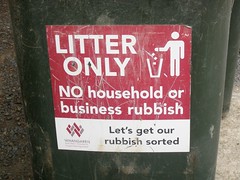
I like to think of our family as environmentally aware. We are conscientious and do what we can to reduce our foot print on this planet. However, we are learning important lessons from New Zealand. This is a country in the grip of a recycling rage. A parallel -- and I believe largely unrelated -- movement involves removing every scrap of litter from every surface in every outdoor space throughout both islands. For these tasks, the Kiwis enlist an army of school children who are indoctrinated from birth to carefully sort their trash and are organized into brigades on a weekly basis to clean town, park, playground, street, and highway. After years of seeing the casually discarded and ubiquitous trash which mars every corner of Mexico, the absence of even so much as cigarette butts and bottle tops on the verge of highways is somewhat disconcerting.
Paradoxically to outsiders, the New Zealand opinion of its own environmental record appears highly critical… and perhaps with good reason. When the Pakehas came to this country, they found a land covered by dense forests of totara, kauri, and fern beneath which lay some of the most fertile ground in the world. So like good, white colonists on every continent, they leveled the place. It is very hard to find any of the original, native forests anywhere. As I said, this pattern is not so unusual. Look at the East coast of the United States, for example. I think what makes it harder for New Zealanders, however, is that this happened so recently. Pennsylvanians and New Yorkers can at least pretend it's not their fault -- those forests were largely gone before we hit the Civil War. We can't be responsible for something that happened 200 years ago… can we? But we on the Western coast of the United States can be more sympathetic to Pakehas who have pictures of their grandparents cutting down giant 3,000 year old kauri trees. There just isn't enough distance between the destruction of our old growth forests and our modern, environmental sensitivity. Short of planting out every cattle range and sheep grazing hill, there appears little to be done to recapture the islands as they existed 100 years ago, let alone 1,000 years ago before the fairly destructive arrival of the Maori wane.
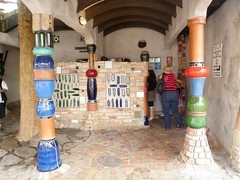
Instead, it feels as though New Zealand is channeling its not inconsiderable energy into keeping everything very clean. This country has, without any exception or qualification, the cleanest toilets in the world. Okay, maybe the Japanese are cleaner… though maybe not. I find the signs on Japanese toilets so baffling I'm never sure I'm using them correctly. In parks, there are special dog-shaped trash cans into which you are instructed to put dog poo. One the of the most highly touted tourist attractions and number 86 on the Kiwi's Must See 101 list is the Hundertwasser public toilets in Kawakawa. The towns and countryside are littered with the high-tech and fancy toilets which Seattle debated for years. Every toilet we've visited is antiseptically clean with no graffiti other than a confetti of government signs encouraging hand washing, counter wiping, and self-policing of rubbish.
My tidy Kiwi kids are already infected with this passion for cleanliness… for the most part. Jaime's bed area still looks like a tornado hit it, and the girls routinely drape wet towels, stinky socks, and dubiously clean clothing on every surface of the house unless I yell at them. Repeatedly. Constantly. Repetitively. Redundantly. Again and again. So they haven't completely adopted the New Zealand passion for cleanliness inside, but they have absorbed the message for the outside world. Slowly but surely, they are transforming the overgrown lawn and beds of Chicken House, replacing the weeds with edible landscaping in the form of winter greens, beans, and clover.
They are also starting to sound strange. "Do I really need this lecture from you, girls?"
*snort* "Wut eh vuh, mum..."
First off… Mum? Second, what am I doing wrong now?
Aaron points at the pile of detritus from our meal making -- packaging plastic and paper, bits of vegetable ends. Rather than scooping them all into the rubbish bin, she shows me how to separate the bits into their appropriate recycling bins outside the campground kitchen.
I like to think of our family as environmentally aware. We are conscientious and do what we can to reduce our foot print on this planet. However, we are learning important lessons from New Zealand. This is a country in the grip of a recycling rage. A parallel -- and I believe largely unrelated -- movement involves removing every scrap of litter from every surface in every outdoor space throughout both islands. For these tasks, the Kiwis enlist an army of school children who are indoctrinated from birth to carefully sort their trash and are organized into brigades on a weekly basis to clean town, park, playground, street, and highway. After years of seeing the casually discarded and ubiquitous trash which mars every corner of Mexico, the absence of even so much as cigarette butts and bottle tops on the verge of highways is somewhat disconcerting.
Paradoxically to outsiders, the New Zealand opinion of its own environmental record appears highly critical… and perhaps with good reason. When the Pakehas came to this country, they found a land covered by dense forests of totara, kauri, and fern beneath which lay some of the most fertile ground in the world. So like good, white colonists on every continent, they leveled the place. It is very hard to find any of the original, native forests anywhere. As I said, this pattern is not so unusual. Look at the East coast of the United States, for example. I think what makes it harder for New Zealanders, however, is that this happened so recently. Pennsylvanians and New Yorkers can at least pretend it's not their fault -- those forests were largely gone before we hit the Civil War. We can't be responsible for something that happened 200 years ago… can we? But we on the Western coast of the United States can be more sympathetic to Pakehas who have pictures of their grandparents cutting down giant 3,000 year old kauri trees. There just isn't enough distance between the destruction of our old growth forests and our modern, environmental sensitivity. Short of planting out every cattle range and sheep grazing hill, there appears little to be done to recapture the islands as they existed 100 years ago, let alone 1,000 years ago before the fairly destructive arrival of the Maori wane.
Instead, it feels as though New Zealand is channeling its not inconsiderable energy into keeping everything very clean. This country has, without any exception or qualification, the cleanest toilets in the world. Okay, maybe the Japanese are cleaner… though maybe not. I find the signs on Japanese toilets so baffling I'm never sure I'm using them correctly. In parks, there are special dog-shaped trash cans into which you are instructed to put dog poo. One the of the most highly touted tourist attractions and number 86 on the Kiwi's Must See 101 list is the Hundertwasser public toilets in Kawakawa. The towns and countryside are littered with the high-tech and fancy toilets which Seattle debated for years. Every toilet we've visited is antiseptically clean with no graffiti other than a confetti of government signs encouraging hand washing, counter wiping, and self-policing of rubbish.
My tidy Kiwi kids are already infected with this passion for cleanliness… for the most part. Jaime's bed area still looks like a tornado hit it, and the girls routinely drape wet towels, stinky socks, and dubiously clean clothing on every surface of the house unless I yell at them. Repeatedly. Constantly. Repetitively. Redundantly. Again and again. So they haven't completely adopted the New Zealand passion for cleanliness inside, but they have absorbed the message for the outside world. Slowly but surely, they are transforming the overgrown lawn and beds of Chicken House, replacing the weeds with edible landscaping in the form of winter greens, beans, and clover.
They are also starting to sound strange. "Do I really need this lecture from you, girls?"
*snort* "Wut eh vuh, mum..."
Friday, April 09, 2010
School Versus Learning
"Mum, I need you to get me more math," Aeron informs me as she slides her backpack off and on to the kitchen table with a thud. The girls have been in the Pukekohe schools for three weeks. This afternoon's flood of noisy children into my peaceful job hunting and insurance-haranguing day is becoming quite routine.
"More math." This isn't really so much a question as a moderately dumbfounded repetition of her words.
"Yes," she informs me cheerfully as she helps herself to milk and cookies. "We're not really doing much math. Those algebra things were cool. More of those."
I confess that living in Chicken House with the girls in school has temporarily slipped me into a June Cleaver mode. I bake cookies, pies, or cake pretty much every day. Of course, part of the motivation is that the house is freezing cold, there is no central heat, and baking appears to be the only source of warmth legitimately possible during the day unless I'm ready to concede defeat and start living in a steamy bathtub eating chocolates and reading Harlequin romances. Absently, I mutter to my youngest, "Only two."
She knows this means two cookies and reluctantly puts one back, "Some science would be good, too."
"Okay, more math and some science. I can do that." At this point, Mera enters the kitchen, and she too immediately heads for the after school nod to suburban domesticity.
"Mom?" Mera asks in her I-want-to-say-something-but-I'm-afraid-you'll-get-upset voice.
Hmm. What now? My youngest wants me to do school after school. What can possibly go wrong now? "Yes, Mera."
"Mom, Mrs. Guise says I need to be accelerated in the accelerated class." Mera's voice is a combination of concern at my response and a vain attempt to suppress pride. She's been in Mrs Guise's accelerated class for one week after getting bumped out of the "normals" due to performing so far out of expectation on her qualifying math and reading tests that her school isn't really quite sure what she's capable of. "I'd like to do some more studying at home."
"Of course you do." Of course you do! Right. I muse, "I thought we were done homeschooling."
"Um… if it's okay with you, I'd like to do some history and science. The maths at school are okay, but they don't do any science really. And I think that not doing history in intermediate school is just wrong, don't you?" Mera is indignant. She is coming out of her modesty shell and pointing out the inadequacies of the curriculum set for an entire nation of people.
I scrub my face, "Well…" I know at this point I should be defending the school system, but we're having a bit of a problem. Can you really tell your kids they are wrong if they want to learn more than they are being offered? Chewing my lip I think for a moment, "Girls have I got this straight? You want me to get you more math, science and history to do after school."
Aeron explains to me, "Yeah. See, we'll just flip our day, okay? We'll play at school and then we'll do school at home. Okay?" Done with her cookies and apparently done with explaining how she's going to organize her day, Aeron disappears around the corner. Mera shrugs, smiles at me, nods her head and leaves as well, her voice trailing behind her as the kitchen door flaps back and forth, "That'll work!"
That'll work. I guess more importantly, Mom will work and Dad will work and when we're done working we'll come home and be teacher. Homeschool families, beware. We made a big mistake. We taught our children to enjoy learning. Now they go to school where it's very fun but completely inadequate intellectually. So my want to play "school" for six hours with all their new Kiwi friends then come home and learn something. I can't imagine how long this bizarre state of affairs will last. I also am pretty sure it would be a good idea to not tell Mrs Guise and Mrs Almond -- not to mention any of their new girl friends -- that school is about as challenging as a construction paper project.
So until and unless this love of learning wears off, I must now add to our daily to do list: more math, some science, and history. So much for the cookies... time to get to work.

"More math." This isn't really so much a question as a moderately dumbfounded repetition of her words.
"Yes," she informs me cheerfully as she helps herself to milk and cookies. "We're not really doing much math. Those algebra things were cool. More of those."
I confess that living in Chicken House with the girls in school has temporarily slipped me into a June Cleaver mode. I bake cookies, pies, or cake pretty much every day. Of course, part of the motivation is that the house is freezing cold, there is no central heat, and baking appears to be the only source of warmth legitimately possible during the day unless I'm ready to concede defeat and start living in a steamy bathtub eating chocolates and reading Harlequin romances. Absently, I mutter to my youngest, "Only two."
She knows this means two cookies and reluctantly puts one back, "Some science would be good, too."
"Okay, more math and some science. I can do that." At this point, Mera enters the kitchen, and she too immediately heads for the after school nod to suburban domesticity.
"Mom?" Mera asks in her I-want-to-say-something-but-I'm-afraid-you'll-get-upset voice.
Hmm. What now? My youngest wants me to do school after school. What can possibly go wrong now? "Yes, Mera."
"Mom, Mrs. Guise says I need to be accelerated in the accelerated class." Mera's voice is a combination of concern at my response and a vain attempt to suppress pride. She's been in Mrs Guise's accelerated class for one week after getting bumped out of the "normals" due to performing so far out of expectation on her qualifying math and reading tests that her school isn't really quite sure what she's capable of. "I'd like to do some more studying at home."
"Of course you do." Of course you do! Right. I muse, "I thought we were done homeschooling."
"Um… if it's okay with you, I'd like to do some history and science. The maths at school are okay, but they don't do any science really. And I think that not doing history in intermediate school is just wrong, don't you?" Mera is indignant. She is coming out of her modesty shell and pointing out the inadequacies of the curriculum set for an entire nation of people.
I scrub my face, "Well…" I know at this point I should be defending the school system, but we're having a bit of a problem. Can you really tell your kids they are wrong if they want to learn more than they are being offered? Chewing my lip I think for a moment, "Girls have I got this straight? You want me to get you more math, science and history to do after school."
Aeron explains to me, "Yeah. See, we'll just flip our day, okay? We'll play at school and then we'll do school at home. Okay?" Done with her cookies and apparently done with explaining how she's going to organize her day, Aeron disappears around the corner. Mera shrugs, smiles at me, nods her head and leaves as well, her voice trailing behind her as the kitchen door flaps back and forth, "That'll work!"
That'll work. I guess more importantly, Mom will work and Dad will work and when we're done working we'll come home and be teacher. Homeschool families, beware. We made a big mistake. We taught our children to enjoy learning. Now they go to school where it's very fun but completely inadequate intellectually. So my want to play "school" for six hours with all their new Kiwi friends then come home and learn something. I can't imagine how long this bizarre state of affairs will last. I also am pretty sure it would be a good idea to not tell Mrs Guise and Mrs Almond -- not to mention any of their new girl friends -- that school is about as challenging as a construction paper project.

So until and unless this love of learning wears off, I must now add to our daily to do list: more math, some science, and history. So much for the cookies... time to get to work.
Subscribe to:
Posts (Atom)