s/v Excellent Adventure invited the girls and I for a sail Saturday. There were a number of really good reasons I did not want to go:
Aeron fitched a pit and jumped into it, refusing to bathe. This not only induced in her mother a strong desire to strangle her, it also resulted in one of those cowboy western standoffs wherein I was stupid enough to say, “If you do not take a shower, you can not go with the Hudsons.” Ugh. I should know better.
Mera slammed my head between the sliding glass door and the navigation table while I was cleaning the scum out of the tracks. I had a splitting headache and a rather scary lancing pain from my neck to my butt.
Hello! I own a sailboat. I live on a sailboat. Why the heck would I want to “go sailing” for the afternoon. Bah humbug!
But the kids really superduper wanted to go, and I’m basically in love with Laureen and Jason. So we strongarmed Aeron into s/v EA’s shower, and I boarded for an afternoon of sitting in an ibuprofinic stupor in the cockpit with a cherubic baby catatonic in my lap. The Hudsons fortunately had a few other friends aboard to help with lines and helm. The wind was brisk, the sun was shining. It was a perfect day for a sail on the Bay.
Jason pointed his 47’ Lagoon straight for the Golden Gate Bridge and ZOOM! off we went. Excellent Adventure is a wonderful boat in the old school of Lagoon manufacture. Back in the day, Lagoon was well known for racing catamarans and the only thing compelling about the otherwise horrid movie Waterworld - the protagonist’s spectacular blade thin catamaran. It was not long before we were ripping out to the Bridge at plus 10 knots.
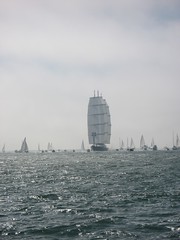
As we approached the Bridge, all the adults started getting excited and pointing. This struck me as peculiar in a group of otherwise rational crew members who had probably been under the Gate a million times. They mustered me out of my seat to see “It.” It was a 290 foot sailboat under full sail escorted by a fleet of hundreds of small pleasure craft, buzzing around like bees around a hive.
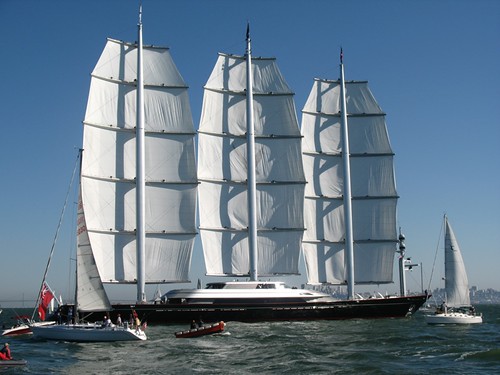
s/y Maltese Falcon is one of the most stunning craft on the water today. She has the proportions of a sailing vessel of yore, but the sleek, modern lines of a 21st century craft. She stands nearly 200 feet with three enormous, independently rotating masts. The pictures -- mine, Jason’s and those of the many professional photographers present on Saturday -- do not do her justice. In person, she is simply amazing.
Our intrepid Cap’n Jason did his standard bold and heart stopping maneuver, positioning us to swing across her bow just before she passed into the Gate zone. We took a lot of photos, had our breath stolen by her beauty, and pissed off a lot of other craft whose bows we zoomed in front of. Later as the Falcon rounded Angel Island, we had another opportunity at low speed to get up close and personal. We even exchanged very happy words with the crew, and a few warning honks with the captain.
Trail magic begins when you are ready to open yourself to experience. Had I not grudgingly agreed to shlep my children over to EA, I would have missed the high point of our visit to the San Francisco Bay area. Thank you, Jason and Laureen. What a treat!!!

Friday, October 03, 2008


Monday, September 29, 2008
The Ocean, She is Loud
One of the most draining aspects of passage making is the volume. I had not anticipated how loud it is when you go to sea. There are many sources of noise when you are in large wind and wave -- most irregular and several highly disturbing. The din takes time to adjust to as your hind brain sorts through the cacophony and starts to selectively ignore the bangs and beeps it can do nothing about. Until this process is complete, you will find it nearly impossible to concentrate or to sleep. I encourage you to feed your hind brain in advance with multivits and a couple of hours of Discovery Channel shows about our Neanderthal ancestors to remind it of its incredible adaptive abilities. Confidence in passage making is key.
Consistently, the loudest noise is the slapping of water against the hull. Even time spent cruising bays, sounds and inner passages and nights on a rocky anchor does not prepare you for the volume of wave slap in ocean swell. There are swooshy gliding sounds as the boat surfs over and through waves. There are splashy splochy sounds as waves crest nearby and drench the deck. Then there are the wappy, smacky sounds as wavelets beat themselves to death on the obdurate fiberglass of the hull.
The ones that really get you going, though, are the really loud bangs which sound exactly like a 2 x 4 wielding sea monster has reached up from the depths and rapped your boat sharply on her nose. These whacks do not in any way sound like water. You will be convinced the first two to three hundred times this happens that the boat has just run into a large tree. It is, even after the thousandth time, nearly impossible to comprehend that the sound is generated by a wave bashing its head against the beam. I challenge you to sleep through these even with the most highly evolved hind brain.
Catamarans in particular are also plagued by something known as "bridge deck boom." This is the sound generated by waves slapping against the bottom of the bridge deck between the two hulls. All catamarans boom. Or more precisely, for every catamaran there is a set of wind and wave conditions which make the boat boom. Designers around the world work to reduce the boom through baffles, angles and nacelles, height above water, and other factors. This results in models which are more "boomy" than others. However, no design escapes booming entirely.
When you get a boom condition, a large volume of water hits the underside of the salon like a toddler with a drum strick on mommy's favorite antique dresser. The shape of the boat, the air space within, create a perfect resonating chamber. The boom radiates out of the salon and down into the cabins where it works its way from your feet up to your eyebrows and fades out the top of your head.
In addition to wave noise, sound emits from your source of fuel. If you are motoring, there is the constant drone of a large diesel engine. If the wind is strong enough to enable you to sail, it is strong enough to vibrate the mast and tensioned running rigging. If the wind is really strong, the combined wind and wave outside sound like a freight train rolling over the boat.
Underlying all the big sounds are the endless number of tiny sounds which roll together into a white noise of clacks, creaks, squeaks, pops, and bangs. Plates, cups, utensils in lockers. The flashlight rolling on a counter. A soft flap of paperbacks rocking back and forth on the shelf. A strange buzz from the stove vibrating in resonance with the engines. The Coast Guard on VFH channel 16 droning on about bar reports, the sound of air flowing through the empty galley sink drain, a spare halyard knocking against the mast, your stomach growling, the kitten purring cat food breath into your ear. I can't catalog all the sources, and there is simply no way you could control them all through padding, oiling, and diligent desqueakifying.
At 0400 having been on watch for three hours, with the red lights dimly illuminating the salon, a new sound emerges. The sound is deep, low, liquid, and buzzes along the nerves with the after effects of sleep deprivation, over caffeination, and exhaustion. This is the sound of my brain melting.

Consistently, the loudest noise is the slapping of water against the hull. Even time spent cruising bays, sounds and inner passages and nights on a rocky anchor does not prepare you for the volume of wave slap in ocean swell. There are swooshy gliding sounds as the boat surfs over and through waves. There are splashy splochy sounds as waves crest nearby and drench the deck. Then there are the wappy, smacky sounds as wavelets beat themselves to death on the obdurate fiberglass of the hull.
The ones that really get you going, though, are the really loud bangs which sound exactly like a 2 x 4 wielding sea monster has reached up from the depths and rapped your boat sharply on her nose. These whacks do not in any way sound like water. You will be convinced the first two to three hundred times this happens that the boat has just run into a large tree. It is, even after the thousandth time, nearly impossible to comprehend that the sound is generated by a wave bashing its head against the beam. I challenge you to sleep through these even with the most highly evolved hind brain.
Catamarans in particular are also plagued by something known as "bridge deck boom." This is the sound generated by waves slapping against the bottom of the bridge deck between the two hulls. All catamarans boom. Or more precisely, for every catamaran there is a set of wind and wave conditions which make the boat boom. Designers around the world work to reduce the boom through baffles, angles and nacelles, height above water, and other factors. This results in models which are more "boomy" than others. However, no design escapes booming entirely.
When you get a boom condition, a large volume of water hits the underside of the salon like a toddler with a drum strick on mommy's favorite antique dresser. The shape of the boat, the air space within, create a perfect resonating chamber. The boom radiates out of the salon and down into the cabins where it works its way from your feet up to your eyebrows and fades out the top of your head.
In addition to wave noise, sound emits from your source of fuel. If you are motoring, there is the constant drone of a large diesel engine. If the wind is strong enough to enable you to sail, it is strong enough to vibrate the mast and tensioned running rigging. If the wind is really strong, the combined wind and wave outside sound like a freight train rolling over the boat.
Underlying all the big sounds are the endless number of tiny sounds which roll together into a white noise of clacks, creaks, squeaks, pops, and bangs. Plates, cups, utensils in lockers. The flashlight rolling on a counter. A soft flap of paperbacks rocking back and forth on the shelf. A strange buzz from the stove vibrating in resonance with the engines. The Coast Guard on VFH channel 16 droning on about bar reports, the sound of air flowing through the empty galley sink drain, a spare halyard knocking against the mast, your stomach growling, the kitten purring cat food breath into your ear. I can't catalog all the sources, and there is simply no way you could control them all through padding, oiling, and diligent desqueakifying.
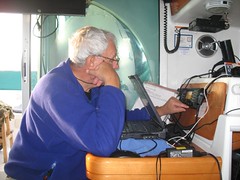
At 0400 having been on watch for three hours, with the red lights dimly illuminating the salon, a new sound emerges. The sound is deep, low, liquid, and buzzes along the nerves with the after effects of sleep deprivation, over caffeination, and exhaustion. This is the sound of my brain melting.
Thursday, September 25, 2008
TechTip - Mal de Mer
 Readers asked me to provide more detail about our Counter Sea Sickness Offensive, also known as Operation Ocean Ack. First off... I am not a doctor. I do not play a doctor on T.V. I do not even own a T.V. Do not take anything I say as medical advice. More importantly, do not even think about suing me if you decide to try any of these medications. This is just what is working on s/v Don Quixote.
Short Answer - We use a combination of first level homeopathic remedies and pretty powerful anti-nausea drugs to beat back mal de mer.
Long Story - Sea sickness hits everyone eventually. As with so many salty issues of nautical accomplishment, there are those who have done it, those to whom it will happen soon, and those who lie. This truism holds for everything from running aground to spending 24 hours vomiting in the head. Some day, you will meet a sea condition that will take you down. It doesn’t have to be big sea, choppy sea, or windy sea. It just has to be the sea with your name on it.
Let's start with the most important bit about sea sickness. Once you get sick, it is damn near impossible to stop throwing up. So with every fiber of your being, you need to prevent yourself from getting sick in the first place. And of course, it really appears that all the best 'remedies' for sea sickness start with the recommendation, "Take the day before you go to sea." Gee thanks. So in addition to everything else you must contend with prior to departure, you need to make sure you drug the entire crew.
Because there is an escalating scale to how much you need to intervene to address sea sickness, it is challenging to figure out where you should start your intervention. We like to begin with a highly advanced, pharmaceutical approach and then gently taper back until the boat is running on ginger snaps and Top Ramen. With experience, you’ll know at what point on the escalation path you need select with each crew member.
Open Air Cures - The simplest cure for queasiness is visibility and fresh air. Stop what you’re doing, look up, look around, go out into the cockpit. Take the helm. Put on some really bouncy music that makes you want to dance. Dance on the deck while you stare around. Alternatively, just go to sleep.
Food - Some foods that settled the tummy are ginger snaps, ginger ale, saltines, and graham crackers. My girls also do well pretzels. Think bland, dry, and gentle. Top Ramen and macaroni and cheese are good for hot foods. Stick to non-caffeinated, low sugar, and low acid beverages.
Berkeley Ideas - There are many, many natural and homeopathic methods to stave off sea sickness. I have had a great deal of success with acupressure bands. There are those that swear by the press-on acupressure dots. Papaya enzyme is good as an antacid. You might also try other homeopathic or natureopathic supplements. I haven’t tried any other than papaya so I can’t speak to their efficacy.
Meclizine HCl - DrGeorge recommends an over the counter anti-emetic called meclizine. Look it up. It's good stuff. It doesn't make you drowsy, which is key. You can take 25 mg twice a day starting the day before, and it does a really good job of keeping the beast at bay. DrC and I took it throughout our passage, and neither of us experienced a moment of sea induced queasiness. I did have that one hour of wanting to toss my cookies in sheer unadulterated terror, but I don't think that counts.
More Meds - Crew that have never been sick are recalcitrant and will not take their meclizine in advance. You'd think the stuff was nasty like that grape antibiotic we feed our kids. It's just a small blue pill, for gods sake. But crew will balk and then proceed to get violently ill. At which point you have to go all macho captain on them and law down the medical law. People who do not get better within about 24 hours can actually start doing themselves some pretty serious harm.
Even at this juncture, you have several options. You can try dramamine crushed under the tongue, the meclizine they should have been taking all along, or a club to the head. But if the boat is really rocking and you've got a true sicky aboard, these measures might be too little too late. The problem is that nothing is staying down your boat's victim. Now you need to start getting really personal.
Suppositories - When there is no other way to get meds into a crew member, we intervene with a suppository dose of prochlorperazine 25 mg. It's available by prescription only so you'd need to get this from a doctor in advance. You can probably get some by taking an emergency medicine course and getting the prescription from the instructor. It's very good to have aboard and should only be taken when you simply can't get the crew member to stop vomiting and start sucking down fluids.
Points Beyond - After that, the problem goes beyond my ability to even speculate what you should do. Dehydration can kill so this isn't just an unpleasant problem. Land is your best bet, but if not land you can look at evacuation off the boat, enemas, and other more serious interventions. Fortunately, we have not as yet made it to this step and are unlikely to do so in the near future. Coastal cruising at least ensures that you can generally drop a really sick crew member on to a rock within 48 hours of any location.
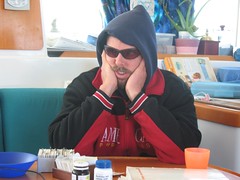
Now someone please give me a cure for land sickness.
Sunday, September 21, 2008
Passage Notes - Part 1
Of course, now that I've actually completed one (1) passage, I am officially an expert on the subject. This is the Toast Way. With all the confidence of a thirty year veteran, I feel qualified now to tell all you dreamers precisely what to do. I restrain myself not out of a sense of experiential deficiency but merely because the subject is so thoroughly covered in the cruising literature by such luminaries as the Pardeys and -- my personal favorite -- Bob Bitchin'.
Instead, I would like to offer some suggestions for the complete passage n00b. This would be the bedazzled sucker who believes her father in law and husband that Neah Bay to San Francisco is not particularly long or challenging during the pleasant months of August and September and who is deluded into believing that both her body and her boat are ready for "big water." I will try to limit myself to only those suggestions that I completely failed to see in my extensive review of the cruising books. If these notes were in there, I must have slept through that day of class.
Contents May Shift During Flight - No matter how tightly packed, no matter how well prepared, everything in your lockers will be both shaken and stirred. Inevitably, something will maneuver itself to the front of the locker only to emerge with a shout of glee and a shatter of glass on opening. Sometimes it is the kitten. More frequently it is something that either (1) can not be easily replaced, (2) requires a vacuum to clean up, or (3) exudes a rank smell that makes everyone want to vomit. Bring lots of rags and the patience of Job, and be careful opening doors.
Everything that Worked, Breaks - We left with a short list of Things Not Yet Fixed (patent pending). We arrived with an extraordinarily long list of stuff that didn't survive the beating. Apparently all the southeasterlies off Vancouver were insufficiently destructive to break our gear conveniently before we left Seattle. So now we have about two hundred things to do in San Francisco. A full passage plan includes weeks at your destination to put the boat back together.
Better Living Through Chemistry - One of our crew arrived with acupuncture dots to help with nausea. The sea jeered him and roundly smacked him upside the head with a 24 hour bout of the nastiest sea sickness I've seen in a long time. Dry heaves are horrid. Don't go there. There are nasty drugs now that you can take to poison your system utterly in a valiant effort to battle off the queasies on the theory if you are sufficiently dead, you can't vomit. Just take them. Trust me. Ultimately, we had to put him on prochlorperazine. The rest of us -- and Jason after we got him back on his feet -- took meclizine 25 mg twice a day. The later is an anti-emetic that does not cause drowsiness. After a few days at sea, we all were able to taper off and by the fourth day we were even reading books.
More Pills Are Better - In addition to the anti-nausea drugs, there are some things you can do to make your body limp along in the very draining conditions of a passage. We made liberal use of the following:
* Papaya enzyme - A really effective and tasty antacid
* Metamucil - Makes you regular which is a complete boon at sea, let me tell you
* Arnica - A homeopathic which works well to speed healing of bruises and can be taken orally or topically
* Ibuprofin - Buy in the huge Costco generic size since you'll have a headache big time
* Vitamins - eating is more sporadic and a multi-vit per day is a good idea
General Foods International Coffees - I hate these usually. They are too sweet and a poor excuse for coffee. However, on watch it is a blessing to just heat a pot of water and let your crew help themselves. Lay out a tray with instant coffee, teas (mint, green and black), and instant soup. The biggest problem in feeding my crew was keeping them hydrated as they tended to drink too little. I did everything I could to tempt them to drink more.
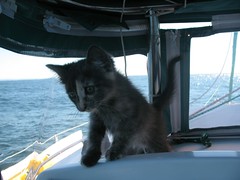
Do Not Bring the Cat - Dulcinea had the time of her life. She loves boat life. The problem is that she LOVES boat life. She is all over this damn boat all the time. Being a cat, she is always in precisely where you want to step. She wants to go on deck in 40 knots winds to play with the whipping straps on the bimini covers. She wants to play on your face in the middle of your off watch. It's like going through finals week in college with an asshat 14 year old child prodigy armed with a brand new Wii and a crush on you. I should have made the grandparents deal with the kitten.
Even Catamarans Rock and Roll - Catamaran motion is called -- sometimes pejoratively, sometimes fondly -- a rocking horse motion. This description is particularly apt during the long haul. While there is no leaning, there is still considerable motion as you sit, drive, contemplate your navel, or attempt to sleep. While catamaran owners do not need to invest in lee clothes, I do recommend a bunch of extra blankets, pillows or bolsters. Place these around your body as you sleep, and your fat will jiggle considerably less. This assumes you are not using the passage to jiggle your fat off, though, a widely proven weight loss technique.
iPod, Accept No Substitute - Seriously. Stop screwing around with competitor products or your radio or, god forbid, CDs. Just invest in an iPod for each crew member. Fill it with music, audio books, and podcasts. Make sure your stereo system has an iPod-in capacity. Make it a Writ From Captain that crew on helm make ALL decisions about what to play, method of delivery (personal ear buds or system stereo), and how loud to play it (within reason).
Let me close these notes with a short list of things you do not need to bring for your passage: books, video games, spicy foods, alcoholic beverages, board games, needlework, carpentry projects, movies, makeup, condoms, or hiking shoes.
Instead, I would like to offer some suggestions for the complete passage n00b. This would be the bedazzled sucker who believes her father in law and husband that Neah Bay to San Francisco is not particularly long or challenging during the pleasant months of August and September and who is deluded into believing that both her body and her boat are ready for "big water." I will try to limit myself to only those suggestions that I completely failed to see in my extensive review of the cruising books. If these notes were in there, I must have slept through that day of class.
Contents May Shift During Flight - No matter how tightly packed, no matter how well prepared, everything in your lockers will be both shaken and stirred. Inevitably, something will maneuver itself to the front of the locker only to emerge with a shout of glee and a shatter of glass on opening. Sometimes it is the kitten. More frequently it is something that either (1) can not be easily replaced, (2) requires a vacuum to clean up, or (3) exudes a rank smell that makes everyone want to vomit. Bring lots of rags and the patience of Job, and be careful opening doors.
Everything that Worked, Breaks - We left with a short list of Things Not Yet Fixed (patent pending). We arrived with an extraordinarily long list of stuff that didn't survive the beating. Apparently all the southeasterlies off Vancouver were insufficiently destructive to break our gear conveniently before we left Seattle. So now we have about two hundred things to do in San Francisco. A full passage plan includes weeks at your destination to put the boat back together.
Better Living Through Chemistry - One of our crew arrived with acupuncture dots to help with nausea. The sea jeered him and roundly smacked him upside the head with a 24 hour bout of the nastiest sea sickness I've seen in a long time. Dry heaves are horrid. Don't go there. There are nasty drugs now that you can take to poison your system utterly in a valiant effort to battle off the queasies on the theory if you are sufficiently dead, you can't vomit. Just take them. Trust me. Ultimately, we had to put him on prochlorperazine. The rest of us -- and Jason after we got him back on his feet -- took meclizine 25 mg twice a day. The later is an anti-emetic that does not cause drowsiness. After a few days at sea, we all were able to taper off and by the fourth day we were even reading books.
More Pills Are Better - In addition to the anti-nausea drugs, there are some things you can do to make your body limp along in the very draining conditions of a passage. We made liberal use of the following:
* Papaya enzyme - A really effective and tasty antacid
* Metamucil - Makes you regular which is a complete boon at sea, let me tell you
* Arnica - A homeopathic which works well to speed healing of bruises and can be taken orally or topically
* Ibuprofin - Buy in the huge Costco generic size since you'll have a headache big time
* Vitamins - eating is more sporadic and a multi-vit per day is a good idea
General Foods International Coffees - I hate these usually. They are too sweet and a poor excuse for coffee. However, on watch it is a blessing to just heat a pot of water and let your crew help themselves. Lay out a tray with instant coffee, teas (mint, green and black), and instant soup. The biggest problem in feeding my crew was keeping them hydrated as they tended to drink too little. I did everything I could to tempt them to drink more.
Do Not Bring the Cat - Dulcinea had the time of her life. She loves boat life. The problem is that she LOVES boat life. She is all over this damn boat all the time. Being a cat, she is always in precisely where you want to step. She wants to go on deck in 40 knots winds to play with the whipping straps on the bimini covers. She wants to play on your face in the middle of your off watch. It's like going through finals week in college with an asshat 14 year old child prodigy armed with a brand new Wii and a crush on you. I should have made the grandparents deal with the kitten.
Even Catamarans Rock and Roll - Catamaran motion is called -- sometimes pejoratively, sometimes fondly -- a rocking horse motion. This description is particularly apt during the long haul. While there is no leaning, there is still considerable motion as you sit, drive, contemplate your navel, or attempt to sleep. While catamaran owners do not need to invest in lee clothes, I do recommend a bunch of extra blankets, pillows or bolsters. Place these around your body as you sleep, and your fat will jiggle considerably less. This assumes you are not using the passage to jiggle your fat off, though, a widely proven weight loss technique.
iPod, Accept No Substitute - Seriously. Stop screwing around with competitor products or your radio or, god forbid, CDs. Just invest in an iPod for each crew member. Fill it with music, audio books, and podcasts. Make sure your stereo system has an iPod-in capacity. Make it a Writ From Captain that crew on helm make ALL decisions about what to play, method of delivery (personal ear buds or system stereo), and how loud to play it (within reason).
Let me close these notes with a short list of things you do not need to bring for your passage: books, video games, spicy foods, alcoholic beverages, board games, needlework, carpentry projects, movies, makeup, condoms, or hiking shoes.

Subscribe to:
Posts (Atom)