A picture graces the cover of Sail Magazine of a magnificent catamaran cresting a wave, bows thrust out over the peaks looking for all the world as though the craft is about to launch itself into space. The sails are full, lines straining, and if you can see the captain and crew their faces are caught in a rictus grin of manic sailing glee. The sun is bright, the boat gleams. As a reader, you can not look at the picture without seriously contemplating purchasing one of these amazing craft. It's 35 degrees out, you're soggy and bundled to the eyebrows in a slightly skanky smelling wool coat, boarding a plane home from a meeting in Chicago. You grab the magazine, a pack of Juicy Fruit, an Odwalla, and a tired looking bagel before heading out of the shop to get in line.
It might improve your state of mind to know that approximately .05 seconds after the picture was taken, the boat slammed back to reality as it smashed bows forward into the back of the wave. Someone screamed over at the camera man, “Do you have the damn picture yet?” If the answer was in the affirmative, the crew breathed a sigh of relief, relaxed the lines a bit and fell at least ten degrees more off the wind; They might take longer to get back to the dock, but at least it won't be a miserable flipping slog. If the answer was in the negative, the crew braced themselves for another 15 minutes of loud, uncomfortable bashing into swells, wind, and a very hard ocean.
In my considered opinion, upwind sailing is romantic only in magazines. In the real world where boats actually float, gentlemen never sail to wind. While it is true that sail boats are generally designed to sail to windward, and in fact many sail considerably better and more rapidly pointed into the teeth of the gale, it is rarely a comfortable ride. In truth, the problem is not really the wind, it is the unfortunate truism that where cometh the wind, there cometh the swell. After only an hour of steady 20 knot winds from the northwest, you can count on a seriously nasty northwest chop. The stronger and longer the winds persist, the steadier, bigger, and crestier the waves become. Ocean swell, in fact, is largely a by-product of really big, really strong, really steady winds someplace out in the middle of the ocean which like ripples in a global pond just radiate out out out out until they roll you in an anchorage on the Mexican coastline during otherwise perfectly calm and windless night.
Just to make life entertaining out here, swell often comes from one direction – let's say a pineapple express from the southwest – while wind waves emerge from a norther. So now we're looking at a 2 foot swell every 7 seconds from your stern port side and a 4 foot wave every 3 seconds from your bow port, 15 knots on the bow port, and a helm woman in a very bad temper. The kids are just queasy enough even after a year at sea to be rendered incapable of geometry and history, while the captain is puzzling over the latest cause for coolant loss in the refrigerator.
We call it “the bash.” The bash is not a party. The bash is precisely what the boat does every few seconds for hours on end as you push your way north. This same coastline southbound in precisely the same conditions is a gentle roller coaster ride, water sluicing down the sides of the boat with an occasional swell thumping playfully on the bridge deck. Current, wind, and the fine performance of a cat in light winds ensure a quick passage with speeds averaging seven or eight knots an hour even in our dog slow condomaran. Upwind, however, is an entirely different story. We barely average four as our poor home crashes against the wind driven waves.
The famously rocking horse motion ascribed to catamarans is strongly evident... no heeled slicing of bow through waves for us. We rock up, push our bows into open air, then bang down. If we start to make too much speed and headway, instead of bashing down on the back of the wave, we swoop our bows directly into the face of the following wave. The girls love it when this happens as the result is a flood of water through the tramp and over the bows, wind driven spray pushing all the way into the cockpit even – when the angle is just right – drenching the helm in her cursing, exhausted splendor. Lest anyone worry about us, Don Quixote is in no danger in these seas of turning turtle. While it is true that burying bows into the face of a wave is precisely how a catamaran can flip, let's be clear that to do so requires much bigger waves, much greater wind than what Don Quixote is facing on the Mexican Riviera. Ironically, it also requires a downwind sail, which I can assure you we are not doing at present.
No, our catamaran is a really solid boat. She doesn't actually object to this type of sailing, and beats steady progress northwards with a resigned, firm approach. She takes the waves, she handles the wind, she explains in small creaks and the occasional smashed wine glass that if we're going to bash upwind, there is a price to pay.
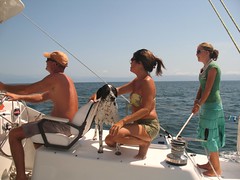
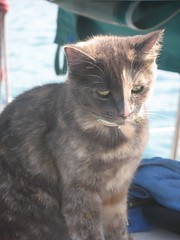
Dulcinea is not nearly so sanguine; She'll meow whenever Don Quixote does one of those magazine worthy flying leaps into the next wave, lifting her head to reproachfully glance at me at the helm, her message obvious, “A smoother ride, please. We cats prefer a downwind sail.”

Saturday, March 28, 2009


Tuesday, March 24, 2009
Pick Your Pleasure
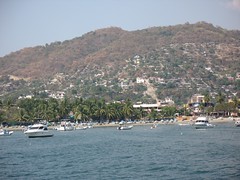
“I think I like it here,” says DrC one evening over pina coladas. We're looking out over the Las Hadas anchorage, watching the white walls turn pink and purple in the setting sun.
I blink, “Really? What brought on this effusive display, husband mine?”
He looks around, sips thoughtfully at his drink, “The pineapple juice really improves it.”
I am reasonably certain he's changed the topic, but with DrC you never can tell. It is within the realm of possibility that his entire interpretation of his experience of Manzanillo Bay is filtered the golden tinted goggles of pina colada fog. I wait a beat, just in case, because the best possible course of action with my husband is to let him think for awhile.
My patience is rewarded with a casual wave of his tumbler at the anchorage, the bay, and the lights on the horizon, “I could live here.” Not the drink, then. “Not too big or busy, hardware stores, spread out, not as polluted.”
Our criteria for favorite place in Mexico varies with each member of the crew. DrC focuses on convenience and accessibility of hardware stores, bait and tackle shops, and large grocery outlets. He likes where the cabbies are indulgent with his many stops, and the local cruiser network is full of pithy advise on how to fix boat gear.
Jaime, on the other hand, focuses exclusively on friends. Hanging out with friends. La Paz, for example, is heaven because she spent the entire time with her friend Isobel. She's driving hard to get us back to Mazatlan solely to meet up with 4-P.A.C.K. and her good friend Casey. Mazatlan? For gods sake child, are you insane? Mazatlan of the stinky sewage anchorage, the smoky horizon and the daily visits by cruise ships?
Aeron selects destinations solely for their swimmability. Pool swimming is good, ocean swimming is great. Any swimming is critical. My little fish. Her partner in all things creative and playful, Mera, also seeks clean water – preferably fresh. However, of all of us Mera is most interested in the remote anchorage. She likes the water calm, the air and water clear, the evenings quiet and peaceful.
I would like to say that I care about the mercadas, clean water for swimming, and the company of fellow cruisers. But when I ask my family what they think is important to me, they tell me that the only really critical feature necessary for my sanity and happiness is a good Internet connection to the boat. I thought I'd broken that umbilical cord. I can stop any time I want to! Really! And they say, “Um... not so much Mom.” DrC just shakes his head.
It is hard to find a place where all of us are happy. Las Hadas has the pool, market, hardware stores, and cruisers, but there are no kid boats here for Jaime. Zihua's water was frequently disgusting, and we rarely got to swim in fresh; There were boat kids, but we didn't have quiet. In Santiago, it's quiet and clean and full of friendly cruisers, but the hardware stores are miles away. Tenacatita? No stores at all. Chamela? No Internet. Ipala? Oh please... just do not even bother dropping hook. La Cruz? Too rolly. Nuevo Vallarta? Too expensive. Mazatlan? You either die of the smell or you live in a boat parking lot. La Paz? Well...
Now La Paz might just do the trick. If we could find a swimming pool...

I blink, “Really? What brought on this effusive display, husband mine?”
He looks around, sips thoughtfully at his drink, “The pineapple juice really improves it.”
I am reasonably certain he's changed the topic, but with DrC you never can tell. It is within the realm of possibility that his entire interpretation of his experience of Manzanillo Bay is filtered the golden tinted goggles of pina colada fog. I wait a beat, just in case, because the best possible course of action with my husband is to let him think for awhile.
My patience is rewarded with a casual wave of his tumbler at the anchorage, the bay, and the lights on the horizon, “I could live here.” Not the drink, then. “Not too big or busy, hardware stores, spread out, not as polluted.”
Our criteria for favorite place in Mexico varies with each member of the crew. DrC focuses on convenience and accessibility of hardware stores, bait and tackle shops, and large grocery outlets. He likes where the cabbies are indulgent with his many stops, and the local cruiser network is full of pithy advise on how to fix boat gear.
Jaime, on the other hand, focuses exclusively on friends. Hanging out with friends. La Paz, for example, is heaven because she spent the entire time with her friend Isobel. She's driving hard to get us back to Mazatlan solely to meet up with 4-P.A.C.K. and her good friend Casey. Mazatlan? For gods sake child, are you insane? Mazatlan of the stinky sewage anchorage, the smoky horizon and the daily visits by cruise ships?
Aeron selects destinations solely for their swimmability. Pool swimming is good, ocean swimming is great. Any swimming is critical. My little fish. Her partner in all things creative and playful, Mera, also seeks clean water – preferably fresh. However, of all of us Mera is most interested in the remote anchorage. She likes the water calm, the air and water clear, the evenings quiet and peaceful.
I would like to say that I care about the mercadas, clean water for swimming, and the company of fellow cruisers. But when I ask my family what they think is important to me, they tell me that the only really critical feature necessary for my sanity and happiness is a good Internet connection to the boat. I thought I'd broken that umbilical cord. I can stop any time I want to! Really! And they say, “Um... not so much Mom.” DrC just shakes his head.
It is hard to find a place where all of us are happy. Las Hadas has the pool, market, hardware stores, and cruisers, but there are no kid boats here for Jaime. Zihua's water was frequently disgusting, and we rarely got to swim in fresh; There were boat kids, but we didn't have quiet. In Santiago, it's quiet and clean and full of friendly cruisers, but the hardware stores are miles away. Tenacatita? No stores at all. Chamela? No Internet. Ipala? Oh please... just do not even bother dropping hook. La Cruz? Too rolly. Nuevo Vallarta? Too expensive. Mazatlan? You either die of the smell or you live in a boat parking lot. La Paz? Well...
Now La Paz might just do the trick. If we could find a swimming pool...
Friday, March 20, 2009
Turning Around
What an odd feeling to be sailing past coastline we have already seen. For the first time since we turned left at Cape Scott, we are treading ground... or more accurately floating over seas... we've already seen and done.
Time is backwards in the Mexican cruising ground. Hard for us to remember down here that in Seattle and Vancouver, Calgary, Portland and San Francisco, the wind is blowing, the rain is falling, and the temperatures require thick blankets, fluffy comforters, and heavy coats. We live in the land of perpetual sun, gentle breezes, hot afternoons and cool evenings. We spend our days avoiding the intensity of direct light, our evenings drinking sun downers on the deck, our nights watching the stars fall out of their orbit and blaze a path to the spangled darkness of the sea. The weather reports are so consistently dull, even the most salty sailor grows complacent and starts to sleep through Don's endless morning chatter on Amigo net.
Now as our season draws to a close, we must all race either north or south to avoid the harsh weather soon to come. The “winter” of the cruising world is the hurricane season which starts in June and runs to roughly November. During this little winter, cruisers flee hot, humid Mexico to visit family in the North or bungalows in the cooler mountains of the central part of the country. Boats must be moved out of the hurricane belt, generally defined by the insurance companies to mean south of Guatemala or north of Mazatlan and La Paz.
So here we are floating the Mexican Riviera, and the time has come to make a decision: north, south, or west. At the end of January, early February, every boat must commit in order to get moved out of the danger zone before the weather turns. The distances in all three directions are actually quite substantial. While we shot down here from Mazatlan to Zihua in roughly two weeks, we now face a 700 mile upwind bash to get back to the Sea of Cortez. Those planning a puddle jump over to the South Pacific have, of course, a considerably farther distance, albeit downwind. Those contemplating the Panama must play dodge with increasingly vicious winds passing from the Gulf of Mexico over the narrowest part of Mexico and blowing with almost sentient ferocity through the Tuanepec.
Don Quixote always planned to head north, back up into the Sea of Cortez to end our first cruising year. DrC's return to the boat in early February signaled an end to our downwind exploration of new coastline. On our return voyage, the family agreed to take our time. First, the trip north is a considerably more challenging sail as we anticipate a sizable portion will involve a bash directly into the prevailing northwest seas and winds. Second, we feel as though we missed too much in our rapid dash south. We'll take our time drifting northwards, stopping in at our favorite haunts to explore them more thoroughly, visiting harbors and anchorages we blew past on our speed run.
I have mixed feelings about turning around. There is the oddest sensation of disappointment. We're not boldly going where no s/v Don Quixote Conger family has gone before. Without the newness, are we still doing something special? Honestly, I don't know where I get these silly notions. My girls would be special in a track house in white suburbia: specially pretty, specially smart, specially charming, specially shitty and annoying. DrC is a stud muffin going into his mid-forties looking like an advertisement for Cruising GQ. And Beach Access not withstanding, Don Quixote can stand on her own as a special craft worthy of attention, notice, admiration. So unless I've complete run out of things to write about, I'm still surrounded in a world of uniquely bright moments, a life full of discovery, hard work, and dirt. Familiarity with the coastline does not render us suddenly average nor does it diminish the value of what we're doing with and for each other.
It may be time to define moving forward less literally. The demands of the cruising life have driven our thinking for nearly two years pushing us always towards new destinations and experiences. Nautical miles and the names of cities gradually replaced our language for describing how we as a family changed, grew, and progressed.
Turning around changes the metric. Dig deeply, Conger clan, to find less geographic milestones to describe the evolution of our sense of family and purpose. Because I can assure you, children mine and handsome hubby, we're not moving backwards. Not yet. Hopefully, not ever.
Author's Note: This was written in late January in Ixtapa just as we started north.
Time is backwards in the Mexican cruising ground. Hard for us to remember down here that in Seattle and Vancouver, Calgary, Portland and San Francisco, the wind is blowing, the rain is falling, and the temperatures require thick blankets, fluffy comforters, and heavy coats. We live in the land of perpetual sun, gentle breezes, hot afternoons and cool evenings. We spend our days avoiding the intensity of direct light, our evenings drinking sun downers on the deck, our nights watching the stars fall out of their orbit and blaze a path to the spangled darkness of the sea. The weather reports are so consistently dull, even the most salty sailor grows complacent and starts to sleep through Don's endless morning chatter on Amigo net.
Now as our season draws to a close, we must all race either north or south to avoid the harsh weather soon to come. The “winter” of the cruising world is the hurricane season which starts in June and runs to roughly November. During this little winter, cruisers flee hot, humid Mexico to visit family in the North or bungalows in the cooler mountains of the central part of the country. Boats must be moved out of the hurricane belt, generally defined by the insurance companies to mean south of Guatemala or north of Mazatlan and La Paz.
So here we are floating the Mexican Riviera, and the time has come to make a decision: north, south, or west. At the end of January, early February, every boat must commit in order to get moved out of the danger zone before the weather turns. The distances in all three directions are actually quite substantial. While we shot down here from Mazatlan to Zihua in roughly two weeks, we now face a 700 mile upwind bash to get back to the Sea of Cortez. Those planning a puddle jump over to the South Pacific have, of course, a considerably farther distance, albeit downwind. Those contemplating the Panama must play dodge with increasingly vicious winds passing from the Gulf of Mexico over the narrowest part of Mexico and blowing with almost sentient ferocity through the Tuanepec.
Don Quixote always planned to head north, back up into the Sea of Cortez to end our first cruising year. DrC's return to the boat in early February signaled an end to our downwind exploration of new coastline. On our return voyage, the family agreed to take our time. First, the trip north is a considerably more challenging sail as we anticipate a sizable portion will involve a bash directly into the prevailing northwest seas and winds. Second, we feel as though we missed too much in our rapid dash south. We'll take our time drifting northwards, stopping in at our favorite haunts to explore them more thoroughly, visiting harbors and anchorages we blew past on our speed run.
I have mixed feelings about turning around. There is the oddest sensation of disappointment. We're not boldly going where no s/v Don Quixote Conger family has gone before. Without the newness, are we still doing something special? Honestly, I don't know where I get these silly notions. My girls would be special in a track house in white suburbia: specially pretty, specially smart, specially charming, specially shitty and annoying. DrC is a stud muffin going into his mid-forties looking like an advertisement for Cruising GQ. And Beach Access not withstanding, Don Quixote can stand on her own as a special craft worthy of attention, notice, admiration. So unless I've complete run out of things to write about, I'm still surrounded in a world of uniquely bright moments, a life full of discovery, hard work, and dirt. Familiarity with the coastline does not render us suddenly average nor does it diminish the value of what we're doing with and for each other.
It may be time to define moving forward less literally. The demands of the cruising life have driven our thinking for nearly two years pushing us always towards new destinations and experiences. Nautical miles and the names of cities gradually replaced our language for describing how we as a family changed, grew, and progressed.
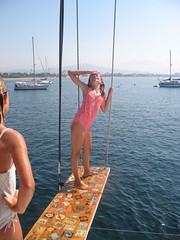
Turning around changes the metric. Dig deeply, Conger clan, to find less geographic milestones to describe the evolution of our sense of family and purpose. Because I can assure you, children mine and handsome hubby, we're not moving backwards. Not yet. Hopefully, not ever.
Author's Note: This was written in late January in Ixtapa just as we started north.
Saturday, March 14, 2009
Ten Cent Solution
A theme I return to over and over again is how to save money by telling the marine industry to take their nautically perfected product and shove it up a thru hull. Life in Mexico has only made me more convinced that the way to cruise safely, sanely and affordably is to purchase nothing from a chandlery unless you can not possibly find an alternative. Corollary, there is almost nothing on your boat except the sails, radar, and chart plotter that you can not find someplace other than a chandlery.
In Mexico, you find that folks are a lot more capable of solving your provisioning and preparation needs than in the United States. This stems primarily from a can do, can build, don't-throw-it-away attitude long since gone in our home country. Usually if you break something in the U.S., it is considerably cheaper to throw the item away and replace it than it is to get it fixed. The opposite is true in Mexico where you can almost always find parts, service, or someone who will build a replacement part from scratch. The one notable exception, by the way, to this general rule of thumb is of course electronics. Electronics are disposable everywhere. So if you want a new trampoline for your catamaran, an extension of your bimini, new sail cover, replacement aluminum pulleys for your dingy davits, or a custom engineered wheel for your crank shaft, wait till you get south of the border.
The ready availability of good quality craftsmanship, machinists, seamstresses, and mechanics changes your thinking on a myriad of subjects. Modifications to your boat that would have otherwise busted the cruising kitty become reasonable investments. Instead of buying something from the States and struggling to have it shipped down, you start looking at ways to fix a part or invest in an alternative. Interestingly, this attitude starts to seep into more prosaic areas of your life. We keep finding ourselves inventing what we call “ten cent solutions to solve ten dollar problems.” The phrase comes from the conversion factor between our old, American-style approach to stuff and our new Mexican version.
A recent example is probably one of the best cases in point: the blender. Now going back nearly two years, you might find me noodling on my kitchen tools and utensils trying to figure out just what I would need on the boat and what was totally unnecessary. Ultimately, I decided to get rid of just about everything except a basic set of pots and pans, plates, mugs, and forks. As we cruise, we gradually picked up a key tool here and there as our lives demanded their adoption. Items I could not have lived without in Seattle such as the toaster oven and the whisk never did make a reappearance in my galley. On the other hand, living in Mexico compels the purchase of a hand-held lime juicer – an item I never would have considered essential.
The blender was a tossup until we met s/v Beach Access. A blender is big and bulky, it consumes power, and it felt like it had limited utility beyond the occasional frosty drink or batch of pesto. Then Beach Access came along and within a week, Glenn had the girls thoroughly addicted to fresh fruit smoothies for breakfast. It is hard to argue with your children when they exorcise their dogz given right to consume fresh fruit for breakfast. So I started researching the hand crank blender Glenn has aboard. It's nifty, let me tell you. It's also pricey. We found one for $60 in the R.E.I. catalog. It was an item that had to wait till our summer road trip and a birthday.
Until we went to Sorianas yesterday and we found a replacement top for a standard, WalMart blender. You can't find these in the States. I know because I once broke ours on the terrazo in the kitchen and could NOT find a replacement anywhere. In Mexico, however, it's challenging to find a new blender, but the blender replacement jugs are on the shelf between the water bottles and the juice pitchers. DrC took one look at the bottom of the blender pitcher and said, “This will work.” Turns out, we have a fitting for our drill which we can use to turn the blender. For 89 pesos (roughly $USD6.00), we could get a blender. 10 to 1. We don't even have to crank it. WHHHrrrrr!
Other “ten cent solutions”?...
* LED deck lights to illuminate the boat at anchor = $150 versus a set of four solar side walk lights for $15
* Dinghy floating bridle line and fittings from marine store roughly $120 versus a shank and roll of whacky colored plastic line from a Mexican ferreteria $11
* Sun shades for the cockpit from nice, fancy nautical store we think would cost us roughly $400 (though it's difficult to say looking at the web site since the biggest catamaran they list is only 14' wide) versus our Mexican blinds which we've been replacing about every four months for $4 each, 3 for $10
If I had it to do all over again – and lordies know living with DrC it's a strong possibility that I'll be prepping another boat someday for a cruise – I'd prepare the boat only well enough to shlep it down the Baja California peninsula and limp into La Paz. I'd fill the bilge with Butterfingers, olive oil, and diced tomatoes, several large bolts of Sunbrella, and roughly 1000 pounds of books. Then I'd spend a few months in La Paz getting the boat ready to cruise.
In fact, that's kind of what we'll do this summer. We'll rent a car, drive up to the States, load up on the essentials, and then come back to down our boat where really highly qualified, reasonably price professionals make the boat look and perform like new. I think I'll even hire someone to scrub the bottom... San Francisco price = $125, Zihuatanejo price = $35.
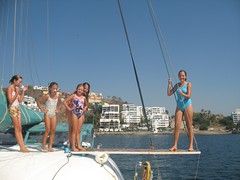
In Mexico, you find that folks are a lot more capable of solving your provisioning and preparation needs than in the United States. This stems primarily from a can do, can build, don't-throw-it-away attitude long since gone in our home country. Usually if you break something in the U.S., it is considerably cheaper to throw the item away and replace it than it is to get it fixed. The opposite is true in Mexico where you can almost always find parts, service, or someone who will build a replacement part from scratch. The one notable exception, by the way, to this general rule of thumb is of course electronics. Electronics are disposable everywhere. So if you want a new trampoline for your catamaran, an extension of your bimini, new sail cover, replacement aluminum pulleys for your dingy davits, or a custom engineered wheel for your crank shaft, wait till you get south of the border.
The ready availability of good quality craftsmanship, machinists, seamstresses, and mechanics changes your thinking on a myriad of subjects. Modifications to your boat that would have otherwise busted the cruising kitty become reasonable investments. Instead of buying something from the States and struggling to have it shipped down, you start looking at ways to fix a part or invest in an alternative. Interestingly, this attitude starts to seep into more prosaic areas of your life. We keep finding ourselves inventing what we call “ten cent solutions to solve ten dollar problems.” The phrase comes from the conversion factor between our old, American-style approach to stuff and our new Mexican version.
A recent example is probably one of the best cases in point: the blender. Now going back nearly two years, you might find me noodling on my kitchen tools and utensils trying to figure out just what I would need on the boat and what was totally unnecessary. Ultimately, I decided to get rid of just about everything except a basic set of pots and pans, plates, mugs, and forks. As we cruise, we gradually picked up a key tool here and there as our lives demanded their adoption. Items I could not have lived without in Seattle such as the toaster oven and the whisk never did make a reappearance in my galley. On the other hand, living in Mexico compels the purchase of a hand-held lime juicer – an item I never would have considered essential.
The blender was a tossup until we met s/v Beach Access. A blender is big and bulky, it consumes power, and it felt like it had limited utility beyond the occasional frosty drink or batch of pesto. Then Beach Access came along and within a week, Glenn had the girls thoroughly addicted to fresh fruit smoothies for breakfast. It is hard to argue with your children when they exorcise their dogz given right to consume fresh fruit for breakfast. So I started researching the hand crank blender Glenn has aboard. It's nifty, let me tell you. It's also pricey. We found one for $60 in the R.E.I. catalog. It was an item that had to wait till our summer road trip and a birthday.
Until we went to Sorianas yesterday and we found a replacement top for a standard, WalMart blender. You can't find these in the States. I know because I once broke ours on the terrazo in the kitchen and could NOT find a replacement anywhere. In Mexico, however, it's challenging to find a new blender, but the blender replacement jugs are on the shelf between the water bottles and the juice pitchers. DrC took one look at the bottom of the blender pitcher and said, “This will work.” Turns out, we have a fitting for our drill which we can use to turn the blender. For 89 pesos (roughly $USD6.00), we could get a blender. 10 to 1. We don't even have to crank it. WHHHrrrrr!
Other “ten cent solutions”?...
* LED deck lights to illuminate the boat at anchor = $150 versus a set of four solar side walk lights for $15
* Dinghy floating bridle line and fittings from marine store roughly $120 versus a shank and roll of whacky colored plastic line from a Mexican ferreteria $11
* Sun shades for the cockpit from nice, fancy nautical store we think would cost us roughly $400 (though it's difficult to say looking at the web site since the biggest catamaran they list is only 14' wide) versus our Mexican blinds which we've been replacing about every four months for $4 each, 3 for $10
If I had it to do all over again – and lordies know living with DrC it's a strong possibility that I'll be prepping another boat someday for a cruise – I'd prepare the boat only well enough to shlep it down the Baja California peninsula and limp into La Paz. I'd fill the bilge with Butterfingers, olive oil, and diced tomatoes, several large bolts of Sunbrella, and roughly 1000 pounds of books. Then I'd spend a few months in La Paz getting the boat ready to cruise.
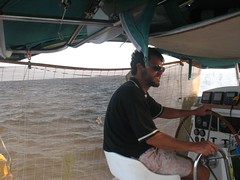
In fact, that's kind of what we'll do this summer. We'll rent a car, drive up to the States, load up on the essentials, and then come back to down our boat where really highly qualified, reasonably price professionals make the boat look and perform like new. I think I'll even hire someone to scrub the bottom... San Francisco price = $125, Zihuatanejo price = $35.
Subscribe to:
Posts (Atom)