Sunday, November 30, 2008

Passage Notes - Part 2

You’d think I would have said everything I have to say on passage making given that I’ve spent a total of six weeks doing it, but I seem to still be full of notions of how not to do it the way we did. Some more ideas:

Two Navigation Stations
My father in law brought along his laptop complete with Nobeltec software, GPS receiver, and charts. He set this up on our salon navigation table. Prior to the arrival of this laptop, the navigation table was a complete misnomer. It’s most significant responsibility was holding DrC’s beer while he practiced guitar. With a computer on the nav table and another at the helm, off duty crew could routinely check our position with bugging the guy at the wheel. I’m going to make this SOP going forward instead of just a happy accident.

Red Lights
Many boats come equipped with a red light for the navigation station. Until you overnight, you don’t understand how important these are. Red lights do not ruin your night vision. White lights blind you for a really surprising amount of time... in fact far longer than it takes a tanker to ride up your transom and run you down. Make sure your existing red lighting gear is functional. Also, consider getting a sheet of red gel from a stage lighting store. Make covers for items like your iPod or secondary laptops so that you can reduce their glare at night. You can also make a cover for flashlights used in the cabin.

Warm Clothes
The boat is colder on the ocean at night. No matter what temperatures you are used to, if you take out your boat at night it is considerably cooler. We see most cruisers living in their foulies during a passage, particularly while they are at the helm. In addition to your foulies, consider a warm hat that covers the ears, wool socks and a decent pair of warm shoes or boats. We also used a lap blanket. Now keep in mind, if you helm on Don Quixote, you are inside a completely enclosed bimini. I can only imagine how cold it would be to do this in a more open cockpit. Dress warmly.

Know Your Lights
When you are out on the water, the lights make absolutely no sense whatsoever. This is a non-trivial problem. Parsing out the message sent by a white-green-white combination can be the difference between getting run over by a tanker and running over a fishing boat with its gear out. I thought I knew the lights. I took the American Sailing Association course, studied the book and reference cards, and memorized all the little light thingies. Then we got out in the big water, and absolutely nothing looked like the cards. For one thing, the lights do not sit idly while you puzzle out their message. They bob like corks, move from left to right, and sometimes they simply change from red to green or white. This -means- something, but figuring it out on the fly is hard. I think an intrepid cruiser-programmer should take about two hundred videos of lights on open water and build an interactive online quiz. Do the best you can by boning up on the subject and make a game of it with the more experienced crew before they go to bed so you don’t panic after they’ve gone to sleep.

***

More things you do not need to take on a passage: television, bathing suit, hair care products, and puzzles.
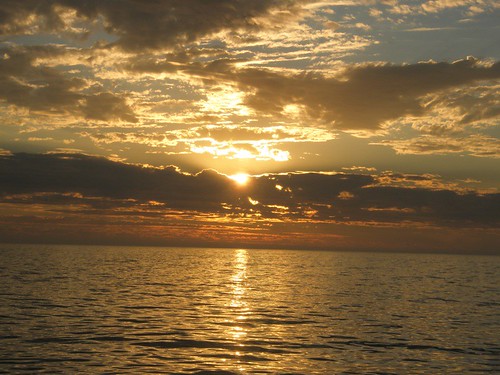
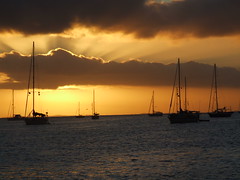
More Sunset
More Sunset
Originally uploaded by purpleteeleaf.

Wednesday, November 26, 2008

Baja Ha Ha - Third Movement


More Profligate
Originally uploaded by toastfloats.
Wind, wind and more wind for our third leg of the Ha Ha leaving Bahia Santa Maria on November 5 and finishing up in Cabo the next afternoon. The Poohbah says this was about the fastest leg 3 he’s ever seen, and a sizable fraction of the fleet sailed the entire way. We certainly did, though I’ll admit we were tempted to motor the last hour just to be done. I know that the Ha Ha isn’t really race, but there was something tremendously satisfying and thrilling about crossing the finish line. It was especially nice to complete a leg without motoring even a bit.

The Ha Ha is exhausting. You travel about 750 miles in ten days. Even with the stops in Turtle Bay and Bahia Santa Maria, it’s a long trip with many overnight passages. The trip took it’s toll on the family. As we completed this third leg, I looked around the boat in a bit of despair. The cockpit is disgustingly dirty. The boat looks like a child’s toy box, picked up, shaken, and upended on the couch in a vain attempt to find a favorite sparkly. Our sleep patterns are totally destroyed. School has pretty much ground to a halt, and DrC and I have trouble mustering the energy to care.

I’ve been maintaining a running calculation of our fuel consumption throughout the trip. Our hope was to avoid fueling until we got to Cabo. The wind was so fantastic on the trip, we changed our objective to La Paz. After completing the Ha Ha in Cabo with nearly full tanks, we’re now eying Mazatlan on the fuel we took on in San Diego. The really annoying bit is that fuel down here costs about half what it cost us in San Diego, so all this frugal sailing is financially not all that helpful. I’m not sure if fuel costs are so much less because world oil prices are dropping or because Mexico is net exporter of gas and oil. In any case, the low cost of fuel should be factored in to any cruisers’ Mexico bound cruising budget.


Herding Cats
Originally uploaded by toastfloats.
Our fishing woes continue. We caught a boat on the first day. It was of the species “monohull elegantistis”, commonly known as an Allegria. We also hooked something absolutely giganormous the second day. We saw it flashing silver right after the hook went whizzing out of the rod at high speed. I swear it was bigger than the Allegria we had hooked the previous day. The result, however, was the same. We lost our lure and a bunch of line. I have reached the point with fishing where I am resolved to catch all my future meals using a VHF line and fruit, coleslaw, and chilled beer lures. We caught ten pounds of prepped, deboned, and stunningly fresh ahi in Bahia Santa Maria using a Sierra Nevada six pack lure on a Walker Bay dinghy line. This method of fishing is highly effective and considerably less work.

We rounded the famous arch and spotted Neptune’s fingers early afternoon on November 6. Caba San Lucas anchorage and bay spread out in front of us, a beautiful resort on the south tip of Baja designed to entice gringos into spending all their money. Time to drop anchor and resist the lure of showers, provisions, and civilization. One night in the Cabo marina rafted three deep with other fleet members would have cost us $140. It is not going to happen. Civilization must wait until we get to La Paz.

Saturday, November 22, 2008

Baja Ha Ha - Second Movement


The Litter Box
Originally uploaded by rmckerb.
The second leg of the Baja Ha Ha 2008 started in Turtle Bay (Bahia de Tortugas) on November 1. The weather was mild, the sun rising over the hills in great swaths of orange, magenta and purple, and the wind non-existent.

Just outside the bahia, the Grand Poohbah introduced us to the “Rolling Start.” A rolling start means, “Stay behind s/v Profligate and motor until we get enough wind to get going. Don’t count the motoring minutes in your total.” This makes for fantastic photos. With the sun bright and strong and every boat in the fleet clustered near the Poohbah, there are boats everywhere you look. There were prizes for “First Spinnaker”, “First Naked Spinnaker”, and “First Spinnaker on the Correct Tack” so everyone was trying to get canvas and chutes into the air. Never mind that the prizes were only a pizza in Cabo, it was the idea of the thing.

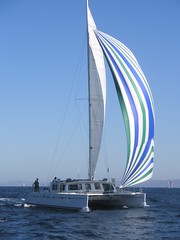
When the wind finally started to pick up, Poohbah basically said “Go” and we went. Profligate circled the fleet capturing photos as we all flew down the coastline in a 15 knot northeasterly. It was during this fine morning sail that the Poohbah crew captured the photo here which was posted to ‘Letronic Latitudes. We poured out on to our deck to engage in a little mutual admiration of our Dark Side boats. As the Poohbah flew by, he told us to “tighten your spinnaker sheets!” which actually worked and picked us up about another 1/2 knot through the water.

Initially, we felt naked on the second leg. Losing our radar and chart plotter going into Turtle Bay, we were now sailing without our heads up display. Okay, I think everyone needs to do this for awhile. Shut off every electronic gadget you have on the boat except your handheld GPS and your depth sounder. Now sail around for a month. On that first morning, we were uncertain, nervous. I was scared spitless about overnighting without the radar. Yet as I write this, we’ve traveled nearly 700 miles, done five or six overnight passages, and navigated into a half dozen anchorages using charts, dead reckoning and our handheld. In all that time, we’ve only had one close call; we had enormous difficulty spotting the south marker going through San Lorenzo Channel and accidentally cut the corner by about 100 feet. Passing over a six foot shoal my heart almost stopped. Folks experienced with Mexico, however, will tell you that this kind of incident could occur even with all the electronic gadgets as the charts here are notoriously inaccurate.

But back to Leg 2. The wind was steady all through the first day and into the evening. In fact, we had to swap out the spinnaker for the jib as the wind increased. We were averaging about 6.25 knots over ground, which for this boat is pretty good. I used to think around six was just horrid speeds... and for a catamaran I suppose they are. But our six, six and a half consistently put us in about the middle of the Ha Ha fleet over the course of the entire rally. So as cruising boats go, we’re not slow and we’re not fast. We’re average.

Course I don’t really like being average.

Wind died out in the middle of the night. I broke down and turned on the motor just to prevent us from moving backwards. The sky was unbelievably clear and beautiful. Mera and Aeron on watch with me so we had a star lesson on the trampoline. We lost count of the number of shooting stars we saw. We could see for miles and miles. With the boat on autopilot, the girls and I could actually see the surrounding fleet traffic, fishing boats, and tankers considerably better from up front so we spent most of the night up there tied down like chickens in a box.

When DrC took over watch in the early morning hours, the wind started to come up. We put the spinnaker up and it stayed up until we hit Bahia Santa Maria. There were moments where we seriously thought about taking it down as the following wind picked up. But just as we got ready to yank it down, the wind would die slightly again. The girls and I spent a good fraction of the morning participating in the fleet roll call. We collected nearly 30 boat positions from Ha Ha participants with VHF but no SSB. We then relayed them to the Poohbah over SSB. The good news is that I can state unequivocally that our SSB works for voice send and receive.

Unfortunately, even with all that sail up all day, we didn’t make it to Santa Maria until the wee wee hours of the third day. This was a serious test. It was pitch black, no moon, no radar, and we were entering an unfamiliar anchorage. Fortunately, the Ha Ha fleet was lining up to enter the anchorage like airplanes going into Chicago O’Hare. We just slotted our boat with a fleet member fore and aft and motored in those last few miles. Anchoring was a dicey proposition at best... everything looks MUCH closer together in the dark and at night, not to mention the pangas trailing off of local fishing boats in long, invisible, deadly strings.


BSM sunrise2
Originally uploaded by rmckerb.
At the girls’ request, we agreed to host a “Ha Ha Kid Party” on Don Quixote our first night in Bahia Santa Maria. We pulled out the slide, the floating island, and our munchies. The Poohbah requested that we move our boat nearer to the fleet flag ship so that folks could find us more easily. This was our pleasure. Profligate was very close to the coastline and moving our boat over there put us smack dab in the middle of the “litter box” -- the crescent of shallow waters along the shoreline of any Pacific Mexican anchorage where all the catamarans drop hook. I think I’ll write about that party separately.


The Ha Ha shore party the next day wasn’t actually as fun as our kid party, in my opinion. We did, however, enjoy a long walk along the coastline and a wonderful swim in the surf. The entire family agreed we want to come back next fall. We’d like to explore Mag Bay as well. An idea for our plans next year is beginning to take shape, and it includes Ha Ha’ing a second year. We’ll see.

Tuesday, November 18, 2008

The Ralf Relative Rolliness Scale

You have no doubt heard of the Beaufort Scale. This is a gauge of wind force from 0 to 150 knots which is supposed to tell you whether or not you can go sailing today. What you really need to know about wind, however, is that it works like earthquakes with the force growing exponentially. 30 knots is a whole lot more than 20. 40 is seriously nastier than 30 by a considerably greater amount than the 20-30 increment. I think 50 and 60 are like 8 and 9 point quakes on the Richter Scale, something to be avoided at all cost.

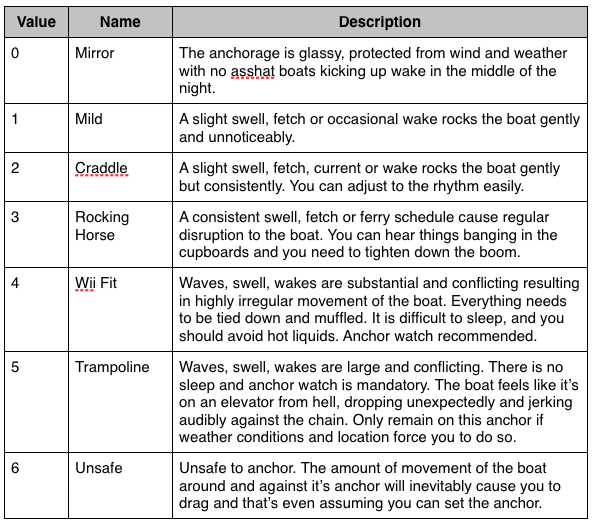
The longer we spend on the Pacific, however, the more convinced I am that we cruisers also need a Ralf Rolliness Scale. This 0 to 6 scale would describe the degree of comfort found at an anchorage based on the amount of bounciness. An anchorage can be quite comfortable with little or no swell, or you can bounce around like the rubber ball on the end of child’s paddle toy. Discomfort comes from the wakes of passing boats, ocean swell, wind fetch, tide and current. Just as wind changes on a daily basis, the Ralf Rolliness rating in a given anchorage can change from day to day, even from hour to hour.

Some anchorages, however, consistently suck. I for one would really like the cruising books to be more explicit about the amount of suckage. I’d also like to be able to get on the VHF and say, “Hey everyone, you know that little place next to Wharf #2 in Monterey Bay that’s supposed to be so comfortable even if there is a NW swell? Well, we’re here in a Ralf 4. Do not venture in. We’re abandoning our anchor early this morning.”

Or how about: “This morning we are waiting out a truly heinous low pressure system in San Simeon. This is the most beautiful spot we have anchored since Native Anchorage in Knight Inlet. Fortunately, the bay provides reasonably good shelter from the prevailing (and in this case storm driven) north westerly. There is a mild Ralf 1 swell from the south, shading to Ralf 2 when the breeze pushes us beam on to the swell.”

See how useful that would be? Let me take a first stab at formalizing the Ralf Rolliness Scale:
Rolliness Scale