“Well, so much for school,” DrC remarks sardonically as we climb out the dinghy and into the cockpit one afternoon. Schoolwork is scattered across every surface, abandoned hours earlier when our buddy boats proposed a kayak trip through the jungle. The girls were full of promises regarding their swift return and diligent pursuit of education after the eagerly sought trip through the mangroves.
It seemed like an acceptable idea at the time. We would all head out, enjoy a long trip through the forest, eat lunch on the other side, and return to our schoolwork renewed and revitalized. We could even legitimately call the trip a combination of P.E. and Science.
Except it's 16:30. DrC and I have already had one beer and too much time in the sun. The girls have either been rowing, swimming, body surfing, or digging enormous holes in the sand for nearly six hours, and are now at least a half hour behind us rowing their way out of the jungle. I'm having trouble mustering the energy to eat a Snickers, let alone correct math or struggle with Aeron's social studies phobias. It will take every particle of our combined intelligence, patience, and persuasion just to get all the school materials, breakfast dishes, and scattered sand covered beach gear stowed in the proper hold and cranny. We're not going to be attempting any algebra.
If we were unschoolers, we'd have a smug moment, waggling our fingers at those schooly types for their planned curriculum, work books, and delusions of competence. And we'd be justified. The girls learned a great deal today. They ooze healthy energy out of their very pores. They are obviously clever enough to get out of spelling tests. Unschoolers do have a way of making their point through the simple self-evident example of my children. It appears that DrC and I are largely superfluous to their needs.
However, we do try to educate the children in ways that provide at least the illusion of measurable progress. We use textbooks, workbooks, and essay assignments. We throw a major standardized test at the girls about once a year just for giggles. But no matter how hard we try, boat schooling has a tendency to make unschooling believers – or at least practitioners – out of all us. To those floating a boat with kids who would like to take an active role in their child's education while underway, I offer a few ideas:
Restaurant Math – No, I'm not going to wax poetic on how to teach kids advanced math through clever attempts to educate at the market or restaurant. That works, by the way, for the little ones, but once you start in on geometry and algebra, you either have to go abstract or you've got to start building swimming pools and opera houses to make your point.
Restaurant math is the simple rule that every time you plan a trip into a restaurant or palapa, you take the math workbooks. After ordering while you wait the interminable amount of time it takes every chef in Mexico to produce even the most simple of dishes, you pull out the books and make everyone get to work. Restaurant math both keeps the kids busy while they wait while simultaneously assuring at least one lesson of math gets done for the day no matter what else happens to screw with the educational schedule. I also think it may result in my daughters forever associating mathematics with tortas, salsa, and limonada... maybe to their long term advantage if some future college professor lets them eat during exams.
Take Over the Net – In many areas frequented by cruisers, a custom has developed for there to be a news and information broadcast on the VHF every morning. This “cruising net”, as it's known, is run by a net controller usually drawn from either the cruising community or a C.L.O.D. (cruiser living on dry land) who settled in the area and enjoys maintaining ties with boaters. Frequently, your children can take over the net. The net controller uses a basic script to prompt for check ins, priority traffic, local services, or swaps and trades. At just about any age, a child can control the net. This offers an amazing opportunity for public speaking, weather prognostication, mediation and negotiation. A side benefit is that the kids become extremely well known throughout the anchorage providing an extra layer of support and security.
Language Find-A-Word – DrC is more or less attempting to teach the girls Spanish. Probably rather less than more. It's a struggle. All the Mexicans we meet want to practice their English. It's quite simple to live down here for years and speak little more than “una cerveza y un jaro de limonado por favour”. We play a game to extend the girls' vocabulary which I call “find a word.” As we move through towns, hotels, marinas, or cities, we ask the girls to find a word on a sign or wall and figure out what it means from the context.
Strew Books – Before you leave the English speaking world, fill the hold with books... and not just the romance and science fiction. We now actively seek “literature.” By this, I include all books any teacher ever assigned me at any grade ever as well as anything with a Nebula, Hugo or other award. If those ever run out, we'll start working our way through the books in the Guggenheim project. Desperate for reading material merely days after leaving a big book exchange source like La Paz or Zihuatanejo, the girls are open to reading anything. Slipping some Asimov, L'Engle, Wells, Twain, or Frank into their hands works like a charm.
Sixthgrading – We don't have an elaborate ceremony or pin a medal on them, but when the kids finish a major academic milestone, we celebrate. We announce it during the morning net, invite other cruisers out to dinner or over for sun downers, and we find or bake something sweet. Recently, we had Mera's sixthgrading party as she finished the last of her 5th grade math workbooks. Aeron should be achieving her fourthgrading in the next few weeks. By making an occasion for the entire anchorage, you create an environment where your child wants to finish up a major bit of academic effort.
Yet for all our cleverness, we still don't seem to be educating our children with anything like the rigor I'm sure their former teachers, our home state's school administration, and their grandparents would like. DrC grabs the VHF as Jaime checks in, “Don Quixote, Don Quixote Mobile.”
“Mobile go ahead,” says the stern taskmaster and father.
Jaime sounds bright and happy, “We just made it to Triumph. We're playing a game of Mexican dominoes.”
DrC looks at me. “Can we put dominoes down as a math check?” I ask rhetorically. Not sure how I'd explain that to the Seattle School District, to be honest. Never mind, I shrug. “Fine,” he snarls and glares over at me as he signs out. “So much for school.”
I yawn, “Dean, you're starting to repeat yourself.”

Wednesday, April 29, 2009


Saturday, April 25, 2009
Questions from the Class - Catitude
One of my lady posse who lives on a beautiful monohull down here on the Mexican coastline with us, recently pushed me on an opinion I had casually tossed out: I'd written, “There is amongst even the older cruisers on cats a slightly different approach to cruising.” She replied, “I'm curious. How would you characterize this?”
The difference is subtle, unmistakable, and probably a temporary demographic oddity or maybe just a Winter 2008-2009 coincidence. However, there is something distinctive about this year's cruising class differentiating the multihull and monohull owners. I wrote on the subject long ago when I was naïve, and my skin was still had the pale healthy pallor of a Pacific Northwesterner. Living amongst a lot of monohull and multihull enthusiasts, it surprises me how much about that series still rings true.
Primarily for comedic effect, I characterized Catamaran guy as wearing Bermuda shorts, sun glasses, and a deep tan... the quintessential surfer dude. Weirdly, all the dedicated surfer-cruisers we have met thus far are on multihulls. That can't be right. There must be monohull surfers. But we haven't seen them yet. And all the surfing catamaran and trimaran owners dress like surfer dudes, sound like surfer dudes, look like surfer dudes complete with Polynesian beach wear, expensive sun glasses, and long bleach blonde locks. Except for Jimmie on Sea Level who looks precisely like Jean Luc Picard – in beach gear. Now all cruisers more or less look like beach bums down here. However, cruisers who surf look just a wee bit more so.
Catamarans and trimarans also show up in the anchorage with kayaks, boogie boards, dogs, cats, children, slides, floating islands, and surf boards. They look like mobile party platforms, and their crews take this responsibility very seriously.
"More room for toys makes us more like kids." -- Steve, Endless Summer
Multihull owners look at the coastline differently for a very practical reason; During the mild winters of the Mexican Riviera, a cat or tri can comfortably stop for the night just about anywhere from Punta Ipala to Acapulco. Now, any boat can stop just about anywhere along the coastline, but in most areas the swell will roll in all night long. If you're tucked in to the beach closely enough, you'll even experience rebound waves off the shore. This means the roadstead anchorages are rolly as all hell. Only the multihulls seem to be able to comfortably skip the microdot breakwaters and just drop a hook anywhere. This totally changes their planning horizon.
"Well, sure the anchorage was a bit bumpy ... but not for ... you know... us." -- Sue, Sun Baby
DrC's theory is that it's a minority group. Any time you are in a minority group -- for whatever reason -- there is a tendency to collect and bond over shared experience. Many in the multihull minority are also a bit defensive, since we prepped our boats in a culture of monohull dominance... negative monohull dominance. One evening in Barra lagoon, for example, we heard a captain bemoan on the net, "Well well, seven catamarans and a hippie tri. Time to party."
"There is still a multihull stigma. Since the 60's, they were homemade and not of good quality. It's going to take a long time for that image to go away." -- DrC
Another by product of being a minority is that multihull owners hang out with other multihull owners. So of course they tend to do the same things, visit the same places, enjoy the same restaurants and palapas.
"It's a choice to do something different. Seeing and hanging around with other multihulls validates that choice." -- DrC
"If you want to talk boat design, equipment and storm tactics, it's better to drink with someone whose boat has the same issues." -- Jim, Sea Level
Anecdotally, the average age of multihull owners and their crews is less than that of the monohull cruisers. I believe this is a demographic and economic shift rather than self-selection or any meaningful distinction. Multihulls are just starting to popularize outside of the Med and Caribbean. As new owners come into the cruising community, a higher percentage than in the past are multihulls. As time progresses, this demographic will distribute more evenly throughout the age range present out here. But for awhile, at least, the average age is lower.
“I'll admit it. We're an oddity out here. Even more than you are.” – Toby (24), captain of Triumph
Whatever the reasons, this year sees an unusually high number of catamaran and trimarans plying the coastline. Long time cruisers here regularly comment on the influx. Those familiar with cruising the Caribbean talk about how it looks like Pacific Mexico is starting to see the same transition to catamarans as happened long since in those cruising grounds. Tonight in Tenacatita, there were 27 boats, 13 of which were multihulls.
Look, it's easy to make too much of this. The hull preference distinction is no more or less significant than “hookers and dockers”, “retirees and sabbatical cruisers”, or “old couples and the rest of us.” Basically, it's human nature to play with these differences to create shifting social groups, not to mention it makes for entertaining shop talk during sun downers.
However, don't be surprised or alarmed if an anchorage near you suddenly fills up with a flotilla of masted tennis courts, blasting music and calling friendly insults and invitations to one another as they spread into the shallow and rolly spots near the beach.
Particularly if the surf is up.
The difference is subtle, unmistakable, and probably a temporary demographic oddity or maybe just a Winter 2008-2009 coincidence. However, there is something distinctive about this year's cruising class differentiating the multihull and monohull owners. I wrote on the subject long ago when I was naïve, and my skin was still had the pale healthy pallor of a Pacific Northwesterner. Living amongst a lot of monohull and multihull enthusiasts, it surprises me how much about that series still rings true.
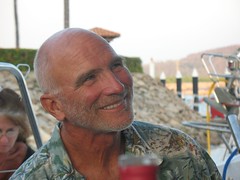
Primarily for comedic effect, I characterized Catamaran guy as wearing Bermuda shorts, sun glasses, and a deep tan... the quintessential surfer dude. Weirdly, all the dedicated surfer-cruisers we have met thus far are on multihulls. That can't be right. There must be monohull surfers. But we haven't seen them yet. And all the surfing catamaran and trimaran owners dress like surfer dudes, sound like surfer dudes, look like surfer dudes complete with Polynesian beach wear, expensive sun glasses, and long bleach blonde locks. Except for Jimmie on Sea Level who looks precisely like Jean Luc Picard – in beach gear. Now all cruisers more or less look like beach bums down here. However, cruisers who surf look just a wee bit more so.
Catamarans and trimarans also show up in the anchorage with kayaks, boogie boards, dogs, cats, children, slides, floating islands, and surf boards. They look like mobile party platforms, and their crews take this responsibility very seriously.
"More room for toys makes us more like kids." -- Steve, Endless Summer
Multihull owners look at the coastline differently for a very practical reason; During the mild winters of the Mexican Riviera, a cat or tri can comfortably stop for the night just about anywhere from Punta Ipala to Acapulco. Now, any boat can stop just about anywhere along the coastline, but in most areas the swell will roll in all night long. If you're tucked in to the beach closely enough, you'll even experience rebound waves off the shore. This means the roadstead anchorages are rolly as all hell. Only the multihulls seem to be able to comfortably skip the microdot breakwaters and just drop a hook anywhere. This totally changes their planning horizon.
"Well, sure the anchorage was a bit bumpy ... but not for ... you know... us." -- Sue, Sun Baby
DrC's theory is that it's a minority group. Any time you are in a minority group -- for whatever reason -- there is a tendency to collect and bond over shared experience. Many in the multihull minority are also a bit defensive, since we prepped our boats in a culture of monohull dominance... negative monohull dominance. One evening in Barra lagoon, for example, we heard a captain bemoan on the net, "Well well, seven catamarans and a hippie tri. Time to party."
"There is still a multihull stigma. Since the 60's, they were homemade and not of good quality. It's going to take a long time for that image to go away." -- DrC
Another by product of being a minority is that multihull owners hang out with other multihull owners. So of course they tend to do the same things, visit the same places, enjoy the same restaurants and palapas.
"It's a choice to do something different. Seeing and hanging around with other multihulls validates that choice." -- DrC
"If you want to talk boat design, equipment and storm tactics, it's better to drink with someone whose boat has the same issues." -- Jim, Sea Level
Anecdotally, the average age of multihull owners and their crews is less than that of the monohull cruisers. I believe this is a demographic and economic shift rather than self-selection or any meaningful distinction. Multihulls are just starting to popularize outside of the Med and Caribbean. As new owners come into the cruising community, a higher percentage than in the past are multihulls. As time progresses, this demographic will distribute more evenly throughout the age range present out here. But for awhile, at least, the average age is lower.
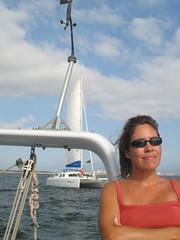
“I'll admit it. We're an oddity out here. Even more than you are.” – Toby (24), captain of Triumph
Whatever the reasons, this year sees an unusually high number of catamaran and trimarans plying the coastline. Long time cruisers here regularly comment on the influx. Those familiar with cruising the Caribbean talk about how it looks like Pacific Mexico is starting to see the same transition to catamarans as happened long since in those cruising grounds. Tonight in Tenacatita, there were 27 boats, 13 of which were multihulls.
Look, it's easy to make too much of this. The hull preference distinction is no more or less significant than “hookers and dockers”, “retirees and sabbatical cruisers”, or “old couples and the rest of us.” Basically, it's human nature to play with these differences to create shifting social groups, not to mention it makes for entertaining shop talk during sun downers.
However, don't be surprised or alarmed if an anchorage near you suddenly fills up with a flotilla of masted tennis courts, blasting music and calling friendly insults and invitations to one another as they spread into the shallow and rolly spots near the beach.
Particularly if the surf is up.
Tuesday, April 21, 2009
What's For Dinner?
As DrC hands me my evening cocktail, Mera asks, “What's for dinner?”
“Food,” I reply in a flat voice.
This is my standard answer to this question. I have not actually answered the question of “What's for dinner?” in over a decade. For some reason, the question itself strikes me as profoundly aggravating, incorporating as it does so many basic assumptions: Thing 1) Mommy is going to make dinner: Thing 2) Mommy knows what she is going to make for dinner; Thing 3) The beginning and end of the questioner's responsibility in making Things 1 and 2 take place is to remind Mommy that dinner is Pending.
I am not the only woman for whom this question enrages. I've met others. They admit it after a few glasses of wine. The sensation is similar to having ants crawl all over your body. “What's for dinner?” is a trick question whose purpose is to goad Mommy and whose underlying objective is to get her off her ass and into the galley.
My counterattack is to be singularly unhelpful. After a thousand times receiving the same precise reply, “Food” you would think those kids would give up. You would think my husband would give up. Unfortunately, he now has a very valid point. If they don't ask me what's for dinner, they won't know what to cook.
Okay, it's not like they are actually committing to cooking. “But I'm just saying,” DrC explains, “if we were going to help, we would have to know what to cook.”
Because provisioning and cooking on a boat is not like the real world. You can't get a craving at the last minute for steak and potatoes and pop over to the grocery to pick them up. Everything on the boat has a purpose and an assigned meal. As project manager and cattle herder extraordinaire, it's my job to figure out what the family is going to eat. The produce needs to be eaten in a certain order as it ripens, the meat has designated dishes, don't eat the cream cheese it's for the dinghy raft up, eat the bollo before they turn to stone... etc etc. Figuring all this out takes a lot of energy, but someone has to do it or we'll get halfway to Cape Corrientes, and we'll run out of bananas, tortillas and rum (not related problems).
So legitimately, if anyone is going to cook anything, they need to ask my permission and gain my cooperation first. I need to answer the question politely and helpfully. I need to elaborate on “food.” But my inner child whines, “I don't wanna!....” I do not want to be helpful. I'm about to sink my teeth into a glass of chilled red and I'd like to sit here and do absolutely nothing, think absolutely nothing for about an hour. Then I want my dinner to magically appear before me like a genie >poofed< from a bottle.
I unbend enough to tell Mera, “Curry and rice.” I glance at my husband, daring him to get off his gorgeously shaped ass and cook dinner. After all, with three words I have released three potatoes, two onions, a squash, some carrots, the pork, and two cups of rice into the wilds of the galley, fair game for an enterprising chef. DrC picks up his guitar and returns the look guilelessly, “What?” He strums a few chords to check the tuning, “That sounds good.” Mera smilingly agrees as she returns to her cabin to read a book. Aeron and Jaime are nowhere in sight.
“What's for dinner?” The ants start crawling all down my arms making my teeth itch and my spine twitch. God, I hate that question.
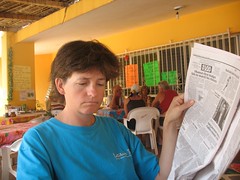
“Food,” I reply in a flat voice.
This is my standard answer to this question. I have not actually answered the question of “What's for dinner?” in over a decade. For some reason, the question itself strikes me as profoundly aggravating, incorporating as it does so many basic assumptions: Thing 1) Mommy is going to make dinner: Thing 2) Mommy knows what she is going to make for dinner; Thing 3) The beginning and end of the questioner's responsibility in making Things 1 and 2 take place is to remind Mommy that dinner is Pending.
I am not the only woman for whom this question enrages. I've met others. They admit it after a few glasses of wine. The sensation is similar to having ants crawl all over your body. “What's for dinner?” is a trick question whose purpose is to goad Mommy and whose underlying objective is to get her off her ass and into the galley.
My counterattack is to be singularly unhelpful. After a thousand times receiving the same precise reply, “Food” you would think those kids would give up. You would think my husband would give up. Unfortunately, he now has a very valid point. If they don't ask me what's for dinner, they won't know what to cook.
Okay, it's not like they are actually committing to cooking. “But I'm just saying,” DrC explains, “if we were going to help, we would have to know what to cook.”
Because provisioning and cooking on a boat is not like the real world. You can't get a craving at the last minute for steak and potatoes and pop over to the grocery to pick them up. Everything on the boat has a purpose and an assigned meal. As project manager and cattle herder extraordinaire, it's my job to figure out what the family is going to eat. The produce needs to be eaten in a certain order as it ripens, the meat has designated dishes, don't eat the cream cheese it's for the dinghy raft up, eat the bollo before they turn to stone... etc etc. Figuring all this out takes a lot of energy, but someone has to do it or we'll get halfway to Cape Corrientes, and we'll run out of bananas, tortillas and rum (not related problems).
So legitimately, if anyone is going to cook anything, they need to ask my permission and gain my cooperation first. I need to answer the question politely and helpfully. I need to elaborate on “food.” But my inner child whines, “I don't wanna!....” I do not want to be helpful. I'm about to sink my teeth into a glass of chilled red and I'd like to sit here and do absolutely nothing, think absolutely nothing for about an hour. Then I want my dinner to magically appear before me like a genie >poofed< from a bottle.
I unbend enough to tell Mera, “Curry and rice.” I glance at my husband, daring him to get off his gorgeously shaped ass and cook dinner. After all, with three words I have released three potatoes, two onions, a squash, some carrots, the pork, and two cups of rice into the wilds of the galley, fair game for an enterprising chef. DrC picks up his guitar and returns the look guilelessly, “What?” He strums a few chords to check the tuning, “That sounds good.” Mera smilingly agrees as she returns to her cabin to read a book. Aeron and Jaime are nowhere in sight.

“What's for dinner?” The ants start crawling all down my arms making my teeth itch and my spine twitch. God, I hate that question.
Friday, April 17, 2009
Summer Plans
I've held off as long as I can updating everyone on our plans for the summer not because I am reluctant to share them but simply because I had no idea. We have been working many ideas and angles. It wasn't clear which plan would bear fruit. However, now the various pieces are coming together. We know where we're going to be for the next five months.
First, the economic fiasco up in the States has made it impossible for us to return to our old lives.
In order to live in the States full time, DrC and I would need to work full time and we can't. DrC can't go back to work full time in the Seattle area because the practice that bought his practice doesn't need him full time, and he's not allowed to work for anyone else up there for another two years. Unemployment in my industry – computer and software development – is at an all time high with 800 resumes showing up for each listing posted.
In order to live in Mexico cruising, however, we only need to work roughly three months out of the year which is actually relatively easy to arrange. DrC can work part-time for his old practice, and people who have laid off all their technical writers find themselves suddenly in need of a contract technical writer for a few weeks every few months.
I know that seems odd. What I'm saying is that it's cheaper and more responsible for us to be irresponsible, semi-retired nomads than it is for us to try to work for full time.
But once you start thinking like this, all sorts of fun ideas pop into your head. For example, why cruise? Why work only in the United States? Why tie yourself to just American clients? We've been putting out feelers in every direction to see what would happen. While a recent tentative assignment to the Caribbean fell through, we are eager to see what happens and ready to move in any direction except backwards including those that might take us to New Zealand, the South Pacific, South American, or the wilds of western Canada.
Cool, huh?
So our plans are all tentative; our planning horizon is month-to-month. As long as the cruising kitty has about six months to a year cushion, we'll just keep stringing these opportunities together like pearls on a rope and see where they lead us.
So this summer and fall look something like this:
May and June -- Cruise slowly in a big half circle up and and over through the Sea of Cortez from La Paz to Guyamas.
July -- DrC working in Seattle while the girls and Toast try to survive the heat in Guaymas.
August -- Family wedding in New Mexico for the first week and then three or four weeks of car camping with Grandma Sue in the Southwest United States.
September -- DrC working in Seattle while the girls and Toast swing south visiting a few land based and boat friends before heading back down to Mexico.
October -- Meet up in Guaymas and prep the boat for another cruising season.
Any questions?

First, the economic fiasco up in the States has made it impossible for us to return to our old lives.
In order to live in the States full time, DrC and I would need to work full time and we can't. DrC can't go back to work full time in the Seattle area because the practice that bought his practice doesn't need him full time, and he's not allowed to work for anyone else up there for another two years. Unemployment in my industry – computer and software development – is at an all time high with 800 resumes showing up for each listing posted.
In order to live in Mexico cruising, however, we only need to work roughly three months out of the year which is actually relatively easy to arrange. DrC can work part-time for his old practice, and people who have laid off all their technical writers find themselves suddenly in need of a contract technical writer for a few weeks every few months.
I know that seems odd. What I'm saying is that it's cheaper and more responsible for us to be irresponsible, semi-retired nomads than it is for us to try to work for full time.
But once you start thinking like this, all sorts of fun ideas pop into your head. For example, why cruise? Why work only in the United States? Why tie yourself to just American clients? We've been putting out feelers in every direction to see what would happen. While a recent tentative assignment to the Caribbean fell through, we are eager to see what happens and ready to move in any direction except backwards including those that might take us to New Zealand, the South Pacific, South American, or the wilds of western Canada.
Cool, huh?
So our plans are all tentative; our planning horizon is month-to-month. As long as the cruising kitty has about six months to a year cushion, we'll just keep stringing these opportunities together like pearls on a rope and see where they lead us.
So this summer and fall look something like this:
Any questions?
Subscribe to:
Posts (Atom)