There are three major categories of boom on a boat: combustible fluids, electricity, and large swinging objects. All three things are destructive. All three things can and do kill people. All three things horrify any right-thinking adult who contemplates a child on board a boat.
While I can largely dismiss the hazards of surrounding children in billions of gallons of water, it is far more difficult for me to dismiss the dangers inherent in surrounding children in things that go boom at the slightest provocation. It strikes me as particularly insane to put 900 amps of battery power, 100 gallons of diesel fuel, and a fire extinguisher in the same room as an 8-year-old and her 6-year-old sister.
You are a boat owner with children or grand children aboard. What do you do? What DO you do?
I cannot tell you what to do. I can only tell you what we are doing which is essentially nothing. All right, it is closer to absolutely nothing than to essentially nothing but saying “essentially” gives me sufficient wiggle room in any legal action. The good news is that children are essentially indestructible. The bad news is that all protestations to the contrary, essentially is a really lousy word.
Now one thing I have long since learned about children – or at least my children – is that seeing is believing. Another way to state this, danger is only dangerous if it has actually bitten you on the ass. Okay, even simpler: your children won’t believe you. You can repeat, “Matches BURN!” until you are blue in the face and unless a child manages to set her cabin on fire, she will not believe you.
My suggestion is that the way you protect your children from the things that go boom on your boat is to let them hurt themselves -- in a controlled, structured, and well monitored environment replete with soothing words and a suitcase of medical supplies. Fortunately, live aboard cruising offers abundant opportunities to teach your children about the dangers of live aboard cruising. It is hard to imagine a life style more replete with wondrous moments for applied lessons in self-preservation.
Take for example the category of things that go boom that involves combustible fluids. Most boats carry at least three – and sometimes four – separate flavors of fuel: diesel, propane, gasoline, and kerosene. Each boat beverage is packaged with its own unique combination of disastrous potentialities. What you need to do is identify those that are most likely to entice junior into blowing up your home.
On our boat, we quickly learned that the girls couldn’t care less about diesel. Diesel was daddy’s problem. They weren’t much more impressed by gasoline. That was mommy’s problem. Kerosene, however, meant heat and light in the salon. Candles and matches meant warmth, light and coziness in the cabins. And propane! Wow. Propane is the source of all heated edibles.
The priority became clear. The girls received a crash course in how to use matches in combination with the propane stove. At every possible opportunity, we used them to open the valves, turn on the solenoid, and start the stove burners or oven. Matches matches matches! Tea candles are the ideal testing ground for good match manners. Scatter them around the salon and you not only learn how to avoid burning bitty fingers, but you also create a charming atmosphere for yourselves and all distant observers watching your boat bob at anchor lit up like an old fashioned Christmas tree.
Electricity follows the same pattern. Though, frankly, the real problem with electricity and children is not the high voltage lines running everywhere, the exposed plugs in every room, or the enormous batteries in the foot of their bed. The real problem is that they never turn out the damn lights. I’m far more concerned with teaching the little twits to conserve energy then I am about them electrocuting themselves.
Nevertheless, I advise getting the children involved in electrical production and maintenance as soon as feasible. They can quickly learn how to handle the electrical panel, hook up to shore power, and manage the battery switches. Teach them how to monitor the battery capacity, and you’ll never need to worry about forgetting to check again.
The real bummer boomer, though, is momentum. I find that where children are particularly prone to disaster is when they take on the basic laws of physics. In other words, chemistry and electricity are too complicated to hurt boat kids. It’s the physical physics that get them every time. Leverage, inertia, mass times acceleration, and good old gravity work wonders for moving your boat through the water and anchoring it to the ground, but against the soft tender skin of young human beings these forces are swift and evil.
I caution parents to spend far less time worrying about drowning and blowing up your offspring and concentrate more on toes crushed in an anchor rode, heads bashed by a swinging boom, or fingers stripped of skin by a line on a bucket dropped into the water at seven knots. Teach your kids basic physics, people, or your boat will do it for you.

Thursday, March 01, 2007


Thursday, February 22, 2007
What You Really Need to Know to Charter a Catamaran
A catamaran isn't like a normal boat. In fact, I have a monohull captain friend who insists it isn't a boat at all. Actually, he calls it a French, production, plastic catamaran. If we break that down, it's clear that all four words are – in his experience and deeply held opinion – highly insulting terms. The opposite would possibly be a New England, hand built, wooden, deep keeled, big butted, fat beamed, cramp quartered, dark tube leaner.
I tried. I really did. But I lost it there toward the end.
The point is that a catamaran does not behave the way a standard monohull sail boat behaves. And while you experienced single-hull sailors expect this when you charter a catamaran for yourself and your fifty in-laws out of Tortuga for a week, it can be deeply surprising when you turn the boat to port and the boat doesn't actually turn -- or more entertainingly, it turns to starboard. The good news on our sailing vessel is that I have not the slightest clue how to sail a monohull and that my husband learns quickly.
Actually, neither statement is strictly accurate, but it stands as a good starting point for a discussion of the principle 'gotchas' that will getcha when you scramble aboard the deck of your average charter cat for the first time. And while I am certain that many of you are interested in points of sail, safety, and performance, I think we should focus on the really salient issue: space.
Probably the single most important difference between a catamaran and a monohull of similar length is that on the former you can lose your children and on the later it quickly becomes necessary to drown them to preserve your sanity. I recommend a strategy of divide and conquer. Some people prefer to put the brother–in-law and his children in the port hull while you and your family take the starboard. Instead, let me suggest this alternative.
Despite the fact that your brother-in-law is a pompous ass whose sexual antics with your sister make you want to vomit and whose standards for personal hygiene leave something to be desired, he is still a better companion on an extended boat trip than your own offspring. Put him in the forward starboard cabin and throw all the children over into the opposite side of the boat. On most charter configurations there are two heads and a long companionway between you and your in-law which is a sufficient buffer for an adult. Children, however, are capable of penetrating shrieks that can stun a dolphin. Placing a dead air zone and fifteen feet of water between you and the younger generation goes a long ways toward saving your vacation.
Another tip for traveling with children aboard a catamaran is to avoid 'their hull' for the duration. Of course, you'll need to turn on the batteries and open the through hulls and check to make sure nothing is leaking before you leave the dock on Day One. After that, however, simply abandon that hull to the under-15 set. Think about it, Monohull Man. You have TWO. You don't need that one. Just let them have it. Don't even try to get them to divide the rooms along any principle of fairness. Just allow that hull to descend into Lord of the Flies chaos while you sip Mai Tais in the cockpit. On your return, hire some teenagers to swill out that hull with buckets of sea water and disinfectant.
A far more serious concern is displacing the rum. On a traditional leaner there are only so many places your family can stow gallon jugs of premium island rum. Generally, they end up under the seats in the central cabin. Occasionally you'll find one stowed under the sink. And once I found one tucked into the magazine rack next to the navigation station, bringing an entirely new dimension to the phrase “drink and drive.”
On your charter cat, however, you've got a considerably bigger problem. In addition to the above-mentioned locations, you have pantry shelves, cabin closets, the laundry room, the starboard recreation room, and, in those monster 50 footers, the upper-deck seating area. We once lost two half–gallon jugs of tequila and a bag of tortilla chips in a pantry closet for nearly three months.
My recommendation is to store your liquor with something that rots. My personal candidate is a lime, as the logical synergy between limes and alcohol make for imaginative drinks when I do find the bottles. The problem with limes is they really do keep well in a cool dark spot. So you would perhaps be better served by stashing the booze with something that both rots faster and smells really bad when it does so. Suggestions include onions, fish sticks, or oranges. Note: Unlike their green counterparts, oranges do not keep and when they go, the smell will knock you flat.
The point is, you can never lose the bottles for long as long as you have a good sniffer. In the end, you can always follow the trail of fruit flies. Just make sure they don't lead you into the children's hull.
Thursday, February 15, 2007
Everything is Wet
This morning I woke up to rivulets of water dripping down the cabin walls. It was like someone had taken a 70’s slasher movie and washed all the color out, leaving nothing but the dripping blood and horrified screams. The screams were mine as the hatch above our bed showered me with frigid drops of condensation while my husband climbed out to head for the head.
I hate living on a boat in the Pacific Northwest in the winter. It’s like living inside a used gym sock stored at the bottom of a cooler left in the garage through the cold season. Water condenses on every surface, drips down the walls and pools in the low spots. No amount of heater output can solve the problem and, in fact, I think sometimes it makes it worse, quickening the pace at which the steam rises to the cold ceiling to reinforce the downward flow of water.
My daughters delight in the boat in these conditions. They liken it to a living science experiment demonstrating the water cycle. Granted, the whole thing is manky and cold, but it is kinda fun. You can practically see the clouds form inside the boat. Add a fan, a little static electricity, and I think they anticipate lightning and thunder to break out in the salon at any moment.
We combat the cold and the wet with candles, kerosene lanterns, and heat. Anyone with even a moderate amount of scientific understanding will immediately understand the blatant stupidity of this strategy. For one thing, a principle byproduct of candles is H2O. Last time I checked, that’s water. We heat the boat and ourselves by cooking… pasta, baked goods, vegetables. These activities introduce clouds of warm, fragrant steam into the cabins, destined to join our bad breath in slimy layers on every window and external surface.
A secondary line of defense is the blue cloth. Blue cloths are an interesting by-product of the insanity of the American legal system combined with the absurdity of the American health care system. In every operating room in every hospital in in America are stacks and stacks of cloths – most of them blue – used during each surgical procedure. In most states, the number of cloths that must be present for each procedure is determined by law. Those cloths not actually used during the procedure are carefully counted and then thrown away.
Yes, millions of unused blue cloths are thrown away every day. You can’t wash them and use them again. It’s against the law. So nurses and doctors all over the country “steal” these unused cloths on the sly and take them home to their families where they do service as napkins, oil cloths, and diapers.
On our boat, we use them to dry our home. Basically, one weekend on the boat requires a minimum of one hundred blue cloths, or we’ll drown in our own spit. You put them under the hatches to prevent water dripping off the metal frames from soaking books, paperwork, and sheets. You use them to wipe off windows so you can see where you are going and to wipe off the seats in the cockpit. Blue cloths are good for soaking up skanky bilge water and rubbing mud off the anchor chain. In short, if you don’t have a steady source of blue cloths, find one.
My husband also professes great confidence in Dry-Z-Air. Like little shrines to the God of Dryness, he places containers full of these white balls of chemical goodness in every nook and cranny. I can’t say as I am equally impressed. The white balls turn to sticky goo and an inoffensive but frighteningly thick, clear liquid which I’m afraid to touch. The stuff costs a fortune, but he swears by it.
I prefer good old cedar chips. You can purchase cedar shavings in megaton bags from any decent pet store. Like any quality, natural, recyclable product, it serves multiple purposes simultaneously. Placed in bowls around the boat, cedar bedding soaks water out of the air while filling the interior with a lovely smell of shaved wood. You can either throw the damp shavings overboard (unless you are in a marina) or toss them into a barbecue. Get the kind designed for small animals with no chemical additives, and you have an environmentally sound and cheap method to reduce the humidity on the boat.
However, for all these lovely ideas, the only real solution to cold, wet, Pacific Northwest boating is summer. Or heading south as fast as the wind and waves will carry you.
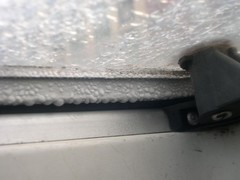
I hate living on a boat in the Pacific Northwest in the winter. It’s like living inside a used gym sock stored at the bottom of a cooler left in the garage through the cold season. Water condenses on every surface, drips down the walls and pools in the low spots. No amount of heater output can solve the problem and, in fact, I think sometimes it makes it worse, quickening the pace at which the steam rises to the cold ceiling to reinforce the downward flow of water.
My daughters delight in the boat in these conditions. They liken it to a living science experiment demonstrating the water cycle. Granted, the whole thing is manky and cold, but it is kinda fun. You can practically see the clouds form inside the boat. Add a fan, a little static electricity, and I think they anticipate lightning and thunder to break out in the salon at any moment.
We combat the cold and the wet with candles, kerosene lanterns, and heat. Anyone with even a moderate amount of scientific understanding will immediately understand the blatant stupidity of this strategy. For one thing, a principle byproduct of candles is H2O. Last time I checked, that’s water. We heat the boat and ourselves by cooking… pasta, baked goods, vegetables. These activities introduce clouds of warm, fragrant steam into the cabins, destined to join our bad breath in slimy layers on every window and external surface.
A secondary line of defense is the blue cloth. Blue cloths are an interesting by-product of the insanity of the American legal system combined with the absurdity of the American health care system. In every operating room in every hospital in in America are stacks and stacks of cloths – most of them blue – used during each surgical procedure. In most states, the number of cloths that must be present for each procedure is determined by law. Those cloths not actually used during the procedure are carefully counted and then thrown away.
Yes, millions of unused blue cloths are thrown away every day. You can’t wash them and use them again. It’s against the law. So nurses and doctors all over the country “steal” these unused cloths on the sly and take them home to their families where they do service as napkins, oil cloths, and diapers.
On our boat, we use them to dry our home. Basically, one weekend on the boat requires a minimum of one hundred blue cloths, or we’ll drown in our own spit. You put them under the hatches to prevent water dripping off the metal frames from soaking books, paperwork, and sheets. You use them to wipe off windows so you can see where you are going and to wipe off the seats in the cockpit. Blue cloths are good for soaking up skanky bilge water and rubbing mud off the anchor chain. In short, if you don’t have a steady source of blue cloths, find one.
My husband also professes great confidence in Dry-Z-Air. Like little shrines to the God of Dryness, he places containers full of these white balls of chemical goodness in every nook and cranny. I can’t say as I am equally impressed. The white balls turn to sticky goo and an inoffensive but frighteningly thick, clear liquid which I’m afraid to touch. The stuff costs a fortune, but he swears by it.
I prefer good old cedar chips. You can purchase cedar shavings in megaton bags from any decent pet store. Like any quality, natural, recyclable product, it serves multiple purposes simultaneously. Placed in bowls around the boat, cedar bedding soaks water out of the air while filling the interior with a lovely smell of shaved wood. You can either throw the damp shavings overboard (unless you are in a marina) or toss them into a barbecue. Get the kind designed for small animals with no chemical additives, and you have an environmentally sound and cheap method to reduce the humidity on the boat.
However, for all these lovely ideas, the only real solution to cold, wet, Pacific Northwest boating is summer. Or heading south as fast as the wind and waves will carry you.
Thursday, February 08, 2007
(Wo)man Overboard
It happened today. It was inevitable, particularly after my rather smug treatise on water safety and children. Today, a crew member of the sailing vessel Don Quixote went ass over tea kettle and kerplopped into the frigid waters of the Puget Sound. This event highlighted several safety concerns and preparations that I may have forgotten to elucidate in my earlier entry:
Number 1: If you warn the children that the deck is slippery, icy, and dangerous, and caution is required, it strongly behooves you to exercise caution when you step out on to the deck.
Number 2: If you are going to insist that your children wear a life jacket before they go to the shore side to use the head because the hoar frost on the dock is turning the entire marina into an ice skating rink, you should probably slip your own life jacket around your neck… or at least sling it over one arm.
Number 3: When you spend a good deal of time drumming into your children’s resistant pea brains that they should set down heavy packages, disembark, and then grab their possessions off the deck before proceeding down the dock, it is an absolute imperative that you set down the heavy box of groceries BEFORE you step on to the aforementioned slippery, icy and very dangerous transom.
The good news is that the girls were magnificent. More on that bit follows as I can’t restrain my maternal instinct to brag. The bad news is that on my rapid decent down the seven feet of transom to the 42-degree water, I managed to wrench my body every which way and hit the swim ladder, producing bruises every where – including a particularly memorable one that looks like the Horsehead Nebula just below my left butt cheek.
But in the interest of offering substantive advice for my fellow boaters, let me tell you what worked and worked well during this experience:
Man overboard drills work – Last summer we spent a few memorable long-distance sailing and motoring treks with nothing to do but watch the coastline. Just to stir things up a bit, I’d randomly toss a fender overboard and then start screaming, “Man overboard!!” at the top of my lungs. This is a fun game which your children will delight in even while it drives every other boat on the water completely mad. Please note that if you let the kids take ownership of this process, you’ll do nothing but spin around in place retrieving fenders and screaming at your spouse to “go left… no your other left!”
Assigned roles in emergencies – A corollary to the drills is to make sure every member of your crew has a clear notion of her (and his) responsibility. Discuss which role each will take, assuming that one member of the team is missing. Make sure you include the scenario in which you and your spouse are making smoochies on the tramp and, in an excessively enthusiastic display of your marital prerogatives, simply roll off the front of the boat.
Clarify priorities – What is important to save in an emergency? Your sister or your favorite doll? The answer to this question is not as obvious to children as you might suppose. In fact, I rather suspect that this question is not as obvious to many adults as you might suppose.
Equip your boat with the proper safety gear – There is what the US Coast Guard requires, there are the recommendations from salty cruisers, and then there is what your mama would say. All I’m going to say is you should never underestimate how much smarter your parents get as you age.
So let’s go back to the rather memorable moment this morning when we tested the Emergency Don Quixote Swimming System. It’s 8:30am, Dr C has already left for work, the docks are deserted on a 34-degree, clear January morning, leaving the ambient temperature in the water roughly between “holy crap this is cold” and “get me the hell out of here my toes are about to freeze off!” After properly advising, warning, and chiding my children, I do everything I told them not to and step on to the icy, slick transom with a box full of heavy groceries. I immediately slip off and drop with a thump, bump, whomp, >splash< into the water.
Instantly – arguably before I hit the water – a peal of “Man overboard!” goes up from three well trained throats. My youngest at six braces herself like a general on the deck and points her arm directly at me, floundering not four feet away between the dock and the stern. Her job, obviously, is to maintain visual contact with the victim. The eight year old starts a fast march up to the marina office. Her job? When possible, get another adult.
My eldest looks first for the life sling which had, unfortunately, already been stowed. In its absence and seeing by this time that I had already half levitated out of the water and back on to the boat in sheer horror at the temperature, she comes down the transom. Her job is, of course, to aid the victim in getting out of the water by use of life sling, swim ladder and just grabbing the victim by the scruff and yanking. All three, seeing me back aboard, move to their second jobs. One and three get me stripped and into dry clothing faster than costume change for a Vegas showgirl. Two begins salvage operations.
Granted, it was not one of my finest moments as a sailor. I do, however, consider it one of my finer moments as a mother, generously allowing my children to shine in the face of adversity.
Subscribe to:
Posts (Atom)